A coffee roastery apron is not the same purchase as a cafe server apron or a retail barista apron. On the roastery floor, the garment needs to sit through long shifts near warm equipment, carry tools and note cards, and keep its shape after frequent washing. If the body fabric is too light, it feels cheap and wears fast. If it is too heavy, the apron becomes tiring by the middle of the day. The right balance is usually found in the 10 oz to 16 oz range for canvas or duck, with pattern adjustments to keep the weight manageable.
For sourcing teams, the real work is not choosing a color. It is matching the apron to the use case: roasting, cupping, packaging, retail fulfillment, or visitor handling. A heat tolerant apron for a roastery should be specified with fabric weight, pocket placement, thread strength, strap hardware, and wash performance from the start. That is the difference between a sample that looks good in a photo and a production run that stays in service for 12 to 18 months.
When buyers ask for a specialty coffee apron, they often want a premium appearance, but they also need predictable costing and lead time. From the factory side, the most stable programs use standard fabric constructions, simple pocket geometry, and controlled branding methods such as woven labels, embroidery, or screen print. That keeps MOQ realistic, reduces sample churn, and protects margin when the order moves from 200 pcs to 2,000 pcs.
- 10 oz to 16 oz canvas or duck is the practical range for most roastery programs, with 12 oz and 14 oz being common compromises between comfort and durability.
- Cross-back straps reduce neck strain on long shifts and are usually preferred over neck-loop styles for a roaster apron used 6 to 10 hours per day.
- Reinforced pockets matter more than decorative panels, because scoops, thermometers, pens, and order slips quickly wear through weak pocket stitching.
- Heat exposure is about splash and proximity, not flame resistance, so buyers should specify heat-tolerant construction rather than assume FR performance.
- MOQ and pricing move sharply with fabric customization, hardware choice, and branding method; standard stock materials usually save 15% to 30% versus fully custom cloth.
- Lead time for a custom coffee roastery apron is typically 25 to 45 days after sample approval, with longer timing for new fabric development or special wash effects.
What a coffee roastery apron must withstand
A coffee roastery apron works in a mixed environment: hot metal surfaces, dust from green or roasted beans, oil transfer from packaging and machinery, and constant movement between roasting, bagging, and dispatch. The apron does not need the thermal protection of industrial protective wear, but it does need enough body to resist abrasion from counters, bean chutes, and tool belts. If the buyer under-specifies the fabric, the first failure is usually not dramatic tear-out; it is edge fraying, pocket sagging, or a neckline that deforms after repeated wash cycles.
The most useful way to brief a supplier is by task. A roaster apron worn close to the machine should prioritize coverage and wash durability. A floor supervisor apron should prioritize pocket organization and readability of branding. A tasting or visitor apron can be lighter, but even there the fabric should look substantial enough to match a premium specialty coffee brand. In practice, buyers usually land on a fabric between 12 oz and 14 oz canvas, or a tightly woven denim around 11 oz to 13 oz, because these weights deliver structure without making the apron feel like workwear armor.
Roastery buyers often ask whether a heat tolerant apron must be flame resistant. For most coffee operations, the answer is no, unless the site has a separate safety requirement from the employer or local regulation. What they really need is resistance to incidental heat, splatter, and brief contact with warm surfaces. That means strong cotton or cotton-rich fabric, secure seam construction, and hardware that does not deform easily under normal operating heat. If the apron is intended for a plant with open burners or high-temperature processing, the specification should be treated as a different product category entirely.
- Specify use location first: roaster, packing line, cupping bar, visitor floor, or retail counter.
- Define the exposure: dust, oil, heat splash, abrasion, and wash frequency, instead of using generic premium language.
- Set the expected service life: 6 months, 12 months, or 18 months, because fabric and trim choices depend on replacement cycle.
- Separate image needs from work needs: a strong logo program does not compensate for weak seams or poor pocket placement.
Fabric choices for a roaster apron program
For bulk orders, fabric choice is the biggest cost and performance lever. Heavy canvas apron programs usually start with cotton duck, canvas, or cotton-poly blends. Pure cotton in the 12 oz to 16 oz range feels more premium and ages well, but it can shrink and wrinkle more if the finishing is not controlled. A cotton-poly blend can improve dimensional stability and reduce drying time, but some buyers find that it looks less authentic in a specialty coffee environment. Denim is common when the brand wants a more relaxed industrial look, though it can show dust and light-colored splash marks more than brown or black canvas.
If the buyer wants a workwear look with a lower GSM, a tightly woven 300 GSM to 420 GSM fabric can still produce a credible apron, but the cut must be simplified and the strap system must carry the load. For a more substantial heavy canvas apron, 450 GSM to 650 GSM is a realistic factory range. At that level, pocket reinforcement and strap stitching become critical, because the fabric itself no longer fails first; the weak point becomes the seam, the bartack, or the rivet placement. Buyers should not ask for the heaviest possible cloth by default. A 16 oz apron sounds premium, but on a humid roastery floor it can become tiring if the pattern is long and the straps are narrow.
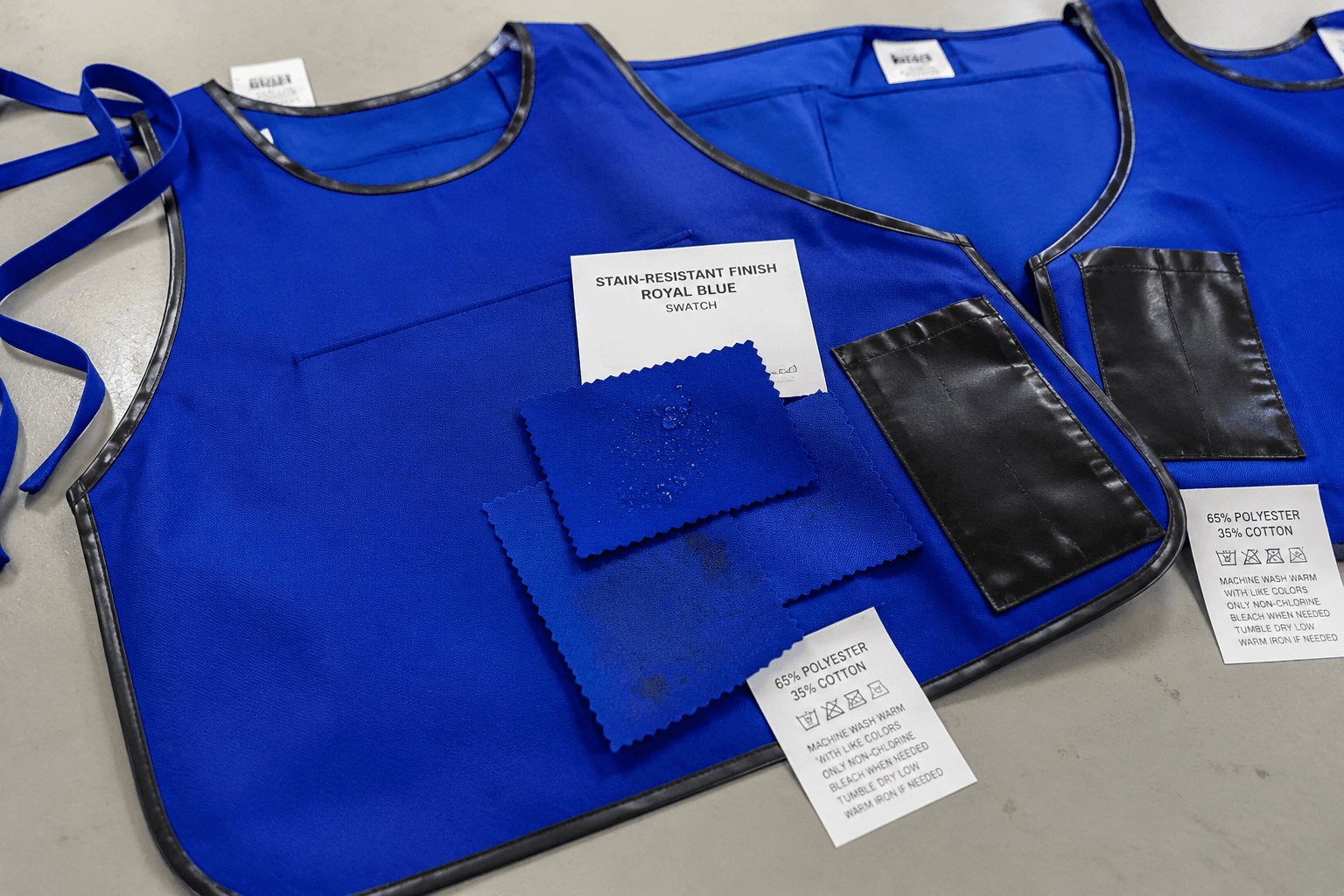
The best sourcing decision is usually to request 2 to 3 fabric options in the same weight band, then compare drape, hand feel, and wash appearance. One mill may offer a slightly rougher canvas that holds shape better, while another gives a softer finish that suits lifestyle branding. For a specialty coffee apron, the factory should also confirm colorfastness and shrinkage target. A practical spec is under 3% shrinkage after one home-launder equivalent test and color change within acceptable range after repeated wash cycles.
- 12 oz to 14 oz canvas is the most balanced range for everyday roastery use.
- 450 GSM to 650 GSM gives the visual weight buyers expect from a premium heavy canvas apron.
- Cotton-poly blends improve stability, while 100% cotton usually gives a better brand story and more natural aging.
- Denim works when the brand wants a casual, industrial image, but it is not always the easiest cloth for dust-heavy environments.
Pattern and fit choices in a coffee roastery apron
The pattern matters as much as the fabric. A roastery apron that hangs too low interferes with walking, lifting bags, and leaning into the roaster area. One that is too short leaves the lower body exposed to dust and spill risk. In bulk production, the common front body length is around 75 cm to 90 cm, with width between 60 cm and 75 cm depending on coverage needs. For teams that move a lot, a slightly shorter front panel and a well-placed waist tie usually perform better than an oversized bib that shifts during the shift.
Cross-back straps are the preferred option for many buyers because they move the load from the neck to the shoulders and upper back. For a roaster apron worn by staff who stand for long periods, this is a practical comfort upgrade, not a cosmetic one. Neck-loop styles are acceptable for light use or visitor programs, but they become less suitable once the apron carries tools, notebooks, or heavier canvas. Strap width should also be discussed at the sample stage. A 2 cm strap can be adequate on a lighter apron, but 3 cm to 4 cm feels better on 12 oz and heavier constructions.
Fit grading is where many bulk orders go wrong. A factory can make one sample that looks fine on a tall model, then the production run ends up too long for shorter staff. For a roastery team, ask for at least two size points or one flexible size with adjustable tie length. If the brand wants a unisex fit, it should test across chest widths, waist girths, and torso length, not only overall height. A good apron does not need exact tailoring, but it should remain centered, stay closed at the sides, and allow the wearer to bend and reach without the front panel twisting.
- Front length of 75 cm to 90 cm is common for roastery programs, depending on coverage and mobility.
- Cross-back straps are better for long shifts because they distribute weight away from the neck.
- Strap width of 3 cm to 4 cm improves comfort on heavier canvas constructions.
- Adjustability should be built into the pattern, not left to loose ties that drift during work.
Pockets, reinforcement, and hardware
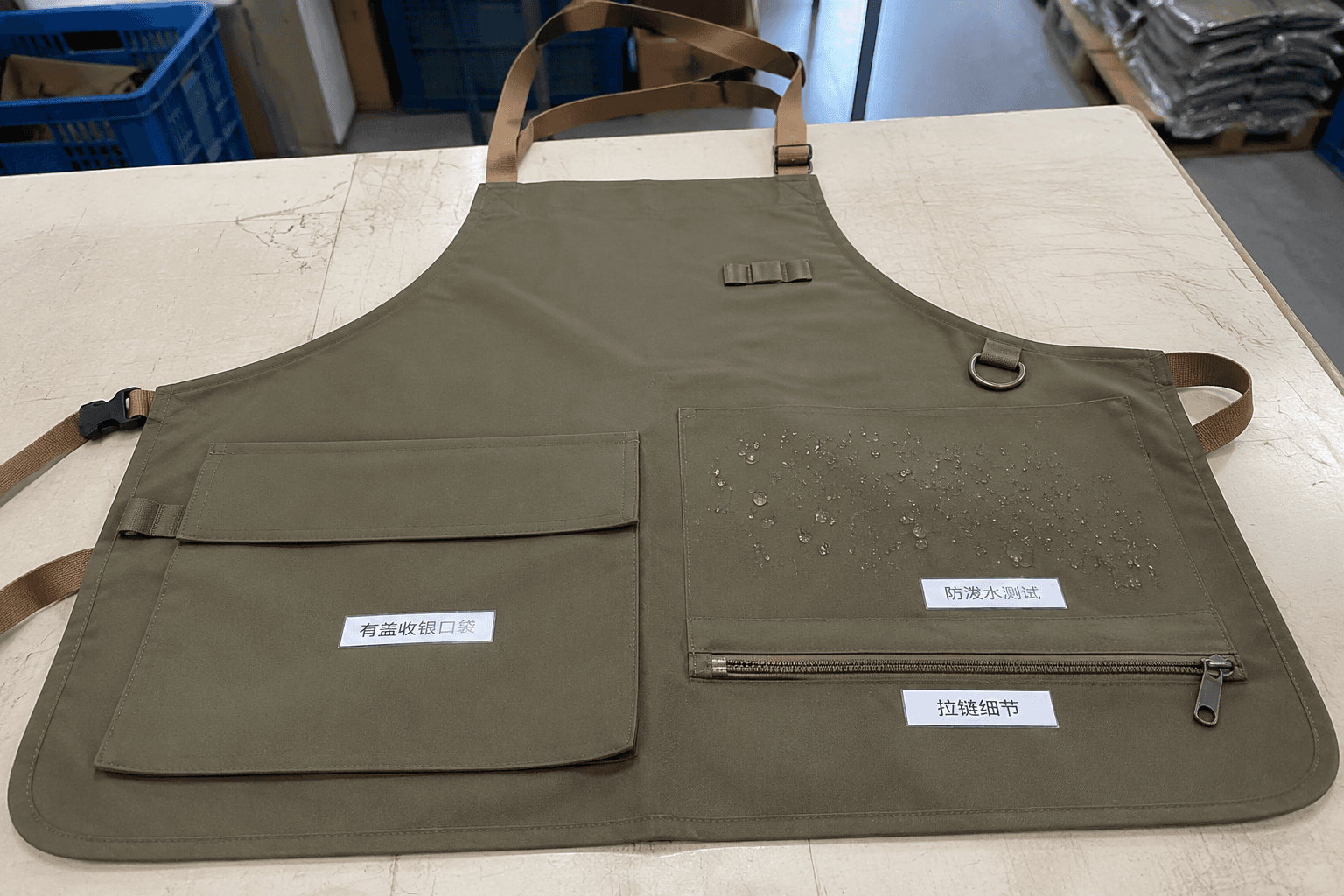
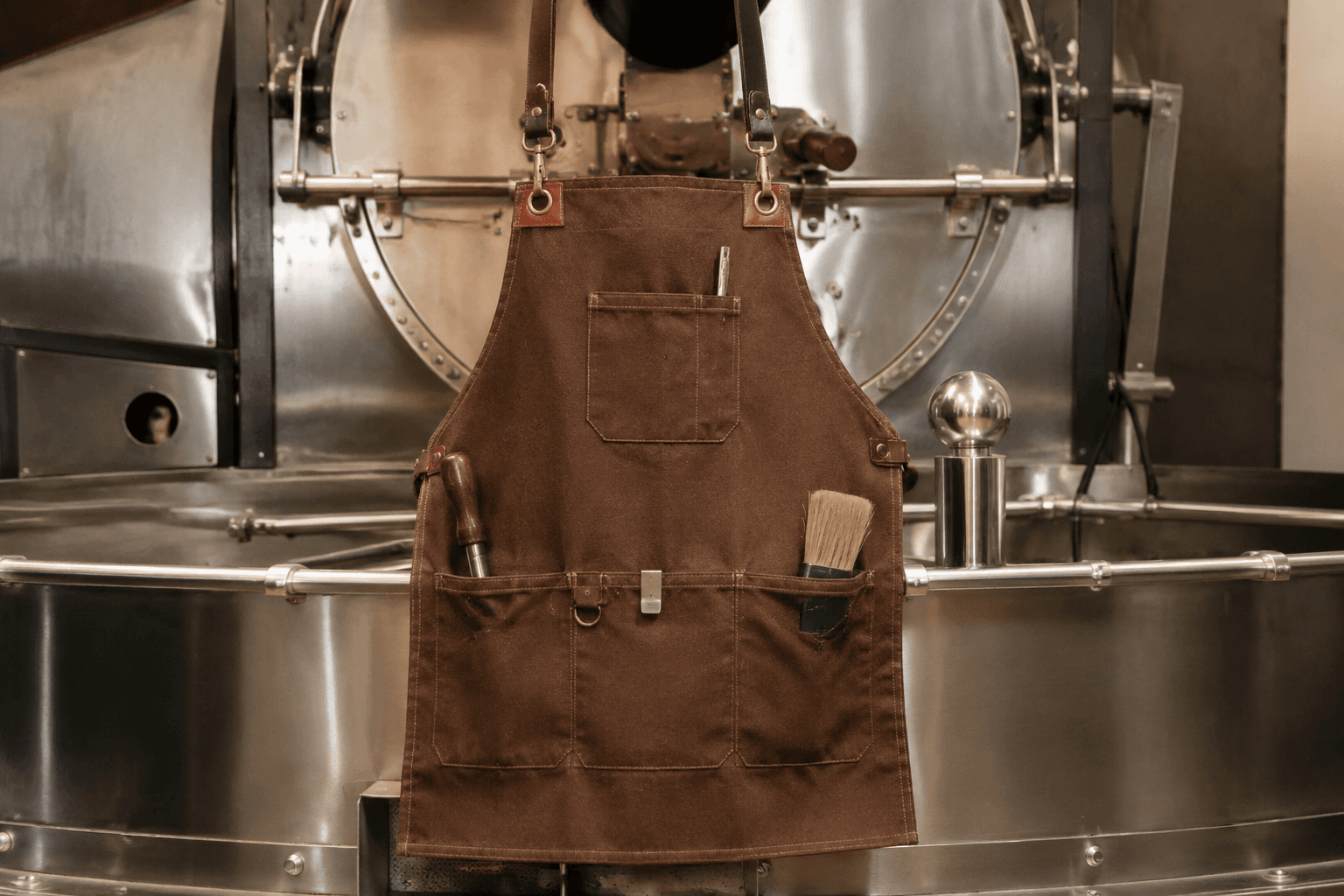
Pocket design should follow actual use. In a coffee roastery, staff may carry pens, markers, pocket notebooks, temperature tools, tape, order slips, and sometimes a small scoop or brush. One large patch pocket looks simple, but two divided pockets or one main pocket with a secondary chest pocket often functions better. The key is not quantity alone; it is access and retention. Deep pockets prevent items from falling when the wearer bends, while slightly angled openings make one-handed access easier during a busy shift.
Reinforcement is essential on any heavy canvas apron because the fabric will concentrate stress where pockets meet the body and where straps connect. Bartacks at all stress points, doubled top-stitching, and clean binding on the edges are not optional if the apron is expected to survive repeated laundering. Rivets can improve durability, but they are not always necessary and can create comfort or wash issues if the buyer wants a softer garment. In many cases, strong bartacks and dense stitching are enough, provided the factory uses the right thread count and seam allowance.
Hardware should be chosen based on maintenance reality. Solid brass or stainless elements look premium, but they raise cost and may affect wash handling. For a more controlled factory program, many buyers prefer matte metal adjusters, nickel-free options for skin contact, or durable plastic sliders where the branding language is more understated. The point is to avoid cheap-feeling parts that will fail before the fabric does. A well-built specialty coffee apron should keep its function after 40 to 60 industrial wash cycles, assuming the buyer does not abuse it with harsh bleach or heat settings beyond the spec.
- Two-pocket or divided-pocket layouts usually work better than a single oversized pocket.
- Bartacks at all load points are the minimum for roastery use.
- Hardware choice should balance cost, wash durability, and the brand's visual language.
- Deep pocket openings reduce item loss during bending, reaching, and machine-side movement.
MOQ, price, and lead time for custom bulk orders
For a custom coffee roastery apron, MOQ depends on fabric type, color availability, and branding method. Using stock canvas or stock denim with standard trims can keep MOQ around 200 to 300 pcs per color. Once the buyer requests a special dyed fabric, custom woven labels, or unique hardware, MOQ often moves to 500 pcs or more. If the order uses several sizes, the factory must also allocate cutting and packing time by size ratio, which affects price more than many buyers expect.
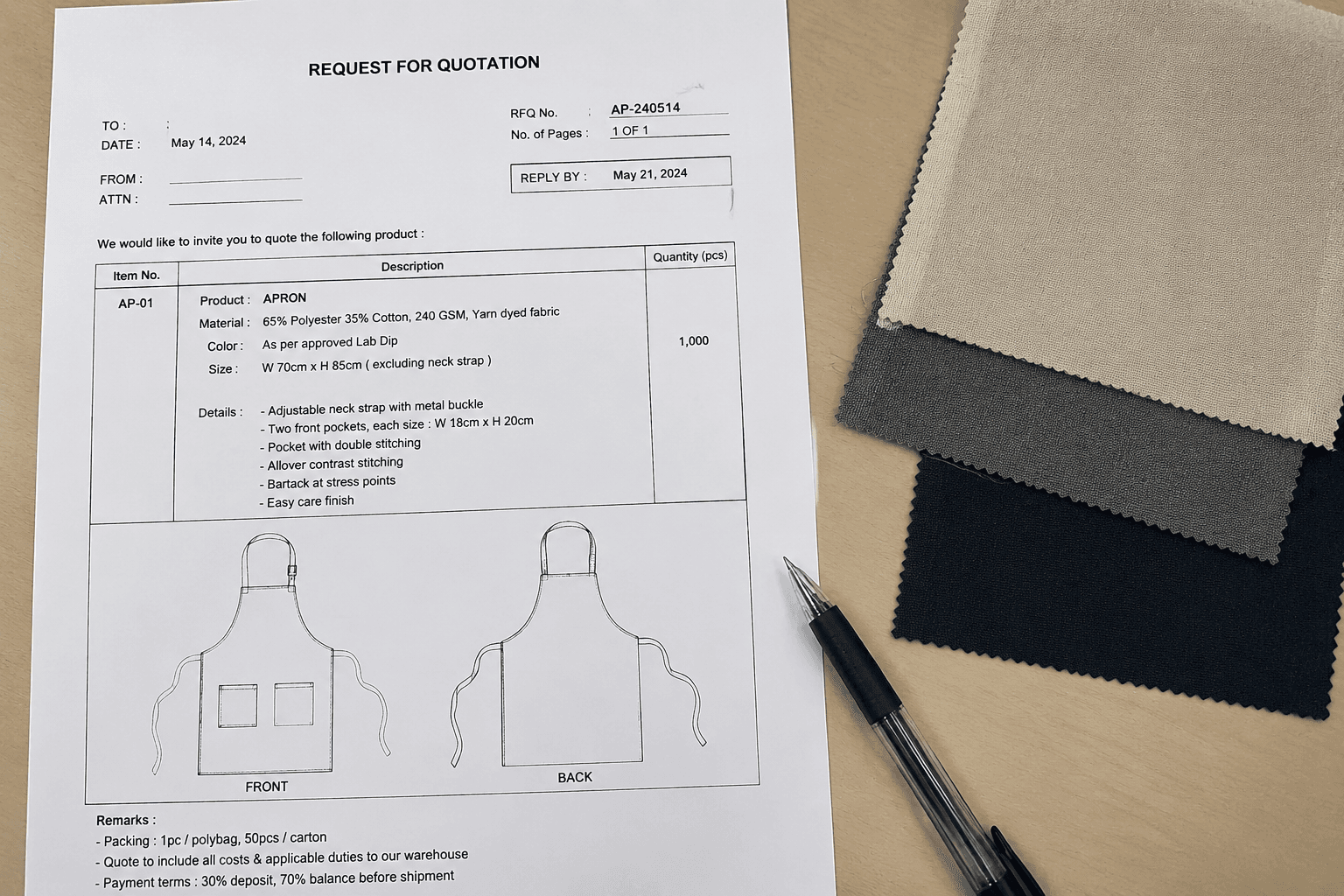
In current sourcing terms, a simple bulk roaster apron in stock fabric may land around USD 6.50 to USD 10.50 per piece ex-factory for midweight construction, depending on strap system, pocket count, and logo method. A heavier canvas apron with premium hardware and more complex finishing can move into the USD 11.00 to USD 18.00 range. Embroidery, PU patches, woven labels, or custom-dyed cloth will push the number higher. Buyers should compare offers on the same basis: same fabric weight, same pocket count, same strap type, same packaging, and same carton ratio. Otherwise the cheapest quote is usually just the least complete quote.
Lead time is usually 25 to 45 days after sample confirmation for a standard production run. If the fabric is in stock and the logo is simple, some factories can compress the schedule closer to 20 to 25 days. If the order needs lab dips, custom weaving, special washing, or a revised fit sample, the timeline extends quickly. A professional buyer should build in 7 to 10 days for sampling and approval, then add shipping time based on mode. For ocean freight, the full program can easily run 45 to 60 days door to door from order lock to arrival, even when production itself is efficient.
- 200 to 300 pcs MOQ is realistic for stock fabric and standard trims.
- 500 pcs or more is common once custom dyeing or special hardware enters the spec.
- USD 6.50 to USD 18.00 per piece is the practical ex-factory band for most roastery apron programs.
- 25 to 45 days is a standard production lead time after sample approval.
How to brief a factory for a specialty coffee apron program
The best brief is specific and measurable. Tell the factory whether the apron is for roasting, packing, retail, or bar service. State the fabric target in oz or GSM, the color standard, the preferred strap system, the pocket layout, the logo method, and the expected wash cycle. If the apron is meant to feel premium, say so, but also define what premium means: heavier cloth, cleaner top-stitching, matte hardware, or tighter color control. A supplier can work with concrete targets. It cannot work efficiently with only mood language.
For a specialty coffee apron program, ask for a pre-production sample that reflects real bulk materials, not a one-off upgraded sample that cannot be repeated. Confirm the wash result after one or two trials, especially if the order uses dark dye or contrast stitching. If the buyer expects staff turnover or frequent replacements, it may be smarter to hold one approved base spec and order replenishment batches from the same factory with minor logo changes only. That keeps consistency high and reduces re-approval time.
The most reliable roastery programs are simple to explain and hard to misinterpret. They use one fabric family, one strap system, one pocket language, and one measured size spec. The buyer then adjusts only the visible brand elements over time. That approach is usually better than redesigning the apron every season. A roastery apron should support the operation, not compete with it. If the garment is comfortable, durable, and easy to reproduce, the brand gets a cleaner result and the factory gets a stable production process.
- State the use case so the supplier can match fabric and pattern to the actual work environment.
- Request a repeatable pre-production sample built from production materials, not a showpiece sample.
- Lock one core spec to reduce inconsistency between replenishment orders.
- Confirm wash and shrink targets before production starts, not after the bulk order ships.