Buyers often approve white aprons by shade, hand feel and price, then discover after launch that chlorine damage starts at the seams, not the cloth. In foodservice, bakery, healthcare support, sanitation and central laundry programs, the service life of bleach safe white aprons is determined by the full bill of materials: shell fabric, thread type, bartacks, overlock yarn, logo decoration, label print and finishing chemistry.
The failure pattern is predictable. After 20 to 30 industrial wash cycles, the apron body may still look usable while tie attachments weaken, overlock thread yellows, chest prints crack, or the white shade drops from bright white to dull gray. For professional buyers, these are not cosmetic details. They increase replacement frequency, complicate garment sorting in shared laundries and raise cost per wear across the program.
This article turns chlorine compatibility into a sourcing specification. It gives realistic targets for fabric weight, seam construction, thread selection, logo survival, wash-cycle testing, AQL, MOQ, sample timing, production lead time and FOB cost so apron buyers can brief an OEM factory with measurable requirements instead of vague bleach-safe claims.
- 100% cotton twill at 210 to 230 GSM, roughly 6.2 to 6.8 oz per square yard, is the most reliable starting point for white aprons exposed to routine chlorine bleaching.
- White polyester sewing thread should be specified across main seams, overlock, bartacks and label attachment; mixed thread packages are a common hidden cause of claims.
- Screen print and heat transfer are the highest-risk logo methods under repeated chlorine laundering, while small embroidery and woven labels usually survive longer.
- Buyers should specify laundry conditions numerically: chlorine ppm, wash temperature, neutralization, drying temperature, cycles per week and target total life in washes.
- Finished-apron testing is more useful than fabric-only testing because failures usually begin at seams, labels, prints or substitutions made during bulk production.
- Bleach-oriented upgrades usually add 0.15 to 0.60 USD per piece, but they often cut replacement orders and claim rates enough to lower total uniform cost.
Why bleach safe white aprons fail first at seams, ties and trims
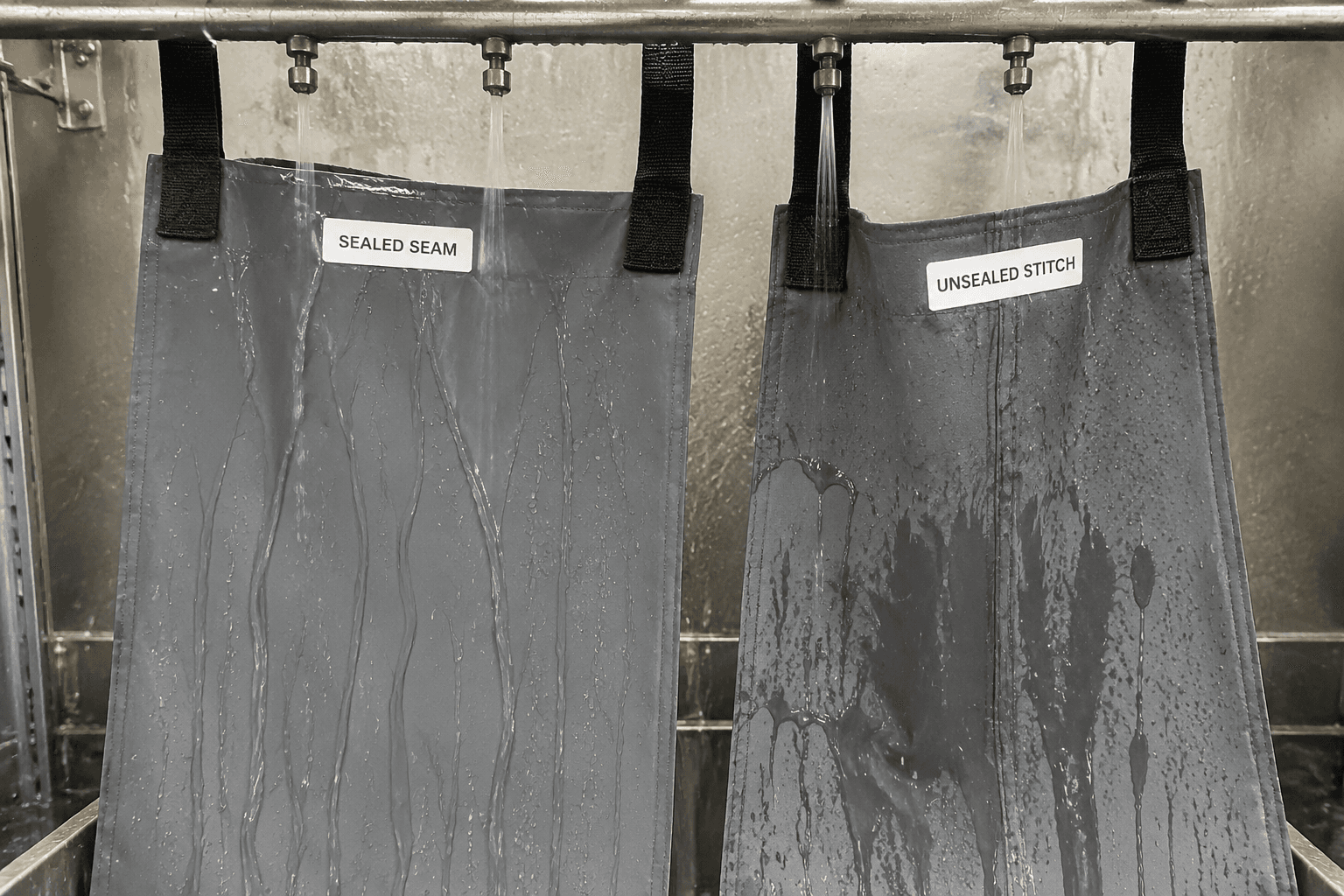
Most failures in bleach safe white aprons are component failures rather than fabric collapse. In commercial laundering, chlorine attacks the apron unevenly. A 220 GSM white twill body can still retain acceptable cover after 30 washes while bartacks become brittle, overlock thread yellows, tie attachments start opening and logo films lose adhesion. Buyers who assess only fabric swatches miss the points where real wear claims begin.
The practical sourcing question is not whether an apron is described as bleach compatible. The question is how many heavy wash cycles the complete apron must survive under the buyer’s actual laundry program. A bakery waist apron washed once a week at 50 to 80 ppm chlorine and line dried does not need the same construction as a sanitation bib apron processed 4 to 5 times a week at 100 to 150 ppm chlorine with hot tumble drying. If both are quoted against one generic white apron specification, the cheaper offer often becomes the more expensive program within a quarter.
A useful RFQ writes service life in measurable terms. Lower-intensity hospitality programs may target 25 to 30 heavy washes. Standard restaurant back-of-house programs often need 40 to 50 washes. Rental or institutional laundry systems may require 60 to 75 washes before retirement. Once that cycle target is fixed, the factory can match fabric weight, thread ticket size, reinforcement points and logo method to the real use case instead of quoting only against price and first-delivery appearance.
- Typical first failures are pocket-corner seam breaks, tie detachment, neck-loop joint weakness, yellow overlock thread, cracked chest prints and loss of brightness after 20 to 40 cycles.
- A fabric approval alone is not enough; buyers should test the finished apron with final thread, bartacks, labels and branding.
- A workable end-of-life definition is: no seam opening above 5 mm, no broken bartack at stress points, logo still legible and shade change still within the buyer’s approved standard after the target wash count.
Fabric spec for bleach safe white aprons: 210 to 230 GSM is the safest buying range
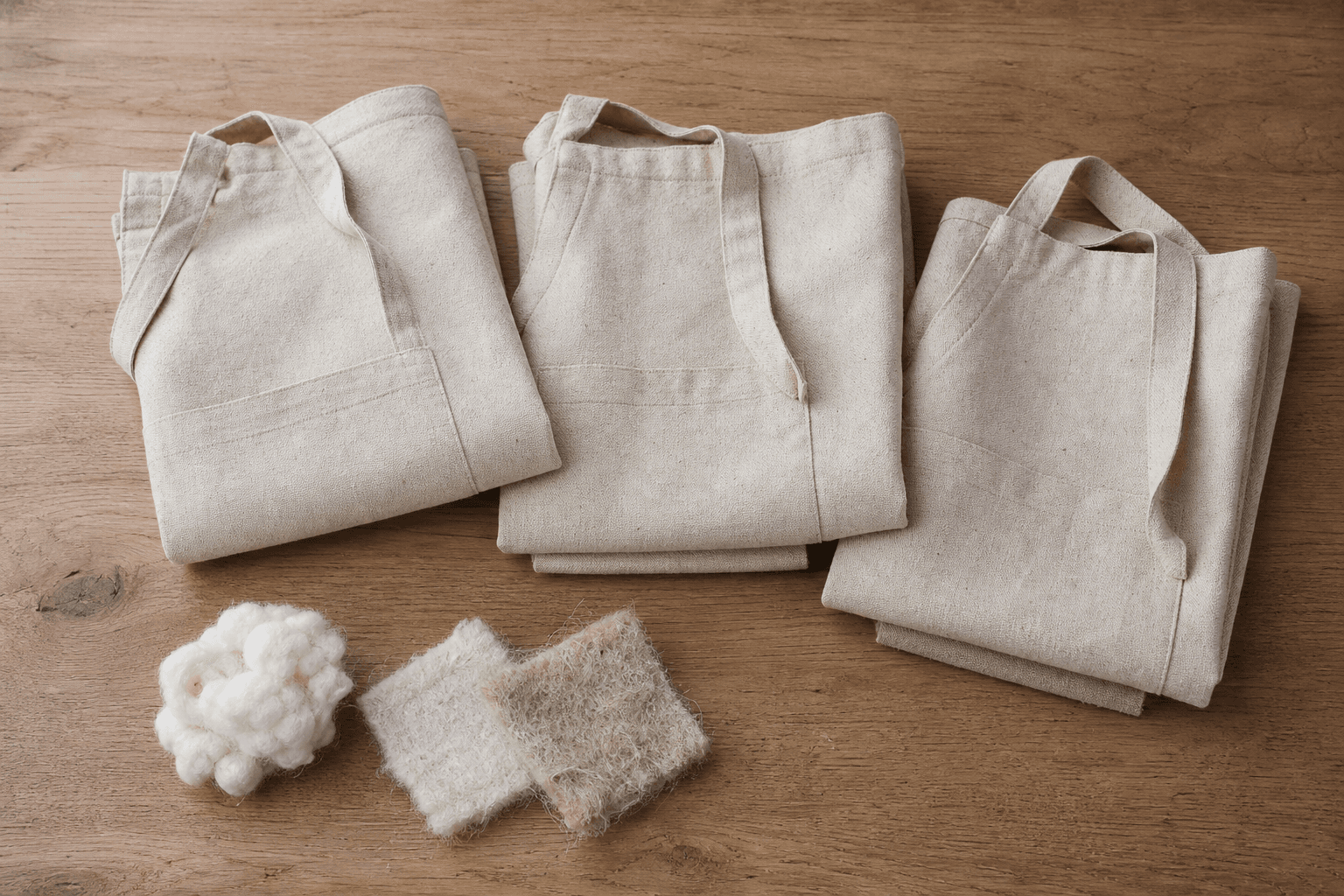
Fabric is the base of chlorine performance, but fiber blend and finish chemistry matter as much as nominal whiteness. In apron sourcing, the common options are 100% cotton twill, 65/35 poly-cotton twill and lighter spun polyester constructions for limited-duty use. For professional white aprons that will be routinely chlorinated, 100% cotton twill is usually the most stable choice for shade acceptance and predictable wash performance. Poly-cotton can reduce shrinkage and sometimes lower FOB cost by 0.08 to 0.20 USD per piece, but repeated bleaching often creates less consistent white appearance and can make blend-related visual variation more noticeable over time.
For most B2B apron programs, the practical weight range is 180 to 245 GSM, or about 5.3 to 7.2 oz per square yard. At 180 to 195 GSM, aprons are lighter, cheaper and quicker to dry, but they show through more easily, distort faster around pockets and usually have a shorter life in industrial processing. At 210 to 230 GSM, buyers typically get the best balance of opacity, drape, shrinkage control, wash durability and manageable drying time. At 240 to 245 GSM, durability can improve again, but the apron feels heavier in wear, takes longer to process in laundry and usually adds 0.12 to 0.28 USD per piece compared with a 220 GSM build.
Finishing chemistry is often the hidden reason two white cotton aprons perform differently in bleach. Heavy optical brightener packages can create a very bright shipment white but lose appeal quickly under chlorine, leaving a dull or slightly green cast after repeated washes. Silicone softeners, wrinkle-control resins and stain-release finishes can also change bleach response. Buyers should therefore approve not only the initial white standard, but also the post-bleach appearance after 20, 40 and, where required, 60 cycles. In OEM costing, moving from a basic 190 GSM white twill to a stable 220 GSM cotton twill often adds about 0.18 to 0.35 USD per apron, which is usually less than the cost of early replacement due to thinness, poor opacity or panel distortion.
- Recommended starting spec: 100% cotton twill, 210 to 230 GSM, pre-shrunk or sanforized if dimensional stability matters.
- Use 180 to 195 GSM only for price-sensitive programs with a target life of about 20 to 30 heavy washes.
- If a mill proposes strong optical brighteners to improve first-delivery whiteness, ask for chlorine wash comparison data before approval.
- If a supplier pushes poly-cotton for cost reasons, request side-by-side finished-apron wash testing against 100% cotton before confirming bulk.
Thread and seam package: the small-cost upgrade that prevents apron claims
In many claim files, the fabric is blamed first even though the failure began in the seam package. Chlorine-exposed aprons place repeated stress on thread at pocket corners, tie joins, neck seams, side hems and bartacks. Cotton sewing thread is usually a poor choice for this use because it can lose strength faster than the body cloth, especially when residual chlorine remains in the garment before hot tumble drying or bundled storage.
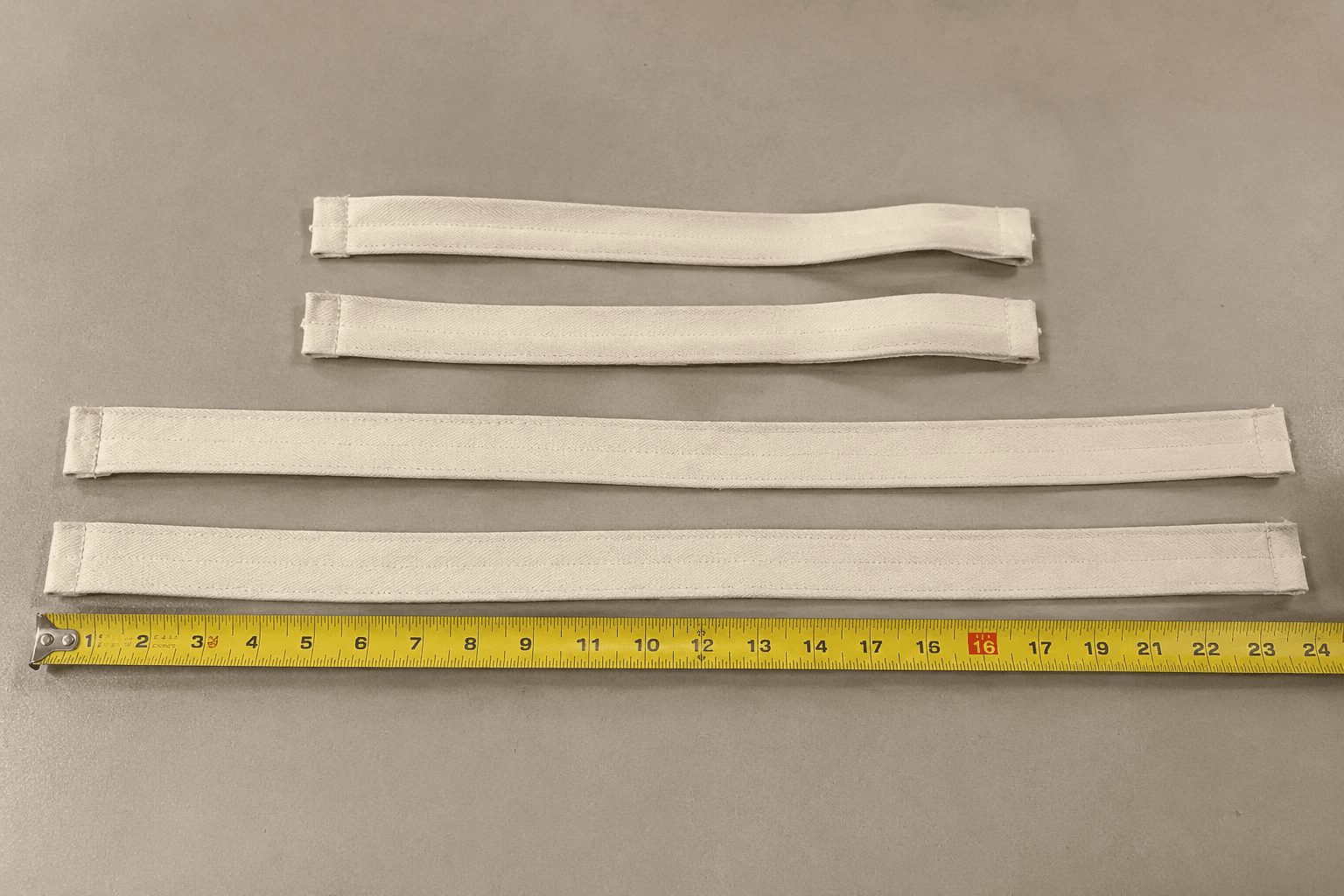
For aprons in the 180 to 245 GSM range, white polyester sewing thread is the safer standard. Good-quality spun polyester or filament polyester thread usually holds seam integrity better than cotton thread after repeated bleaching. Ticket 40 works for many standard assembly seams on bib and waist aprons. Ticket 30 is more secure for tie insertion, strap joints and high-stress reinforcement. Bartacks may use a heavier setup again, depending on machine gauge and stitch density. The important point is consistency: the visible lockstitch, overlock, bartack thread, label attachment thread and embroidery thread all need to be bleach-compatible and color-matched.
The words poly thread in an invoice are not enough. Lower-cost factories sometimes upgrade the visible main seam thread but keep cheaper overlock yarn or bartack thread, creating a weak point that appears only after laundering. Construction details matter as well. Double-turned hems hold up better than raw-edge shortcuts. Pocket corners should be reinforced. Tie joins should be box-stitched or bartacked. A bib apron intended for 50-plus heavy washes should not rely on minimal stitch counts at stress points. In cost terms, upgrading from generic thread to tested bleach-compatible polyester thread often adds only 0.02 to 0.05 USD per piece, and stronger reinforcement at stress points may add another 0.03 to 0.08 USD. That is a modest premium compared with seam-failure claims and emergency replenishment orders.
- Specify thread by application: main seams, overlock, bartacks, label attachment and embroidery.
- Request reinforcement at pocket corners, tie attachments and neck-loop insertion points because these are the first stress locations to fail.
- Seal an approved pre-production sample so repeat orders cannot drift into cheaper thread substitutions.
- Check seam integrity after 20, 40 and 60 bleach cycles, not after one confirmation wash.
Logo survival in bleach safe white aprons: embroidery usually outlasts print
Branding is often the first visible element to fail in bleach safe white aprons. In restaurant chains, food plants, hospitals and contract-laundry programs, a cracked or faded logo can trigger rejection even when the apron body is still usable. Decoration method should therefore be treated as a durability decision with replacement-cost impact, not just a visual decision.
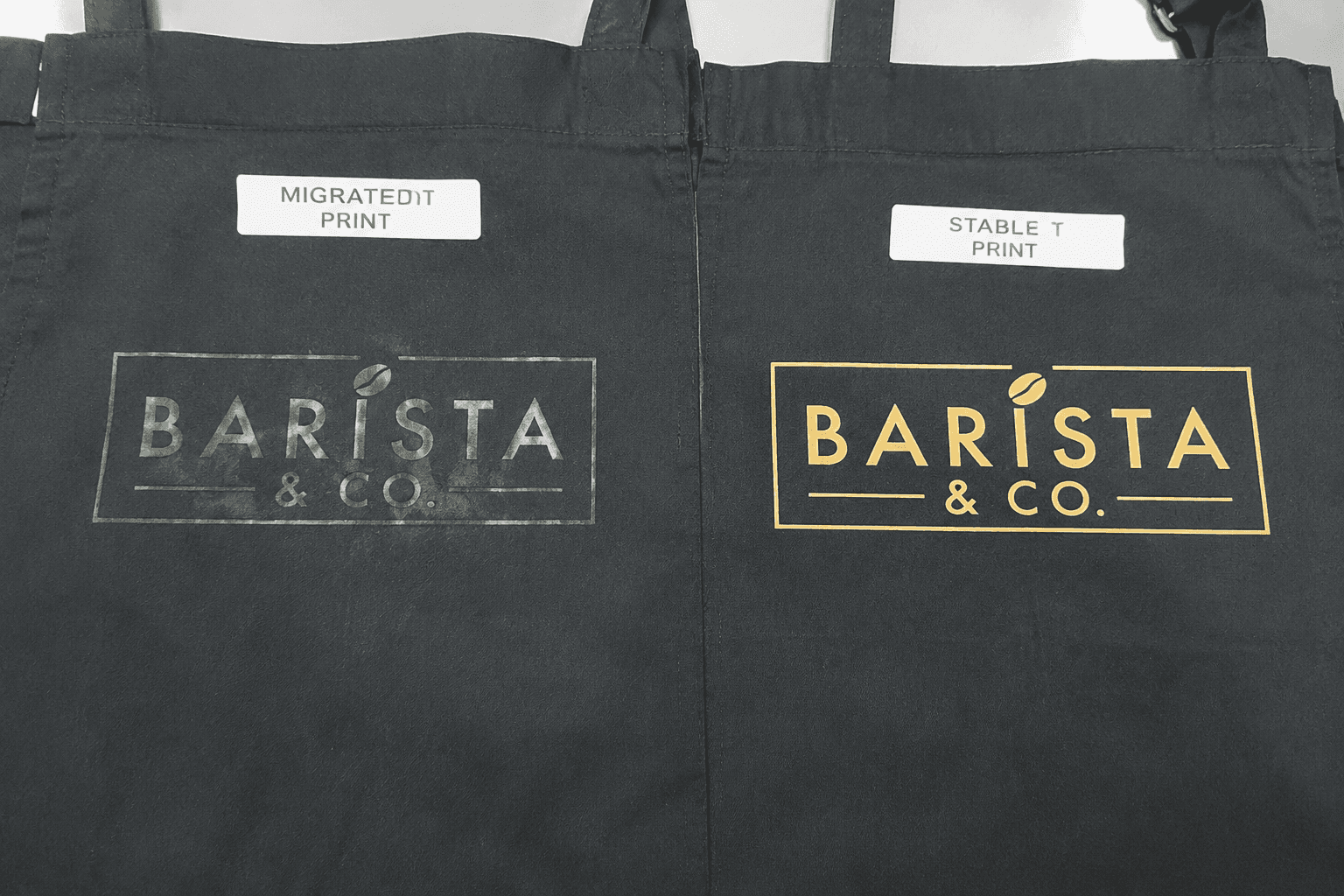
Direct screen print and heat transfer are usually the highest-risk methods under repeated chlorine laundering. Ink films can fade, harden or crack, and transfer adhesives can edge-lift after aggressive wash-and-dry cycles. These methods may still be acceptable for low-cycle retail or promotional aprons, but they are rarely the safest choice for aprons expected to last 40 to 75 industrial bleach washes. Large front prints are particularly vulnerable because the decorated area experiences more mechanical stress in washing and drying.
Embroidery is usually more stable, provided the embroidery thread itself is bleach-compatible and the backing does not shrink or distort the bib panel. A small left-chest embroidery with controlled stitch density typically survives better than a large filled logo across the front. Woven brand labels sewn into a hem or pocket edge are often the most stable option of all, though they provide less visible branding area. From a sourcing perspective, print may appear cheaper on the quote sheet but more expensive over the life of the apron. In China OEM pricing, a simple one-position screen print might add 0.06 to 0.18 USD per piece, while embroidery commonly adds 0.18 to 0.55 USD depending on stitch count, placement and volume. For a bleach-exposed program, that premium is often justified if it prevents early rejection for visual failure.
- Lowest-risk branding methods are woven labels, tonal embroidery and small bleach-tested chest embroidery.
- Higher-risk methods are PU heat transfer, large solid screen print, metallic ink, high-build print and special-effect coatings.
- Approve decoration only after washing the exact production fabric with the actual backing, thread and placement.
- If strong front branding is mandatory, compare at least two decoration methods and decide from post-wash results rather than showroom appearance.
Laundry data buyers must provide before a factory can quote chlorine compatibility
An apron factory can only engineer the right product when the buyer provides real wash conditions. The term industrial laundry is too broad to guide production. One operator may use 50 to 100 ppm available chlorine at 60 to 70°C with controlled neutralization. Another may use 120 to 150 ppm, longer dwell time, stronger alkali support and tumble drying above 80°C outlet temperature. Those are materially different service environments and should not be quoted against the same apron specification.
Every RFQ or tech pack for white aprons exposed to bleach should state the chlorine range in ppm, wash temperature, target cycle count, expected washes per week, drying method and intended total service life in washes. Buyers should also state whether bleaching is dosed automatically or handled manually on site. Manual soaking, over-concentrated spot treatment and poor dilution are common reasons for local seam yellowing, edge brittleness and premature strap failure. If those practices exist, the factory should know before development starts.
Residual chlorine is another frequent source of dispute. If rinsing and neutralization are poorly controlled, chlorine stays in the apron and continues degrading thread and fabric during drying or storage. In those situations, the factory may be blamed for a problem that is partly created by laundry control. The care label should therefore reflect actual washroom practice rather than a generic white-garment instruction borrowed from another product line. For professional buyers, clear laundry data shortens development time, reduces contradictory claims and improves the value of finished-apron testing.
- State available chlorine in ppm, not just the word bleach.
- State wash temperature, rinse or neutralization control and drying method because heat plus residual chlorine accelerates damage.
- State whether aprons are washed once, three times or five times per week because service-life targets depend on frequency.
- If staff use ad hoc bleach soaking, either prohibit it operationally or ask the factory to test that exact misuse pattern before approval.
Testing, AQL, MOQ and lead-time control for white apron sourcing
For serious B2B buying, fabric certificates are only a starting point. The useful validation method is finished-apron testing using the final shell fabric, thread package, bartacks, labels and decoration. Testing only a flat fabric swatch hides the most common failure points and creates false confidence before bulk.
A practical development flow has four stages. First, approve the base fabric, initial white standard and hand feel. Second, make a proto apron in the target cloth. Third, produce a pre-production sample with the exact intended thread, reinforcement and branding method. Fourth, run bleach simulation on the finished sample. For programs expecting 30 to 40 heavy washes, a 20-cycle screen test is the minimum sensible gate. For institutional programs targeting 50 to 75 washes, 40-cycle and 60-cycle checkpoints are far more useful because many seam and logo failures appear later rather than early.
Inspection planning should be explicit. For most apron orders, a practical shipment benchmark is AQL 2.5 for major defects and AQL 4.0 for minor defects. The inspection checklist should define shade variation, seam defects, skipped stitches, incorrect thread use, logo defects and measurement tolerance. This matters because a bleach-oriented apron program can still fail commercially if the lot contains off-white panels, weak bartacks or unapproved accessory substitutions. Sample timing should also be realistic. Custom apron development usually takes 7 to 12 days for samples. In-house wash testing may need another 5 to 10 days, while third-party validation often takes 10 to 15 days depending on queue and protocol. After approval, bulk production is commonly 25 to 40 days for standard bib and waist apron styles, with another 5 to 7 days if the order includes custom woven labels, mixed branding methods or special packing. MOQ also depends on whether the buyer uses stocked fabric or a custom base cloth. Standard white twill apron programs often run efficiently at 800 to 1,500 pieces per style. If the buyer needs a non-standard GSM, custom finish or multiple test variants, practical MOQ often rises to 1,500 to 3,000 pieces.
- Minimum useful test points are shade change, seam integrity, logo appearance, shrinkage, pocket distortion and handle after drying.
- Recommended shipment benchmark is AQL 2.5 major and AQL 4.0 minor, with white shade and seam construction written into the defect criteria.
- Expect 7 to 12 days for sample making, 5 to 15 days for testing and about 25 to 40 days for bulk sewing after final approval.
- Confirm MOQ before development so the approved construction can be produced economically at the intended order size.
FOB cost targets and when the better white apron spec pays back
Bleach-oriented construction is usually a controlled premium, not a major cost jump. A standard adult white bib apron in 220 GSM cotton twill with one front pocket and basic export packing often falls in an approximate FOB China range of 2.10 to 3.80 USD per piece, depending on dimensions, order quantity, fabric source and branding method. Upgrading that apron to a more chlorine-stable build with tested polyester thread, stronger bartacks and embroidery instead of print may increase FOB cost by about 0.15 to 0.60 USD per piece.
That premium should be evaluated against replacement frequency rather than ex-factory price alone. If a low-cost printed apron needs replacement after 20 to 25 bleach-heavy washes, while a better-specified embroidered apron remains acceptable for 40 to 60 washes, the higher-priced version is often cheaper on a cost-per-wear basis. This is especially true in foodservice chains, central kitchens, healthcare support units and rental programs where apron shortages create operating disruption and unplanned replenishment purchases.
The best sourcing approach is to rank priorities in the tech pack. If front-of-house appearance matters most, put the upgrade budget into white shade retention and logo durability. If the apron is strictly back-of-house, seam life, opacity and pocket stability may matter more than large branding. For repeat orders, buyers should lock three controls early: the approved white standard, the approved thread and seam package, and the approved branding method. Those controls reduce the chance that a future reorder drifts into a cheaper but less bleach-stable build without anyone noticing until laundry claims start.
- Typical FOB range for standard white bib aprons is 2.10 to 3.80 USD per piece, depending on size, GSM, branding and volume.
- Typical upgrade premium for bleach-oriented construction is 0.15 to 0.60 USD per piece.
- Common efficient MOQ for custom white apron sourcing is 800 to 1,500 pieces per style, rising when special fabric or trim development is required.
- Compare supplier offers using cost per wear, replacement rate and claim risk, not unit price alone.