For a cheese plant or creamery, an apron is not a decorative uniform item. It is a daily barrier between wet product, brine, whey, cleaning chemicals, stainless benches and the operator’s base garment. When buyers source a creamery apron from China, the key decisions are usually fabric weight, coating type, strap construction, color control and whether the apron is meant for wipe-down use, machine laundering or both.
Most dairy apron programs we see are not single-style orders. A cheese maker apron for curd handling may need a different hand feel from a packing-room food hygiene apron. A wipe down apron for sanitation crews may need heavier coated material and reinforced neck points. Product developers should define the work zone first, then confirm the apron specification, because a 260 GSM coated twill and a 420 GSM PVC apron can both look correct on a sample table but behave very differently after 40 wash cycles.
This article explains practical sourcing trade-offs for creamery and dairy apron orders: material selection, hygiene features, sizing, laundering, branding, MOQ, costing and inspection points. The numbers are typical for OEM production in Zhejiang and nearby textile supply chains, but final prices and lead times depend on fabric stock, labelling, packing method and order complexity.
- Fabric weight should match the wetness of the workstation, with 240-320 GSM suitable for light dairy prep and 380-550 GSM better for wash-down or brine areas.
- A wipe down apron is not automatically a washable apron, because coating chemistry and seam construction decide how it survives repeated laundering.
- Neck and waist strap strength matters more than decorative styling, especially when operators wear aprons for 6-10 hour shifts.
- White, navy and bottle green are easier to control in bulk production, while custom pale colors require stricter lab dip and lot-shade review.
- Realistic OEM lead time is usually 25-45 days after approval, depending on fabric procurement, coating, logo method and packing requirements.
- Inspection should focus on contamination risk, coating defects and strap bar-tacks, not only general garment measurements.
What a creamery apron must do in real dairy production
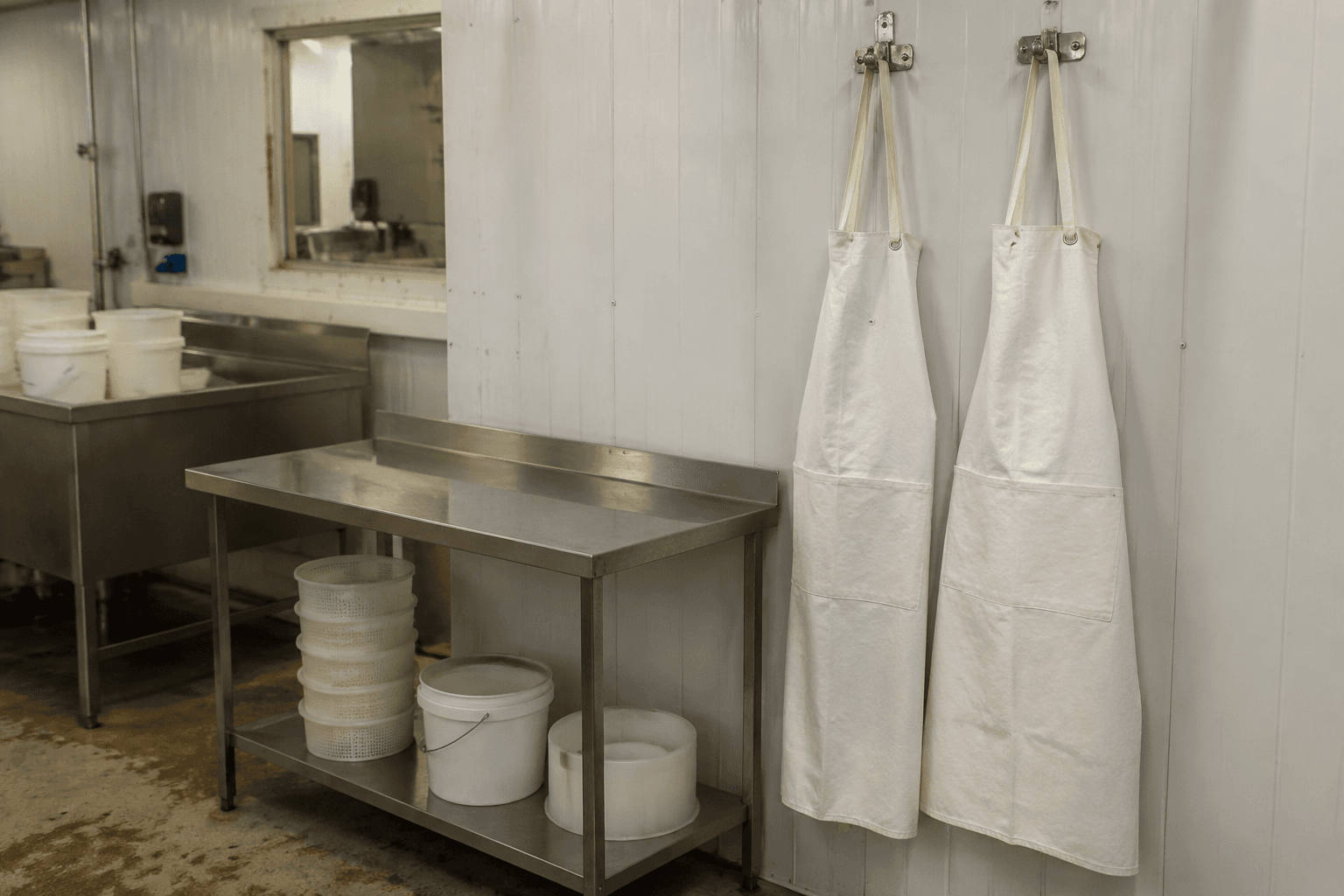
A creamery apron has three jobs: keep the worker’s clothing cleaner, reduce liquid transfer during handling, and remain practical through repeated cleaning. In cheese production, aprons may contact whey splash, milk residue, brine, butterfat, curd fines, detergent solution and sanitizer mist. The apron cannot be treated like a café apron, where the main requirement is presentation. It must tolerate moisture, abrasion from benches and crates, and repeated tying and untying with wet hands.
The production zone determines the required build. In make rooms and aging support areas, a breathable cotton-poly blend may be acceptable if the apron is changed frequently and laundered. In brining, washing and sanitation areas, buyers usually need a coated dairy apron that can be wiped or hosed. Packing rooms often need a lighter food hygiene apron that is clean-looking, easy to size across staff, and compatible with color-coded HACCP controls.
A common sourcing mistake is asking for one universal apron for every dairy workstation. This keeps SKU count low but often produces complaints: too heavy for packing, too absorbent for brine, too stiff for retail cheese counters, or too difficult to launder. For medium and large programs, two apron types often work better than one: a lighter washable apron for handling and packing, plus a heavier wipe down apron for wetter or chemical-exposed jobs.
- For cheese making and curd handling, specify moderate water resistance, easy movement and strong waist ties.
- For brine or wash-down stations, specify coated fabric, sealed or well-controlled stitching and a longer bib or full-front cut.
- For packing rooms, specify clean color, consistent sizing, low-lint fabric and simple laundering.
- For visitor or training use, specify lower cost fabric and clear size labelling rather than heavy-duty coating.
Fabric choices: twill, canvas, coated polyester and PVC
Fabric selection is the largest performance decision and usually the largest cost driver after logo work. For a cheese maker apron used in lower-splash work, 65/35 poly-cotton twill at 220-260 GSM is common. It launders well, feels familiar to staff and is cost-efficient for high-volume programs. However, it absorbs liquid. If the work area includes whey splash or wet benches, a higher GSM or water-resistant finish may be needed.
For a sturdier dairy apron, cotton canvas or poly-cotton canvas in the 280-360 GSM range gives more body and abrasion resistance. Canvas feels substantial, but it becomes heavier when wet and may require more drying time. If the buyer wants a rustic retail creamery look, canvas can be attractive, but for production hygiene it should be specified with tight weave, stable shrinkage and minimal loose fiber. A 320 GSM canvas apron may look premium, yet it is not the best choice for frequent wipe-down unless treated or coated.
Coated polyester and PVC-coated materials are used when the apron must shed liquid. A 210D or 300D polyester base with PU or TPU coating can sit around 180-280 GSM and provide a lighter wipeable product. PVC-coated polyester or vinyl aprons commonly run 380-550 GSM and are more suitable for wash-down, brine and sanitation. The trade-off is comfort: heavier coated aprons are hotter, less breathable and less flexible. For full-shift dairy work, buyers should not chase maximum thickness without testing wearer comfort.
- 220-260 GSM poly-cotton twill is suitable for light prep, packing and lower-splash work.
- 280-360 GSM canvas gives more heft but can hold moisture and increase drying time.
- 180-280 GSM PU-coated polyester works for lighter wipe-down use where flexibility matters.
- 380-550 GSM PVC-coated material is better for wet rooms, brine areas and sanitation tasks.
- Above 600 GSM, durability may improve, but operator fatigue and stiffness become real concerns.
Hygiene details that should be built into the specification
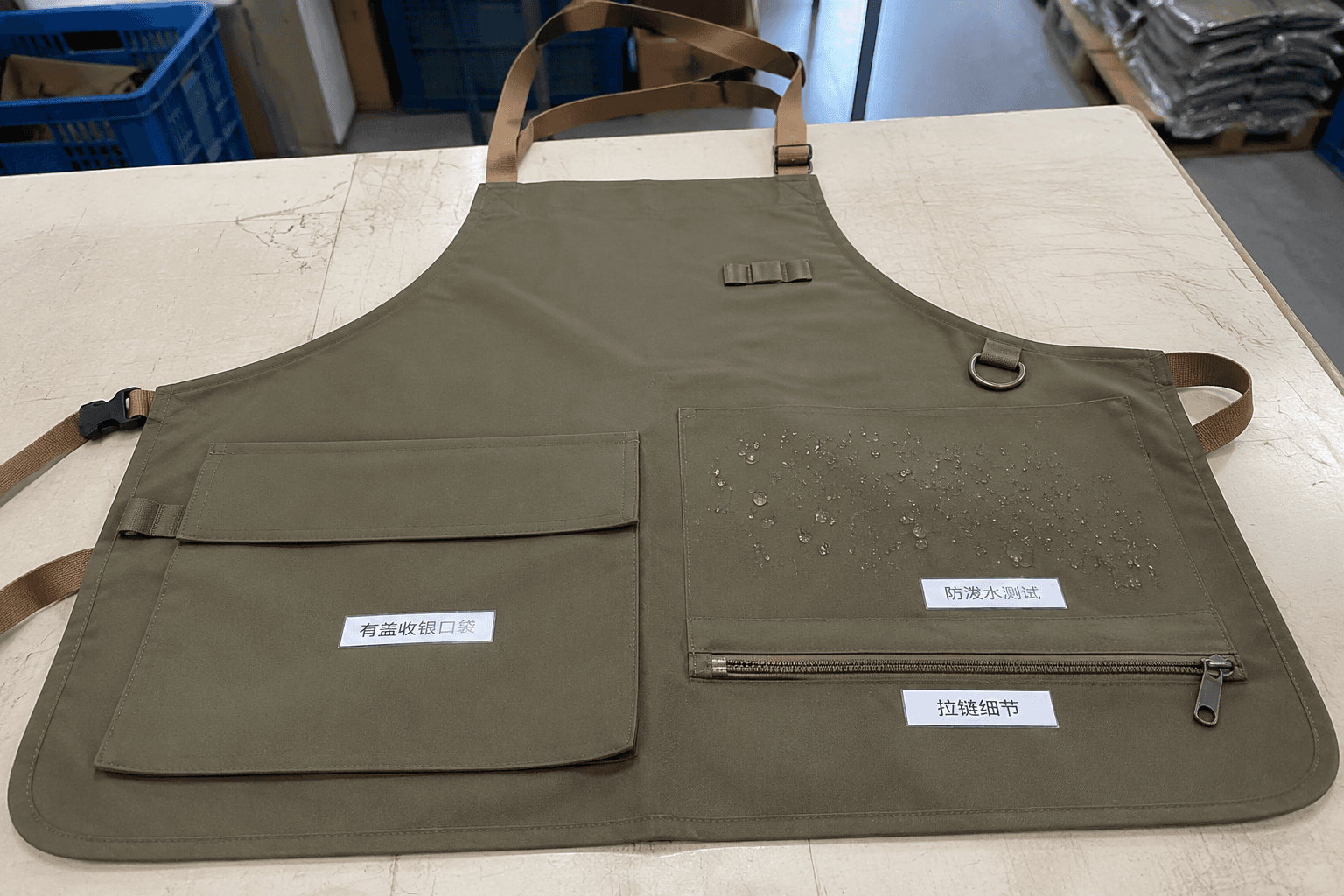
A food hygiene apron should be simple. Extra pockets, decorative seams, metal eyelets, contrast trims and complex strap systems can create cleaning issues. In dairy environments, buyers usually prefer a smooth front panel, minimal stitch lines and secure straps. If a pocket is required for tools or a thermometer, it should be placed and constructed so it does not collect curd particles or liquid. Many production aprons are intentionally pocketless for this reason.
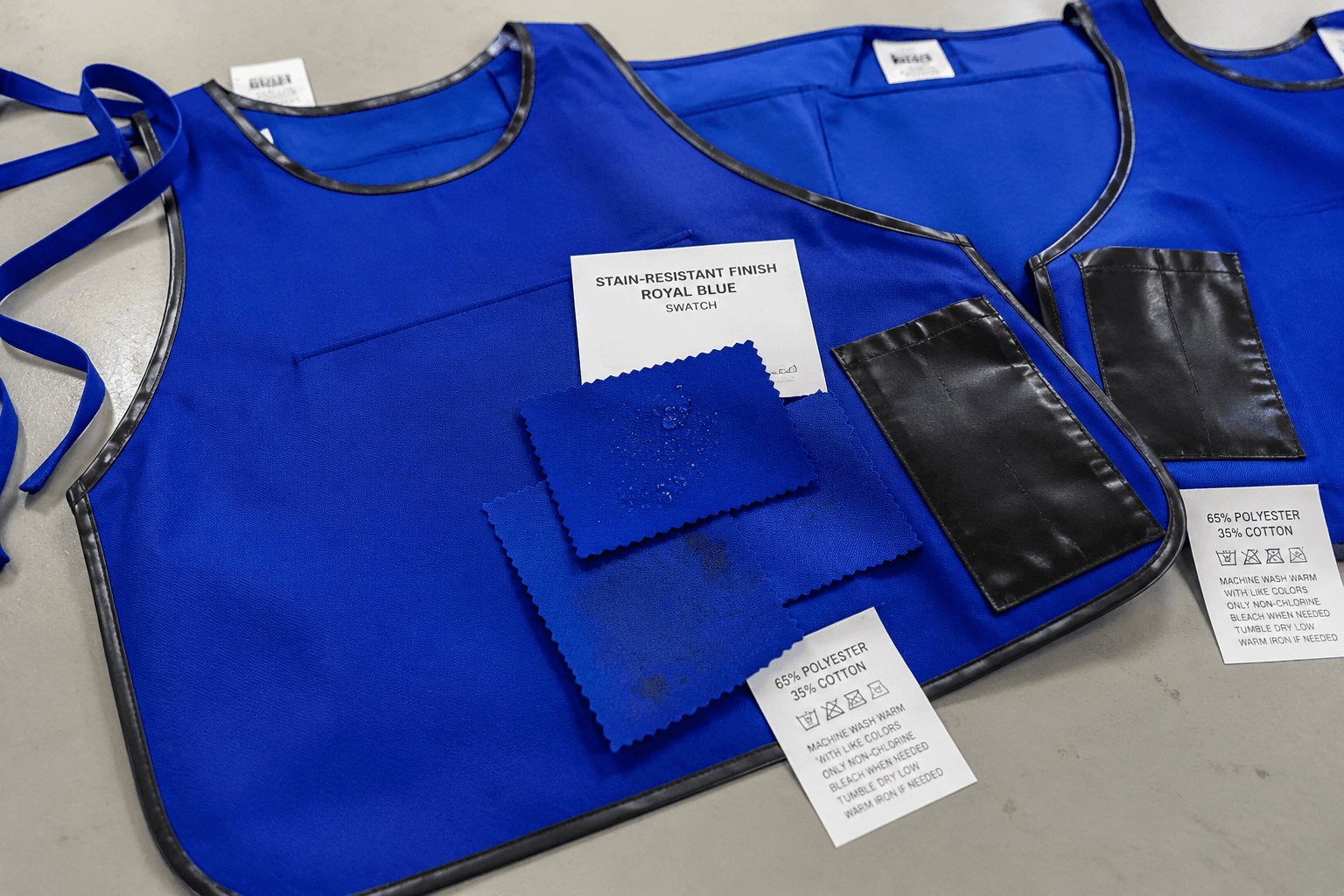
Color also supports hygiene control. White shows contamination quickly and is common in dairy, but it stains easily and demands tighter laundering discipline. Navy, royal blue, bottle green and black hide marks better and may support department coding. Some buyers use yellow for sanitation, blue for packing and white for production. If color coding is part of the program, confirm the exact shade at lab dip stage and keep bulk cutting by shade lot. Mixed dye lots can be obvious when aprons are worn side by side.
Hardware should be selected carefully. Plastic adjusters are lighter and avoid metal contamination concerns, but low-grade plastic can crack under hot wash or chemical exposure. Metal hardware is durable but may not be acceptable in some food facilities. For many creamery orders, fixed neck straps or adjustable fabric neck ties are simpler and safer than buckles. Where adjustability is needed, we often recommend acetal plastic hardware and confirm wash temperature before production.
- Use smooth front panels where hygiene is more important than tool storage.
- Avoid unnecessary metal parts unless the buyer’s food safety team approves them.
- Specify pocketless construction for high-risk wet or product-contact zones.
- Use department colors only after confirming lab dips and shade lot separation.
- Choose bartack reinforcement at stress points, especially neck strap ends and waist ties.
Wipe down apron versus machine-wash apron
The term wipe down apron is often used too broadly. A buyer may mean a vinyl apron that can be wiped with sanitizer between tasks. Another buyer may mean a coated apron that can be machine washed every day. These are not the same requirement. Some coatings resist wiping chemicals well but crack after repeated high-temperature laundering. Some washable coated fabrics survive machine cycles but are less resistant to aggressive cleaning agents.
For machine laundering, the apron needs stable shrinkage, secure stitching and coating adhesion that can handle wash agitation. For poly-cotton twill, typical shrinkage after industrial-style washing should be controlled within about 3-5 percent, depending on fabric and wash temperature. For coated aprons, the critical points are coating peel, edge fray, seam leakage and stiffening after cycles. Buyers should request a wash test matching the real process: for example, 40°C household wash, 60°C commercial wash, or low-temperature tunnel laundering.
For wipe-down use, ask what chemicals are used and at what concentration. Quaternary ammonium compounds, chlorine-based sanitizer and peracetic acid can affect coatings differently. A sample wiped once in an office does not prove long-term performance. A practical test is 20-50 wipe cycles on the same area, followed by flexing and visual inspection. If the apron will be hosed, the buyer should also check water run-off at stitch lines and strap attachments.
- For washable twill aprons, request shrinkage results after 3 wash cycles and confirm target wash temperature.
- For coated aprons, test coating adhesion, cracking and edge condition after repeated flexing.
- For sanitizer wipe-down, confirm the chemical type and concentration before fabric approval.
- For hosed aprons, inspect water retention at seams, binding and strap attachment points.
Sizing, pattern and comfort for long shifts
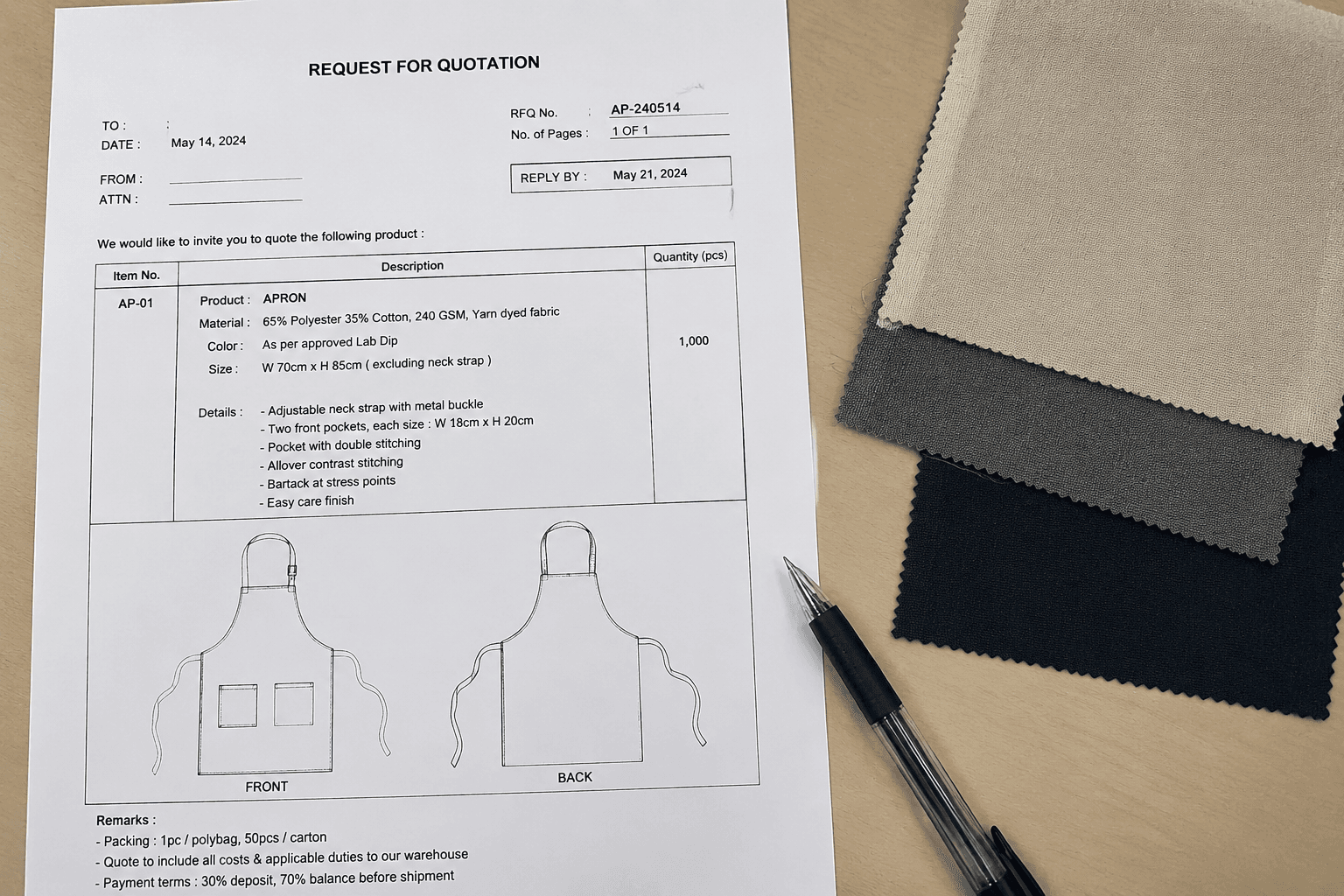
Apron sizing looks simple until a buyer needs one pattern to fit operators of different heights and body shapes. A standard adult bib apron for dairy packing may measure around 70 x 85 cm or 72 x 90 cm. A longer creamery apron for wet production may be 80 x 110 cm or larger. For shorter staff, too much length becomes a trip or snag risk; for taller staff, a short bib may expose the lower garment to splash. We usually recommend confirming the user height range and testing two sizes if the workforce is broad.
Neck comfort matters because coated aprons carry more weight. A narrow neck strap on a 500 GSM PVC apron can become uncomfortable after several hours. Cross-back straps distribute weight better than a neck loop, but they take longer to put on and cost more in labor and components. For production teams that change aprons frequently, a simple neck-and-waist construction may be more efficient. For long-shift brine or sanitation users, cross-back support can reduce complaints.
Pattern shape also affects mobility. A square apron body gives broad coverage but can restrict bending or crouching if the material is stiff. Rounded lower corners reduce snagging and make binding cleaner. Side coverage may be important in wash-down areas, but too much wrap makes the apron harder to ventilate. For coated dairy aprons, a small pattern change can make a large comfort difference, so pre-production samples should be worn during actual tasks, not only checked on a mannequin.
- Standard adult bib size is often 70 x 85 cm or 72 x 90 cm for light production and packing.
- Long wet-room aprons commonly run 80 x 110 cm, with larger sizes available for full-front coverage.
- Neck straps should be at least 2.5 cm wide for medium-weight aprons and wider for heavy coated styles.
- Cross-back straps improve weight distribution but add cost, sewing time and fitting complexity.
- Rounded lower corners can reduce snagging and improve binding consistency.
Branding and labeling without creating hygiene problems
Branding for a creamery apron should be controlled and practical. Embroidery looks durable on cotton twill or canvas, but the back of embroidery creates thread texture and may hold moisture or residue. For food production zones, many buyers avoid embroidery on the main front panel and use woven labels, heat transfer logos or plain unbranded aprons. For retail-facing cheese counters, embroidery can be acceptable if the apron is laundered properly and not used in high-splash areas.
Screen printing is cost-effective for simple logos, especially at 500-3,000 pcs. On cotton or poly-cotton, one-color screen print may add roughly USD 0.15-0.45 per apron depending on logo size and ink system. On coated materials, ink adhesion must be tested; some prints scratch or peel when wiped with sanitizer. Heat transfer can give clean detail but may not tolerate high heat, harsh chemicals or repeated bending on heavy coated aprons.
Labels should also be specified with hygiene in mind. A woven brand label on the neck facing or side seam is common, but large external labels can collect residue. Care labels must state the real wash limitation. If a coated apron is wipe-clean only, the label should not imply machine washing. For export orders, buyers may require fiber content, country of origin, RN number, batch code or bilingual wash symbols. These details should be confirmed before bulk production because late label changes can delay packing by 3-7 days.
- Use embroidery mainly for retail-facing or lower-splash aprons, not high-risk wet production areas.
- Use heat transfer only after confirming wash temperature, coating compatibility and sanitizer exposure.
- Keep external labels small and away from heavy contamination zones.
- Confirm care symbols before bulk cutting so labels are ordered with enough lead time.
- For traceability, add lot codes on carton labels or inner polybags rather than on the apron front.
MOQ, lead time and cost structure for a creamery apron order
MOQ depends on fabric availability and customization level. For stock poly-cotton twill in common colors, a practical MOQ can be 300-500 pcs per color. For custom dyed fabric, MOQ often starts around 1,000-2,000 pcs per color because dyeing mills need minimum batch quantities. For PVC or PU-coated materials, MOQ depends on whether the coating supplier has stock rolls. If custom color coating is required, 1,000 pcs may still be too low unless the apron size is large enough to consume the roll efficiently.
Lead time should be separated into sampling, material preparation and bulk sewing. A first OEM sample usually takes 5-10 days if stock fabric is used and 12-18 days if custom fabric or special coating is needed. Lab dips may take 3-7 days per round. Bulk production for 1,000-5,000 pcs is commonly 20-35 days after approval and deposit for standard twill or canvas aprons, and 30-45 days for coated aprons with custom materials, logo tests or special packing. Peak season and fabric mill schedules can add another week.
Cost is built from fabric consumption, material price, trimming, sewing minutes, logo process, inspection and packing. As a broad factory-side reference, a simple 240 GSM poly-cotton dairy apron may fall around USD 1.60-2.80/pc FOB at 1,000-3,000 pcs, depending on size and logo. A heavier canvas cheese maker apron may be around USD 2.40-4.20/pc. A PVC-coated wipe down apron can range from USD 2.80-5.80/pc, with higher prices for large sizes, reinforced straps, cross-back systems or thicker material. These ranges are not quotes, but they help buyers compare specifications realistically.
- Stock twill color MOQ is often 300-500 pcs per color for simple custom apron programs.
- Custom dyed fabric MOQ is commonly 1,000-2,000 pcs per color, depending on mill requirements.
- First samples usually take 5-10 days with stock fabric and 12-18 days with custom material.
- Bulk lead time is commonly 20-35 days for standard washable aprons and 30-45 days for coated styles.
- Price movement is driven more by fabric and construction than by small measurement changes.
Quality inspection points before shipment
For apron inspection, buyers should go beyond general appearance. A creamery or food hygiene apron needs clean edges, secure straps, stable measurements and no defects that can trap residue. On coated aprons, inspectors should check pinholes, coating bubbles, delamination, uneven thickness, scratches and color streaks. On washable woven aprons, they should check oil stains, loose threads, needle damage, fabric slubs, skewing and shrinkage risk. AQL can be set like a normal sewn product, but the defect classification should reflect food-use risk.
Strap strength is one of the most common failure points. Neck straps and waist ties are pulled repeatedly, often when wet. A bartack that looks acceptable may still fail if the thread tension is poor or the coating tears around the stitch. For medium and heavy aprons, pull testing at the factory is useful. A practical internal check is a firm manual pull at each strap point plus visual review for tearing, skipped stitches and loose thread tails.
Packing should protect cleanliness without creating unnecessary handling. Individual polybags are common for export, but some food service buyers prefer bulk inner bags to reduce plastic waste. Cartons should be strong enough for heavy coated aprons; a carton of 100 PVC aprons can become difficult to lift and may deform in transit. For heavy styles, 25-50 pcs per carton is often more practical. Carton marks should show PO number, style, color, size, quantity and gross weight so receiving teams can separate departments quickly.
- Inspect coated fabric for pinholes, bubbles, peeling, scratches and shade variation.
- Inspect woven fabric for stains, slubs, loose threads, skewing and inconsistent GSM feel.
- Check bartacks at neck and waist attachments with manual pull testing.
- Confirm measurements after pressing or folding, because coated aprons can distort if packed too tightly.
- Use carton quantities that match apron weight, especially for PVC or long wet-room styles.
- Verify carton labels against PO, style code, color, size and packed quantity before shipment.