For restaurant groups, hotel operators, uniform distributors, and private-label sourcing teams, bulk fabric booking for aprons is usually a fabric-risk decision, not a sewing decision. A sewing line can often recover 3 to 5 lost days with overtime or a second line. A dye-house queue cannot. Once an apron program moves from stock black twill into custom-dyed canvas, washed denim, recycled poly-cotton, or water-repellent finishes, the mill calendar starts controlling the shipment.
The key sourcing question is straightforward: when should a buyer secure fabric capacity if the final purchase order is still under approval? In apron buying, the answer depends on whether the cost of missing the ship window is greater than the cost of a controlled early commitment. A 2,500-piece reorder in stock 235 GSM black twill may not justify early exposure. A 18,000-piece hotel-opening program in one custom Pantone shade, with a 75-day countdown to launch, usually does.
A sound decision starts with stable inputs: expected piece volume, apron consumption per piece, colorway count, target width, GSM or oz weight, mill MOQ, shrinkage allowance, AQL standard, and the date the goods must leave the factory. When those points are 75% to 80% confirmed, early fabric booking becomes a sourcing control tool rather than a guess. The objective is simple: lock the right stage of capacity, with the lowest practical liability, before the fabric calendar closes.
- Use early booking when custom dyeing, washing, coating, or finishing adds 20 to 35 days that sewing cannot recover.
- For apron programs, booking is usually justified when fabric construction, weight, width, and color direction are at least 75% stable.
- Greige booking is the lowest-risk option when volume is credible but shade approval is still pending.
- For delayed apron launches, air freight can add about $1.50 to $4.00 per piece, often more than controlled fabric exposure.
- Write every booking term clearly: booked meters, MOQ, cancellation date, shade tolerance, leftover ownership, and reuse rules.
- Repeat apron programs with stable demand can justify deeper mill commitment 30 to 45 days earlier than first-time launches.
Why bulk fabric booking for aprons is usually decided before sewing capacity
In apron sourcing, buyers often spend early meetings on pocket layouts, neck buckle options, embroidery size, barcode labels, and carton counts. Those details matter, but they rarely create the main delivery risk. The real risk sits upstream: yarn availability, loom allocation, greige output, dye-house queue, finishing, relaxation, testing, and final fabric inspection. If the fabric is late, cutting cannot start, regardless of how efficient the sewing floor is.
That is why bulk fabric booking for aprons should be reviewed as soon as the forecast is commercially credible, not only after the final PO is signed. A 7,500-piece bib apron program using 10 oz cotton canvas at 58/60 inch width may require about 4,600 to 5,000 meters after 3% shrinkage allowance, marker loss, and fabric inspection replacement. If the mill MOQ is 1,500 meters per color and the dye-house lead time is 18 to 24 days after lab-dip approval, waiting another 10 days for internal PO signoff can remove the entire schedule buffer.
For professional buyers, the logic is practical. Sewing capacity can often be expanded with overtime, Saturday shifts, or line balancing. Fabric lead time is less flexible because it depends on mill and dye-house capacity shared across multiple customers. When the apron shipment is tied to a restaurant opening, a hotel pre-opening, or a chain reset date, fabric booking is usually the first critical capacity decision in the whole program.
- Stock apron fabric can often be approved and moved to cutting in 7 to 12 days.
- Custom-dyed apron fabric typically needs 20 to 35 days before cutting starts.
- Washed canvas, denim, and coated fabrics usually carry more queue risk than stock twill.
- In most apron programs, fabric delay is harder to recover than sewing delay.
When to secure mill capacity before the final apron PO
There is no single calendar day that fits every program. The better trigger is a combination of forecast confidence and specification stability. Early booking is normally justified when four conditions exist together: the volume is reasonably reliable, the color count is mostly settled, the fabric is not stock-supported, and the shipment window has clear commercial consequences. For example, a hospitality buyer may still be adjusting store-by-store size ratios, but if the body fabric is already fixed at 65/35 poly-cotton twill, 235 GSM, in black and dark olive, the upstream path is specific enough to reserve capacity.
A practical threshold for apron buyers is 75% to 80% confidence in the base-cloth specification. That means the team has already aligned on construction, width, target weight, finish, and a narrow color direction. At that point, the supplier can split the commitment into stages: first reserve greige or loom capacity, then hold a dye slot once lab dips are approved, then confirm finishing after the PO is released. This staged approach protects the ship date without taking full finished-goods risk too early.
The financial comparison should be explicit. If a late apron shipment forces a split delivery, premium freight, or a delayed opening, the commercial loss can exceed the fabric exposure very quickly. A buyer may hesitate over a $4,200 greige commitment, but the same program could incur $9,000 to $28,000 in extra air freight if 6,000 to 7,000 aprons miss the vessel cutoff. Booking should be approved because the numbers support it, not because a supplier pushes for it.
- Book earlier when the fabric is custom dyed, washed, brushed, coated, or recycled-content.
- Book later only when the fabric is stock-supported and replenishment is available within 7 to 10 days.
- Use staged booking when color approval is pending but the body cloth is already fixed.
- Compare booking exposure against delay cost in dollars, not only in days.
Bulk fabric booking for aprons: the real mill timeline behind one quoted lead time
A quotation may show one fabric lead time, but apron buyers should separate that number into the actual production stages. A typical path can include yarn preparation, weaving, pre-treatment, dyeing, drying, finishing, relaxation, testing, and inspection. Each step may carry its own queue. A mill that quotes 28 days may actually mean 6 days waiting for loom allocation, 7 days weaving, 5 days in dye queue, 3 days finishing, 2 days relaxation, 2 days inspection, and 3 days inland transport to the apron factory.
This breakdown matters because different apron fabrics behave differently. A 12,000-piece waist apron order in 240 GSM poly-cotton twill may need around 5,700 to 6,200 meters after marker loss and shade allowance. In a quiet month, the fabric may be ready in 18 to 22 days. In peak periods, especially before holiday hospitality demand or before a long factory shutdown, the same fabric can stretch to 30 to 40 days. A 10 oz enzyme-washed canvas or 300 GSM denim can run even longer because washing and finishing add extra queue time.
The most reliable planning method is backward scheduling. Instead of trusting one headline lead time, set three fixed dates: fabric-in-house date, sewing start date, and ex-factory date. If sewing needs 12 days, metal trim installation adds 2 days, final inspection to AQL 2.5 needs 1 day, packing needs 2 days, and truck cutoff is fixed, then the latest safe fabric-ready date becomes visible. Once that date is known, the mill-booking deadline can be defended internally with real numbers.
- Custom apron fabric usually needs 18 to 35 days before cutting can begin.
- Special finishing such as water repellency, brushing, or garment wash can add 3 to 10 days.
- Peak-season queues can extend mill lead times by 30% to 60% versus off-season capacity.
- Backward planning works better than relying on one total quoted lead-time figure.
Three booking models apron buyers can use before final approval
Not every early booking needs the same exposure. The lowest-risk model is greige reservation. In this structure, the supplier secures loom time or unfinished cloth without immediately dyeing to the final shade. It works well for stable apron constructions such as 8 oz poly-cotton twill, 10 oz cotton canvas, or 280-300 GSM denim where the base cloth is already confirmed but color approval is still moving. If the lab dip is approved a few days later, the fabric can enter dyeing without losing its place in the queue.
The middle option is greige plus dye-slot booking. Here, the buyer reserves unfinished cloth and also holds a tentative dye-house window. This model fits apron programs where the approved shades are likely to stay within a tight range such as black, navy, burgundy, or forest green. It is often the best balance for hotel, café, and uniform launches because it reduces schedule risk without creating full finished-fabric liability too early.
The highest-commitment model is finished fabric booking. In this case, the exact apron fabric is woven, dyed, finished, and inspected before the final PO lands. This is only sensible for repeat SKUs, annual framework business, or core hospitality colors with proven monthly consumption. The advantage is speed: once the PO arrives, cutting can begin almost immediately. The tradeoff is clear: if the order quantity falls, shifts color, or cancels, the booked inventory becomes a real balance-sheet issue that must already be covered in the agreement.
- Greige reservation suits programs with fixed construction and pending shade signoff.
- Greige plus dye-slot booking suits launch programs with narrow color risk and fixed deadlines.
- Finished fabric booking suits repeat apron SKUs with proven replenishment patterns.
- The booking model should match demand certainty, not the supplier’s preference.
MOQ, cost exposure, and liability terms in apron fabric booking
The right question is not whether early booking is possible. The right question is who carries the cost if the forecast changes. Buyers should ask for exposure in both meters and piece-cost terms. If a custom-dyed 10 oz canvas costs $2.55 per meter and the mill MOQ is 1,500 meters per color, one color represents $3,825 before cutting. If one bib apron consumes 0.80 meter including allowance, that MOQ covers about 1,875 aprons. With those figures on paper, the booking risk becomes concrete and comparable.
MOQ pressure changes by fabric type. Standard 210-240 GSM twill may run at 1,000 to 1,500 meters per color. Heavier washed canvas, slub weave canvas, or certified recycled-content cloth may need 2,000 to 3,000 meters per color to run efficiently. If the apron program is only 900 pieces in one color, forcing a custom fabric run may be less efficient than using a stock body cloth with custom webbing, contrast straps, or embroidery. Good sourcing discipline means matching the fabric strategy to realistic volume, not to wishful assortment plans.
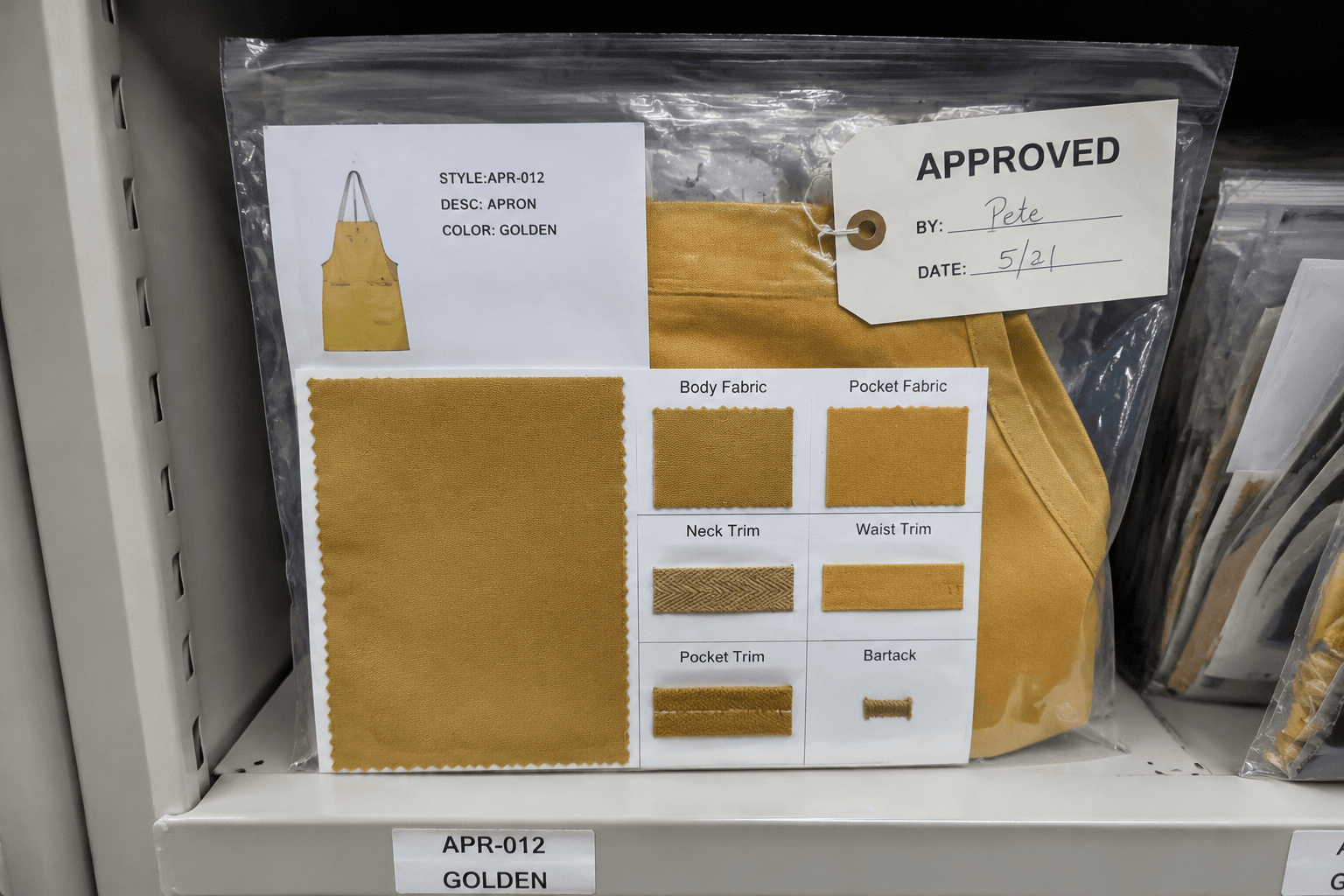
Liability must be written line by line. The booking sheet should specify fabric construction, width, target GSM tolerance, color standard, booked meterage, usable shade tolerance, cancellation deadline, and who owns the leftover cloth if the order does not consume the full run. Many buyers also specify whether excess meters can be carried forward to the next apron replenishment and for how long. If the factory will inspect the fabric to AQL 2.5 at finished-goods stage, the buyer should also confirm whether additional meterage is booked to cover defect replacement or shrinkage variance.
- Typical apron fabric MOQ runs about 1,000 to 3,000 meters per color.
- Custom fabric choices can shift FOB cost by roughly $0.18 to $0.90 per apron.
- Premium air freight can add about $1.50 to $4.00 per apron if the vessel cutoff is missed.
- Written terms should define cancellation timing, leftover ownership, tolerance, and reuse rights.
How repeat apron programs and launch programs should be booked differently
A common sourcing mistake is treating every apron program the same. Repeat business and first launches do not deserve the same booking profile. A repeat chain order with six or more prior replenishments is easier to book early because the fabric hand, color standard, shrinkage pattern, and average monthly drawdown are already known. In that case, finished fabric booking or a deeper greige position can be commercially sensible, especially when the buyer has a 90-day or 180-day framework agreement behind the business.
A first launch should be managed more cautiously. If the design is approved but store count, replenishment velocity, or final embroidery artwork is still uncertain, the safer path is usually greige booking or partial dye-slot booking. This protects upstream capacity while limiting dead-stock risk. For example, a 15,000-piece launch forecast may support reservation of the full base cloth, but only the first 6,000 to 8,000 pieces may justify immediate dye commitment until final rollout approval is received.
Seasonality also changes the decision. Hospitality, food-service, and promotional apron demand often tightens before holiday trading periods, spring openings, and major events. In those windows, securing capacity even 10 to 15 days earlier can materially improve the chance of keeping a workable slot. Once the queue is full, the remaining options are usually unattractive: accept a later ex-factory date, downgrade to available stock fabric, or pay for premium freight to recover part of the delay.
- Repeat stable programs can often justify booking 30 to 45 days earlier than new launches.
- First launches should start with the lowest-risk commitment layer that still protects the schedule.
- Peak-season capacity makes dark core shades like black and navy harder to secure quickly.
A practical approval checklist for bulk fabric booking for aprons
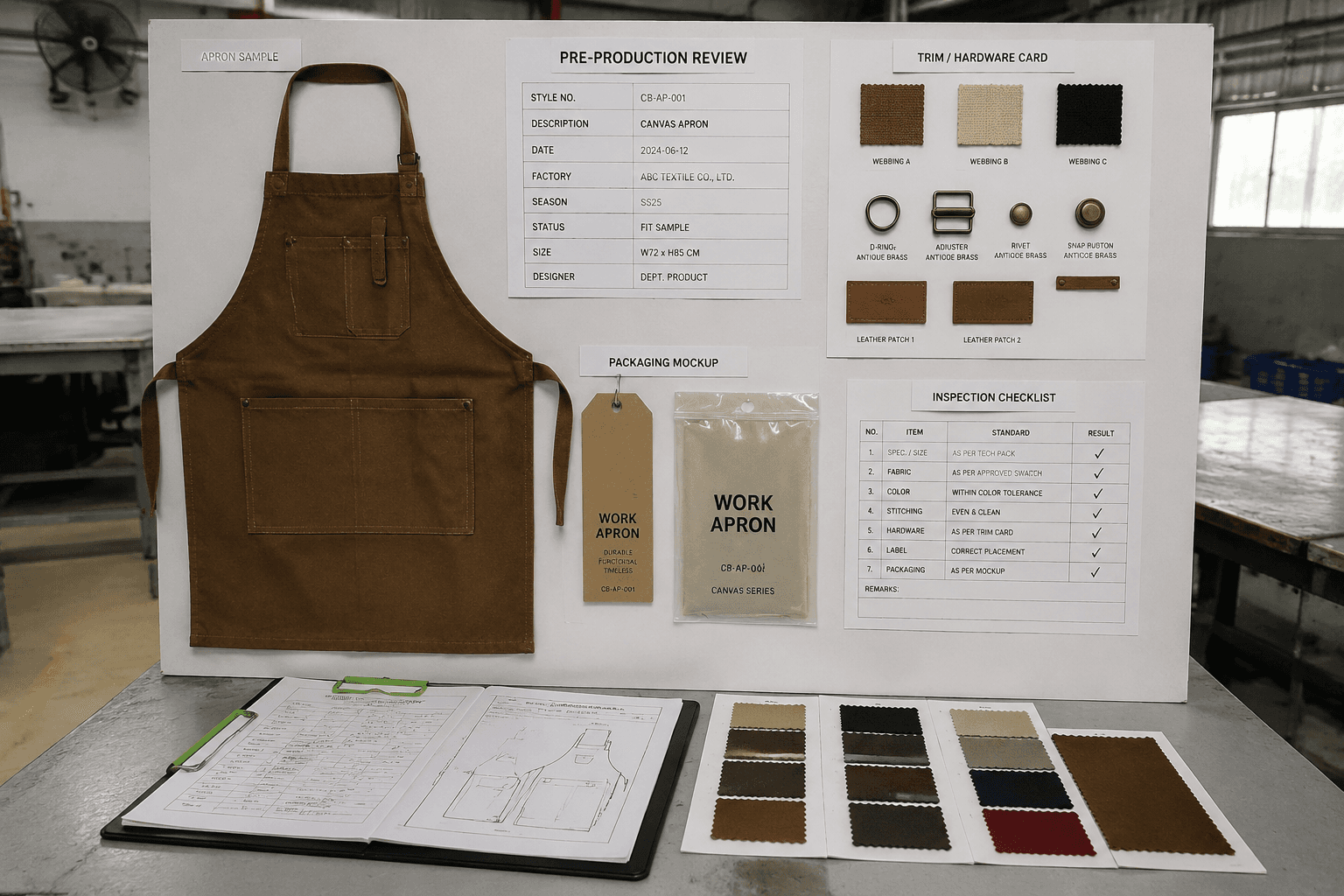
The cleanest way to manage bulk fabric booking for aprons is to turn it into a gated sourcing approval instead of an informal conversation. First define whether the apron fabric is stock, semi-custom, or fully custom. Then confirm whether projected volume sits above the mill MOQ. Then calculate backward from the ex-factory date to the latest fabric-ready date. If the remaining window is shorter than standard mill lead time plus a safety buffer of 5 to 7 days, the booking decision should move immediately rather than waiting for final paperwork.
A simple five-point review works well for B2B buying teams. One: is the fabric construction fixed? Two: are the colorways approved or narrowed to a final family? Three: is volume confidence above 75%? Four: is the launch date commercially sensitive? Five: is the current mill queue already above 20 days? If four of the five answers are yes, early booking is usually justified. If only one or two answers are yes, flexibility is normally worth more than speed.
The supplier’s role is to present numbers, not pressure. A capable apron factory should show booked meters, MOQ per color, expected lead-time days, projected consumption per piece, and cancellation exposure in plain commercial terms. The best sourcing outcome is not the lowest nominal fabric price. It is the plan that secures the right apron cloth at the right time, at an exposure level the buyer can approve with confidence.
- Classify the fabric as stock, semi-custom, or fully custom before booking.
- Work backward from ex-factory date and add a 5 to 7 day safety buffer.
- Escalate quickly when normal mill lead time exceeds the remaining fabric window.
- Approve booking only after meter MOQ, lead time, and liability are clearly quantified.