For professional apron sourcing, inspection timing is a shipment-control decision, not an admin task. If an inspector arrives before pressing, folding, polybagging, ticketing, carton assortment, sealing, and export marking are complete, the sample does not represent what will ship. If the inspector arrives after pallets are wrapped and booked for dispatch, every opened carton adds labor, recount risk, and delay cost. That is why pre shipment inspection apron timing should be written into the PO, QC plan, and booking calendar from day one.
The timing error usually appears in the last week because factories report sewing completion faster than packing completion. On a 6,000-piece apron order, a supplier may claim 100% production finished while only 4,100 pieces, or 68%, are actually packed. In a mixed program with bib aprons, waist aprons, black and natural colorways, embroidery, care labels, and retailer barcodes, that gap is large enough to distort AQL sampling and hide the highest-risk SKUs.
The practical rule is simple: book against verified packing status, not against the original ex-factory date. A workable apron inspection plan should define the packed-percentage trigger, style coverage, AQL level, booking window before ETD, correction buffer, and cost owner if the lot is not ready when the inspector arrives.
- Book final inspection when 85% to 100% of apron units are packed, with all main styles, colors, and logo versions available for AQL sampling.
- Use a defined acceptance standard, such as AQL 2.5 major and 4.0 minor, and do not treat a partially packed apron lot as a finished export lot.
- Keep 2 to 5 working days between inspection and cargo handover: around 2 days for simple 180 to 220 GSM poly-cotton aprons, and 3 to 5 days for 10 oz to 12 oz canvas aprons with hardware or washed finishes.
- Avoid inspection after pallet wrapping unless there is no alternative, because reopen labor, retaping, recounting, and relabeling can quickly exceed the visible per-carton charge.
- Require a 24-hour readiness check showing packed quantity, carton count, SKU coverage, approved carton marks, and available correction capacity before confirming inspector attendance.
- Assign cost responsibility in advance for attendance fees, carton reopen charges, and logistics delays, especially on mixed-SKU apron orders above 5,000 pieces or 120 cartons.
Why pre shipment inspection apron timing must follow export packing, not sewing completion
The most common timing mistake in apron sourcing is using sewing completion as the trigger for final inspection. Sewing finished only means the garments have left the main line. A true pre-shipment inspection should happen after trimming, loose-thread cleaning, pressing, logo verification, needle control or metal detection where required, folding, polybagging, ticketing, carton assortment, carton sealing, and shipping-mark application. Until those steps are complete, the inspector is not evaluating the same condition the customer will receive.
This matters more in aprons than many buyers expect because a single PO often combines different constructions and pack rules. One order can include 65/35 poly-cotton bib aprons at 200 GSM, 8 oz waist aprons with divided pockets, and 10 oz canvas aprons with cross-back straps, each with different labels, barcode placements, or carton assortments. If only the black bib apron is packed but the natural canvas apron is still waiting for rivets or hangtags, the inspection result can look acceptable while the unfinished SKU still carries the highest risk.
Good pre shipment inspection apron timing solves two operational problems at once. First, it gives a representative sample because the inspector can pull cartons from the actual export lot. Second, it preserves time for rework, replacement sewing, and repacking before cargo handover. The objective is not to inspect as late as possible; it is to inspect when apron condition is stable and correction is still realistic.
- Use packed quantity, not sewn quantity, as the booking trigger.
- Require 100% availability of main SKUs and at least 85% overall packed completion before attendance.
- Ask for a SKU-by-SKU packing report, carton count, and packed-unit total 24 hours before the inspector arrives.
- State the acceptance rule clearly, such as AQL 2.5 major / 4.0 minor, unless the buyer standard is tighter.
Best pre shipment inspection apron timing windows by order size, fabric weight, and shipment mode
For most bulk apron orders, the safest booking point is when 85% to 100% of the PO is export-packed and the inspection falls 2 to 5 working days before cargo handover. For ocean shipments from China, that usually means booking at ETD minus 4 to 6 working days for standard orders. For air shipments, ETD minus 2 to 3 working days can work, but only when the aprons are fully packed and the factory can complete corrections within 24 to 48 hours.
Order size changes the amount of buffer a buyer needs. A 1,000-piece MOQ apron order packed into 28 cartons is easier to inspect and recover than a 12,000-piece program spread across 240 cartons with five colorways and two packaging specs. Once the order exceeds about 8,000 pieces or 150 cartons, even a moderate issue such as wrong assortment ratio, inconsistent embroidery position, or mixed barcode labels can take a full working day to sort and reclose.
Fabric weight and construction affect correction speed. A 180 to 220 GSM promotional apron with a one-color print can often be corrected within one working day. A 280 to 340 GSM canvas apron, or a 10 oz to 12 oz style with rivets, D-rings, buckles, detachable straps, or washed finish, usually needs 2 working days for repair and repacking. Buyers who apply the same booking rule to both categories often inspect heavier apron orders too late.
- 500 to 1,500 pieces: book around ETD minus 3 to 4 working days if the lot is already 85% packed.
- 3,000 to 5,000 pieces: target ETD minus 4 to 5 working days.
- 5,000 to 15,000 pieces or 150+ cartons: target ETD minus 5 to 7 working days.
- 180 to 220 GSM poly-cotton aprons: usually need 1 buffer day after inspection.
- 260 to 340 GSM or 10 oz to 12 oz canvas aprons: reserve 2 to 3 buffer days after inspection.
What late inspection costs on apron cartons, pallets, and booked cargo
Late inspection costs are usually underestimated because the visible charge per carton looks small. In practice, the expense starts with cutting pallet wrap, moving staged cartons back to the inspection zone, reopening sample cartons, restoring the assortment, replacing tape, and checking any damaged or removed labels. On apron orders with retailer barcodes, carton sequence numbers, country-specific care labels, or mixed destination packs, the work also includes recounting and label verification so the physical goods still match the packing list.
Direct reopen and repack cost on apron shipments from China commonly runs from $0.08 to $0.35 per carton. On a 200-carton order, that equals $16 to $70 before extra materials and labor supervision. Fresh polybags, carton labels, stickers, or replacement tape can add another $0.01 to $0.06 per carton. If the pallets already have corner boards, stretch wrap, and final shipping marks, a late inspection can consume 0.5 to 1.5 working days on a larger order.
The bigger risk is packing accuracy under cut-off pressure. Apron shipments often contain mixed assortments by color, style, or label version. Once workers reopen cartons against a truck appointment or CFS receiving deadline, the chance of ratio errors, missing inserts, wrong carton marks, or unmatched barcodes rises sharply. For a B2B buyer, that is exactly why pre shipment inspection apron timing should be fixed before palletizing starts.
- Typical reopen speed is 10 to 25 cartons per worker hour, depending on fold complexity and assortment rules.
- Third-party inspection attendance often costs $150 to $300 per inspector day, excluding rebooking losses.
- Missing a truck slot or CFS receiving window can cost more than the reopen fee through storage, truck rescheduling, or rolled ETD.
- Mixed-style apron shipments carry higher recount and relabel risk than solid-pack cartons.
How to set a factory-ready SOP for pre shipment inspection apron timing
A workable SOP should convert vague language into measurable release conditions. Instead of writing 'book PSI before shipment,' define the trigger in numbers: book inspection when 90% of PO quantity is packed, all primary SKUs are available, carton marks are approved, and the factory confirms at least one day of correction capacity. That level of detail removes guesswork and helps both buyer and supplier decide whether to proceed or rebook before losing an attendance slot.
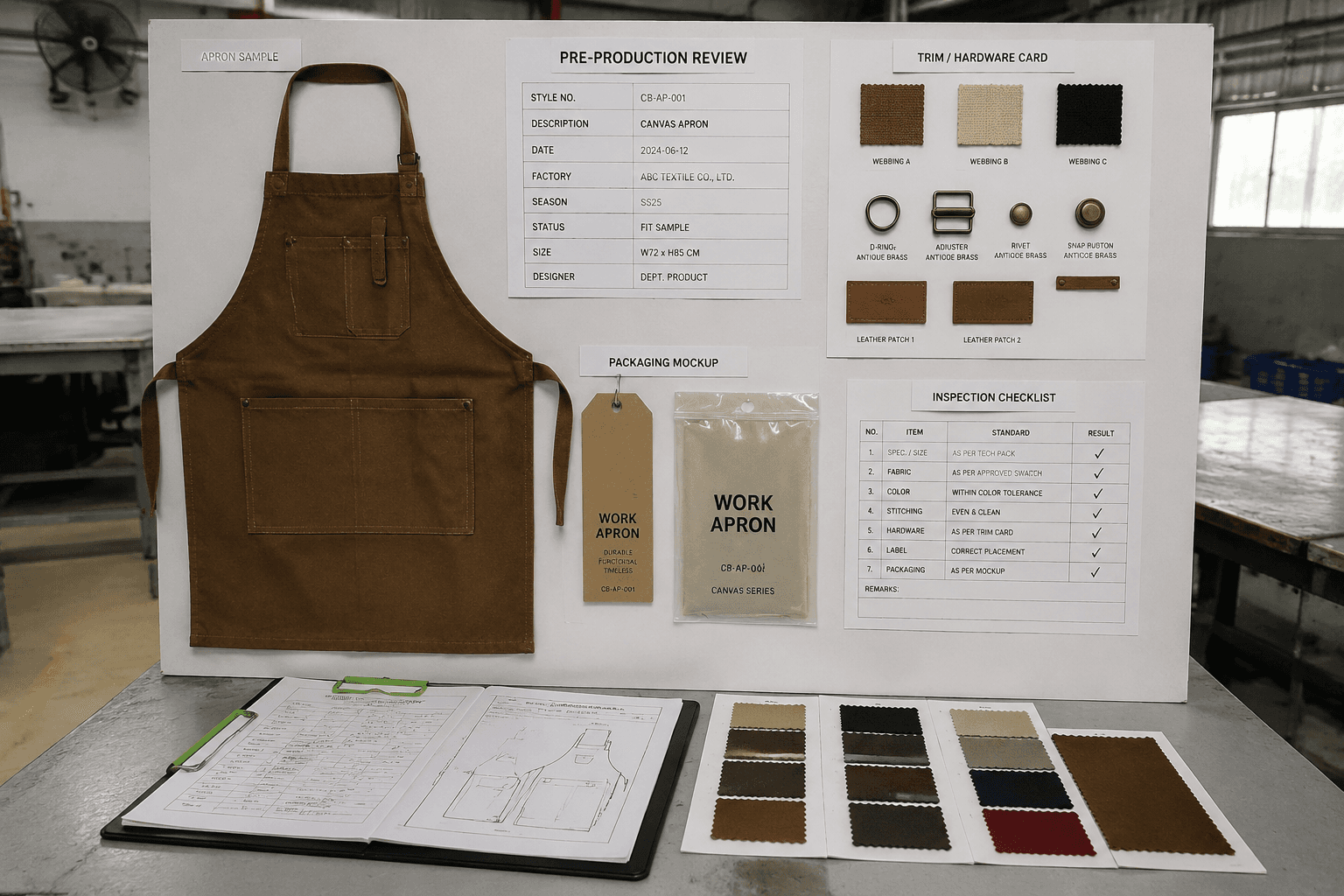
The SOP should start with a short milestone sheet that tracks fabric arrival, cutting completion, sewing completion, washing or finishing where applicable, accessory arrival, packing start date, daily packed units, expected carton count, and cargo handover date. This forces the booking decision to follow real packing progress rather than optimistic production claims. It also exposes typical apron bottlenecks such as late woven labels, missing buckles, incomplete embroidery, unfinished wax finish, or delayed carton-mark approval.
Shipment release should depend on three controls: packed quantity, document readiness, and correction capacity. Packed quantity makes the sample representative. Document readiness confirms that packing lists, barcode formats, carton marks, and shipping labels match the goods. Correction capacity means the factory still has operators, spare fabric, trims, hardware, and packing labor available if the inspection finds open seams, print deviation, pocket measurement variance, or missing accessories.
- Request a daily packed-quantity update during the final 5 to 7 days before shipment.
- Require a 24-hour readiness check with packed percentage, carton count, and full SKU coverage.
- Freeze carton marks, barcode layouts, and assortment ratios before the inspection request is submitted.
- Define who pays the $150 to $300 attendance fee if the lot is below the agreed readiness level.
- Hold shipment release until the buyer receives the inspection report, final carton count, and confirmed packing list.
Adjust pre shipment inspection apron timing for canvas, washed finishes, and hardware-heavy builds
Timing rules should change with apron construction complexity. A plain restaurant bib apron in 200 GSM TC with one chest logo can move from finishing to stable export packing within one day. A premium workshop apron in 300 GSM canvas with cross-back straps, antique brass buckles, rivets, and divided tool pockets usually cannot. The heavier style needs more time for hardware matching, final pressing, fold consistency, and packed-condition verification before an inspection result becomes reliable.
Washed, waxed, and coated aprons need extra caution because the final appearance can shift after finishing, pressing, and folding. Dark shades may show crease marks, wax rub, or shade variation only once the goods are fully packed. If inspection happens too early, the buyer may approve an unfinished presentation and then face claims after arrival. The same issue applies to detachable straps and trim kits: an apron may be sewn, but if strap sets, care labels, or branded hangtags are not fully matched to export cartons, the lot is not ready for meaningful final inspection.
Correction speed also drops as product value rises. A small print-position issue on a 190 GSM poly-cotton apron may be solved by replacing a few units from buffer stock. A rivet alignment issue or buckle shortage on a 12 oz canvas apron may require new component matching, extra sewing time, and full carton restoration. In those cases, buyers should book earlier within the valid packed window and protect at least 2 working days after inspection for controlled recovery.
- 180 to 220 GSM poly-cotton aprons: faster repair, faster repack, lower correction risk.
- 260 to 340 GSM canvas aprons: slower resewing and more repacking labor.
- Washed, waxed, or PU-coated aprons: inspect only after final packed appearance is stable.
- Aprons with rivets, D-rings, buckles, or detachable straps: verify accessory count before confirming the PSI date.
Who pays when inspection timing fails on an apron order
Cost responsibility should be agreed before the last production week. Most disputes happen because one side treats readiness as a factory promise while the other treats it as a buyer assumption. A cleaner approach is to define a measurable threshold in the PO or quality agreement. If the factory confirms 90% packed with all main SKUs available and the inspector finds only 62% packed, the factory should normally bear the attendance loss or rebooking fee. If the buyer changes artwork, labels, assortment rules, or booking date after cartons are sealed, the supplier should not automatically absorb reopen and delay costs.
It is useful to separate three cost buckets. The first is inspection attendance cost, typically $150 to $300 per man-day depending on city and agency. The second is carton reopen and repack cost, often charged at $0.15 to $0.30 per carton when buyer-driven changes happen after palletizing. The third is delay-related logistics cost, which may include storage, truck rebooking, documentation amendment, or rolled vessel space. These losses are different in cause and should not be buried under one generic penalty line.
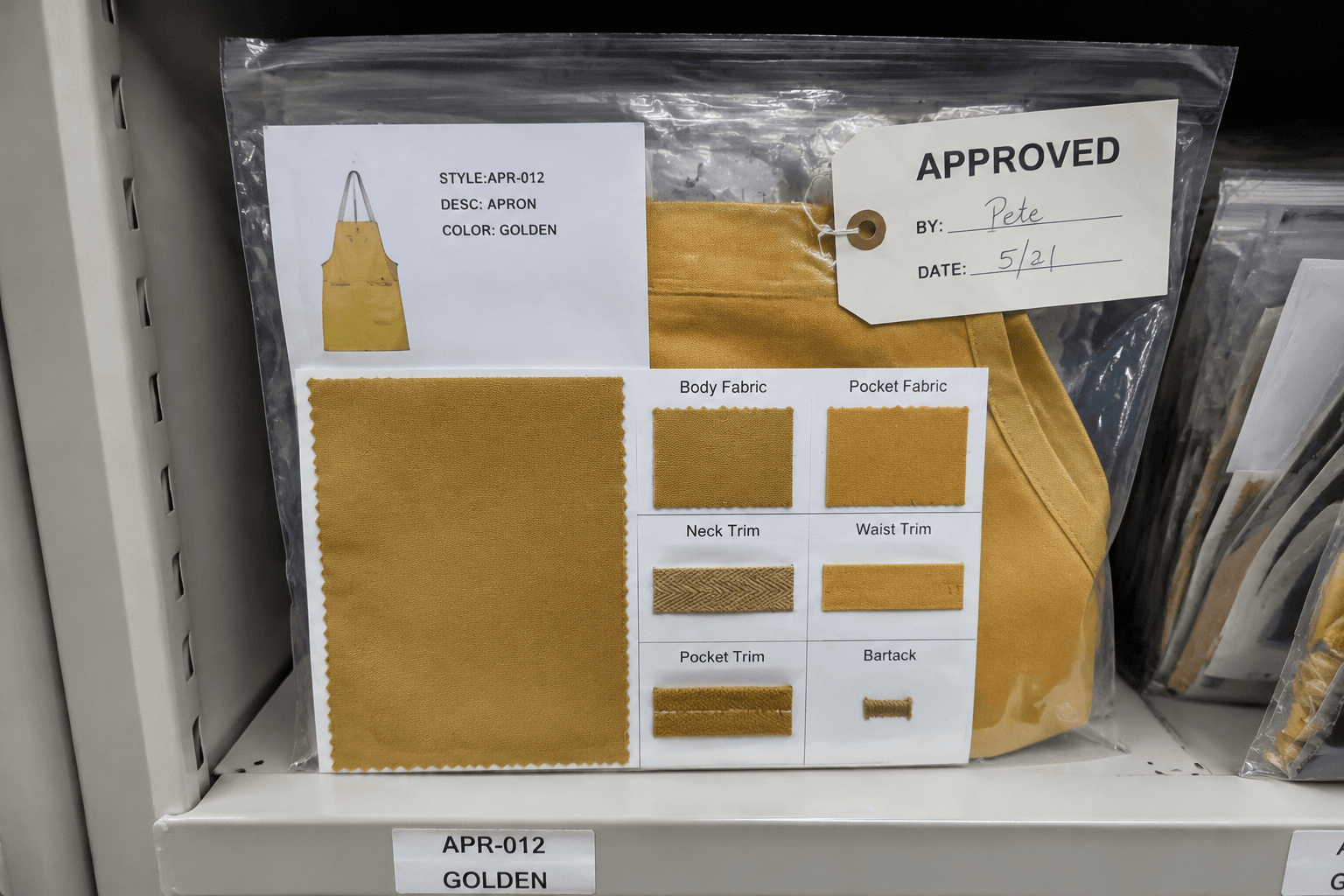
Evidence reduces arguments. Before attendance is confirmed, ask for date-stamped photos of packed cartons, a style-by-style packing report, and a final carton estimate. After inspection, keep the report, sample-size record, and corrective-action list together with the factory's readiness evidence. Once the facts are documented, payment responsibility is usually straightforward and repeat suppliers learn to report readiness more accurately.
- Set a minimum readiness rule such as 85% packed overall and 100% of main SKUs available.
- Separate attendance fees, repack charges, and logistics delay costs in the agreement.
- If buyer changes occur after palletizing, pre-agree a per-carton reopen fee such as $0.15 to $0.30.
- Use date-stamped photos, carton counts, and SKU status sheets as the approval record.
A repeatable booking model for professional apron sourcing teams
The most practical model for repeat apron buying is to count backward from ETD or cargo handover and build a fixed inspection buffer into the sourcing calendar. Start with one day for inspection, one day for simple correction, and one day for cargo staging. That makes ETD minus 3 working days the absolute minimum for a very simple order that is already fully packed. For most orders, especially anything above 3,000 pieces or with mixed styles, a safer base is ETD minus 4 to 6 working days.
Then adjust by construction and volume. Move the inspection earlier for canvas aprons above 260 GSM, for washed or waxed finishes, for hardware-rich builds, and for orders above 150 cartons. Keep the packed-percentage rule constant even on low-MOQ orders. A 600-piece apron order can still fail to represent the real shipment if only one colorway is packed. The discipline is to separate production completion from shipping completion every time.
Professional sourcing teams should also turn timing into a supplier KPI. Track booking accuracy, packed-percentage honesty, attendance waste, reopen incidents, and post-inspection correction lead time by factory. After three to six orders, the data shows which supplier reports readiness truthfully and which one relies on optimistic promises. In repeat business, strong pre shipment inspection apron timing does more than prevent carton reopen cost; it improves schedule reliability, reduces quality blind spots, and lowers last-week friction across the apron supply chain.
- Use ETD minus 4 to 6 working days as the default ocean-shipment planning rule.
- Run a mandatory 24-hour readiness check on every bulk apron order.
- Track booking accuracy, reopen incidents, and correction lead time as supplier performance data.
- For orders above 10,000 pieces, request a final-week dashboard with daily carton updates.