For buyers sourcing a blacksmith apron from China, the main decision is not only whether the apron is made from leather. The important questions are which leather, what thickness, how much body coverage, how the straps are anchored, and whether the construction can stay consistent across 300, 1,000 or 5,000 pieces. In factory production, small specification changes such as moving from 1.2 mm split leather to 1.8 mm full-grain cowhide can change cutting yield, sewing speed, carton weight, lead time and final unit cost.
A metalwork apron is a functional PPE-adjacent product, even when it is sold as workshop apparel rather than certified protective equipment. It is expected to resist sparks, grinding debris, heat flash, sharp edges and heavy daily use. At the same time, many brand buyers want the apron to look premium enough for retail, with clean edges, branded rivets, waxed straps or contrast stitching. These requirements often pull in different directions, so the sourcing brief needs to be specific before sampling starts.
This article explains the practical sourcing points for a leather forge apron: leather selection, heft, spark resistance, pattern design, reinforcement, hardware, MOQ, testing and bulk production control. The aim is to help product developers and sourcing managers define a realistic specification and avoid expensive revisions after the first sample.
- 1.2-1.6 mm split cowhide is the common commercial range for a spark resistant apron with workable cost and manageable weight.
- Full-grain or top-grain leather gives better appearance and hand feel, but cost and color variation are higher than split leather.
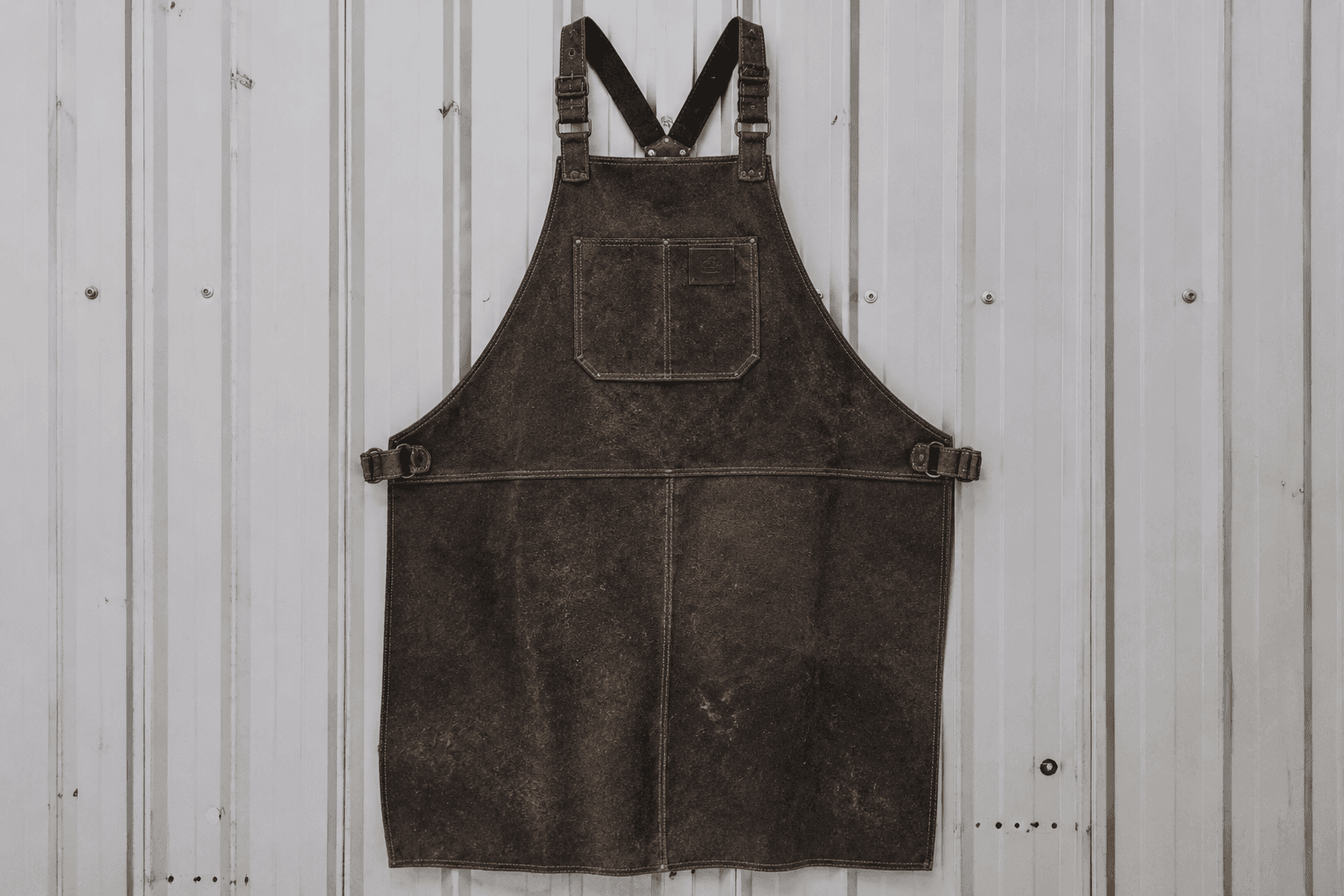
- Cross-back straps reduce neck pressure on a heavy duty leather apron, especially when the apron exceeds 850 g per piece.
- Rivets, bar tacks and reinforced corners matter as much as leather thickness because failure often starts at strap points and pocket edges.
- Bulk lead time is usually 30-45 days after PP sample approval for 500-3,000 pieces, depending on leather sourcing and branding.
What a blacksmith apron needs to protect against
A blacksmith apron is exposed to different hazards than a cooking, barber or light workshop apron. The product must handle hot scale, short spark contact, grinding dust, charcoal stains, edge abrasion from tools and pressure from bending near an anvil or workbench. It does not replace certified welding PPE unless it is designed, tested and sold under that category, but it should still be specified as a protective work apron rather than a fashion item.
The biggest sourcing mistake is treating a metalwork apron as a standard leather apron with darker color and more rivets. Standard 0.8-1.0 mm fashion leather can look attractive in a showroom but may curl, crack or burn through faster under forge use. Conversely, a very thick 2.2-2.5 mm leather forge apron can be durable but too heavy for daily wear, especially for smaller users or long training sessions. The practical balance is usually found between protection, flexibility and finished piece weight.
For most OEM orders, a finished apron weight between 750 g and 1,250 g is commercially acceptable. Below 650 g, buyers should check whether the leather is too thin or the coverage is too limited. Above 1,400 g, the strap design, waist support and user fatigue become important concerns. A bulk blacksmith apron should protect the torso and upper legs while allowing the user to squat, lean forward and move around tools.
- The apron should cover from upper chest to mid-thigh or lower thigh, commonly 70-90 cm body length depending on size.
- The chest panel should not be too narrow, with 25-32 cm width at the upper bib being common for adult sizing.
- The lower skirt should allow movement, with 55-70 cm width used for many one-size workshop aprons.
- The specification should identify whether the apron is for forging, grinding, welding-adjacent work, woodworking with spark exposure, or general maker use.
Leather choices for a blacksmith apron: split, top-grain and full-grain
Leather grade has the strongest effect on the cost, appearance and performance of a heavy duty leather apron. In China OEM production, the most common options are split cowhide, top-grain cowhide and full-grain cowhide. Buffalo leather and pigskin are also available, but cowhide is the most stable choice for export orders because the supply chain is broad and thickness control is easier.
Split cowhide is often used for a spark resistant apron because it gives good thickness at a controlled price. It has a suede-like surface, handles sparks reasonably well, and does not show scars as clearly as full-grain leather. Typical bulk thickness is 1.2-1.6 mm. At 1.2 mm, the apron is lighter and easier to sew. At 1.6 mm, it feels more protective but increases cutting waste, sewing needle wear and shipping weight. For a 3,000-piece order, this thickness difference can influence both unit cost and production schedule.
Top-grain and full-grain cowhide are chosen when the buyer wants a premium retail product. The surface looks cleaner, can be waxed or oiled, and supports debossed branding well. However, these leathers show natural grain variation, wrinkles and scars. That is not a defect if agreed in the standard, but it must be explained to the brand and retail team. If a buyer expects every leather forge apron to have identical smooth color, full-grain leather may create avoidable inspection disputes.
- Split cowhide, 1.2-1.6 mm: practical for forge and metalwork use, moderate cost, stable bulk supply, matte surface.
- Top-grain cowhide, 1.1-1.5 mm: better surface appearance, suitable for premium workshop retail, higher cost than split.
- Full-grain cowhide, 1.3-1.8 mm: strongest premium positioning, more natural variation, usually lower cutting yield.
- Chrome-tanned leather: common, flexible and cost-effective, but buyers should confirm chemical compliance requirements.
- Vegetable-tanned leather: attractive and firm, but usually higher cost, longer procurement time and more color variation.
Heft, GSM equivalents and finished apron weight
Textile buyers often think in GSM, but leather is normally specified by thickness in millimeters or ounces. For leather aprons, both methods can be useful. A 1.2 mm cowhide is roughly comparable to 3 oz leather, while 1.6 mm is around 4 oz. The exact weight depends on moisture, tanning method and finish. In bulk sourcing, it is better to approve a thickness range and a finished piece weight range instead of relying on one number.
A blacksmith apron with a 78 cm body length, 60 cm lower width, 1.4 mm split cowhide and cross-back straps often lands around 850-1,050 g per piece. Adding large pockets, double-layer chest reinforcement, leather waist pads or brass hardware can push this to 1,200 g or above. That may be acceptable for professional users, but it changes carton loading and shipping cost. A 1,000-piece order at 1.2 kg per piece means the product weight alone is 1.2 metric tons before cartons and pallets.
Heft also affects sewing. Many apron factories can sew canvas, denim and lightweight leather, but not every line is set up for 1.8 mm leather plus folded seams. For heavier specifications, the supplier needs walking-foot machines, appropriate needles, stronger thread and skilled operators. If the apron uses double-layer reinforcement at stress points, the machine may be sewing through 3.0-4.0 mm total thickness at corners. This should be checked during sampling, not discovered during mass production.
- A light-duty leather workshop apron is commonly 550-750 g per piece.
- A practical blacksmith or metalwork apron is commonly 750-1,250 g per piece.
- A very heavy leather forge apron can exceed 1,400 g and should use cross-back or harness-style straps.
- For bulk specifications, request leather thickness tolerance such as 1.3-1.5 mm rather than a single fixed value.
- For inspection, set a finished weight tolerance such as approved sample weight plus or minus 8-12 percent.
Spark resistance is about material, surface and construction
A spark resistant apron is not made spark resistant by thickness alone. The leather surface, finish chemicals, seams, thread and pocket placement all matter. Split leather has a fibrous surface that can absorb dirt but often tolerates short spark contact well. Smooth leather can shed debris more easily, but oily finishes may darken or mark when exposed to heat. Before confirming the order, the buyer should define whether the apron must resist light forge sparks, grinding sparks, welding spatter, or only incidental workshop contact.
Thread is a common weak point. Standard polyester thread is acceptable for many general leather aprons, but if the apron is promoted for forge or metalwork use, the buyer may request stronger bonded nylon, aramid thread, or protected stitch placement. Aramid thread increases cost and may require special procurement, but it improves heat tolerance at seams. Many commercial metalwork apron orders use bonded nylon thread with reinforced stitch lines because it balances cost and strength. For higher-risk use, the specification should move beyond a marketing claim and include test expectations.
Pockets also require attention. Tool pockets are convenient, but open lower pockets can catch hot particles. Chest pockets are useful for pencils, soapstone or small tools, but they should not create thick, stiff areas that make the apron uncomfortable when bending. If the apron is intended for blacksmithing, pocket openings should be considered carefully. Some professional buyers prefer fewer pockets, covered pockets, or side tool loops instead of deep front pouches.
- Avoid plastic buckles in high spark zones; use metal buckles, D-rings or leather tie systems where exposure is likely.
- Keep synthetic webbing away from the front body unless it is protected or positioned behind the apron.
- Use rivets at strap anchors and pocket corners, but confirm the back side is smooth enough not to irritate clothing.
- Specify thread type and color, especially if the product copy uses terms such as forge, welding or spark resistant.
- Confirm whether the apron requires lab testing, in-house spark exposure checks, or only visual and construction inspection.
Pattern design, coverage and ergonomics for metalwork apron sourcing
Pattern design decides whether the apron will be worn after the first week. A metalwork apron that protects well but pulls on the neck or restricts movement will generate returns, even if the leather is correct. For heavy aprons, cross-back straps are usually better than a simple neck loop. A neck loop is cheaper and faster to sew, but it places the apron weight on the neck. Once finished weight passes about 850 g, many users notice the difference.
A cross-back system normally uses leather straps, cotton webbing, polyester webbing or mixed materials. For forge use, leather straps are the safest-looking and most consistent with the product category. Cotton webbing is softer and lower cost, but it may absorb dirt and moisture. Polyester webbing is strong and stable, but buyers should consider heat exposure and brand positioning. If the front body is leather and the back straps are synthetic, this should be a deliberate specification choice, not a factory substitution.
Sizing is another practical issue. Many brands request one-size-fits-most, but the fit range needs definition. For adult export orders, body length may run 76-86 cm, lower width 58-68 cm, and strap adjustability should cover a wide chest and waist range. If the product is for professional blacksmith schools, makerspaces or rental use, adjustability and repairability matter more than a tight fashion fit. If the product is for retail gifting, symmetry, clean edges and premium packaging may receive more attention.
- A neck-loop design is lower cost and acceptable for lighter aprons under about 750-850 g.
- A cross-back design improves weight distribution and is recommended for heavy duty leather apron programs.
- A waist tie length of 85-110 cm per side is common, depending on target users and whether front tying is expected.
- Split-leg or center-slit patterns can improve mobility but add sewing time and require reinforced slit ends.
- Detachable straps improve packing and replacement options but add hardware cost and assembly checks.
Branding, hardware and reinforcement details that affect bulk quality
For a leather forge apron, branding usually includes debossing, embossing, laser marking, woven labels, metal logo plates or branded rivets. Debossing is the most common premium choice because it works well on full-grain and top-grain leather. On split leather, debossing can be less sharp, so a leather patch or metal plate may give a cleaner result. Laser marking can look precise, but the result depends heavily on leather color and surface finish. Dark brown and black leather may show subtle contrast only.
Hardware selection should match both use and target price. Antique brass and gunmetal finishes are popular for retail, while nickel-plated steel can be economical. Solid brass is durable and attractive but may be too expensive for large price-sensitive orders. Rivets should be tested for pull strength and corrosion resistance. If the apron is packed in humid conditions or shipped by sea for 30-40 days, poor plating can show oxidation before retail delivery.
Reinforcement should focus on high-stress zones: neck or bib strap anchors, waist strap anchors, pocket corners, lower slit ends and tool-loop attachments. A factory can add rivets, bar tacks, leather backing patches or double stitching. More reinforcement is not always better because every extra layer increases stiffness and sewing difficulty. The correct method depends on the leather thickness and intended use.
- Debossed logo tooling commonly requires 5-7 days after artwork approval and may cost USD 30-120 depending on size.
- Custom metal logo plates often require 12-20 days for tooling and MOQ from 500-1,000 pieces.
- Standard antique brass or gunmetal rivets are normally available faster than custom branded rivets.
- Contrast stitching improves shelf appeal but makes stitch defects more visible during inspection.
- Edge finishing can be raw cut, burnished, painted or folded; raw cut is common for rugged split leather aprons.
MOQ, pricing and lead time for blacksmith apron OEM orders
MOQ depends on leather type, color, branding and packaging. For a standard split cowhide blacksmith apron using available leather and standard hardware, 300-500 pieces can often be practical. For custom leather color, custom hardware, branded metal plates or retail gift packaging, MOQ may move to 1,000 pieces or more. If the buyer needs exact color matching across repeat orders, the tannery MOQ and leather lot control become part of the sourcing plan.
Indicative FOB pricing varies widely, but buyers need a working range when building a program. A basic 1.2-1.4 mm split leather metalwork apron with simple straps may sit around USD 8.50-13.50 per piece at 1,000 pieces, depending on size and leather market. A heavier 1.5-1.8 mm apron with cross-back leather straps, rivets, pockets and debossed logo may run around USD 14.00-24.00 per piece. A premium full-grain apron with custom hardware and retail packaging can move above USD 28.00 per piece. These are planning ranges, not final quotes, because leather yield and hardware details can change the calculation quickly.
Lead time should include sampling, material procurement, cutting, sewing, finishing, inspection and packing. A normal development path is 5-10 days for first sample if leather is in stock, 3-7 days for revised sample, and 30-45 days for bulk production after PP sample approval and deposit. If custom dyed leather is required, add 15-25 days. If branded hardware is required, the hardware schedule may become the critical path. For seasonal retail launches, the buyer should confirm all components before approving the final price.
- A practical MOQ for available split leather and standard hardware is often 300-500 pieces.
- A practical MOQ for custom leather color or custom metal branding is often 1,000 pieces or higher.
- First sample cost may range from USD 50-150 depending on leather, tooling and complexity.
- Bulk production after PP approval is commonly 30-45 days for 500-3,000 pieces.
- Sea freight transit to the US or Europe may add around 25-40 days, excluding customs and inland delivery.
Quality control standards before shipment
Quality control for a heavy duty leather apron should be more detailed than checking color and logo position. Leather is a natural material, so the approved standard must define acceptable scars, wrinkles, grain variation, shade variation and surface marks. Without this agreement, the buyer may expect fabric-like consistency while the factory grades according to normal leather practice. The inspection checklist should use the approved sample, signed color swatch and production specification sheet as the reference.
Dimensional tolerance should be realistic. Leather cutting and sewing can vary more than woven fabric, especially with thick hides. For body length and width, plus or minus 1.0-1.5 cm is common. Strap length may allow plus or minus 2.0 cm depending on design. Stitching should be straight enough for retail presentation, but the buyer should specify whether minor needle marks or natural edge irregularity are acceptable. Pull testing on straps and pockets is useful for products sold to professional users.
Packing also matters because leather can be damaged by moisture, compression and color transfer. Aprons are often folded, placed in polybags or kraft sleeves, then packed 10-20 pieces per export carton depending on weight. A carton of heavy leather forge aprons can reach 18-25 kg quickly, so carton strength and local handling limits should be checked. For premium leather, tissue paper or protective interleaving may reduce surface marks, but it adds cost and packing time.
- Check leather thickness against the approved range at multiple points, not only one sample corner.
- Inspect strap anchor points with pull checks or reinforced visual criteria.
- Confirm rivets are tight, aligned and free from sharp backs.
- Check pocket openings, tool loops and slit ends for reinforced stitching or rivets as specified.
- Verify carton weight, folding method and moisture control before shipment release.