For a buyer sourcing a bbq apron, the main challenge is not simply making the apron look rugged. The product must handle heat exposure, grease, smoke, repeated washing, tool weight, and brand decoration without becoming too stiff, too expensive, or uncomfortable for long wear. A good grilling apron is a controlled balance of fabric, construction, pocket layout, and decoration method.
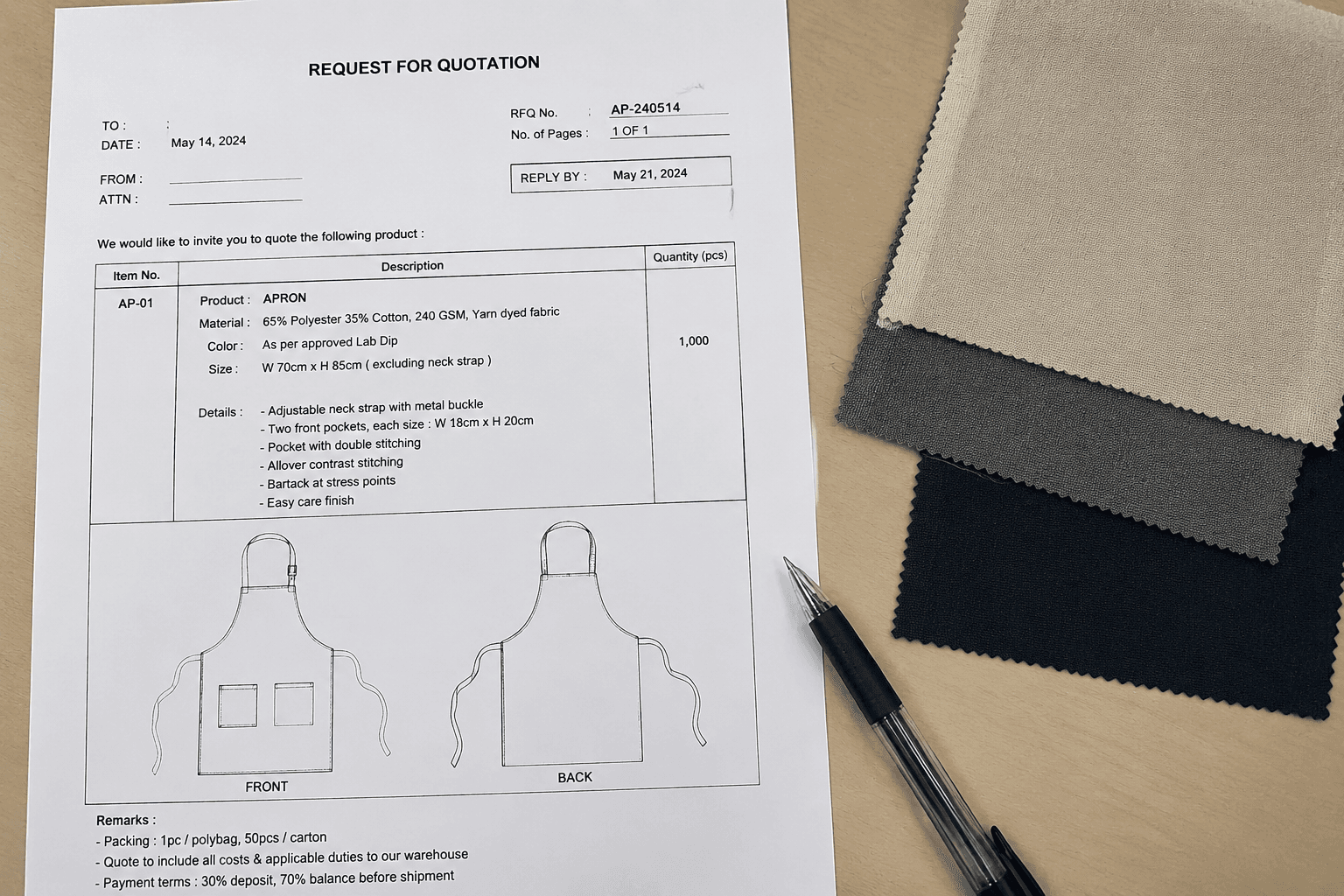
From the factory side, most problems appear when the specification is written too generally: “heavy canvas apron,” “leather-look straps,” “large pockets,” or “heat resistant.” These terms are useful for design direction, but they do not define GSM, yarn count, coating, pocket reinforcement, buckle material, wash performance, or carton packing. For bulk orders, those details decide whether the apron lands at US$3.80/pc or US$9.50/pc, and whether the delivery runs smoothly or gets stuck during sample approval.
This article explains how professional buyers can specify a bbq apron or grilling apron for retail, hospitality, promotional, private label, and outdoor cooking brands. The focus is on practical sourcing decisions: fabric heft, heat tolerance, pocket engineering, branding, MOQ, lead time, and inspection criteria.
- Fabric weight should match the use case, with 240-280 GSM for promotional grilling aprons, 300-360 GSM for retail canvas programs, and 380-450 GSM for heavy duty bbq apron styles.
- Heat resistance is not the same as fire resistance, and most cotton or canvas bbq aprons protect against brief contact, grease, and sparks rather than open flame.
- Pocket layout should be tested with real grilling tools, because oversized pockets can sag, pull the apron forward, or interfere with movement.
- Decoration method affects both appearance and cost, with screen print often suitable for volume orders and embroidery or leather patches better for premium positioning.
- Bulk lead time depends on fabric readiness, with stock-color cotton canvas often shipping in 25-35 days and custom-dyed heavy canvas usually needing 45-60 days.
- A custom bbq apron supplier should confirm shrinkage, colorfastness, pocket load, metal trim quality, and needle detection requirements before production starts.
What makes a bbq apron different from a standard kitchen apron
A kitchen apron used in cafes or bakeries is usually designed around stain protection, light tool carrying, and brand presentation. A bbq apron must work in a rougher environment. It may be exposed to charcoal dust, oil splatter, smoke, sauce, beer, outdoor humidity, and metal tools. Buyers often ask for a stronger handfeel because end users associate grilling with durability. However, “stronger” should be defined in measurable terms: fabric GSM, weave density, reinforcement, strap width, and seam construction.
For bulk sourcing, the first specification question is whether the apron is mainly for brand promotion, retail sale, restaurant use, or premium outdoor cooking. A promotional bbq apron for a sauce brand may use 240 GSM cotton twill and a one-color screen print to reach a US$2.20-3.20/pc FOB range at 3,000-5,000 pcs. A retail heavy duty bbq apron may use 400 GSM dyed canvas, antique brass hardware, multiple reinforced pockets, and a branded patch, moving the FOB range to US$6.50-10.50/pc depending on fabric, trims, and packaging.
The difference is not only cost. Heavy fabric affects carton weight, shipping volume, sewing speed, needle wear, washing shrinkage, and decoration result. A sourcing manager should avoid copying a fashion apron specification without checking whether the garment will remain practical when worn near a grill for one to three hours.
- A bbq apron usually needs stronger fabric than a cafe apron, but the weight should still allow bending and sitting.
- A grilling apron often carries long tools, towels, thermometers, gloves, and bottles, so pocket placement needs load testing.
- A heavy duty bbq apron may require bartack reinforcement at stress points, especially pocket corners and strap joints.
- A mens grilling apron often needs longer body length, wider chest coverage, and adjustable neck or cross-back straps.
Choosing fabric weight and handfeel for a bbq apron
Fabric is the largest driver of cost, appearance, and end-user satisfaction. For bbq apron programs, the common fabric choices are cotton twill, cotton canvas, poly-cotton twill, denim, waxed canvas, and sometimes split leather or PU leather panels. Each has a different sourcing profile. Cotton absorbs dye well and gives a natural look, but it shrinks and wrinkles more. Polyester blends control shrinkage and dry faster, but they can feel less premium and may be less suitable near heat if the buyer implies flame resistance.
For ordinary grilling aprons, 240-280 GSM cotton twill is a practical entry point. It is lighter, easier to print, comfortable in warm weather, and cost efficient. For mid-range retail aprons, 300-360 GSM cotton canvas gives better structure and a more substantial handfeel. For heavy duty bbq apron styles, 380-450 GSM canvas is common, but buyers should request a wearing sample before confirming production. Above 450 GSM, the apron can become stiff, hot, and expensive to sew, especially with multiple folded layers at pockets and hems.
Fabric weight is not the only measure of durability. A tightly woven 320 GSM canvas can perform better than a loose 380 GSM canvas. Buyers should ask the supplier for yarn count, weave type, shrinkage data, and colorfastness. For washed canvas effects, the factory should confirm whether the wash is garment wash, enzyme wash, or stone wash style, because each affects dimension tolerance and shade consistency.
- 240-280 GSM cotton twill is suitable for promotional bbq apron orders, event kits, and lighter retail price points.
- 300-360 GSM cotton canvas is a balanced option for private label grilling apron programs with screen print or embroidery.
- 380-450 GSM canvas supports a heavy duty bbq apron look, but requires stronger needles, slower sewing, and careful carton planning.
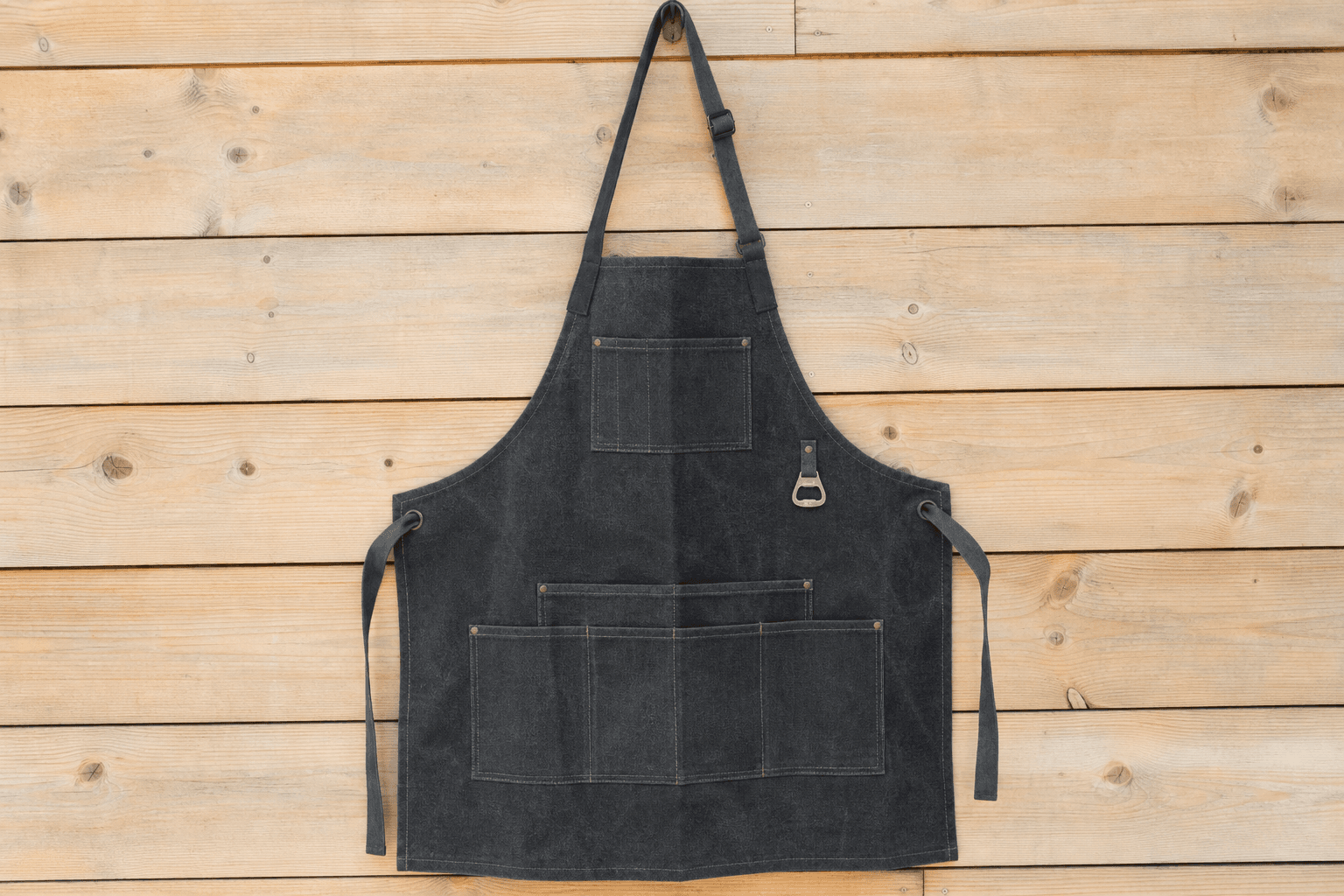
- 10 oz denim can work for western or workshop-inspired styles, but indigo crocking must be checked before bulk approval.
- Waxed canvas improves water resistance and rugged appearance, but it increases fabric cost and may restrict decoration options.
Heat exposure, coatings and realistic performance claims
Many buyers use the phrase “heat resistant” when sourcing a grilling apron. From a manufacturing and compliance viewpoint, that phrase needs caution. A normal cotton or canvas bbq apron can reduce contact with sparks, splatter, and warm tools, but it should not be described as fireproof unless the material has certified flame-retardant treatment and the finished product is tested to the relevant market standard. For most consumer grilling products, buyers are actually asking for heavy fabric, good coverage, and protection from grease and brief contact.
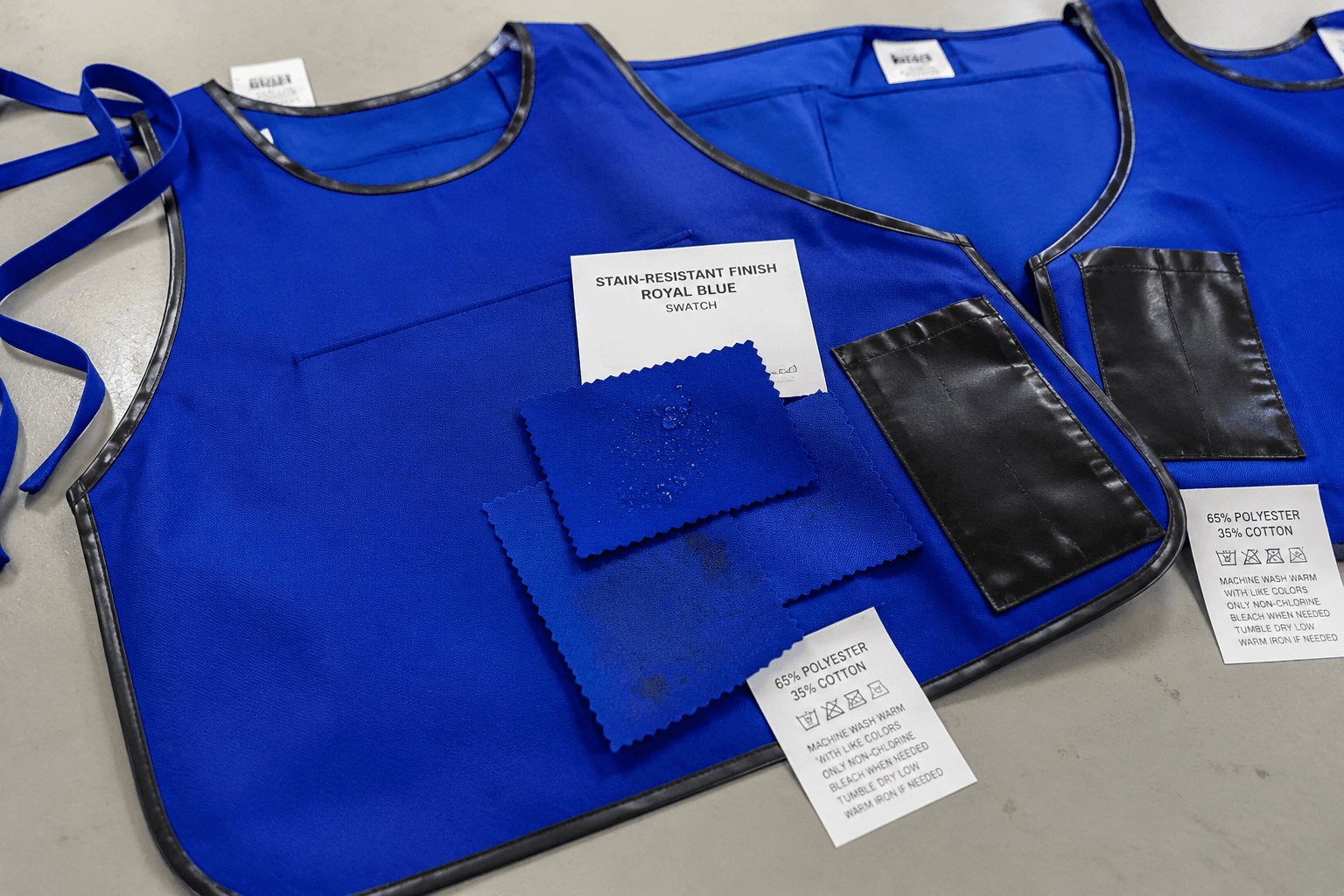
Coatings can improve certain functions but create trade-offs. Waxed canvas gives water repellency and a premium outdoor look, yet it may show crease marks and cannot always be machine washed. PU coating on the back side can reduce liquid penetration, but it may reduce breathability and change the drape. Flame-retardant finishing can be applied to cotton, but it adds cost, may affect handfeel, and often requires test reports and controlled washing instructions. A factory should not promise flame resistance based only on fabric thickness.
If the buyer sells into professional food service or hardware retail chains, wording on packaging and product pages should be reviewed carefully. Claims such as “protects from open flame,” “fireproof,” or “extreme heat resistant” can create liability. More realistic wording is “heavy cotton canvas for grilling use,” “helps protect clothing from grease and splatter,” or “reinforced apron for outdoor cooking and barbecue preparation.”
- Cotton canvas can char if exposed to direct flame, even at high GSM.
- Polyester-rich blends should not be positioned as high-heat protective gear.
- Waxed canvas is better described as water repellent, not flame resistant.
- Flame-retardant treatment requires confirmed test standards, washing limits, and documentation.
- Product claims should match the tested material, not only the visual style of the apron.
Pocket engineering for grilling tools and outdoor cooking use
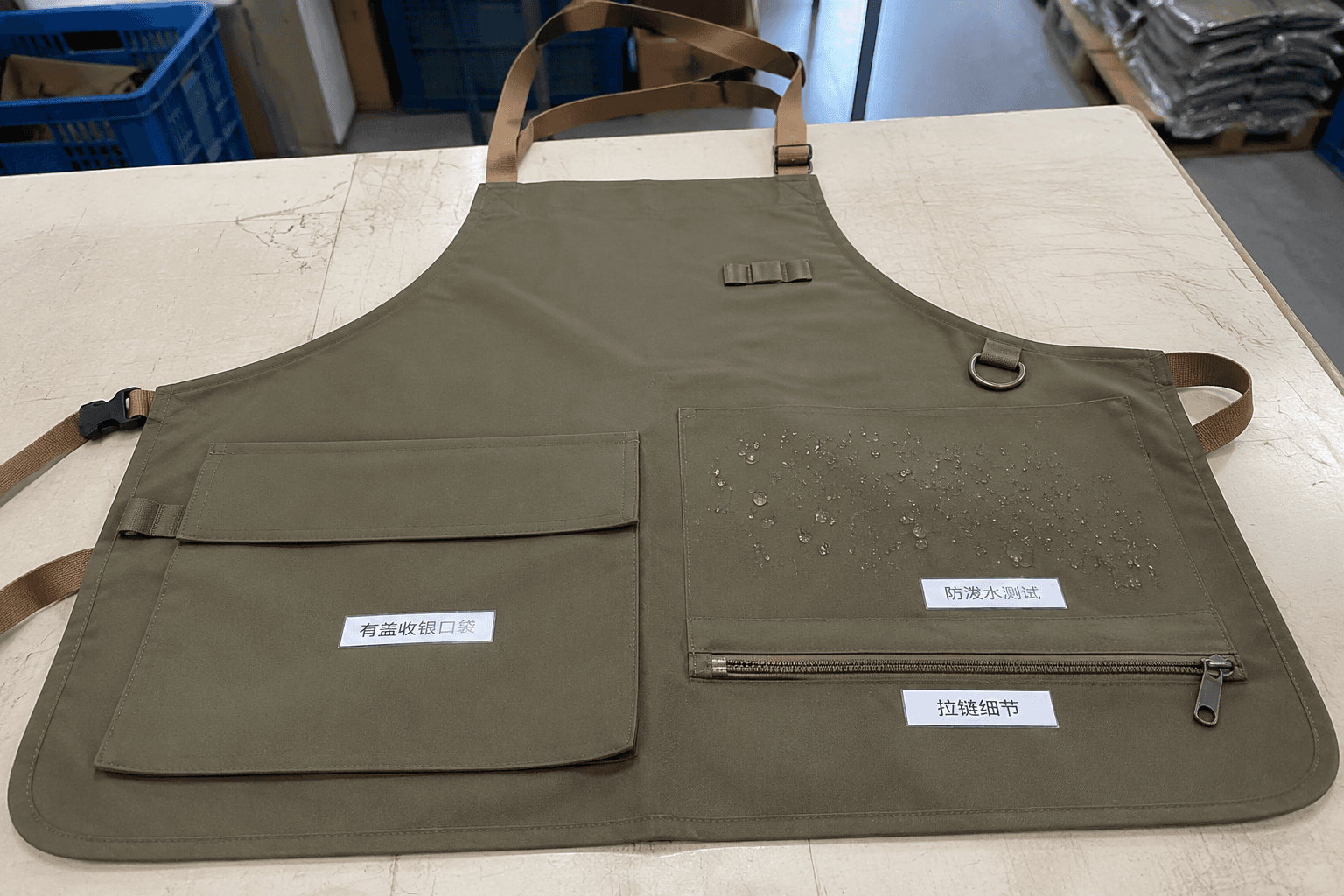
Pockets are one of the most important design elements on a bbq apron, but they are also a common source of sampling delays. Buyers often request many pockets: large front pouch, phone pocket, thermometer pocket, towel loop, bottle opener loop, pen slot, and side pocket. The factory can sew these features, but the apron must still hang correctly on the body. If too much weight sits below the waist, the bib pulls forward and the neck strap becomes uncomfortable.
A practical grilling apron pocket layout starts with the actual tools. A spatula can be 35-45 cm long. Tongs may be 30-40 cm. A digital thermometer pocket needs a narrow opening and enough depth to stop the tool from falling out. A towel loop should be placed where the user can reach it without crossing the body. For retail aprons, mock-up testing with tool weights of 300-800 g is more useful than judging a flat sample on a table.
Pocket construction should be stronger than the main seam. Pocket corners need bartacks or triangle reinforcement. For a heavy duty bbq apron, pocket opening edges should use double fold or binding, because raw stress points will fray after repeated tool insertion. When using contrast stitching, buyers should confirm thread thickness and colorfastness. A thick beige thread on black canvas looks premium, but poor dye quality can cause visible rubbing or shade change after washing.
- Large lower pouch pockets should be divided, otherwise tools slide to one side and distort the apron.
- A phone pocket should sit high enough to avoid bending pressure when the wearer sits.
- Thermometer and pen slots should be narrow, usually 2.5-3.5 cm wide depending on the tool.
- Towel loops are usually more reliable in fabric tape or webbing than in thin PU leather.
- Bottle opener loops need bartack reinforcement and should be tested with pulling force before approval.
- Pocket corners should be bartacked with 28-42 stitches depending on fabric weight and machine setting.
Sizing, strap systems and mens grilling apron fit
Many bbq apron orders are positioned as a mens grilling apron, but the factory still needs a clear size specification. A common adult bib apron size is 70 x 80 cm or 72 x 86 cm. For stronger coverage, especially for outdoor cooking and barbecue gift sets, 75 x 90 cm is common. Taller Western markets may request 80 x 95 cm, but fabric consumption increases quickly. A 5 cm increase in width and 10 cm increase in length can raise fabric usage by 10-15%, depending on marker efficiency.
Neck straps are simple and low cost, but heavy aprons can create pressure on the neck. Cross-back straps distribute weight better and are preferred for premium heavy duty bbq apron designs. However, cross-back straps add material, hardware, assembly time, and packaging complexity. A basic neck-strap apron may need 1.4-1.8 meters of tape, while a cross-back system can require 2.8-3.6 meters depending on size and adjustability.
Strap material also changes the product feel. Cotton webbing is soft and natural, polyester webbing is strong and color stable, and leather or split leather straps create a premium look but increase cost and require more careful packing. PU leather is cheaper, but low-grade PU may crack after folding or washing. For export orders, buyers should confirm whether leather trims need REACH, California Proposition 65, or azo-free compliance depending on destination market.
- 70 x 80 cm is suitable for standard adult promotional and hospitality bbq apron programs.
- 75 x 90 cm gives better coverage for retail grilling apron styles in North America and Europe.
- Cross-back straps are recommended when finished apron weight exceeds roughly 450-550 g.
- Metal adjusters should be tested for rust resistance, edge smoothness, and plating consistency.
- Removable leather straps reduce washing issues but add snaps, rivets, and assembly cost.
Decoration options for a custom bbq apron supplier
Branding is where many custom apron programs become more expensive than expected. A bbq apron usually uses larger logos, bold typography, outdoor cooking graphics, or private label patches. The right decoration method depends on fabric surface, order quantity, color count, and target retail price. A custom bbq apron supplier should advise early because decoration affects cutting sequence, sewing order, and reject risk.
Screen printing is cost efficient for medium and large runs. On 300 GSM cotton canvas, a one-color chest print or lower-pocket print can be stable and sharp. For 1,000 pcs, a simple one-color print may add US$0.20-0.45/pc depending on size and ink type. Multi-color printing adds screen charges and alignment risk. Heat transfer can give fine detail, but heavy canvas texture may reduce adhesion if pressure and temperature are not controlled. Embroidery gives a premium look, but dense embroidery on thick canvas can pucker unless backing, stitch count, and tension are managed.
Leather patches, woven labels, and metal rivets are common on heavy duty bbq apron styles. A small PU patch may add US$0.15-0.35/pc. Genuine leather can add US$0.50-1.20/pc or more depending on thickness and origin. Rivets and antique brass hardware look strong, but they must be set cleanly to avoid sharp backs. For food service buyers, decoration should also be checked for wash durability, because a beautiful patch that fails after five washes creates customer complaints.
- Screen print is usually the best cost choice for 1,000-10,000 pcs and simple artwork.
- Embroidery is suitable for premium logos, but stitch count should be confirmed before price approval.
- Woven labels are stable, low cost, and useful for private label programs with multiple colorways.
- Leather patches improve perceived value but require compliance and wash-care review.
- Heat transfer can reproduce detailed artwork, but adhesion testing is necessary on rough canvas.
MOQ, costing and lead time for bbq apron bulk orders
A realistic sourcing plan should separate fabric MOQ, trim MOQ, decoration MOQ, and final apron MOQ. For stock fabric colors, many factories can accept 500-1,000 pcs per style, especially for cotton twill or common canvas colors such as black, natural, khaki, navy, olive, or dark grey. For custom-dyed canvas, fabric mills may require 800-1,500 meters per color. Depending on apron size and fabric width, that can mean roughly 1,200-2,500 pcs per color before dyeing becomes efficient.
Costing depends heavily on fabric weight and construction. As a general FOB China reference, a simple 240 GSM cotton promotional bbq apron may be US$2.20-3.50/pc at 3,000 pcs. A 320 GSM canvas grilling apron with adjustable neck strap, two pockets, and one-color print may be US$3.80-5.80/pc. A 400 GSM heavy duty bbq apron with cross-back straps, metal hardware, reinforced pockets, and patch branding may be US$6.50-10.50/pc. Waxed canvas, genuine leather trims, gift box packaging, and low-volume colorways can push the price higher.
Lead time is usually 7-10 days for initial sample making if fabric and trims are available, plus 3-5 days for buyer review and courier transit. Pre-production sample approval may take another 5-7 days. Bulk production for stock fabric programs is commonly 25-35 days after deposit and sample approval. Custom-dyed fabric programs often need 45-60 days because greige fabric booking, dyeing, finishing, testing, cutting, sewing, inspection, and packing must all be scheduled.
- 500-1,000 pcs can be workable for stock fabric and simple decoration, depending on factory schedule.
- 1,500-3,000 pcs is a more efficient MOQ for custom color canvas and multiple trims.
- Sample lead time is commonly 7-10 days when materials are available.
- Bulk lead time is usually 25-35 days for stock fabric and 45-60 days for custom-dyed heavy canvas.
- Gift box or retail header card packaging can add 5-10 days if printing approval is slow.
Quality control points before shipping a bbq apron order
For bbq apron inspection, the factory and buyer should agree on measurable checkpoints before production. The inspection should not only check general appearance. It should confirm finished dimensions, fabric weight, shade consistency, seam strength, pocket position, strap length, hardware function, decoration placement, and packing. Dimension tolerance is commonly plus or minus 1 cm for key body measurements, but washed or heavy canvas styles may need a slightly wider tolerance if agreed in advance.
Shrinkage is especially important. Cotton canvas can shrink 3-5% after washing if not pre-shrunk or properly finished. If the buyer expects home laundering, the care label must match the tested result. For black, navy, and dark olive aprons, rubbing colorfastness should be checked because straps and pocket edges contact light clothing. For denim grilling aprons, dry and wet crocking are critical. A sample that looks excellent in photos can still fail if it transfers color onto a white shirt.
Final packing also deserves attention. Heavy duty bbq apron styles with metal trims can damage each other if packed too tightly. Leather or PU straps can crease if folded sharply. For e-commerce programs, each apron may need individual polybag packing with suffocation warning, barcode sticker, desiccant if required, and carton drop-test consideration. For wholesale hospitality programs, bulk packing may be acceptable, but carton weight should usually stay below 18-22 kg for safer handling.
- Check finished width, length, pocket size, strap length, and logo placement against the approved sample.
- Verify GSM and fabric composition from the bulk fabric report or internal fabric inspection.
- Test pocket load with representative grilling tools before final approval.
- Inspect bartacks at pocket corners, strap joints, towel loops, and bottle opener loops.
- Check metal hardware for rust, burrs, plating shade, and secure attachment.
- Review wash care, shrinkage, and rubbing colorfastness before applying retail labels.