For bakery chains, patisserie groups, hotel pastry departments, and retail bread brands, an apron is not only a uniform item. It is a daily production tool that touches flour, dough, butter, chocolate, steam, and repeated laundering. When buyers source a bakery apron in bulk, the practical questions are usually fabric hand feel, flour release, shrinkage, strap comfort, and whether the apron still looks acceptable after 50 to 80 wash cycles.
From the factory side, the main trade-off is simple: the apron must be dense enough to block flour and light dough residue, but not so stiff that bakers feel heat and shoulder pressure during a 9 to 12 hour shift. A pastry chef apron also needs a cleaner front appearance than a general kitchen apron, because many pastry teams move between prep, finishing, display counters, and customer-facing areas.
This article explains how we specify flour-resistant fabrics, fit dimensions, pocket layouts, and bulk production details for bakery apron programs. The numbers below reflect common OEM ranges used by China apron factories, not luxury one-off tailoring.
- 220-280 GSM twill is the most common starting range for a durable bakery apron with acceptable flour release.
- A flour resistant apron usually depends on yarn density, surface finish, and laundering behavior more than a heavy chemical coating.
- Cross-back straps reduce neck pressure for bakers who wear aprons through long mixing and oven-loading shifts.
- Dark colors hide chocolate and fruit stains, while white and natural colors show bakery cleanliness but need stricter washing control.
- For OEM bulk orders, realistic development time is usually 7-12 days for sampling and 25-40 days for production after approval.
- Pocket design should be limited and low-profile because flour accumulation inside deep pockets is a real hygiene and appearance issue.
What Makes a Bakery Apron Different from a General Kitchen Apron
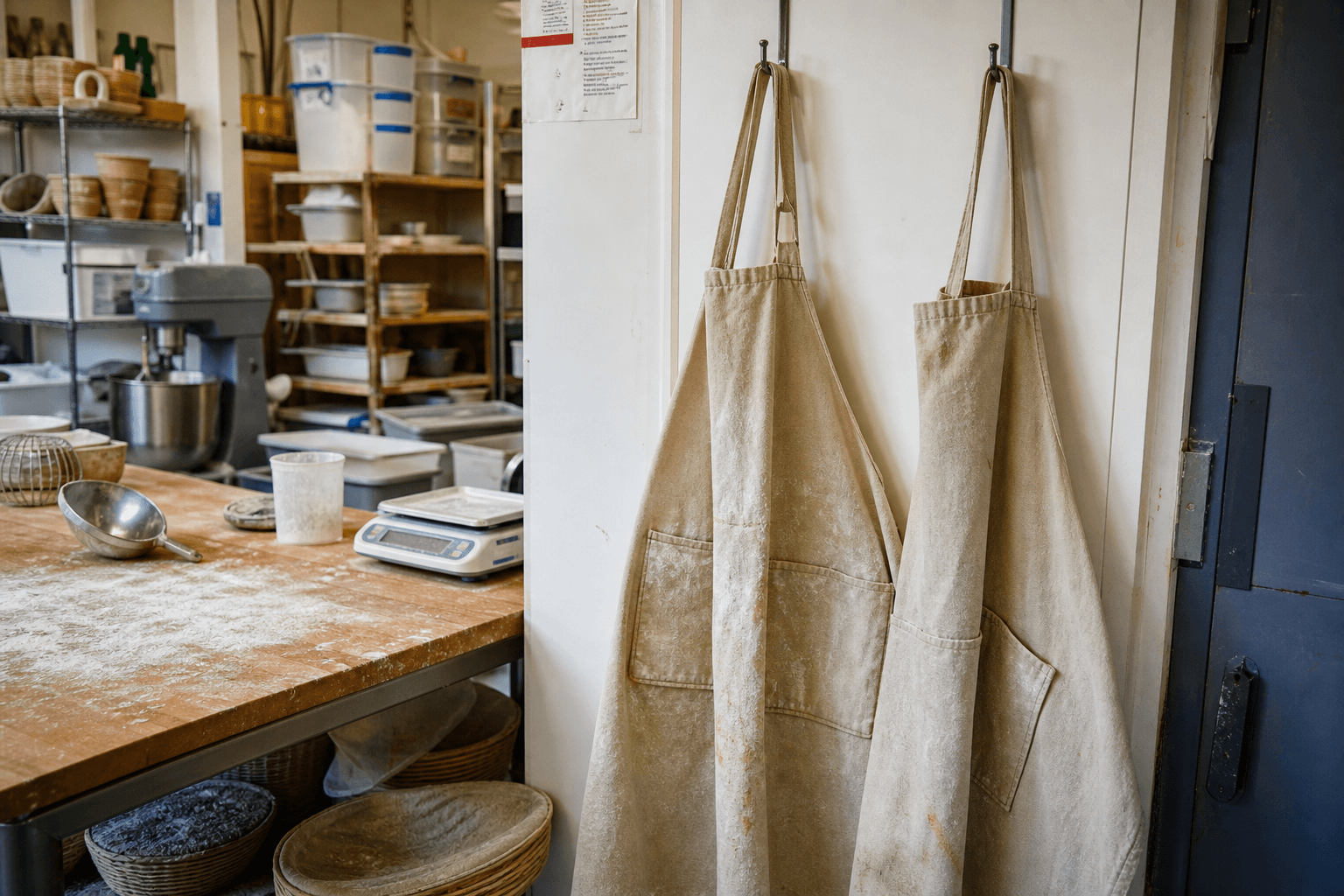
A bakery apron is exposed to dry particulate contamination more than oil splash. Flour behaves differently from sauce, grease, or stock. It sits on the surface, enters loose weave gaps, and becomes paste when combined with water. If the fabric is too open, flour embeds into the yarn structure and the apron looks permanently dusty after only a few washes. If the fabric is too heavy, the wearer overheats near ovens and proofing rooms.
For a baker apron, we normally evaluate three points before price: fabric surface, coverage, and strap load. A dense 3/1 twill at 240 GSM may perform better than a loose 300 GSM canvas because flour brushes off more easily. A bib that is too narrow may look neat in a catalog photo but leaves flour marks on the side body during scaling and bench work. A neck strap that is acceptable for a 2 hour service shift may become uncomfortable during a 10 hour bakery production day.
The user profile is also different. Pastry chefs often need a cleaner, more refined silhouette because they may plate desserts, finish cakes, or work near a retail counter. Bread bakers need stronger coverage around the waist and thigh area due to bench flour and dough handling. For one mixed bakery team, a shared pattern can work, but the fabric and strap system should be selected around the heaviest-use position.
- A bakery production apron should cover from upper chest to at least mid-thigh, typically 80-90 cm body length for adult sizes.
- A patisserie apron should maintain a smooth front panel because visible wrinkles and flour shadows affect presentation.
- A flour resistant apron should allow dry brushing before washing, reducing laundry load and improving appearance between shifts.
- A pastry chef apron should avoid bulky hardware at the chest because it can press against counters and worktables.
Fabric Options for a Flour Resistant Apron
Most bakery apron programs start with cotton twill, polyester-cotton twill, canvas, or denim. Each option has a different balance of flour release, comfort, shrinkage, and cost. For bulk sourcing, the question is not which fabric is best in theory, but which fabric gives stable quality at the required MOQ and target cost.
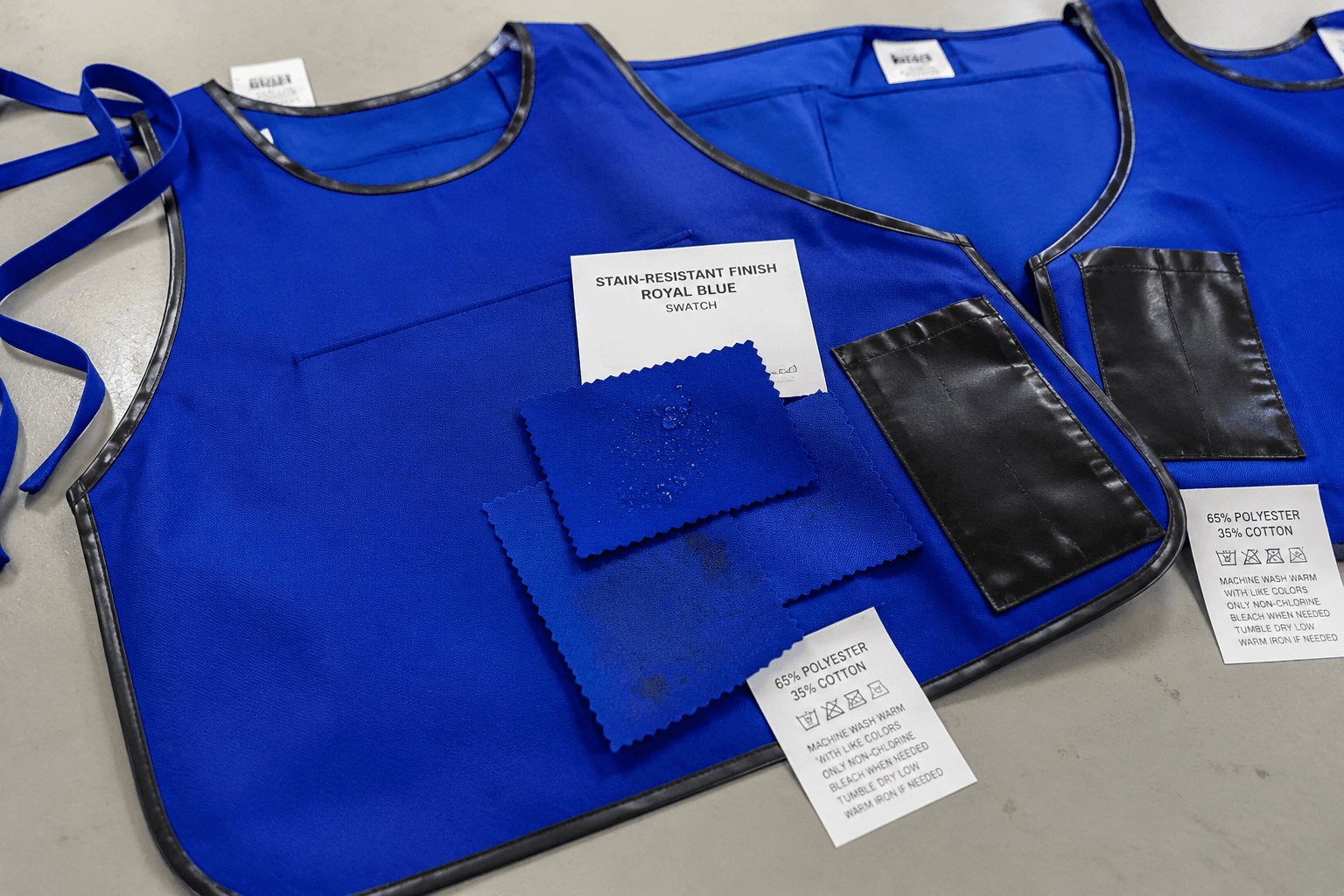
Cotton twill in 220-280 GSM is widely used because it has a natural hand feel and good heat comfort. It absorbs moisture, which is useful in warm bakeries, but it can shrink 3-5% if not properly pre-shrunk or controlled in finishing. Polyester-cotton twill, often 65/35 or 80/20, reduces shrinkage to around 1-3% and usually gives better color consistency. It is also more cost stable, but some buyers find it slightly less breathable than cotton.
Canvas can be useful for rustic bakery concepts, especially in 10 oz to 12 oz weights, but it is not automatically better for flour resistance. A rough canvas surface may hold flour in the texture. Denim, usually 8 oz to 10 oz for aprons, provides strong visual character and good durability, but dark indigo denim needs careful testing for colorfastness, especially if the apron is worn over white bakery jackets.
- 220-240 GSM poly-cotton twill is a practical choice for bakery chains needing stable shrinkage and moderate cost.
- 250-280 GSM cotton twill gives better natural comfort but needs shrinkage allowance in the pattern.
- 10 oz canvas suits heavier baker apron designs but may feel warm near ovens.
- 8-10 oz denim works for front-of-house bakery uniforms but requires color migration checks.
- 180-200 GSM fabric is usually too light for a serious flour resistant apron unless the use is promotional or short shift.
Bakery Apron Fabric Construction: GSM, Weave, and Surface Finish
Buyers often ask for a higher GSM when they want better durability. GSM matters, but weave density and finishing matter just as much. A 260 GSM twill with compact yarns and singed surface can shed flour better than a 300 GSM fabric with a hairy surface. For bakery use, we prefer a smoother face, stable diagonal twill lines, and moderate stiffness after washing.
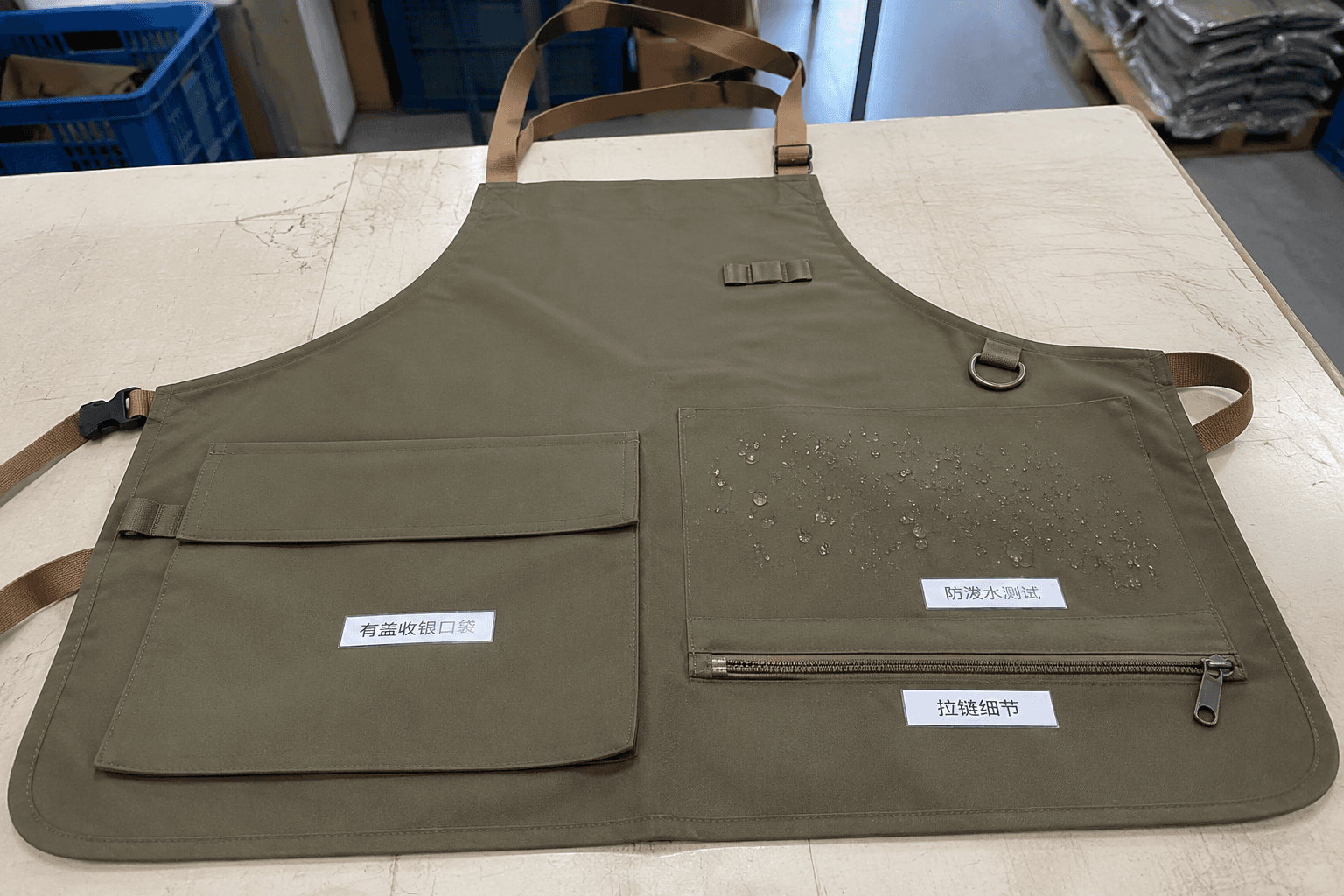
For flour resistance, a light soil-release or easy-clean finish can help, but we do not normally recommend heavy waterproof coating for bakery production aprons. Coatings can reduce breathability, crack after industrial washing, and make the apron feel plastic. In bakeries, flour is not a liquid barrier problem. It is a surface release and wash recovery problem. The fabric should allow flour to be brushed away and should not trap powder deep inside the weave.
Before bulk production, a factory should test fabric after laundering, not only in its new state. We normally check shrinkage, seam puckering, color change, and surface roughness after 5 wash cycles at the buyer's intended washing temperature. For industrial laundry, 60 degrees C washing and tumble drying create more stress than home washing. A fabric that looks excellent before washing may become distorted if the yarn and finishing are not stable.
- For standard bakery apron programs, use 220-280 GSM as the main fabric range before considering heavier options.
- For industrial laundry, request shrinkage testing after 5 washes and set an acceptance target, commonly within 3%.
- For flour release, compare brushed-off appearance after dry flour contact, not only stain testing with liquid soil.
- For coated fabrics, confirm breathability and cracking performance after repeated folding and washing.
- For natural cotton, allow pattern compensation if bulk shrinkage is expected to be above 3%.
Fit and Coverage for Pastry Chef Apron Programs
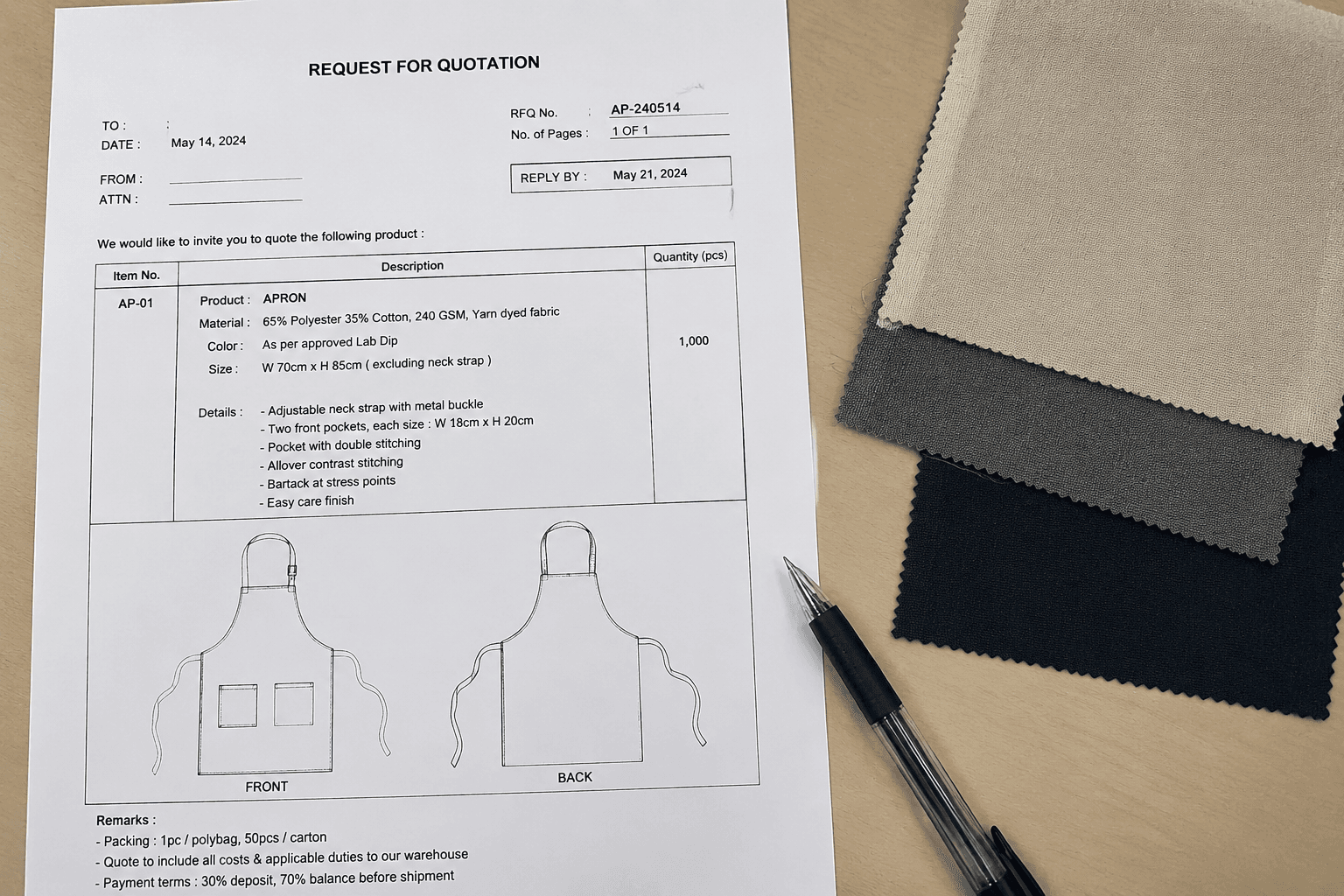
Fit is where many bulk apron projects lose practical value. A pastry chef apron must look clean on different body sizes while allowing reaching, bending, scaling, and tray handling. A common adult bib apron size is 70 cm wide by 85 cm long, but this is only a starting point. For taller bakery teams or Western markets, 72-76 cm width and 88-92 cm length may give better coverage. For Asian retail bakery teams, 68-72 cm width and 80-86 cm length may be enough.
Neck strap systems are important. A fixed neck loop is the cheapest option and works for low-cost programs, but it creates fit problems across different heights. An adjustable metal slider adds cost, usually USD 0.08-0.18 per piece depending on hardware quality and order volume, but improves wearability. Cross-back straps reduce neck pressure and are preferred for full-shift use, although they increase sewing time and fabric or webbing consumption.
Waist ties should be long enough for front tying if the brand wants a neat retail appearance. For standard adult sizing, each tie is often 90-100 cm. For larger markets, 105-115 cm is safer. If ties are too short, staff cannot adjust the apron properly over bakery jackets or winter uniforms. If ties are too long, they hang into work surfaces and collect flour. This is a small specification point, but it strongly affects daily use.
- Standard adult bakery apron size often starts at 70 x 85 cm, then adjusts by market and wearer profile.
- Cross-back straps are recommended for production bakers working full shifts near ovens and benches.
- Adjustable neck hardware is useful for mixed teams but should be rust-resistant and laundry-tested.
- Waist ties of 95-110 cm per side usually cover most bulk uniform needs.
- Bib width should protect the torso without restricting arm movement during kneading, piping, or tray lifting.
Pocket Layouts for Bakery and Patisserie Work
Pocket requests need discipline. Many buyers ask for multiple pockets because it looks functional on a drawing. In bakery use, deep and open pockets collect flour, dough crumbs, chocolate dust, and packaging debris. A large center pocket may be acceptable for front-of-house use, but it is often less suitable for bench production where the wearer leans against tables.
For a baker apron used in production, we usually recommend one low-profile waist pocket or no pocket at all. If a pocket is needed, a divided pocket with shallow depth around 16-18 cm can hold a pen, small thermometer, or order note without becoming a flour bag. For a pastry chef apron, a narrow chest pen pocket can be useful, but it should not be placed where piping bags, trays, or folded arms press against it.
Pocket stitching also affects durability. Stress points need bartacks, especially if staff carry tools. For bulk OEM production, bartacks add minor cost but reduce repair claims. A simple bartack operation may add USD 0.02-0.05 per apron depending on quantity and factory setup. For aprons above USD 3.00 FOB, this is usually worth including.
- Use no pocket or one shallow pocket for heavy flour production areas.
- Use divided waist pockets for retail bakery staff who carry pens, order tickets, or small tools.
- Avoid deep pouch pockets below the waist if staff lean against flour-covered benches.
- Add bartacks at pocket corners when the apron is intended for daily commercial use.
- Keep pocket openings smooth so flour can be shaken or brushed out before laundry.
Color, Branding, and Stain Visibility
Color selection for bakery aprons is not only a branding decision. White, cream, and natural cotton communicate cleanliness and traditional bakery craft, but they show chocolate, jam, butter, and egg wash quickly. Black, charcoal, navy, and dark brown hide some stains, but flour becomes more visible. Mid-tone grey, olive, khaki, and muted blue often give the best compromise for real bakery operations because flour and food marks are less severe visually.
For a flour resistant apron, the buyer should test appearance during actual work, not only under showroom lighting. A dark apron may look premium when new, then show every hand wipe in flour-heavy bread production. A white apron may match a classic patisserie image, then require more frequent replacement if the laundry process cannot remove fruit and chocolate stains. Replacement rate affects total cost more than a USD 0.20 fabric difference.
Branding should be restrained for production aprons. Embroidery looks durable and premium, but on dense twill it adds stiffness and may trap flour around thread edges. Screen printing is lower cost for larger logos, usually economical above 300-500 pieces, but it can crack if the print area is too thick or if industrial washing is harsh. Woven labels are stable and cost-effective, often USD 0.03-0.10 per piece depending on size and quantity, and they work well for apron side seams or pocket edges.
- Choose white or natural only when the buyer has reliable laundry control and accepts visible work marks.
- Choose grey, muted blue, or olive for balanced flour and stain appearance in mixed bakery environments.
- Use embroidery for small logos, ideally below 8-10 cm width on bib or pocket areas.
- Use screen print for larger brand marks, but confirm wash testing before bulk approval.
- Use woven labels when the program needs stable branding with low impact on fabric hand feel.
OEM Cost Drivers and MOQ for a Bakery Apron
Bulk apron pricing depends on fabric width, GSM, dyeing method, strap construction, pocket details, logo method, packaging, and inspection level. For a basic 220 GSM poly-cotton bakery apron with fixed neck loop and one pocket, FOB China pricing may start around USD 1.60-2.30 per piece at 1,000-3,000 pieces, depending on fabric market and specifications. A 260 GSM cotton twill apron with adjustable neck, bartacked pockets, and logo branding may sit around USD 2.60-4.20 per piece. A cross-back canvas or denim patisserie apron can move to USD 4.50-7.50 per piece or higher.
MOQ is strongly linked to fabric availability. If the buyer accepts stock fabric colors, MOQ can sometimes be 300-500 pieces per color for simple apron styles. For custom dyed fabric, 1,000-2,000 pieces per color is more realistic because fabric mills have dye lot minimums. For yarn-dyed stripes, special canvas, or custom finishes, MOQ may reach 2,000-5,000 pieces. Buyers should separate style MOQ from color MOQ when comparing suppliers, because this is where many quotations become unclear.
Lead time also needs to be planned honestly. Lab dip or color approval usually takes 4-7 days. Fit sample takes 5-10 days if fabric is available. Pre-production sample takes 5-7 days after final comments. Bulk production commonly requires 25-40 days after deposit and approval, with longer timing during peak seasons before Christmas, Easter, and major retail bakery campaigns. Sea freight to Europe or North America may add 25-40 days port to port, while air freight is faster but can erase the savings on low-price apron items.
- Stock color simple bakery apron MOQ can be 300-500 pieces per color when fabric is available.
- Custom dyed apron MOQ is commonly 1,000-2,000 pieces per color.
- Sampling normally takes 7-12 days for a practical OEM bakery apron development round.
- Bulk production after approval is usually 25-40 days, depending on fabric and order size.
- FOB pricing for commercial bakery aprons commonly ranges from USD 1.60 to USD 7.50 per piece based on construction.
Quality Control Points Before Bulk Shipment
For bakery and pastry apron orders, inspection should focus on dimensions, shrinkage, seam strength, color consistency, and visible defects. AQL inspection is useful, but the buyer should also define functional tolerances. For example, body length tolerance may be plus or minus 1 cm, tie length plus or minus 2 cm, and pocket placement plus or minus 0.5-1 cm. Without written tolerances, small differences become disputes after production.
Seams should be checked at stress areas: neck strap attachment, waist tie insertion, pocket corners, and lower hem turns. A bakery apron is pulled, tied, washed, and folded daily, so weak strap stitching is more serious than a small loose thread. For heavier fabrics, needle size and stitch density must be balanced. Too many stitches on thick canvas can perforate the seam line; too few stitches on lighter twill can reduce strength. A common range is 8-10 stitches per inch for many apron constructions, adjusted by fabric.
Packaging should match the buyer's distribution method. For central laundry or staff issue, bulk polybag packing in 10 or 20 pieces may reduce waste and cost. For retail or franchise store allocation, individual polybags with size, color, and barcode labels may be necessary. Carton weight should usually stay below 18-20 kg for easier warehouse handling. These details are not decorative; they decide whether the receiving team can distribute the aprons without rework.
- Confirm approved sample measurements and tolerances before cutting bulk fabric.
- Test shrinkage after washing, especially for cotton twill, canvas, and denim bakery apron styles.
- Inspect strap attachment strength because this is one of the highest-failure points in daily use.
- Check color shading between panels, pockets, ties, and replacement fabric lots.
- Define carton packing method according to warehouse, laundry, or franchise distribution needs.