Many bakery groups start with the same sourcing question: can one apron cover commissary bakers, packers, decorators, counter staff, and cashiers? On paper, one SKU looks efficient. In production and store use, it usually becomes an expensive compromise. Bakery commissary aprons work in flour-heavy, oil-prone, high-laundering environments, while front-of-house aprons support service, presentation, and all-day comfort.
The gap is operational, not aesthetic. Commissary staff handle dough, butter, fillings, sheet pans, racks, benches, and mixers, then send aprons through repeated washing at 60 to 75 degrees C. Front-of-house staff spend more time serving, boxing pastries, restocking displays, and working POS for 8 to 10 hours. A fabric built to survive 80 industrial washes often feels too stiff and hot at the counter. A soft 190 to 210 GSM retail apron may look right under store lighting, then stain out, shrink, or fail at ties and seams in production.
For professional buyers, the practical answer is usually one coordinated apron program with two functional specs. Keep procurement aligned on logo artwork, color family, care label format, barcode logic, size grading, and carton pack. Split the features that drive wear life and user acceptance: fabric weight, apron length, pocket layout, tie construction, reinforcement, and target wash performance. That structure gives clearer costing, fewer quality disputes, and more predictable replenishment.
- Bakery commissary aprons should be specified around industrial wash durability, abrasion resistance, stain tolerance, and realistic replacement cycles of about 180 to 270 days in regular rotation
- Front-of-house bakery aprons usually perform better in 180 to 230 GSM fabrics that give cleaner drape, lower neck strain, and sharper logo presentation
- One shared fabric spec often overbuilds retail aprons and underbuilds production aprons, which raises annual cost-per-wear even when opening $/pc looks lower
- Role-based apron SKUs can still share trims, branding, labels, barcode placement, and packing standards to keep the buying process simple
- The most useful sourcing comparison is not only ex-factory price, but wash performance, claim rate, wear life, AQL results, and reorder stability
Why one apron spec fails both production and service roles
A commissary apron is a workwear item first. It takes flour dust, dough tack, butter, syrup, tray contact, bench abrasion, and frequent laundry. A front-of-house apron still needs protection, but it also functions as part of the bakery uniform in customer view. That changes the buying priority from maximum durability to balanced comfort, cleaner drape, and a sharper visual line.
A common mistake is to issue one 220 to 230 GSM 65/35 poly-cotton twill bib apron across every role. It often passes the first sample review because it feels like a middle-ground fabric. After rollout, the compromise shows up quickly. Commissary teams report seam stress, edge abrasion, flour retention, and early staining. Retail teams report stiffness, heat buildup, bulky ties, and an apron that looks more like back-of-house gear than customer-facing uniform.
A better approach is to score each role separately before bulk approval. For commissary use, buyers should rate wash survival, dimensional stability, coverage, and seam strength. For retail use, they should rate handfeel, drape, logo presentation, and pocket usability during service. Once those criteria are separated, a single shared spec rarely remains the lowest-risk option.
- Commissary use prioritizes wash tolerance, abrasion resistance, stain management, and body coverage
- Front-of-house use prioritizes presentation, comfort, lower bulk, and consistent drape
- A compromise apron often creates two failures at once: shorter wear life in production and poor wearer acceptance in retail
- If one universal apron is mandatory, buyers should set an expected replacement cycle of about 90 to 150 days and budget for higher claims
Bakery commissary aprons: fabric, reinforcement, and coverage that hold up in production
For bakery commissary aprons, fabric construction should be set before styling details. In most commercial programs, the practical range is 245 to 300 GSM. A 65/35 poly-cotton twill at 245 to 270 GSM is often the most stable choice for bulk orders because it balances shrinkage control, drying speed, wrinkle resistance, and cost. Cotton-rich canvas at 8 oz to 10 oz can suit buyers who prefer a more natural hand, but it usually dries slower, creases more, and needs tighter shrinkage control after wash.
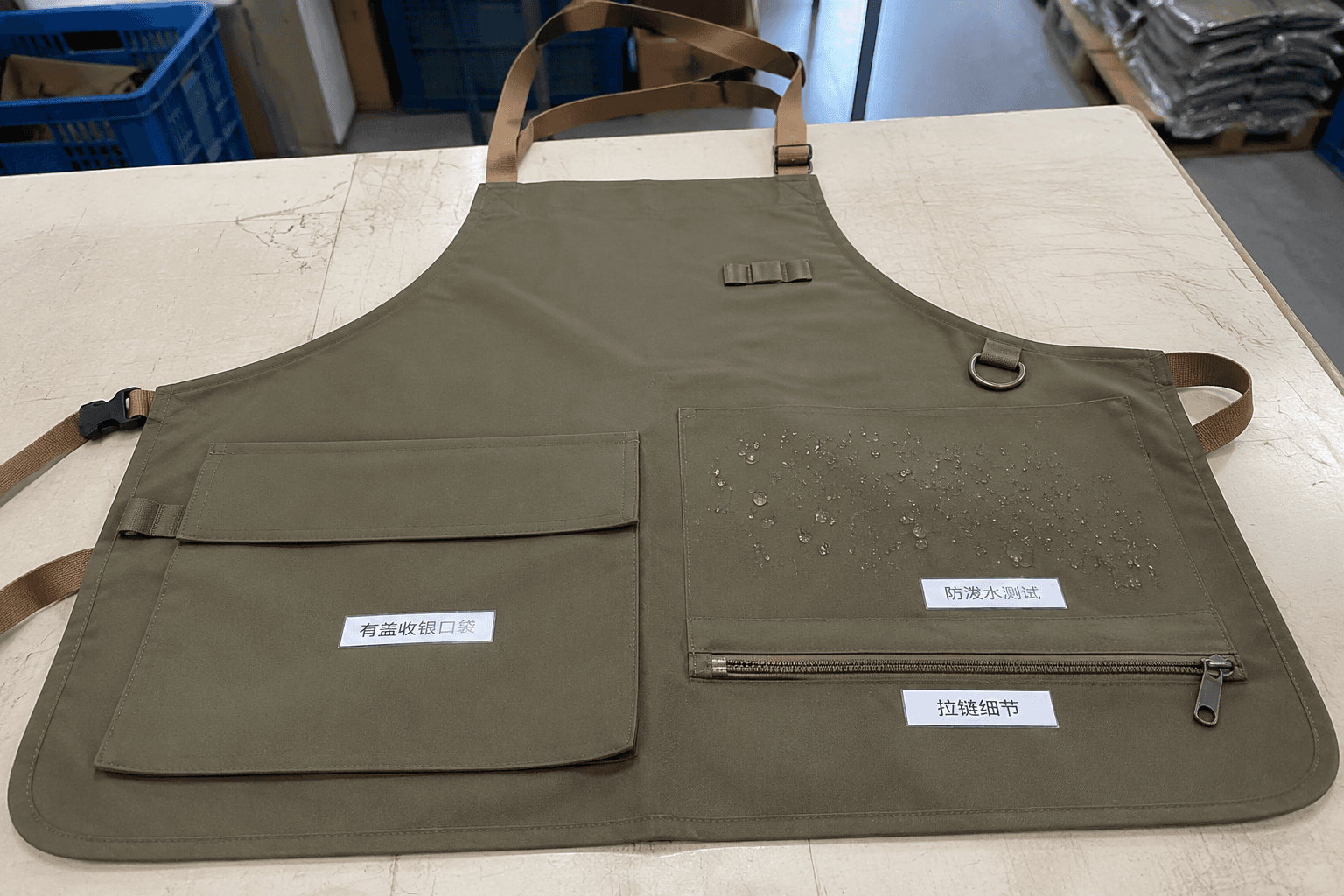
Construction has to match real strain points. A commissary apron tied and untied several times per shift, then laundered repeatedly, should usually have bartacks at pocket corners, reinforced tie joins, and double-needle stitching on main seams. On body fabrics above 270 GSM, self-fabric ties often become bulky after washing. Many factories shift to 2.5 to 3 cm polyester webbing ties because they knot faster, dry faster, and usually outlast self-fabric ties over 60 to 100 wash cycles.
Coverage is where cost cutting often backfires. A sample that looks acceptable on a hanger may expose more of the wearer once they lean over a bench or lift trays. In bakery production, adult bib apron body length of 85 to 95 cm and width of 68 to 75 cm is common where side soiling is a regular complaint. Reducing body length by 5 cm can trim roughly $0.20 to $0.35 per piece in fabric cost, but it often increases soiling complaints and replacement requests within the first 60 to 90 days of use.
- Typical fabric range for bakery commissary aprons: 245 to 300 GSM or 8 oz to 10 oz
- Common bulk base: 65/35 poly-cotton twill for better wash stability than pure cotton
- Recommended construction: bartacks, reinforced tie joins, double-needle seams, and durable waist ties
- Typical custom MOQ: 500 to 1,000 pcs per color per style
- Usual ex-factory range: $3.50 to $5.80 per piece at 1,000 pcs, depending on logo method and pocket complexity
Front-of-house bakery aprons: lighter weight, cleaner drape, and lower neck load
Front-of-house bakery aprons still need protection from crumbs, milk, chocolate, and syrup marks, but they are judged first by how they look in store. That shifts the specification toward lighter fabrics, less bulk, and a neater silhouette. In most bakery retail programs, the practical range is 180 to 230 GSM, usually in poly-cotton twill, plain weave, chambray, or a softer canvas-lite construction.
When buyers issue commissary-grade 270 to 300 GSM aprons to retail teams, the problem is not only comfort. Heavy aprons can read as industrial in stores designed to feel warm, clean, and premium. They also add waist bulk, pull harder at the neck during long shifts, and restrict movement around pastry cases, beverage stations, and POS counters. Across an 8 to 10 hour shift, that usually hurts wearer acceptance more than buyers expect during office sample review.
Pocket planning should follow the service task, not the factory template. A cashier or counter associate may need a pen slot, a narrow receipt pocket, or one divided lower pocket for order slips and small tools. A large reinforced production pocket can pull the front panel out of shape, especially in a 190 to 210 GSM fabric. Some bakery brands get better wear compliance with no lower pocket at all, provided the staff workflow does not require one.
- Common retail fabric range: 180 to 230 GSM
- Typical ex-factory range: $2.20 to $3.60 per piece at 1,000 pcs for a custom bib apron
- Preferred retail outcome: softer handfeel, cleaner silhouette, and lower neck strain over 8 to 10 hour shifts
- Retail pocket layouts should support POS, packaging, and guest service tasks, not bench production
Set wash, shrinkage, and shade standards before approving bakery commissary aprons
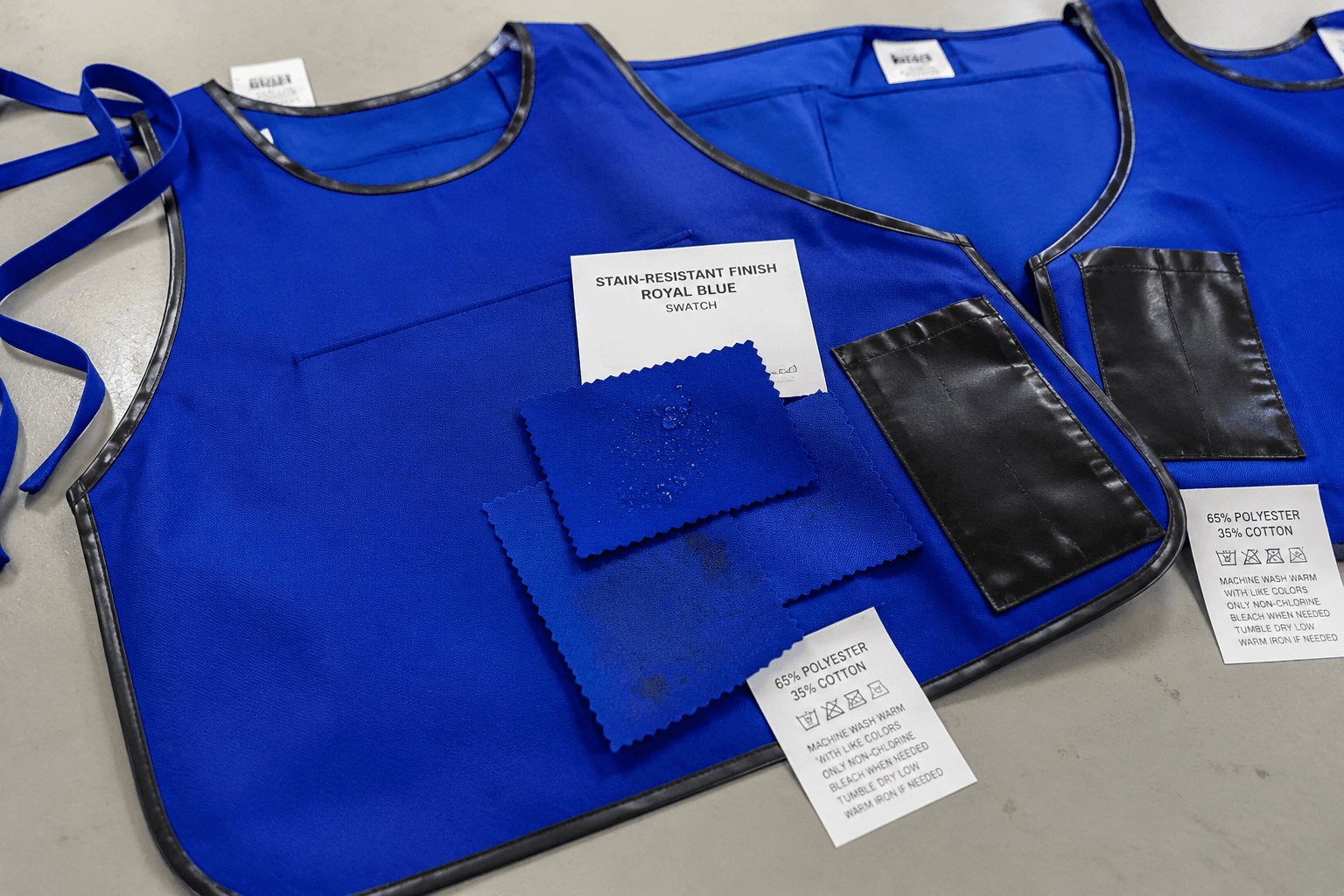
The most useful fabric review is not whether the swatch feels premium in the buying office. It is whether the apron holds size, color, and shape through the actual laundry method. Bakery soils are not limited to flour; the harder combination is butter, oil, chocolate, fruit filling, and heat exposure from repeated washing and drying. For that reason, poly-cotton blends usually outperform 100 percent cotton in dimensional stability and drying efficiency. If cotton-rich fabric is required for brand reasons, buyers should request after-wash measurements and shrinkage data, not just pre-production specifications.
Special finishes also need disciplined review. Water-repellent or stain-release claims can sound useful, but many finishes lose effect after repeated industrial laundering. For a commissary program expected to complete 60, 80, or 100 wash cycles, any finish claim should be tied to a stated test method and wash-count standard. If a supplier cannot show how the finish was validated, that finish should be treated as secondary, not as a core buying argument.
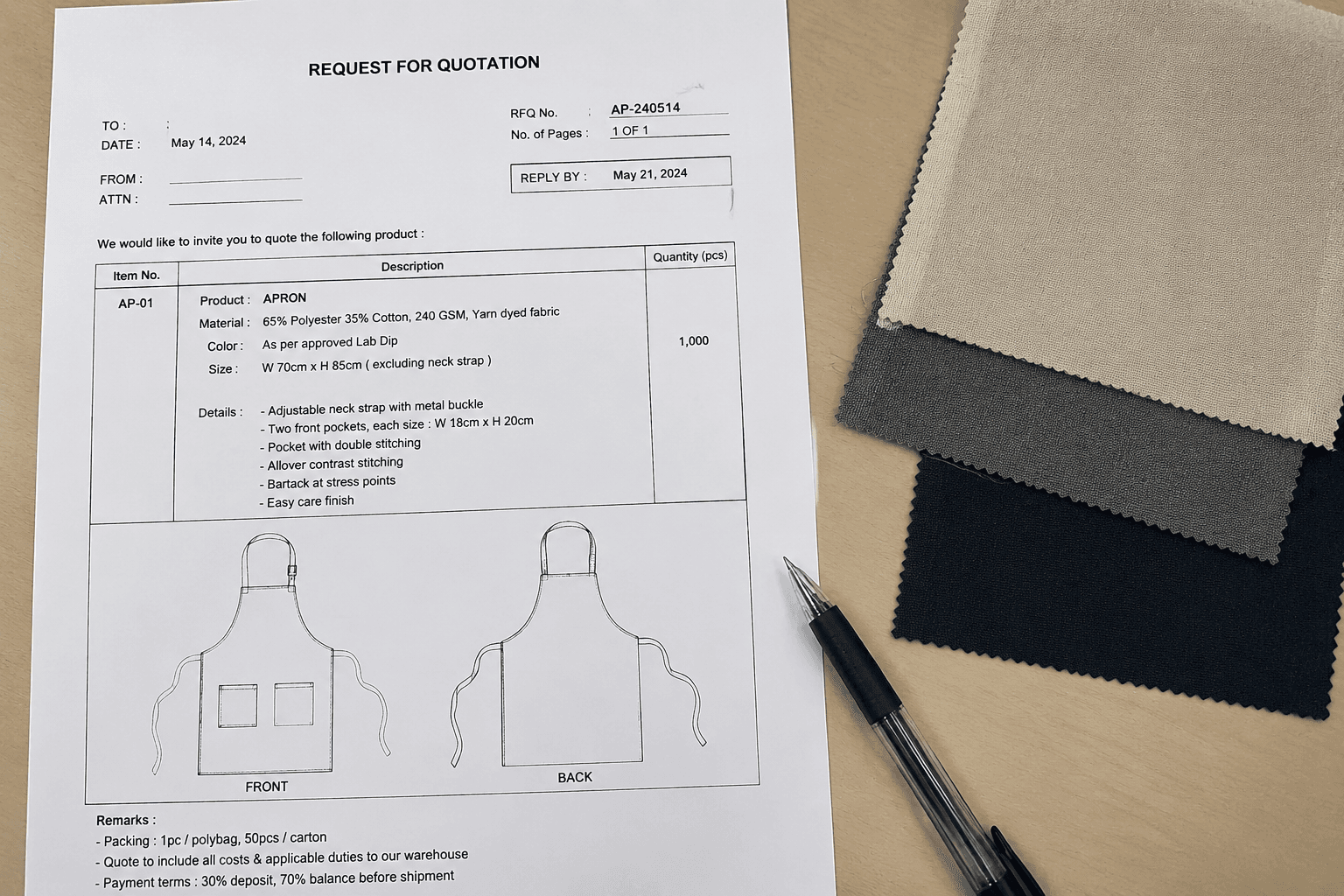
Color control deserves different standards for production and retail. Navy, black, charcoal, and dark brown usually hide bakery soils better and remain the safest commissary shades. Retail programs often move toward oat, stone, forest, muted rust, or dusty blue because they fit modern bakery interiors. Those lighter or fashion-led shades can work, but they require tighter lab-dip approval, stronger repeat-order shade control, and realistic tolerance for lot variation. Many chains solve this simply: dark core shades for production and branded lighter shades for store teams.
- Ask for shrinkage data after washing, with warp and weft percentages clearly stated; many buyers cap both at 3 percent after test wash
- Define laundry method early: home wash or industrial wash at 60 to 75 degrees C
- Request finish validation by wash-cycle count, not by sales language alone
- Use tighter shade control for lighter retail colors than for dark commissary shades
- Set a written inspection target before shipment, commonly AQL 2.5 major / 4.0 minor for workmanship and appearance
Cost-per-wear: why two apron SKUs usually beat one compromise program
Buyers often assume that splitting aprons into two specs increases cost because it adds SKUs. In practice, two functional specs often lower annual spend. A heavy-duty apron issued to retail staff adds unnecessary fabric, reinforcement, and sewing cost without improving the task. Depending on fabric weight, pocket design, and logo method, that overbuild can add about $0.60 to $1.50 per piece on a front-of-house unit.
The reverse mistake is usually more expensive. A lighter retail apron may save $0.50 to $1.20 per piece at opening, but if commissary teams replace it twice as often, the annual cost rises. A production apron priced at $4.20 to $5.80 that lasts roughly 180 to 270 days in regular rotation often outperforms a $3.40 to $4.30 lighter apron that loses shape, stains out, or fails at ties in 90 to 120 days. The right comparison is annualized cost per wearer, not ex-factory price alone.
For finance and operations teams, role-specific apron pricing is easier to defend because each cost line maps to a clear operating need. Retail units pay for comfort and presentation. Commissary units pay for wash durability and longer service life. That distinction also reduces internal disputes when one department rejects a sample that technically meets another department's needs.
- Track cost-per-wear alongside ex-factory $/pc
- Retail over-specification wastes spend on fabric weight, reinforcement, and oversized pockets
- Production under-specification shows up later as claims, faster replacement, and lower user acceptance
- A useful review cycle is every 6 to 12 months using reorder, claim, and replacement data
MOQ, sampling, and lead-time planning for role-based apron sourcing
Complexity stays manageable when buyers split only the features that affect performance. Many apron factories can build two styles from one base pattern family while keeping the same logo file, care label format, barcode logic, and outer carton standard. That means the buyer is not managing two disconnected uniform programs. They are managing one apron package with role-based construction.
Sampling should test function, not only appearance. For front-of-house use, sample review should cover drape, neck comfort, logo scale, and compatibility with shirts or dresses already worn in store. For commissary use, the sample should be worn during actual bakery tasks and washed repeatedly before approval. Even a 7 to 10 day wear check can expose neck strain, tie length issues, flour retention, seam distortion, or unacceptable shrinkage before a 1,000-piece PO is placed.
For custom aprons sourced from China, MOQ is often 500 pcs per style per color, though simple repeat programs may start from 300 pcs and custom-dyed or trim-heavy programs may require 1,000 pcs. Sample lead time is typically 5 to 10 days for basic development and 10 to 14 days when embroidery layout, new fabric sourcing, or pattern revision is involved. Bulk production usually runs 25 to 35 days for stocked colors and 35 to 50 days for custom colors or more complex sewing. Buyers should also reserve 3 to 5 days for PP approval and 2 to 3 days for final inspection booking.
- Practical MOQ range: 300 to 1,000 pcs depending on fabric, dyeing, and customization
- Sample development lead time: 5 to 14 days
- Bulk production lead time: 25 to 50 days
- Inspection standard should be fixed before shipment, commonly AQL 2.5 major / 4.0 minor
- Role-specific wear trials reduce the risk of approving an apron that photographs well but performs poorly
A sourcing framework that separates bakery commissary aprons from front-of-house aprons
The simplest buying framework is to create two apron specs under one sourcing brief. Spec A covers bakery commissary aprons: 245 to 300 GSM fabric, 85 to 95 cm body length, stronger reinforcement, darker shades, and pockets only where the production task requires them. Spec B covers front-of-house bakery aprons: 180 to 230 GSM fabric, cleaner silhouette, lighter feel, and pocket layouts aligned to service and packaging tasks. For most bakery groups, that level of separation is enough to improve wear performance without adding unnecessary sourcing overhead.
Standardization should be limited to details that do not weaken function. Buyers can usually align logo size, thread color, neck-adjuster hardware, label content, carton quantity, spare ratio, and barcode placement. That keeps ordering and replenishment simple while preserving the differences that matter in wear life, comfort, and presentation.
The practical lesson is direct: source aprons as role-based tools, not as one visual uniform item. When buyers define use conditions early, they get cleaner costing, better sample evaluation, fewer quality disputes, and more stable repeat orders. In bakery programs, the visual similarity between production and retail work can hide a real performance gap. The apron specification should reflect that gap before bulk production starts, not after claims arrive.
- Build two role-based specs under one coordinated apron program
- Standardize branding, labels, barcode logic, and packing details where they do not affect performance
- Assign each SKU a clear user environment, wash method, and expected replacement cycle
- Review claim data, reorder timing, and wear feedback every 180 to 365 days before changing fabric or construction