For buyers sourcing tea room aprons, the main issue is not fashion; it is visual tolerance under service conditions. Cream, blush, sage, milk blue, and warm grey show pocket shadow, seam grin, and color drift much faster than black or navy. In a tea room or patisserie counter, staff are usually seen at 1-2 meters under 2700K-3500K lighting, so even a Delta E 1.0-1.5 difference between body, straps, and pocket can be visible during normal service.
That changes the buying brief. A stable apron program needs controlled fabric weight, realistic stain expectations, and trims that keep their appearance after repeated washing. The most common failures on export orders are straightforward: pastel components approved separately instead of as one set, light surfaces showing early localized stains at the counter, and decorative trims that pass sample review but reduce bulk yield. Each failure affects rejection rate, FOB cost, and lead-time reliability.
Professional buyers should lock the technical decisions before PPS approval and before cutting starts: the GSM range that keeps a bib apron opaque without feeling stiff, the shades that can be repeated at 500-1,000 pcs per color, the parts of the apron that will stain first in tea and pastry service, and the trim details that add refinement without slowing production or increasing claims.
- Tea room aprons usually perform best in 190-235 GSM poly-cotton twill or 210-240 GSM cotton twill; below 180 GSM, pale styles often show read-through, pocket shadow, and unstable drape.
- Approve body fabric, pockets, straps, binding, and hardware together as one PPS set. Separate approvals are a frequent cause of visible mismatch on pastel aprons.
- The first stain-failure zones are usually pocket mouth, lower center front, tie-contact points, and side hip wipe areas; layout and trim color should reflect those exposure points.
- Controlled trims usually add US$0.08-0.55 per piece and 2-7 days, depending on whether the style uses piping, binding, embroidery, or plated metal hardware.
- A practical MOQ for custom pastel aprons is often 300-500 pcs per colorway, while 500-1,000 pcs per color gives better dye-lot control and lower FOB volatility.
- For export production, buyers should usually define AQL 2.5 for major defects and 4.0 for minor defects, with written tolerances for color, measurement, shrinkage, and trim performance.
Why pastel tea room aprons need tighter production control
Pastel aprons look clean and simple in concept development, but they are less forgiving than dark servicewear once bulk production starts. A navy apron can hide minor stitch tension variation or slight pocket-to-body shade difference. A pale almond, dusty pink, butter cream, or soft sage apron exposes those faults immediately, especially in front-of-house service where customers stand close to the counter.
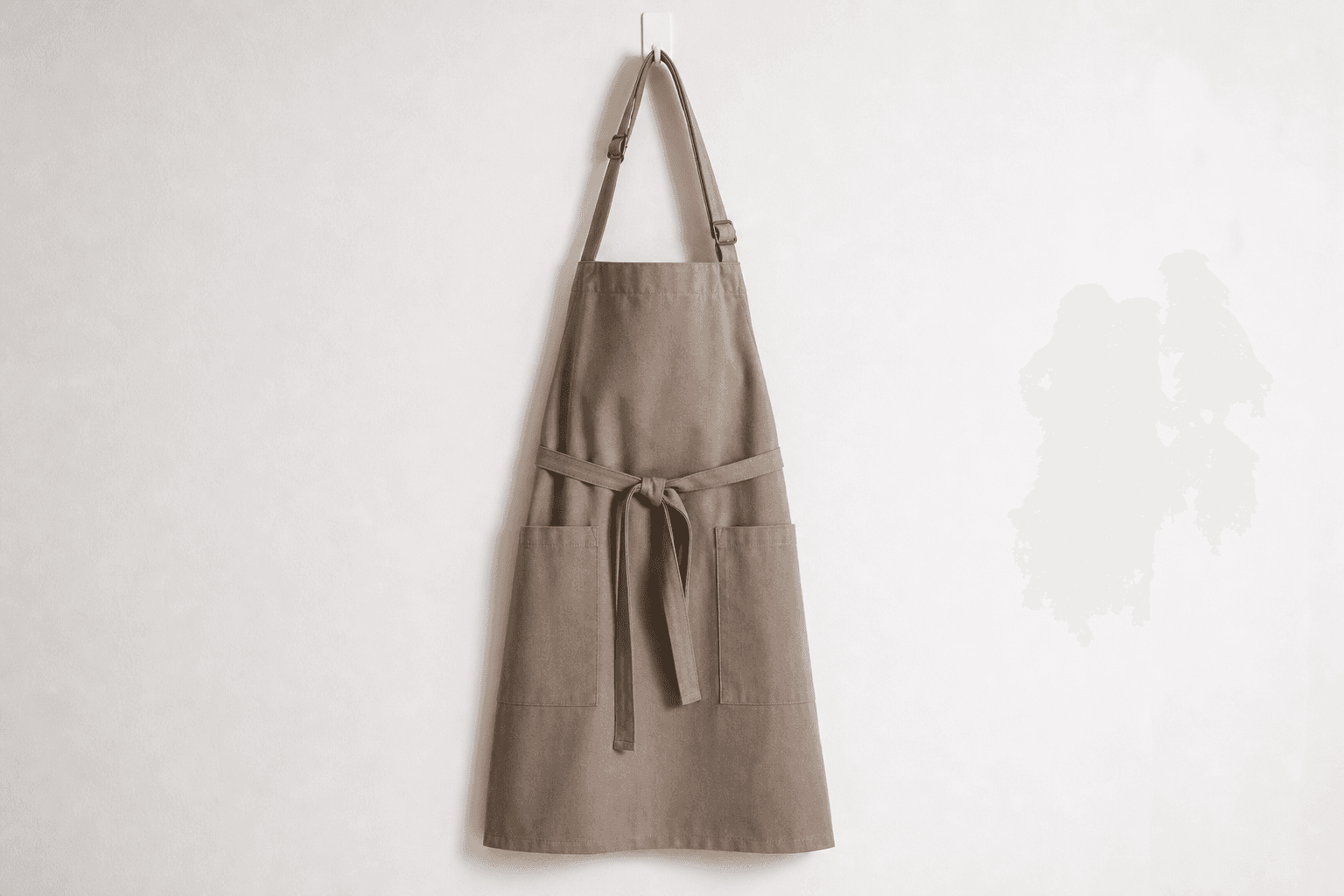
For professional tea room aprons, the most stable fabric routes are usually 190-235 GSM poly-cotton twill, 210-240 GSM cotton twill, and in smaller premium programs, 185-220 GSM linen-look blends. Poly-cotton twill is generally the safest option for repeatability because it gives better shrinkage control, more consistent dye results, and tighter FOB management. Cotton twill gives a softer hand and better matte depth in pale colors, but it needs stricter shrinkage and lot control. Linen-look blends can fit premium tea concepts, yet their irregular surface and crease tendency make visual uniformity harder to maintain in light shades.
Component matching is where many light-color apron programs fail. If the body is custom dyed but the straps or bindings come from stock tape, the nominal color may match on paper while the actual appearance does not. Twill, webbing, and binding absorb dye differently, and the mismatch becomes obvious on pale tones. For this category, self-fabric straps, same-lot pockets, and same-lot bindings usually reduce claims, even if sewing time increases by about 0.5-1.0 minute per piece.
- Recommended body fabrics for front-counter pastel aprons: 190-235 GSM poly-cotton twill and 210-240 GSM cotton twill.
- Below 180 GSM, pale aprons often show seam read-through, pocket bag visibility, or weak drape after washing.
- If straps, pockets, or bindings use different materials, require one combined PPS approval set instead of separate approvals.
Color approval and dye-lot discipline for tea room aprons
Pastel color control needs measured standards, not descriptive comments. Instructions such as 'slightly warmer blush' or 'less green sage' are not stable enough for bulk production or reorders. A stronger process uses a Pantone target, a signed physical swatch, and lab dips with an agreed tolerance. For most front-counter pastel aprons, a practical limit is Delta E 1.0-1.5 maximum against the approved target under D65 light, followed by a second visual review under warm retail lighting because blush, cream, and sage often shift under 3000K lamps.
Lot discipline matters as much as shade approval. A 300-500 pc order in one color can often be planned from one dye lot if consumption is managed correctly. At 2,000-5,000 pcs, split lots become more likely, and the risk of visible mismatch rises unless the factory controls visible components by lot family. Mixing a body from lot A with a pocket from lot B is one of the fastest ways to create rejections on pale aprons.
Buyers should connect the color brief to the production calendar. Custom pastel dyeing usually needs 4-6 days for lab dips, 2-3 days for approval feedback, and 7-10 days for bulk dyeing and finishing before cutting can start. When shipment is forced into 15-18 days after artwork sign-off, there is little room to correct shade drift or remake failed components. For stable output, 25-35 days after final approval is realistic for simple styles, and 30-40 days is more typical once trims or embroidery are added.
- Approve color by Pantone reference, signed swatch, and lab dip.
- Set visible pastel tolerance at about Delta E 1.0-1.5 under D65, then recheck under warm store lighting.
- Confirm before PO whether production will run as single-lot or split-lot.
- Retain a sealed fabric hanger, trim card, and PPS sample for reorder comparison.
Fabric weight, opacity, and drape benchmarks for front-counter aprons
A patisserie counter apron has to look clean and structured through a full service shift, so fabric weight cannot be chosen on appearance alone. If the cloth is too light, the apron may look refined on a hanger but show pocket bags, bartacks, and seam buildup under retail lighting. If it is too heavy, the bib becomes rigid across the chest and waist, which reduces comfort and gives smaller staff a boxed silhouette.
For most bib aprons, 190-235 GSM is the working range that balances opacity, drape, and production efficiency. At 190-205 GSM poly-cotton twill, the apron usually stays neat, economical, and easy to sew at scale. At 210-240 GSM cotton twill, cream, blush, and pale sage generally look richer and more opaque, but buyers should expect a fabric cost increase of roughly US$0.18-0.40/pc at 1,000 pcs, along with tighter shrinkage control. For waist aprons used mainly behind pastry displays, 180-210 GSM is often sufficient because there is less vertical drop and lower pull stress.
Opacity should be checked practically rather than assumed from GSM alone. A compact 205 GSM weave can perform better than a looser 225 GSM cloth. On pale aprons, internal construction shows quickly, so clean pocket finishing, controlled bartack placement, and reduced seam bulk matter. Sample review should include hanger view, on-body view, and backlighting under the same warm retail conditions the apron will face in service.
- Target 190-235 GSM for bib aprons and 180-210 GSM for lighter waist aprons.
- Use 210-240 GSM cotton twill when cream or blush shades need stronger opacity and a softer premium hand.
- Check opacity under warm retail light, backlighting, and on-body wear before bulk approval.
Stain exposure zones and finish choices on tea room aprons
Light aprons do not fail because they stain once; they fail because they show uneven staining early and in customer-facing areas. In tea rooms and pastry counters, visible wear usually starts as localized dulling, drip marks, cocoa dust, berry transfer, butter smears, or hand-oil darkening. These marks appear in predictable places and are easy to notice on cream, pale blue, blush, and light grey surfaces.
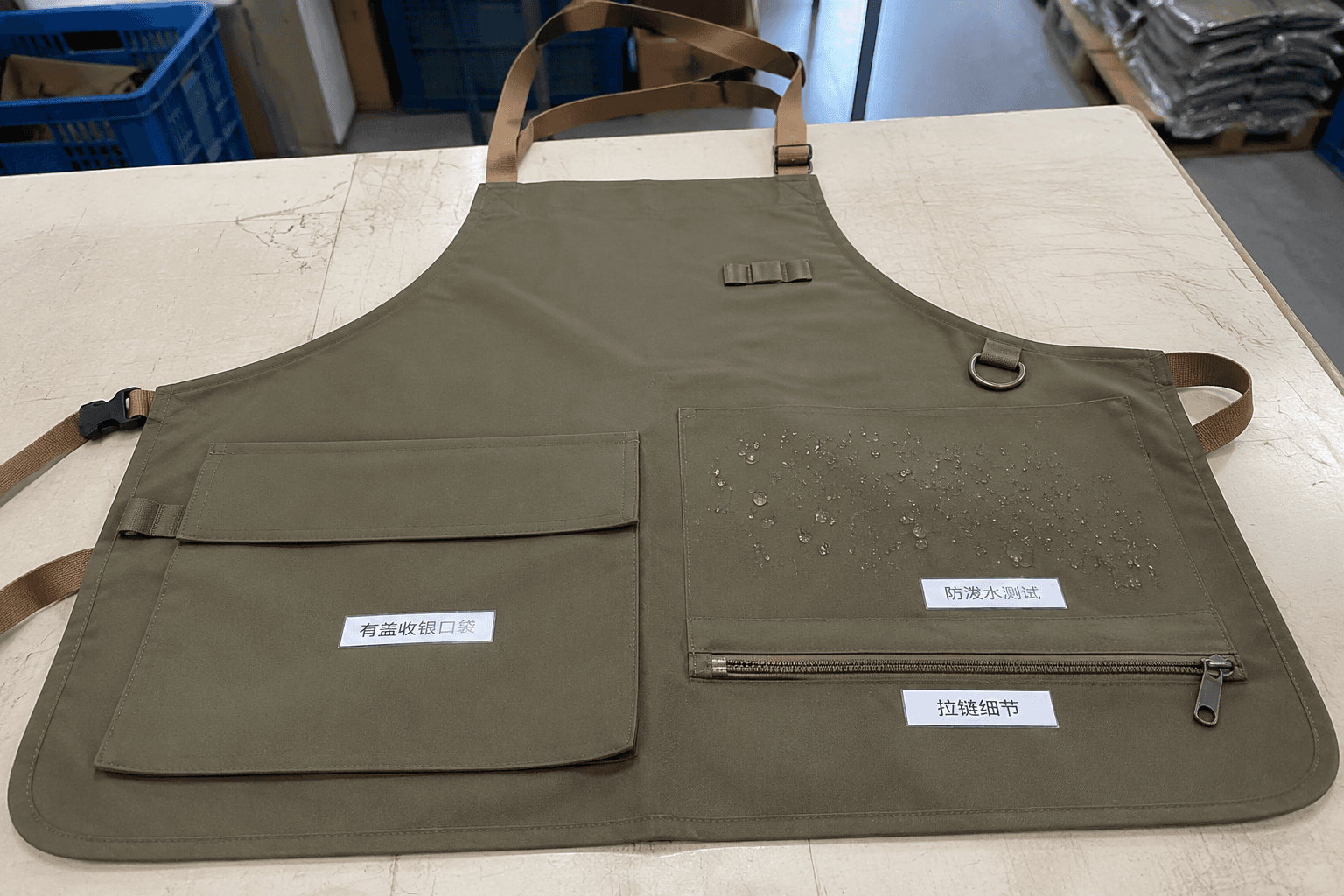
Exposure mapping should follow the actual workstation. In tea service, the lower center front often catches drips from teapot pouring and tray transfer. In pastry service, the pocket mouth, lower abdomen, and side hip zones usually collect flour dust, butter contact, and chocolate fingerprints. If the concept requires a pale main body, buyers can still improve day-to-day appearance by specifying a denser twill face, a slightly darker self-fabric tie, deeper pocket overlap, or a removable overskirt panel in the highest-contact zone.
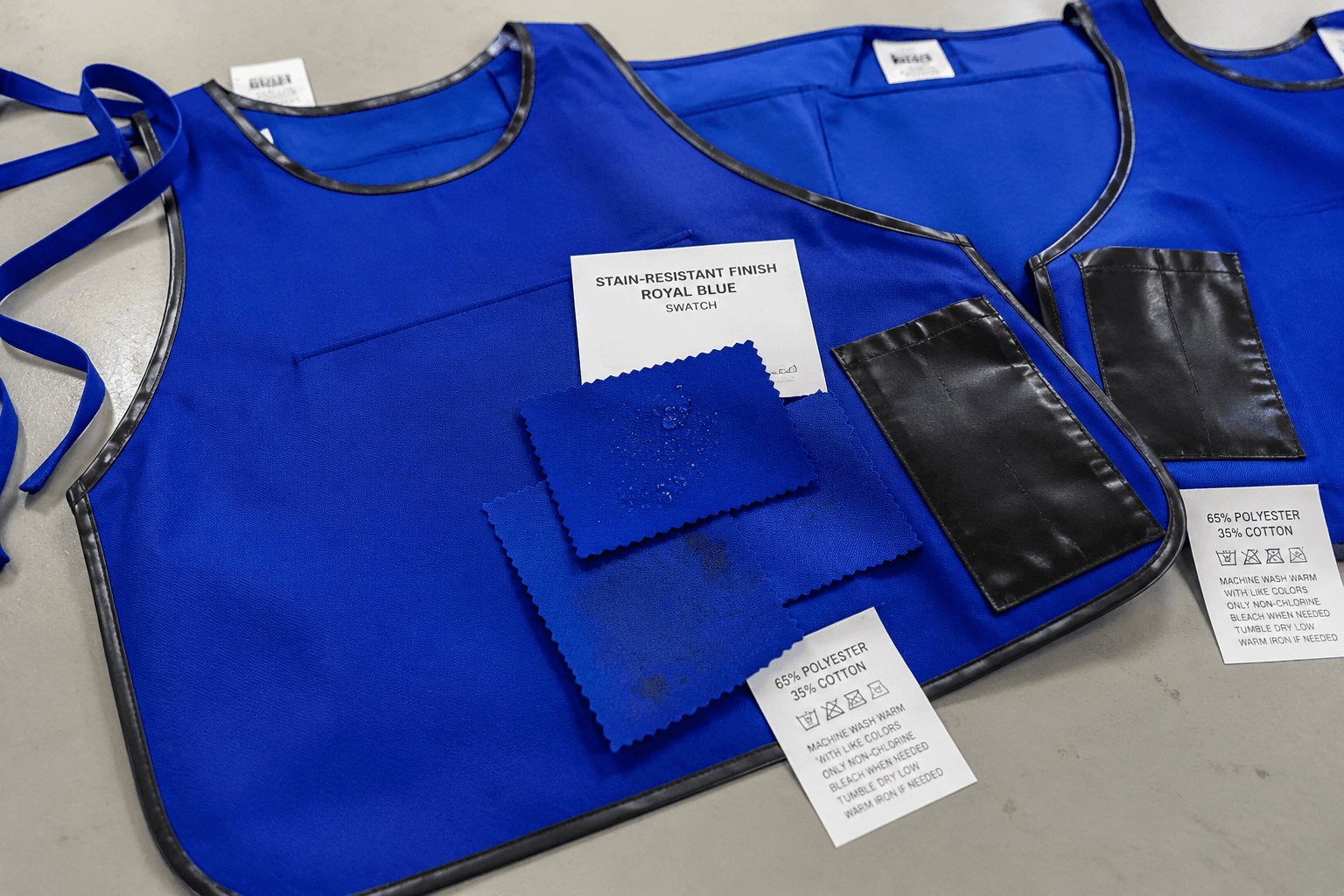
Finishes can help, but they should be specified with realistic expectations. A fluorine-free water-repellent or stain-release finish on 200-220 GSM poly-cotton twill can improve liquid beading and slow light splash penetration, but it will not prevent oily transfer or dark fruit stains after repeated use. In bulk costing, these finishes typically add US$0.12-0.28/pc and 2-4 finishing days. Buyers should ask to see results after 5 and 10 home-launder cycles, because some finishes lose performance sharply after the first few washes.
- Highest stain-visibility zones: pocket mouth, lower center front, tie-contact points, and side hip wipe areas.
- Useful service stain tests: black tea, coffee, berry syrup, cocoa, butter, and light cooking oil.
- A slightly darker tie, facing, or pocket top edge often keeps the apron looking cleaner in daily service than a fully monotone pastel build.
Elegant trims that hold up in washing and bulk sewing
Trims matter in this category because they carry much of the visual identity, but they also create quality risk if they are chosen only for sampling impact. A narrow contrast piping, matte metal adjuster, clean monogram embroidery, or fine self-binding can sharpen a plain apron without changing the core construction. Problems start when decorative details look refined in a showroom sample but perform poorly in line sewing, washing, or reorders.
For front-counter aprons, the lowest-risk trim choices are usually self-fabric waist ties, fine piping on pocket edges, plated metal adjusters with coating test data, and small embroidery placements under about 6,000 stitches. These details can usually run on a standard sewing line without serious loss of efficiency. Higher-risk options include velvet ribbon neck ties, lace insertion, glued ornament parts, and pale stock webbing sourced separately from the body fabric. Those details increase the chance of mismatch, fraying, wash distortion, plating claims, or slower line speed.
The cost effect is manageable when trim use stays controlled. Fine piping generally adds US$0.08-0.15/pc. Metal slides or D-rings usually add US$0.18-0.35/pc depending on gauge and finish. Full-edge decorative binding often adds US$0.25-0.55/pc plus extra sewing time and higher puckering risk on curves. Small logo embroidery typically adds US$0.10-0.30/pc and 2-3 days when outsourced. In most apron programs, one or two controlled trim features scale better than layered decoration.
- Lower-risk trims: self-fabric ties, fine piping, matte metal adjusters, and small embroidery.
- Higher-risk trims: stock ribbon, lace, glued ornaments, and separate-color webbing.
- Request 5-wash appearance photos and plating or colorfastness data before approving decorative hardware.
MOQ, FOB pricing, lead times, and QA checkpoints before PO release
For professional buyers sourcing aprons from China, the commercial framework should be fixed before sample approval turns into a purchase order. A workable MOQ for custom pastel aprons is usually 300-500 pcs per colorway for standard styles in dyed twill. If the apron needs custom Pantone dyeing, branded trims, embroidery, or premium packing, most factories prefer 500-1,000 pcs per color to keep efficiency and shade control stable. Orders below that level are still possible, but setup cost and dyeing overhead are spread over fewer units, which pushes FOB higher and makes repeat color control less stable.
At around 1,000 pcs, a standard bib apron in 190-220 GSM poly-cotton twill with one front pocket, adjustable neck, and custom color usually lands around US$3.10-4.60/pc FOB. A premium version in cotton twill or linen-look blend with refined hardware and small embroidery more often sits around US$4.80-6.80/pc FOB. Waist aprons usually run lower, commonly US$2.20-3.80/pc FOB, unless decorative trims or branded packaging are added. Post-approval lead time is normally 25-35 days for simple styles and 35-45 days for trim-heavy programs or split-lot color management.
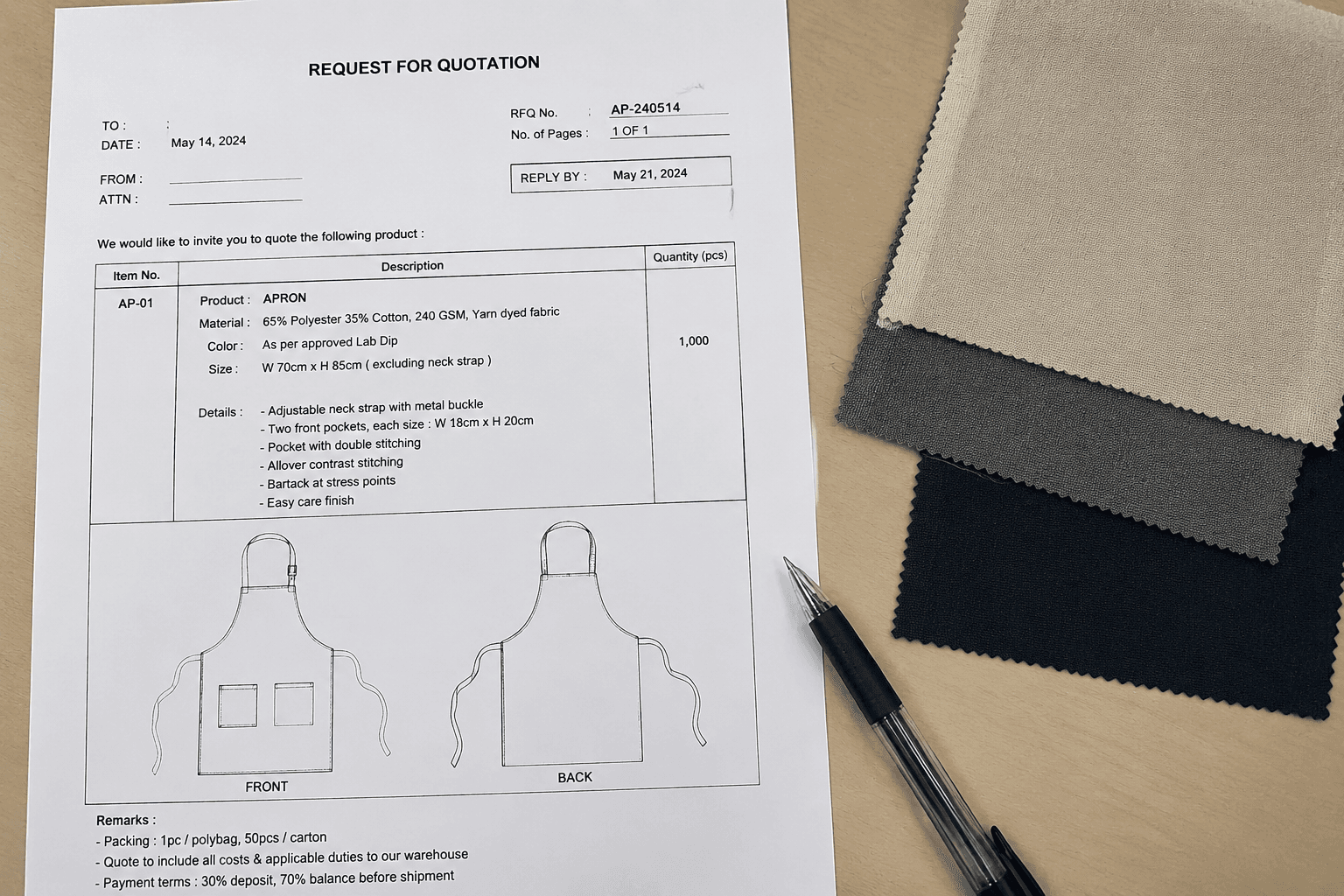
The most common delays come from approvals that look complete but remain vague. The specification sheet should define composition, GSM tolerance, color standard, shrinkage, measurements, stitch density, trim materials, wash expectation, and inspection rules. For this category, many importers use AQL 2.5 for major defects and AQL 4.0 for minor defects. Major defects usually include visible shade mismatch, measurements outside +/-1.0 cm on key points, broken stitching, or hardware failure. Minor defects usually include small thread ends, slight puckering outside the visual center, or minor packing faults. Once those points are fixed on the first order, repeat apron orders become faster and more predictable.
- Typical MOQ: 300-500 pcs per color for standard custom-dyed apron programs.
- Better dye-lot control and FOB efficiency usually begin at 500-1,000 pcs per color.
- Basic bib apron FOB at 1,000 pcs: US$3.10-4.60/pc; premium bib apron: US$4.80-6.80/pc; waist apron: US$2.20-3.80/pc.
- Normal post-approval lead time: 25-35 days for simple styles and 35-45 days for more complex trim programs.
- Lock before PO: composition, GSM tolerance, Pantone, Delta E tolerance, shrinkage, measurements, trim specifications, and AQL standard.