In winery retail floors, cellar doors, guided tasting bars, and club lounges, tasting room aprons are working uniform components, not decorative extras. Staff wear them through pours, bottle presentation, food-pairing service, floor resets, and checkout, while guests view the apron at close range. A stained lower bib, faded pocket edge, twisted tie, or collapsed front pocket is visible quickly and weakens the venue's presentation even when the garment is still structurally sound.
That is why apron sourcing for wine service has to be judged by appearance retention, not only by seam strength. A 10 oz to 12 oz cotton canvas bib can look premium on day one, but under Cabernet, Pinot Noir, Shiraz, or Merlot-heavy service it often shows pink-brown shadowing after 15 to 25 industrial wash cycles. A tighter 65/35 or 80/20 poly-cotton twill at 220 to 250 GSM usually lasts longer in guest-facing use, even if its hand feel is less artisanal. In many winery programs, spending $0.40 to $0.90 more per piece cuts total replacement demand across a season.
This guide focuses on the sourcing decisions professional buyers actually need to make: which fabrics hold shape and shade in red-pour service, which dimensions and pockets work on shared staff pools, what to request when suppliers claim stain resistance, how darker shade allocation extends usable life, and how to brief factories on MOQ, price, lead times, and inspection so custom tasting room aprons move from sample approval to bulk production with fewer revisions.
- 65/35 or 80/20 poly-cotton twill at 220 to 250 GSM is the most reliable default for daily-use tasting-room aprons because it balances drape, stain release, shade retention, and embroidery stability.
- For red-heavy service, approve a fabric only after reviewing residual stain visibility on the actual bulk color after 1, 5, 20, and 30 washes at 40 to 60 degrees Celsius.
- A practical shared bib spec for most wineries is 80 x 72 cm with adjustable neck hardware, 90 to 100 cm waist ties per side, and pocket depth of 18 to 22 cm.
- Typical OEM terms are MOQ 300 to 500 pcs per style/color, sample lead time 7 to 12 days with stock materials or 14 to 20 days with custom components, and bulk lead time 25 to 55 days after approval and deposit.
- A finish, darker shade, or fabric upgrade adding $0.18 to $0.90 per piece is usually commercially justified if it extends acceptable front-of-house appearance from roughly 18 washes to 30 washes or avoids one in-season replacement cycle.
Why tasting room aprons fail on appearance before they fail at the seams
Most winery apron programs break down because the apron stops looking credible in service, not because it tears apart. Front-of-house staff repeat the same contact points all shift: they pour red flights, turn bottles label-forward, wipe damp hands, carry stemware, clear tasting mats, handle card terminals, and lean against bars. That creates many small stain and abrasion events in fixed zones rather than one obvious construction failure.
For tasting room aprons, the risk is cumulative stain memory. Red-wine pigments bond quickly to absorbent yarn surfaces, especially on lighter cotton-rich faces, brushed finishes, and textured fabrics. Even when staff blot immediately, the lower bib, pocket lip, and dominant-hand wipe area often keep a visible shadow after laundering. On black or charcoal twill, the apron may remain acceptable for 35 to 50 wash cycles. On sand, oat, stone, or natural canvas, the same service pattern can make the apron look unfit for guest-facing use in 12 to 20 washes.
That means the service-life question for buyers is specific: how many shifts and commercial washes pass before the apron no longer supports a polished cellar-door presentation? If a bib apron survives physically for six months but looks stained after three weeks, it is a failed specification for front-of-house wine service.
- Common appearance-failure zones are lower bib, center body, pocket edge, side wipe area, tie ends, and pocket corners.
- In active tasting service, one staff member may take 2 to 5 visible splash events per shift, with more during seated flights, launch weekends, or events.
- Light 260 to 320 GSM cotton canvas usually shows visible staining sooner than dark 220 to 250 GSM poly-cotton twill.
- Track apron performance by wash-count appearance retention, not just tear strength or seam security.
Fabric weights and blends that give tasting room aprons longer front-of-house life
For most winery programs, the safest base cloth is a tightly woven poly-cotton twill. The strongest commercial range is usually 65/35 or 80/20 poly-cotton at 220 to 250 GSM, roughly 6.5 to 7.4 oz. In this band, the apron hangs neatly, resists pocket collapse better than light shirting fabrics, dries faster than cotton canvas, and typically releases residual wine marks more effectively in commercial laundry.
A heavier 250 to 270 GSM twill can work for cooler-climate cellar doors, prestige tasting rooms, or uniforms layered over shirts and knitwear. It gives a slightly richer drape and better coverage, but buyers should confirm that the extra weight does not become uncomfortable during long standing service. At the other end, fabrics below 200 GSM often twist more at the ties, flutter at the front panel, and lose shape faster once staff carry an opener, order pad, or handheld terminal.
Cotton still has a place where brand positioning favors a softer, artisanal hand. A 10 oz to 12 oz canvas bib can suit low-volume boutique settings with lower spill frequency and disciplined stain handling. The trade-off is practical: more absorbency, slower drying, higher shrinkage risk, and a shorter guest-facing life under heavy red-pour service. Linen-look textures, slub yarns, and open weaves should be specified cautiously because the uneven surface traps pigment and makes stain recovery less predictable.
- Best all-round sourcing spec: 65/35 poly-cotton twill, 220 to 250 GSM.
- Premium cooler-climate option: 80/20 poly-cotton twill, 250 to 270 GSM.
- Warm-weather option: 190 to 205 GSM twill, but only if wash tests confirm stable drape and limited pocket sag.
- Use 10 oz to 12 oz cotton canvas mainly in lower-volume environments where hand feel matters more than wash-count efficiency.
- Avoid pale untreated fabrics, slub textures, and open weaves for teams pouring red wine across full shifts.
How to test red-wine recovery claims before approving tasting room aprons
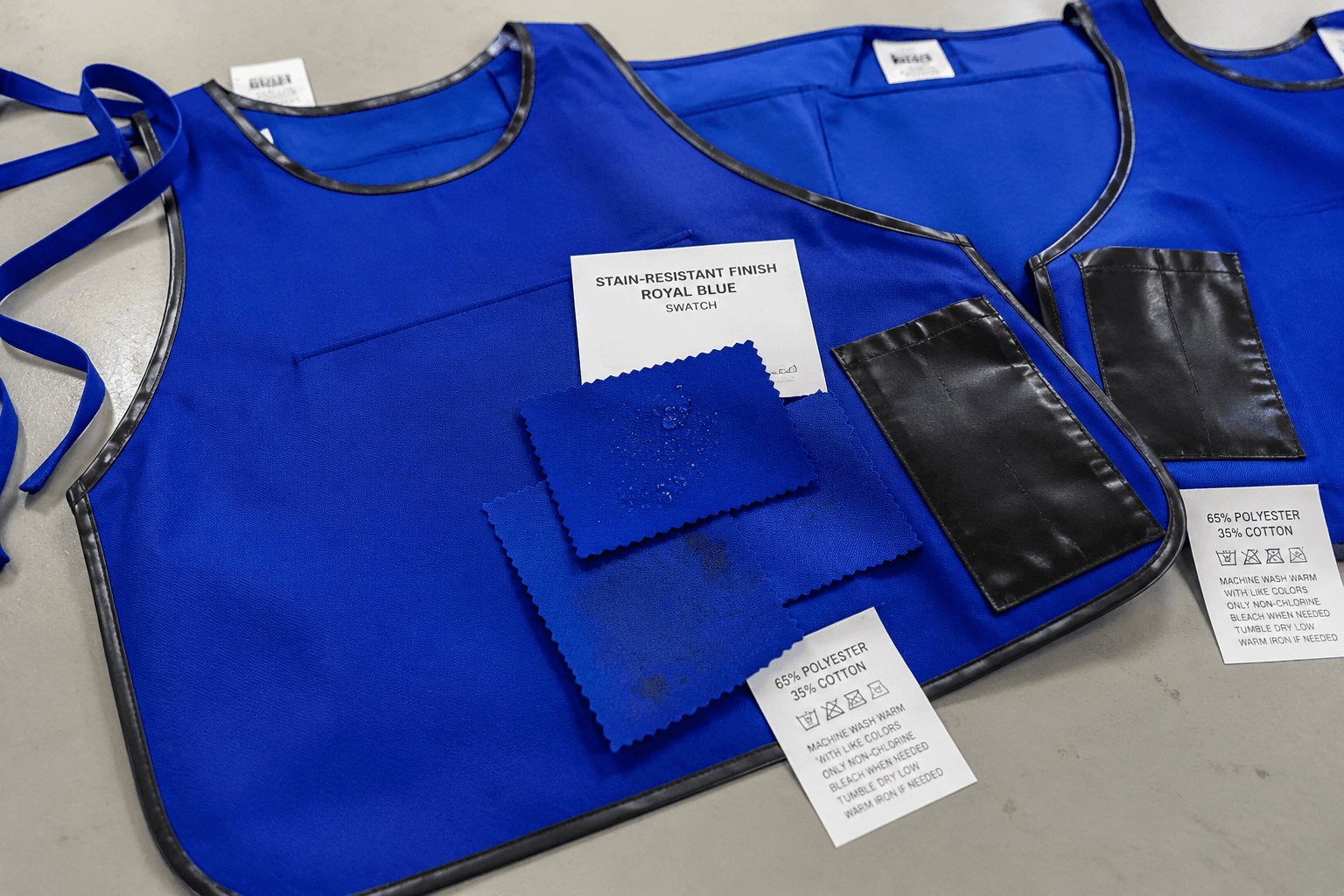
A supplier claim that an apron is stain resistant has limited value unless the claim is tied to a repeatable method. Buyers should require the supplier to test the actual proposed bulk fabric and shade, not a generic swatch in a different color. A useful basic protocol is to apply red wine, leave it for 10 to 15 minutes, blot, then launder under conditions close to the intended route: typically 40 to 60 degrees Celsius using standard detergent, followed by tumble or line drying according to the program. One-wash recovery matters, but the more useful checkpoints are after 5, 20, and 30 washes, because finishes weaken and fabric surfaces change with use.
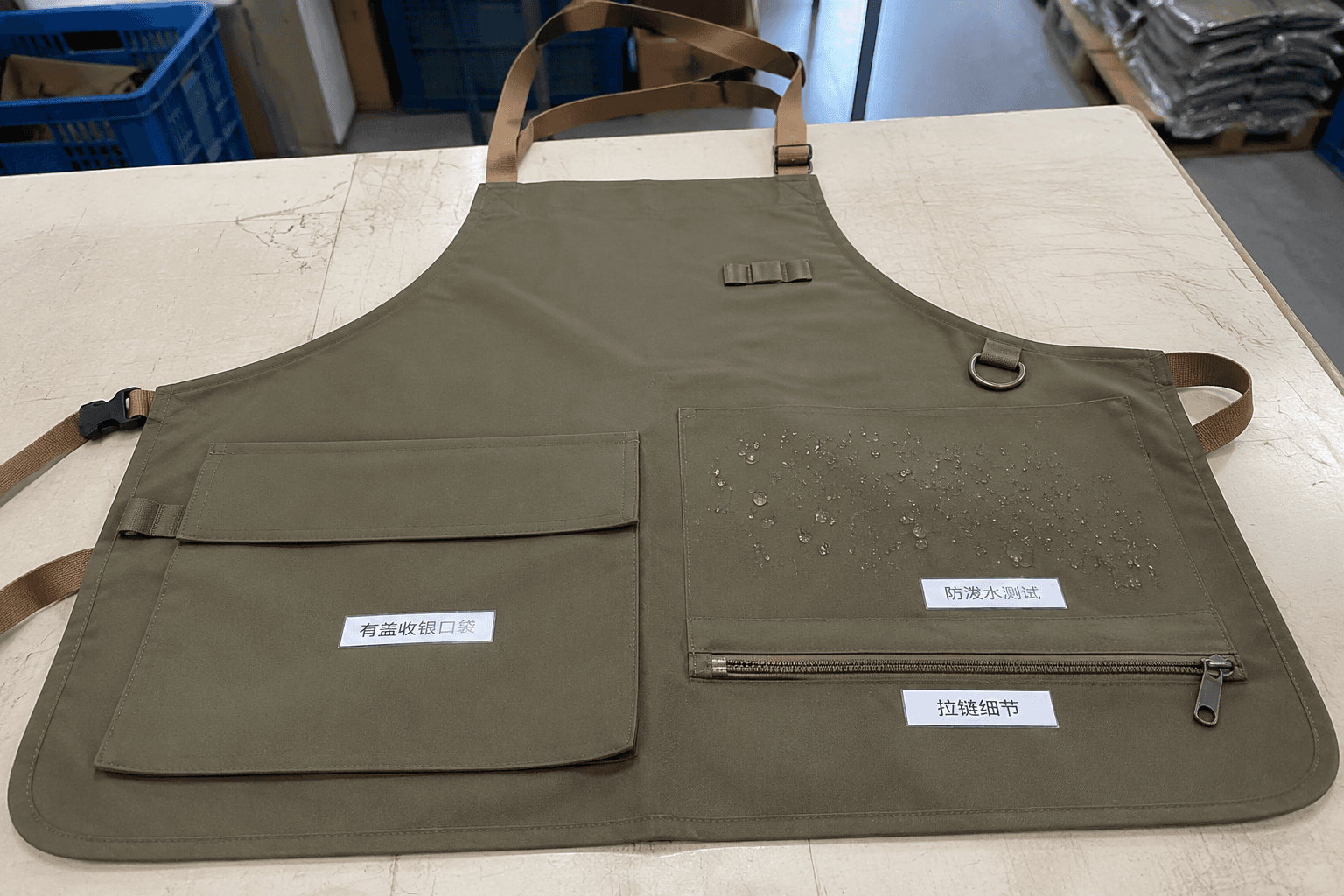
Water repellency and stain release should also be separated in the brief. A fresh sample may bead liquid for a short time and still hold a visible ring after washing. On dark twills, a finish upgrade often reduces residual shadowing enough to extend acceptable front-of-house life by 8 to 15 washes. On natural, stone, or sand shades, the same chemistry may improve cleanup but still leave visible pigment memory. Buyers should expect measurable improvement, not a guarantee of full stain disappearance.
If the winery uses outside industrial laundry, that information needs to be shared before sampling starts. Wash chemistry, extraction speed, tumble conditions, pressing temperature, and any bleach exposure affect color life and stain recovery. The best suppliers can show wash-test photos, shrinkage percentages, colorfastness results, and inspection criteria against the exact fabric, color, and finish proposed for production.
- Request photos on the actual production fabric and shade at four stages: before wash, after 1 wash, after 5 washes, and after 20 or 30 washes.
- Ask for test data covering shrinkage, colorfastness to washing, colorfastness to rubbing, seam slippage, and pilling.
- Typical stain-release finish upcharge is $0.18 to $0.45 per piece on a simple bib apron and $0.45 to $0.90 on more complex builds.
- Set finished-goods inspection at AQL 2.5 major / 4.0 minor; premium hospitality programs may tighten to AQL 1.5 / 2.5.
Dimensions, pocket layouts, and trims that keep aprons neat through repeated service
The apron styles that perform best in wineries are usually the least complicated. Heavy leather straps, decorative rivets, oversized contrast webbing, and barista-style utility builds often increase FOB cost without extending useful life. They also complicate laundering and introduce more failure points, including plating wear, edge cracking, hardware rusting, and color migration from trims to the base cloth.
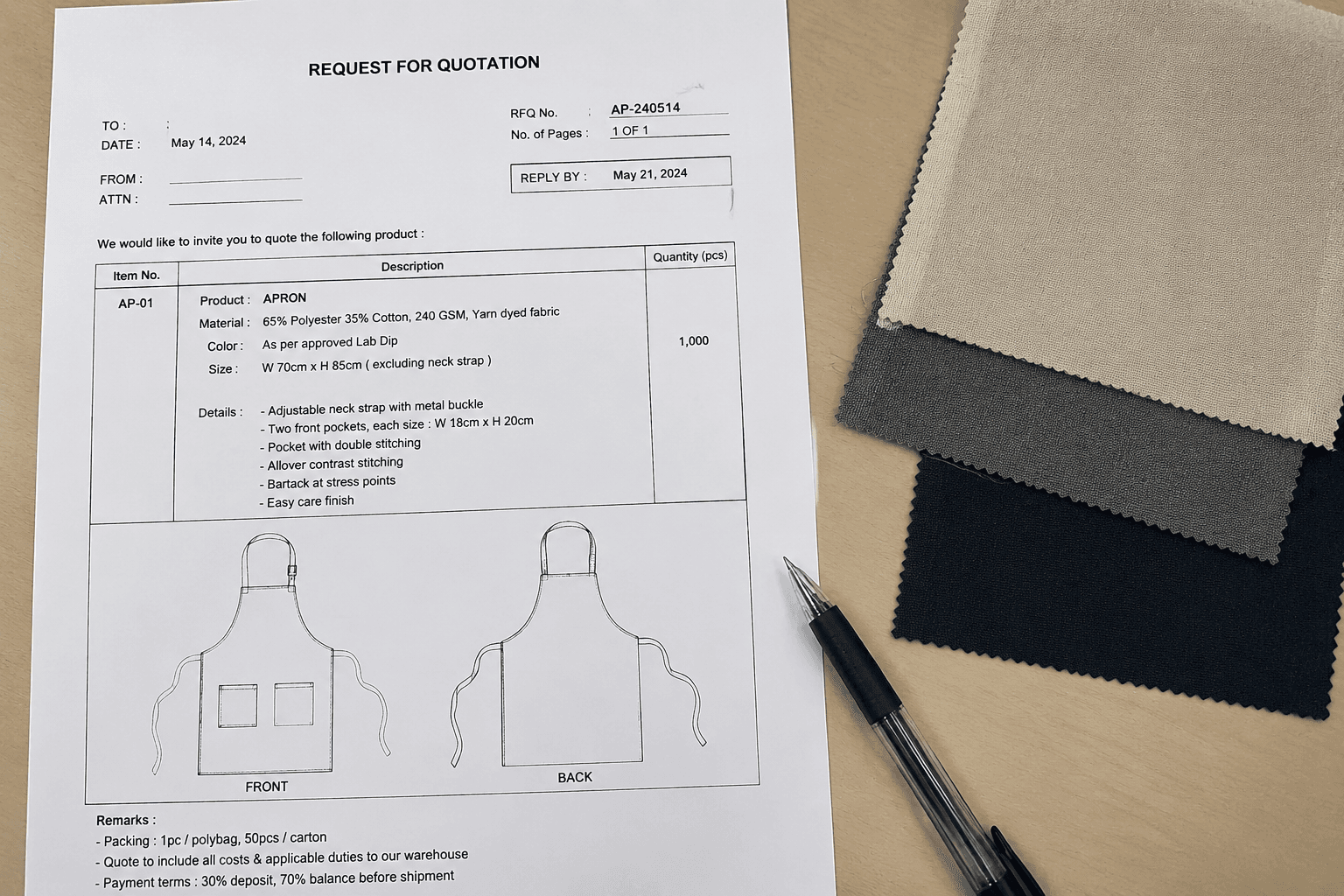
A clean bib apron remains the most efficient format for tasting-room teams because it protects the shirtfront during pours, bottle carry, and rinse-back tasks. A practical shared-size specification is 80 x 72 cm, with finished body length at 78 to 82 cm and width at 70 to 74 cm. Waist ties should generally run 90 to 100 cm on each side so staff can fasten in front or back. Adjustable neck hardware is useful when aprons are issued from pooled stock, but the hardware should stay simple: plated metal sliders or durable molded adjusters are easier to maintain than mixed leather-and-metal sets.
Pocket planning should reflect real winery tools rather than cafe styling. Most teams need one divided front pocket, one pen channel, and in some cases a narrow slot for a handheld device or order pad. Pocket depth of 18 to 22 cm is normally enough. Deeper pockets sag when loaded and pull the front panel out of shape. Straight topstitching, clean edge turn-backs, bartacks at stress points, and stable hems do more for perceived quality than ornamental trim.
- Recommended shared bib size: 80 x 72 cm.
- Waist ties should typically be 90 to 100 cm per side.
- Useful pocket depth is 18 to 22 cm; deeper pockets often distort the apron front when loaded.
- Topstitching should stay consistent at 1/8 inch or 1/4 inch, with bartacks at pocket corners and tie joins.
- Avoid leather, suede, and raw-edge trims on frequently washed aprons because they often crack, stiffen, or bleed after 20 to 30 commercial cycles.
Color allocation strategy for longer-lasting tasting room aprons
Color is one of the simplest cost-control tools in apron sourcing. In heavy red-pour environments, black, charcoal, deep olive, forest, burgundy, and dark brown-red usually deliver the longest visually acceptable life because they mask splash shadowing between washes. Deep navy can also work, although lint and hard-water spotting sometimes read more clearly on navy than on charcoal or black.
Lighter neutrals may better match a vineyard brand palette, but they rarely perform well for full-shift pour staff unless volume is low and stain handling is immediate. A more effective B2B approach is role-based allocation. Darker tasting room aprons go to core pour staff, while lighter, logo-forward, or more decorative styles are reserved for hosts, greeters, retail advisors, and event staff with lower direct splash exposure. This keeps brand presentation intact without forcing one fabric and one shade to handle incompatible tasks.
This allocation model also improves replenishment control. A winery can standardize one dark core apron for everyday service, hold lighter variants for selective use, and reorder the high-rotation core style in cleaner volume breaks. That reduces emergency top-up orders, limits shade mismatch across seasons, and keeps embroidery execution more consistent over repeat runs.
- Best stain-masking shades are black, charcoal, deep olive, forest, burgundy, and dark brown-red.
- Reserve lighter shades for hosts, greeters, retail staff, and low-pour event roles.
- Embroidery generally holds a cleaner premium look than print after 30 or more wash cycles on daily-use aprons.
- Standardize one dark core style across venues when replenishment speed and visual consistency matter.
MOQ, FOB cost, lead times, and replacement planning for winery apron programs
For OEM sourcing, apron cost is driven mainly by fabric choice, branding method, color route, and trim complexity. A straightforward bib apron in 220 to 250 GSM stock-color poly-cotton twill with one embroidery position usually lands around $3.20 to $4.80 FOB at 500 to 1,000 pcs. Add stain-release finish, custom-dyed fabric, contrast straps, woven labels, or upgraded adjusters and the range often moves to $4.60 to $6.20 FOB. Heavier cotton canvas or mixed-material builds with premium detailing commonly sit at $6.50 to $10.50 FOB. Orders below 300 pcs can still be quoted, but unit cost rises quickly because fabric utilization and setup efficiency worsen.
Lead time should reflect the actual material path. A standard branded sample generally takes 7 to 12 days if stock cloth is available and artwork is approved. Custom dyeing, special hardware, or non-standard labels usually push development to 14 to 20 days. After sample approval and deposit, bulk production is commonly 25 to 40 days for simple styles and 40 to 55 days for more complex programs. Buyers ordering ahead of harvest, holiday tourism peaks, or major club events should add at least 10 buffer days for revision loops, pre-shipment inspection, and freight handover.
Replacement planning should be done before the first PO is placed. If a winery has 24 front-of-house staff and issues 3 aprons per person, the base issue count is 72 pcs. In practice, most operations need an additional 15% to 25% reserve for wash rotation, new hires, event use, damage, and inspection shortfall, taking the working opening requirement closer to 84 to 90 pcs. If a higher-spec apron costs $0.60 more but extends acceptable appearance from 18 washes to 30 washes, it usually reduces annual spend and avoids service disruption. The buyer brief should therefore lock the target FOB, ex-factory date, fabric blend, GSM or oz, dimensions, pocket layout, logo size in centimeters, wash route, expected red-wine exposure, and inspection standard from the first inquiry.
- Practical MOQ is usually 300 pcs per style/color; stronger pricing usually starts at 500 pcs+.
- Sample lead time is commonly 7 to 12 days with stock materials and 14 to 20 days with custom components.
- Bulk lead time is generally 25 to 40 days for simple apron builds and 40 to 55 days for complex mixed-material programs.
- Basic FOB range is $3.20 to $4.80 for standard poly-cotton bib aprons and $4.60 to $6.20 with added finish or customization.
- Add 15% to 25% reserve quantity above issue count to reduce rush top-up orders and dye-lot mismatch risk.