In an open kitchen, the apron is part of the guest experience. It sits beside chef jackets, shirting, stemware and plated food, so buyers cannot hide stiff fabric, reflective trim, twisted straps or a puckered logo. That is why fine dining apron sourcing requires tighter specifications than apron buying for cafés, bakeries or casual restaurant chains.
The strongest programs begin with measurable standards instead of mood boards alone: shell fabric at 260-320 GSM or 7.7-9.4 oz, shrinkage held within 3-5%, hardware selected for low movement noise, logo placement tolerance within +/-0.5 cm, and a schedule that allows 7-21 days for sampling plus 25-40 days for bulk production after PP approval. A showroom sample is only the starting point; bulk output must repeat the same drape, stitch balance, strap length and trim finish across 300, 1,000 or 5,000 units.
For professional buyers, the task is controlled trade-off management. The target is not the heaviest cloth or the lowest headline quote. The target is an apron program that hangs cleanly through service, launders without distortion, stays quiet in motion and lands at a workable FOB at the intended MOQ. In practice, good fine dining apron sourcing is disciplined apron engineering for hospitality use, not decorative sampling.
- 260-320 GSM shell fabrics usually give the best balance of elegant drape, opacity and wash durability for premium restaurant aprons.
- Quiet performance comes from compact adjusters, stitched strap channels, hidden sliders and tight trim installation, not free-hanging clips or oversized rings.
- Restrained branding such as tonal embroidery, woven labels or washable debossed patches usually looks more premium than large contrast logos.
- Using one base fabric and one hardware finish across bib and waist styles often cuts mixed-program cost by about 8-12% and lowers MOQ risk.
- Bulk consistency depends on written shrinkage targets, measurement tolerances, PP approval and AQL 2.5/4.0 inspection standards, not on sample appearance alone.
Why open-kitchen uniforms need stricter fine dining apron sourcing standards
Open kitchens bring the apron into the dining-room sightline. Guests see the front edge against white jackets and pressed shirts, and they hear trim movement at the pass, chef’s counter or service station. That changes the sourcing brief. A bib or waist apron for fine dining has to work as visible uniform, brand signal and protective workwear at the same time, so poor drape, unstable pockets or noisy hardware are noticed immediately.
Many standard hospitality aprons fail in this setting because they are built for broad use, not premium presentation. Stiff canvas, oversized utility pockets and exposed clips may work for bar, bakery or casual concepts, but they read too industrial in a formal dining room. Fine dining buyers usually need a narrower front profile, fewer visual breaks, cleaner strap adjustment and deeper shades such as black, charcoal or dark navy that hold tone under warm pendant lighting.
Role mapping should be settled before development starts. A guest-facing chef, captain, sommelier and server do not need the same coverage, pocket layout or apron length. Forcing one universal style across every role often creates an apron that is too heavy for front-of-house, too minimal for kitchen use and too expensive because every wearer carries the same construction burden. In most cases, a two-style program built on one fabric and trim platform is the cleaner commercial answer.
For premium groups opening multiple sites, that role split also improves reorder control. One bib apron and one waist apron, both using the same shell fabric, edge finish and hardware tone, typically create a more coherent uniform system than a single overbuilt style applied everywhere.
- Typical premium bib apron length is 84-92 cm with chest width at 26-30 cm for a slimmer visual line.
- Typical premium waist apron length is 78-90 cm, depending on service mobility and required formality.
- A common role split is bib aprons for chef-facing or captain roles and waist aprons for servers or sommeliers.
- Using two silhouettes on one shared fabric platform often reduces average program cost by 8-15% versus one overbuilt universal style.
Fabric specs for fine dining apron sourcing: drape, GSM and laundering stability
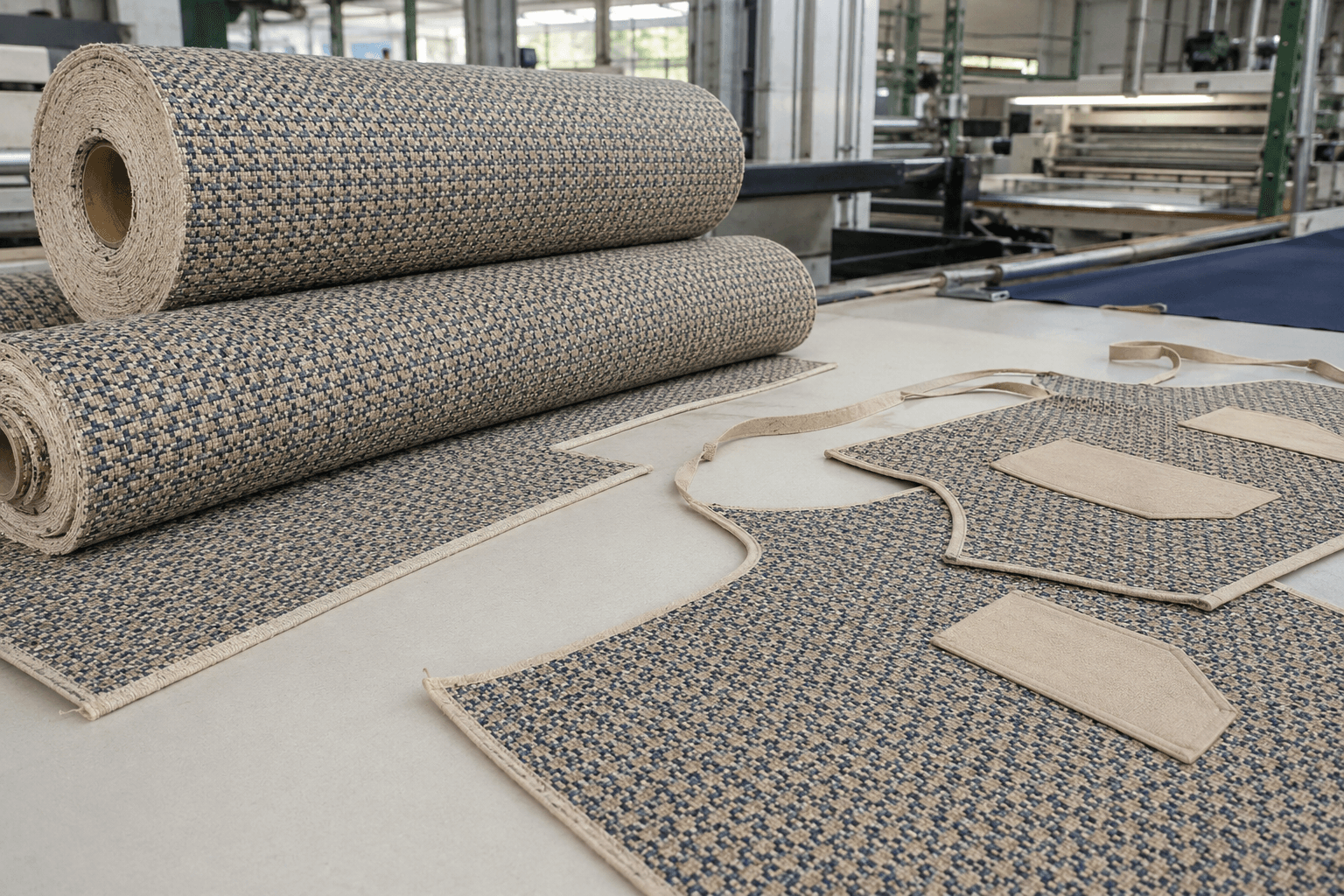
Fabric drives most of the final impression. Buyers often ask for heavy canvas because it sounds premium, but very rigid canvas can stand away from the body and make the apron look more like workshop wear than refined hospitality uniform. For open-kitchen service, softer cotton-rich twill, brushed twill, enzyme-finished cotton/poly and some cotton-Tencel blends usually create a better line because the apron follows movement instead of resisting it.
For most OEM developments, the dependable working range is 260-320 GSM. Below 220 GSM, the shell can feel insubstantial, pocket bags may print through the front and the hem can lose control after repeated laundering. Above 350 GSM, many bib aprons become too stiff and warm for long shifts under pass heat. The middle range gives enough body to look premium while still draping close to the torso.
Finish matters as much as nominal weight. Enzyme wash, light brushing and peached surfaces can soften the hand and reduce visual harshness, but the buyer should confirm whether the finish is applied at fabric stage or garment stage. Post-sew washing can widen shade variation and measurement drift. If reorder consistency matters more than fashion effect, pre-finished fabric is usually safer unless the supplier is highly experienced in calibrated garment-wash production.
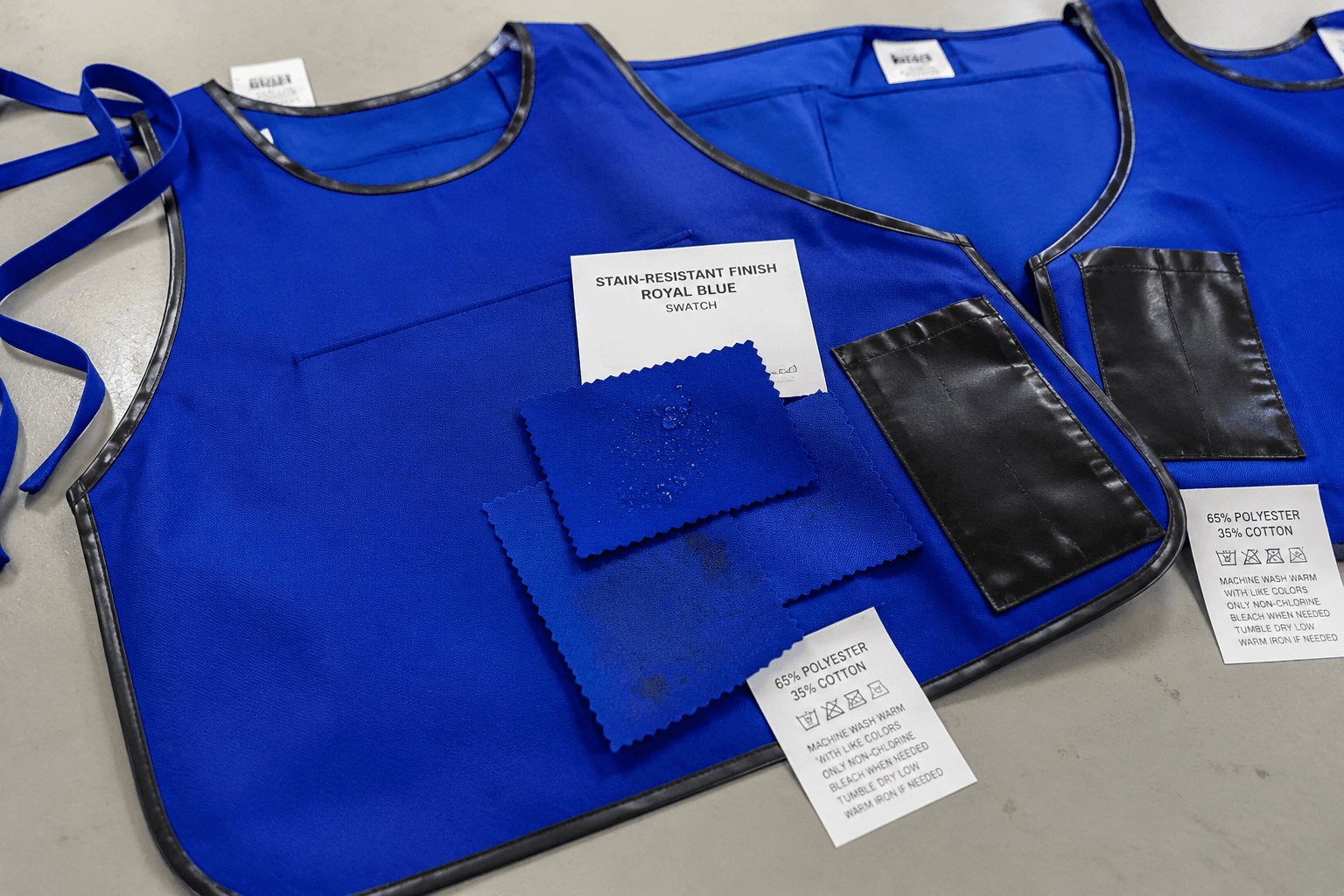
Laundering performance should be specified in numbers, not general promises. A practical target for premium aprons is total shrinkage within 3-5% under the agreed care method, no severe seam torque, and colorfastness suitable for dark service shades that are washed often. In sourcing terms, a technically stable fabric usually adds more long-term value than decorative trim that increases cost without improving wear life.
- 260-280 GSM usually suits servers, hosts and sommeliers who need softer drape and lighter wear.
- 290-320 GSM usually suits guest-facing chefs and captain roles that need more body and opacity.
- Common blends include 65/35 cotton/poly for wrinkle control and 60/40 for a slightly softer hand.
- Target shrinkage before bulk approval is warp and weft each within 5%; stronger programs hold both closer to 3%.
- Dark shades such as black, deep navy and charcoal usually present drape more elegantly than bright fashion colors in formal dining rooms.
Quiet hardware systems for open-kitchen service aprons
Noise is a genuine product issue in premium restaurants. During chef’s counter service, tasting menus or intimate dining formats, guests are close enough to hear clips tapping, D-rings shifting or strap ends striking worktops. In that environment, sound control is part of function, not a styling preference. Good fine dining apron sourcing treats hardware noise as a technical requirement from the first sample.
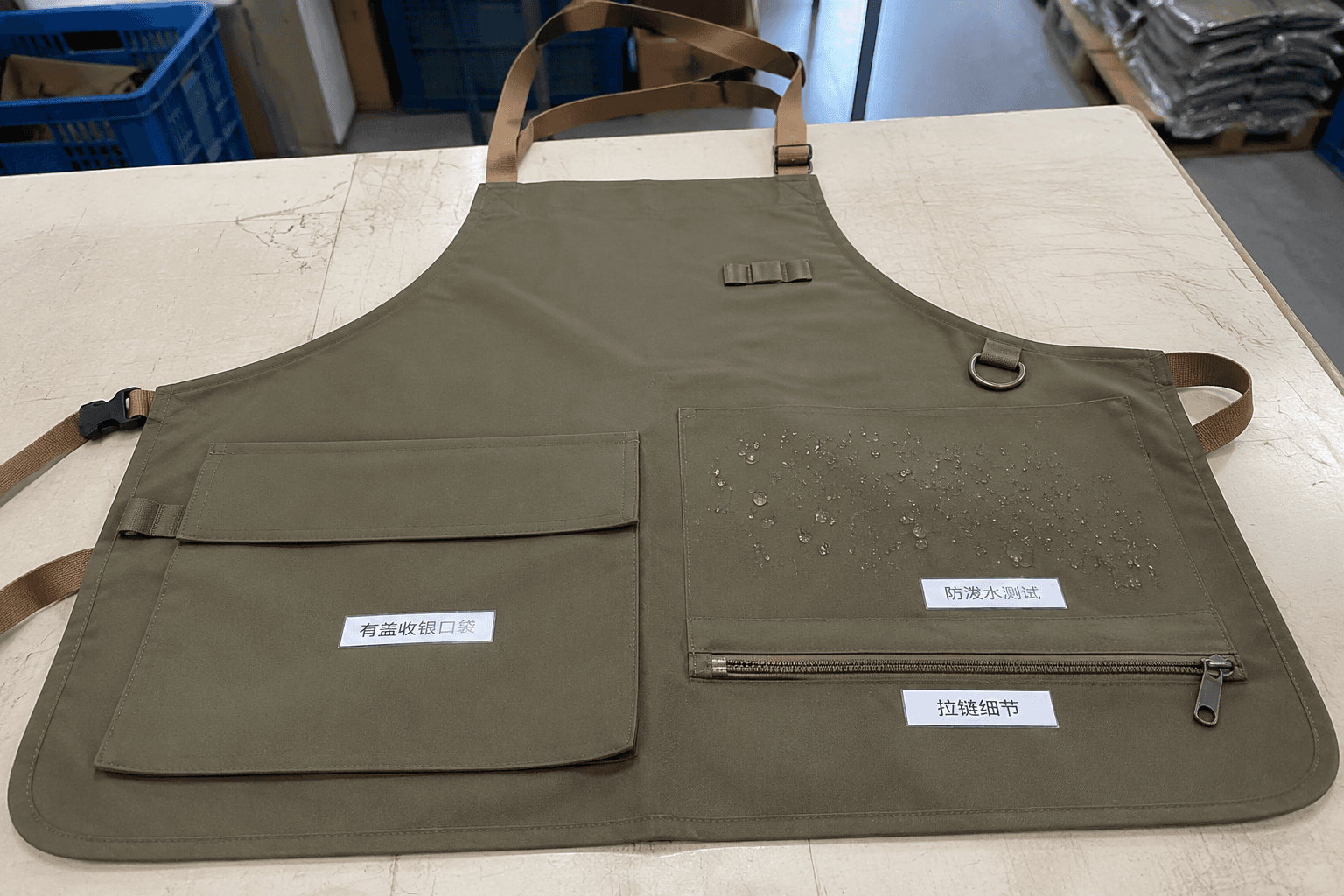
The most common problems come from free-hanging hooks, long detachable clips, oversized sliders, decorative chains and loose strap-end parts. These may photograph well, but they add movement noise and visual distraction during service. Better solutions include stitched strap tunnels, hidden webbing adjusters, buttoned ladder systems, compact eyelets and small sliders that sit tight to the body.
Hardware finish changes the visual result as well. Bright polished nickel can reflect dining-room lighting and look sharp against muted interiors, while matte gunmetal, antique brass and color-coated metal usually look more controlled. If the design needs leather-look detail, washable microfiber or bonded synthetic tabs are generally more suitable than natural leather for commercial laundering, unless the buyer accepts special care and shade variation across reorders.
Installation discipline matters as much as hardware choice. Buyers should request trim pull testing, movement checks and confirmation that strap width matches hardware size. On many premium bib aprons, a compact adjuster on 30 mm webbing performs better than a looser decorative metal assembly on the same garment because it stays quieter, sits flatter and reduces service distraction.
- Avoid free-hanging clips or hooks longer than 35 mm when sound control matters.
- Hidden webbing sliders and buttoned ladders are usually quieter than carabiner-style neck systems.
- Specify eyelet smoothness, setting firmness and strap pull strength before PP approval.
- Matte metal generally shows less glare and fewer fingerprints than polished finishes in restaurant lighting.
Premium branding details that hold up through laundering and reorders
In fine dining, branding should support the apron rather than dominate it. Large contrast embroidery, oversized patches and decorative rivets often make a uniform look more like retail merchandise than professional hospitality wear. The strongest branding programs are small in scale, tonal in color and positioned to preserve the garment’s drape.
For bib aprons, a modest left-chest embroidery or a discreet lower-corner mark is usually enough. For waist aprons, tonal woven labels in the side seam, a small embroidery near the pocket edge or a washable debossed synthetic patch near the hem are common options. These placements keep the identity visible at close range without competing with plating, glassware or jacket lines.
Execution quality matters because premium buyers are paying for restraint. Dense embroidery on midweight twill can pucker the shell if stitch density, backing and placement are not controlled. Debossed patches need washable material and edge finishing that will not curl after repeated commercial laundering. Woven labels should fit the color story and avoid stiff constructions that telegraph through the shell. In most programs, one well-managed logo technique performs better than two or three smaller applications scattered across the apron.
Placement must also account for stain exposure, pressing behavior and wear points. Branding too close to a pocket mouth can abrade or crease, while branding near the bib edge can distort the front line after washing and pressing. The stronger sourcing approach is to make fabric quality, edge finish and color depth the main branding language, then add one small identifier that remains stable through multiple production cycles.
- Refined chest embroidery width is commonly 45-70 mm on bib aprons.
- Tonal woven labels usually add identity at about $0.05-0.12/pc, depending on size and fold type.
- Washable debossed synthetic patches often cost less and perform more predictably than natural leather patches.
- Limiting the apron to one logo technique usually improves consistency and controls sewing labor in bulk.
MOQ, FOB cost and production timing in fine dining apron sourcing
Premium apron costing is shaped by fabric quality, trim count, pattern complexity, finish method and branding choice. A visually simple apron can cost more than a decorative one when the buyer specifies better drape, quieter hardware, cleaner stitch balance and stricter inspection. Quotes therefore need to be compared against bill of materials and construction details, not silhouette photos alone.
For China OEM production, a premium waist apron in 260-300 GSM cotton/poly twill with one logo application and minimal hardware commonly lands around $3.20-5.20/pc FOB at standard bulk MOQ. A premium bib apron with adjustable straps, cleaner internal finishing and upgraded low-noise trim typically falls around $4.80-8.50/pc FOB. If the buyer adds custom-dyed fabric, specialty wash effects, molded branded hardware or multiple logo techniques, realistic pricing can move above $9.00-12.00/pc FOB.
MOQ should be planned together with the material strategy. Many factories can support 300-500 pcs/style/color when using stocked or standard-dyed materials. Once the program requires custom shade development, exclusive trim colors or special label tooling, the workable MOQ often rises to 800-1,500 pcs. Buyers covering several restaurant roles usually reduce risk by standardizing one shell fabric and one hardware finish across bib and waist options, then varying only length, pockets or branding position.
Lead-time planning should be counted backward from opening day. Existing-pattern samples are often ready in 7-12 days, while new patterns or major fit revisions usually require 14-21 days. Bulk production commonly needs 25-40 days after PP approval, deposit and material confirmation. Custom dyeing often adds 7-12 days, and custom trim development can add another 10-20 days. In premium apron buying, a realistic calendar is usually more valuable than a slightly lower price from a supplier that has not locked fabric or trim capacity.
- Indicative premium waist apron FOB is $3.20-5.20/pc at standard MOQ.
- Indicative premium bib apron FOB is $4.80-8.50/pc with adjustable straps and upgraded trim.
- Typical MOQ is 300-500 pcs/style/color for standard materials and 800-1,500 pcs for custom fabric or trim programs.
- Sample lead time is usually 7-12 days for existing patterns and 14-21 days for new development.
- Bulk lead time is typically 25-40 days after approvals, with custom dye often adding 7-12 days.
AQL, tolerances and factory briefing for repeatable premium apron reorders
A premium apron looks expensive when construction is controlled. Buyers should review top-edge symmetry, strap attachment balance, pocket alignment, edge-turn smoothness and reinforcement placement on the PP sample. Heavy visible bartacks, uneven topstitch spacing, twisted straps and drifting pocket placement can quickly undermine even a strong fabric. In formal hospitality uniforms, precision is what creates a premium result.
Pocket design deserves the same level of control because it shapes the apron’s overall language. Large divided utility pockets often read as workshop, bar or café rather than fine dining. For servers and sommeliers, a cleaner front usually comes from slim internal divisions, restrained lower pockets or side-entry constructions that do not dominate the panel. For pass or chef-facing roles, a towel loop may be useful, but it should sit flat and stay quiet rather than swing during service.
Quality control should be written before bulk cutting begins. A practical benchmark for most B2B apron programs is AQL 2.5 for major defects and AQL 4.0 for minor defects, with checks covering measurements, stitching, logo placement, fabric shade, hardware finish and pressing presentation. Pocket placement tolerance at about +/-0.5 cm, strap length tolerance at +/-1.0 cm and overall length tolerance at +/-1.0 cm are realistic premium targets. Without written limits, avoidable inconsistencies turn into end-stage disputes.
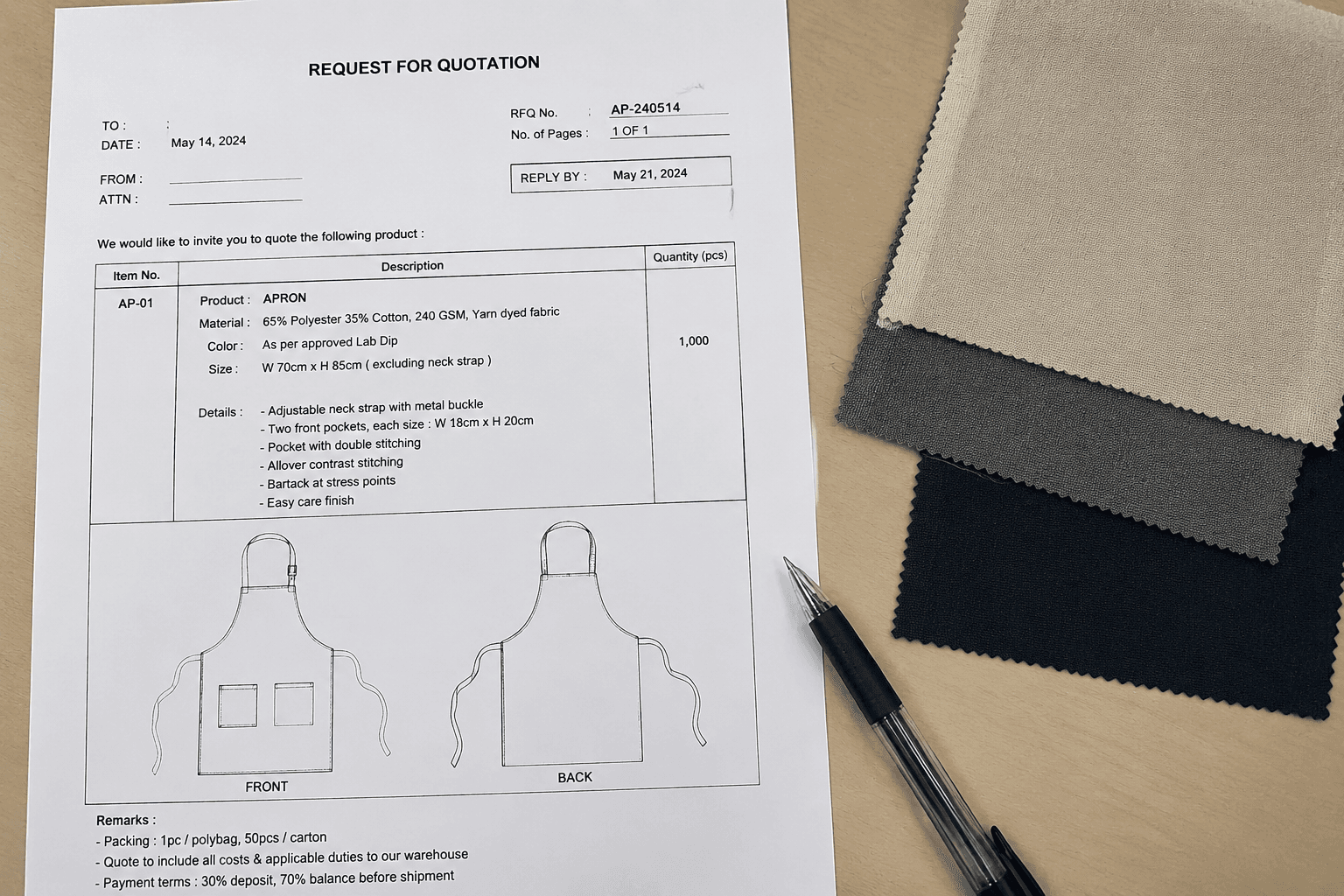
The factory brief should combine commercial and technical detail. It should state target FOB, intended staff role, wash condition, shell fabric range, trim finish, logo method, packing format and reorder forecast. The sealed standard should include approved shell swatch, hardware finish, measurement chart, logo placement, pressing standard and carton requirements. For restaurant groups opening new sites over the next 6-12 months, that sealed standard is what keeps replenishment consistent long after first sample approval.
- Recommended inspection benchmark is AQL 2.5 major and AQL 4.0 minor.
- Practical tolerance targets are pocket placement +/-0.5 cm, strap length +/-1.0 cm and overall length +/-1.0 cm.
- Include a target FOB such as $4.50-6.50/pc early in development to keep sampling commercially realistic.
- Confirm whether packing is flat pack, hanger-ready or individual polybag because presentation changes freight and finishing cost.
- Approve both the PP sample and bulk material standard before cutting, especially for custom-dyed or specially finished fabrics.