Mobile bar teams do not pull aprons from a back-of-house rail and press them at leisure. Their aprons are folded into export cartons or reusable bins, compressed under other event supplies, moved through vans and service corridors, then issued on site with as little as 15-30 minutes to recover. That operating pattern changes the sourcing brief. For most mobile bartending aprons, a 200-240 GSM poly-cotton twill or soft canvas blend is a safer commercial choice than a 320-360 GSM washed cotton canvas because it packs flatter, springs back faster, and keeps the bib area cleaner after transit.
The frequent buying mistake is to source mobile-use aprons as if they were permanent restaurant uniforms. Heavy canvas, multi-layer utility pockets, oversized metal trims, and dense embroidery may look premium on a freshly steamed sample, but they often perform poorly after 24-48 hours under fold pressure. Bib panels hold hard crease lines, pocket stacks print through adjacent layers, and embroidered logos pucker the surrounding fabric. For event operators moving between venues, the real requirement is consistent first-use appearance across 50, 200, or 1,000 pieces, not showroom presence.
For professional buyers, the most useful metric is delivered cost per usable apron on first issue. Moving from a 230 GSM twill to a 340 GSM canvas may add only $0.45-$0.85/pc FOB, but it can also reduce carton yield by 10-18%, increase steaming labor at setup, and raise first-use rejection. The strongest OEM program for mobile bartending aprons balances foldability, wrinkle recovery, logo readability, and repeat-order control.
- 200-240 GSM 65/35 poly-cotton twill is the safest baseline for most mobile bar programs because it balances packability, wrinkle recovery, stain tolerance, and price.
- For cleaner branding after transit, screen print or heat transfer usually outperforms large dense embroidery, especially on aprons under 240 GSM.
- Heavy patch pockets, thick webbing, metal rings, and decorative rivets can cut carton efficiency by 10-18% and leave pressure marks in the bib and waist zones.
- Write a transit simulation into approval: 24-48 hours folded, then review recovery at 30 minutes, 2 hours, and 12 hours with photos of the bib, pocket, and logo zones.
- Typical OEM terms are 300 pcs/style/color for stock-fabric programs, 800-1,500 pcs for custom-fabric or custom-trim programs, and 25-45 days bulk lead time after PP approval.
- Inspect finished goods to AQL 2.5 major / 4.0 minor and approve logos for readability at 2-5 meters, not only on a flat sample table.
1. Why mobile bartending aprons need a transit-first buying brief
A fixed bar can accept a heavier apron because garments are stored on site, issued from a stable stockroom, and corrected before service if they need steaming. Mobile teams work differently. Aprons are folded beside towels, POS devices, menu boards, bottle openers, and charging cables; stacked in cartons or road cases; then unpacked in hotel back corridors or temporary prep rooms where steaming time may be limited to 10-20 minutes or unavailable.
That is why the buying brief for mobile bartending aprons should begin with logistics rather than styling language. Buyers need to specify how long the aprons stay folded, whether they ship in export cartons or reusable bins, whether they move through humid routes, and how quickly they must look event-ready after unpacking. A style that looks acceptable after overnight hanging can still be commercially wrong if staff must wear it within 30 minutes of arrival.
The cost impact is practical. A heavier apron may raise FOB by less than $1.00/pc, but the hidden loss appears in lower carton efficiency, more venue prep labor, and more first-use rejection for poor appearance. For B2B buyers, the right benchmark is not sample-room handfeel; it is the lowest landed cost per usable apron at first issue.
- Typical FOB for a basic bib apron in 200-240 GSM poly-cotton twill: $2.80-$4.60/pc at 500-2,000 pcs.
- Typical FOB for a structured bib apron in 240-280 GSM canvas blend with upgraded trims: $4.40-$6.90/pc at 500-2,000 pcs.
- Useful inspection target: AQL 2.5 major / 4.0 minor across appearance, measurement, sewing, and logo placement.
- Normal sample timing: 5-7 days for proto samples and 7-10 days for PP samples after trims and artwork confirmation.
2. Fabric weights for mobile bartending aprons: where GSM starts to help or hurt
Fabric weight is the first technical filter because it controls packed bulk, fold memory, and recovery speed. For most event-service apron programs, 180-220 GSM works best when compact packing and fast recovery are the highest priorities. This range gives a smaller folded profile and usually reduces the severity of crease lines after 24 hours under carton pressure. The trade-off is appearance: at the low end, some fabrics can read too promotional for premium beverage service.
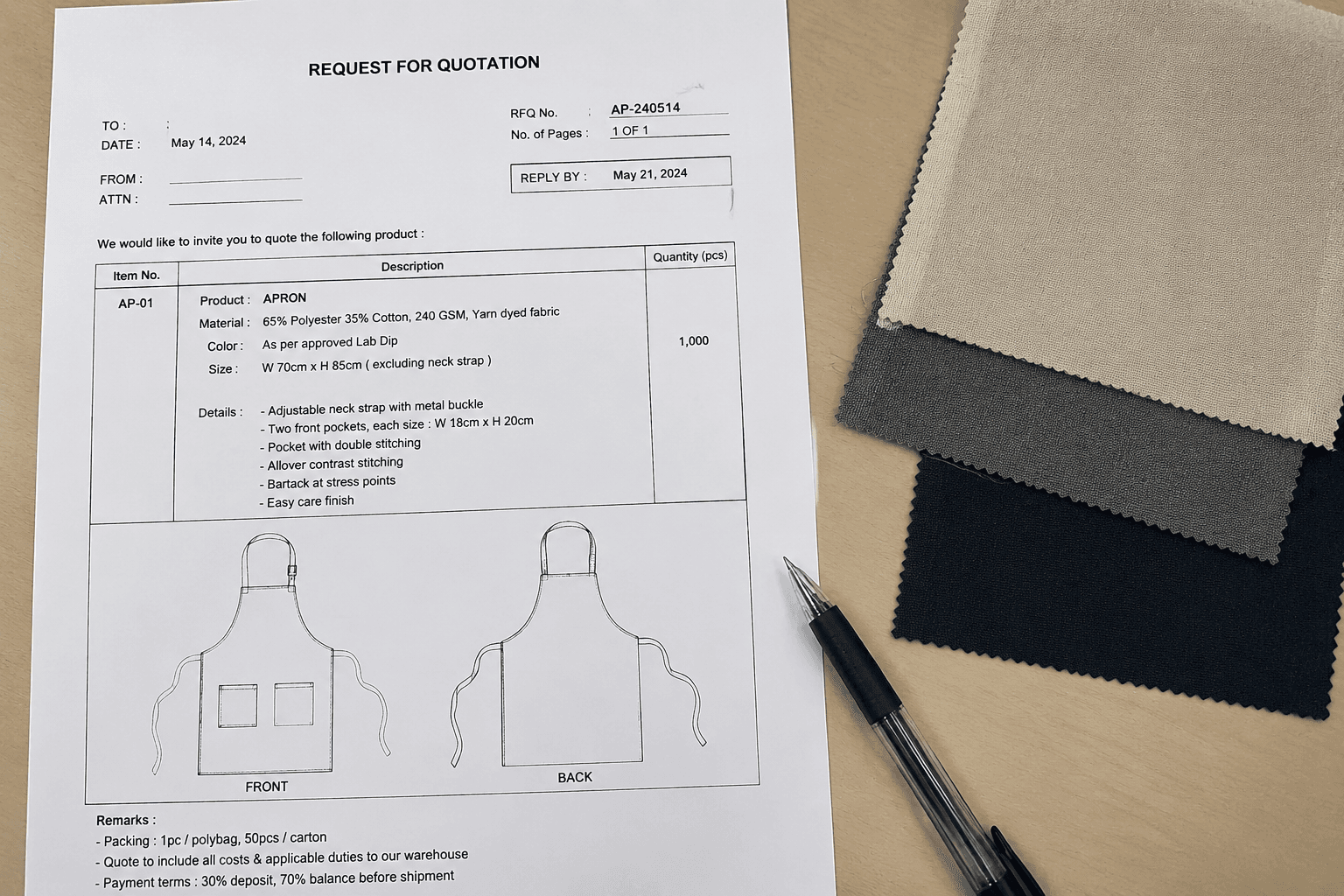
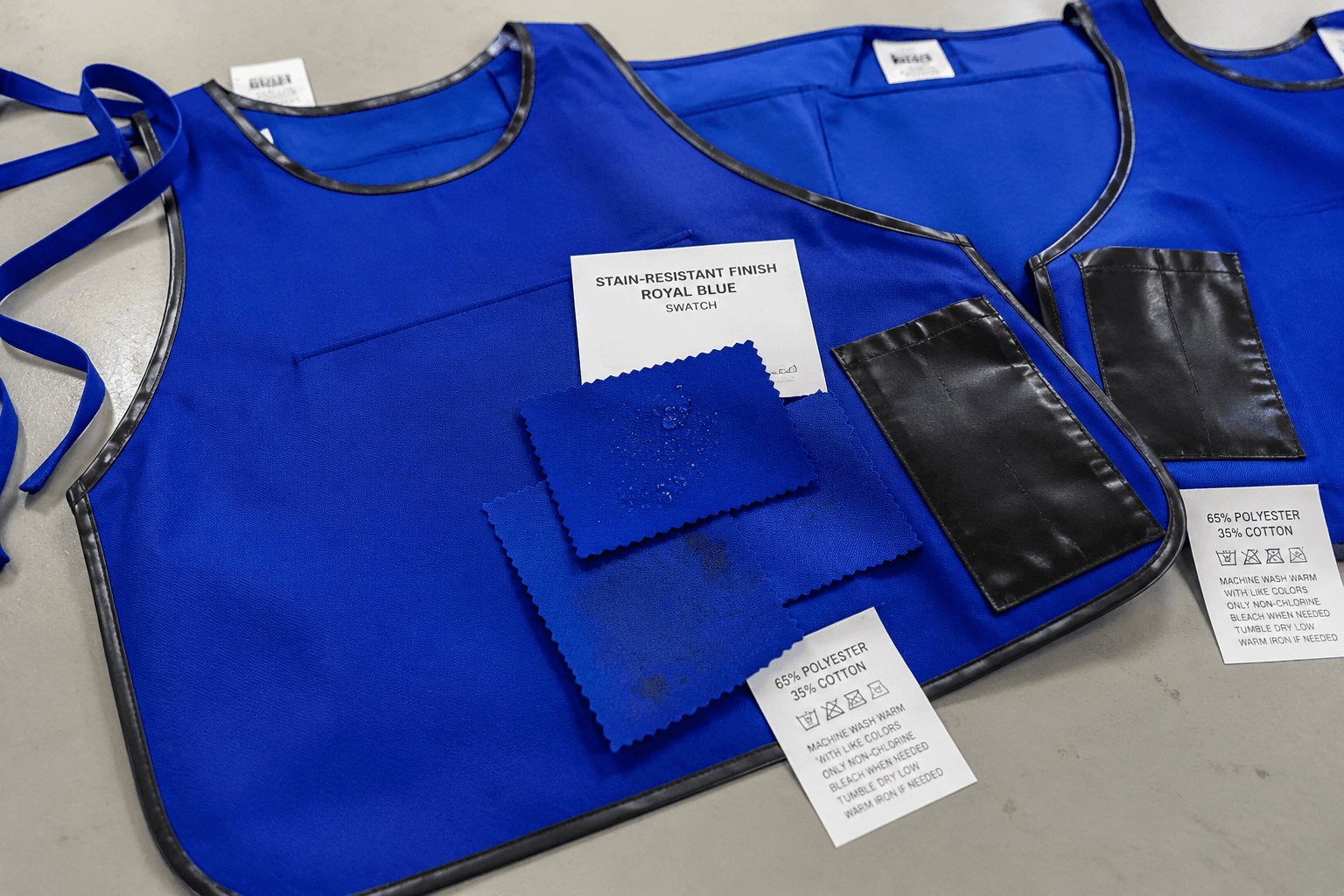
In practice, many buyers settle on 200-240 GSM because it is the most reliable middle ground for mobile bartending aprons. It gives enough body for a professional front-of-house look, but it avoids the thick seam build and hard fold ridges common with heavier canvas. A 65/35 poly-cotton twill is often the safest starting point. Polyester supports crease recovery and abrasion resistance, while cotton softens the handfeel and reduces excessive surface shine under venue lighting and flash photography.
If the brand wants more structure, 240-280 GSM canvas blends can still work, but only after testing the actual finished fabric. GSM alone is not enough. A stiff 260 GSM cotton canvas may hold worse fold memory than a softer 280 GSM polyester-rich canvas with the right finishing. Yarn count, weave density, resin level, and finishing treatment all affect post-transit appearance. Side-by-side fold tests with the final logo method give better decisions than comments on loose swatches.
- 180-200 GSM: suitable for compact packing, lower-cost event use, and high-turnover staffing.
- 200-240 GSM: best all-round range for professional mobile bar teams.
- 240-280 GSM: workable when stronger drape is required, but transit testing becomes mandatory.
- Recommended blend window: 65/35 or 80/20 poly-cotton, depending on required handfeel and decoration response.
- Useful performance checks: crease recovery, colorfastness to crocking, dimensional stability, stain release, and shade consistency.
3. Construction details that keep aprons flatter and cleaner in cartons
Pattern and construction details often matter as much as fabric weight. A clean one-piece apron body with limited horizontal seaming usually travels better than a style divided into decorative panels. Every extra seam creates a thickness ridge that can print through adjacent pieces when 50-100 aprons are packed together. Simpler construction also improves sewing consistency in bulk, which helps buyers control measurements and appearance at final inspection.
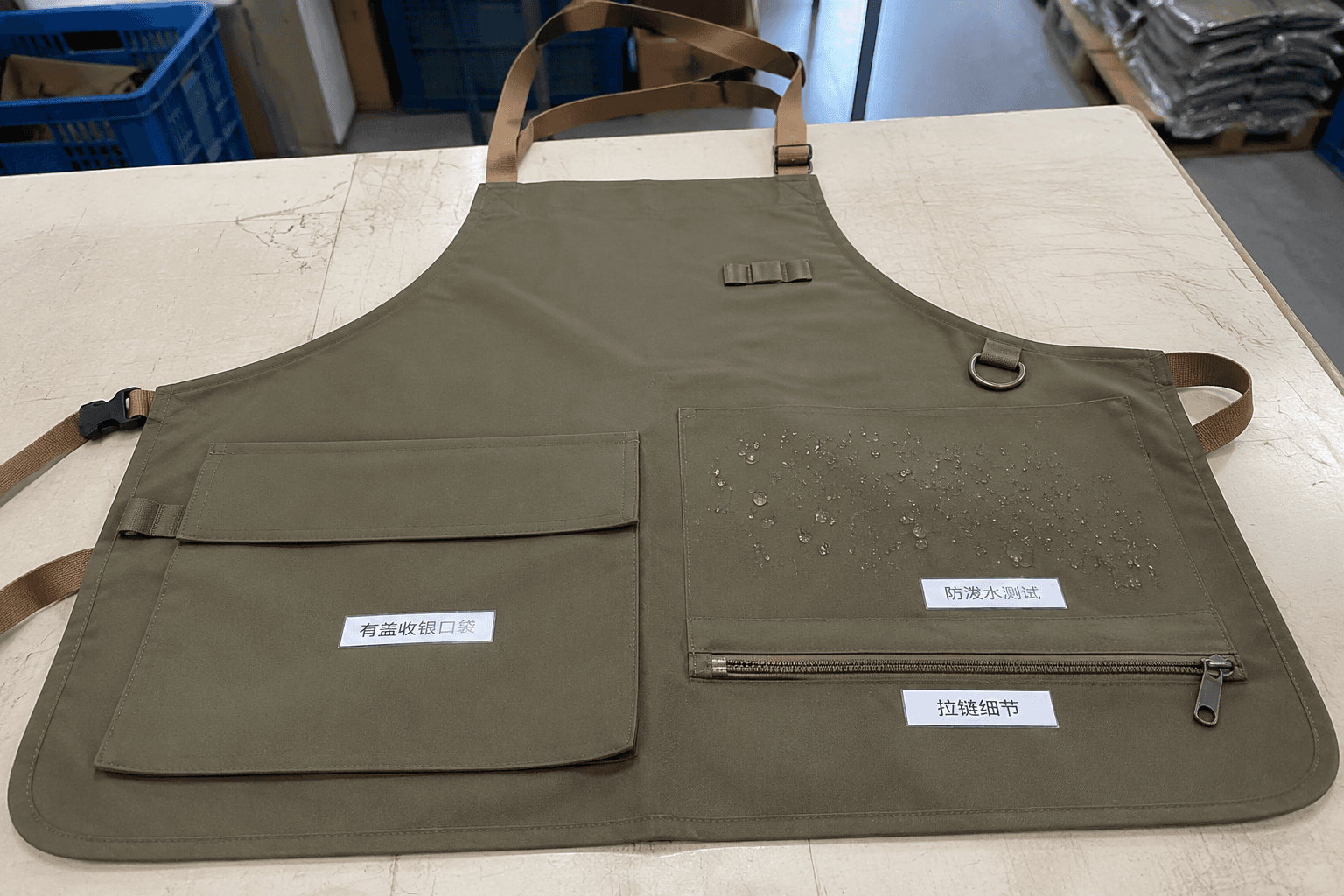
Pocket design is the most common source of unnecessary bulk. Mobile bartenders need practical storage, but three-layer utility pockets, folded facings, and heavy bartacks create the thickest zone on the garment. Under compression, those built-up areas press into the bib and lower body, leaving marks when the apron is unpacked. A flatter patch pocket with internal stitch divisions is usually enough for pens, order pads, openers, or small bar tools without creating a hard pressure block.
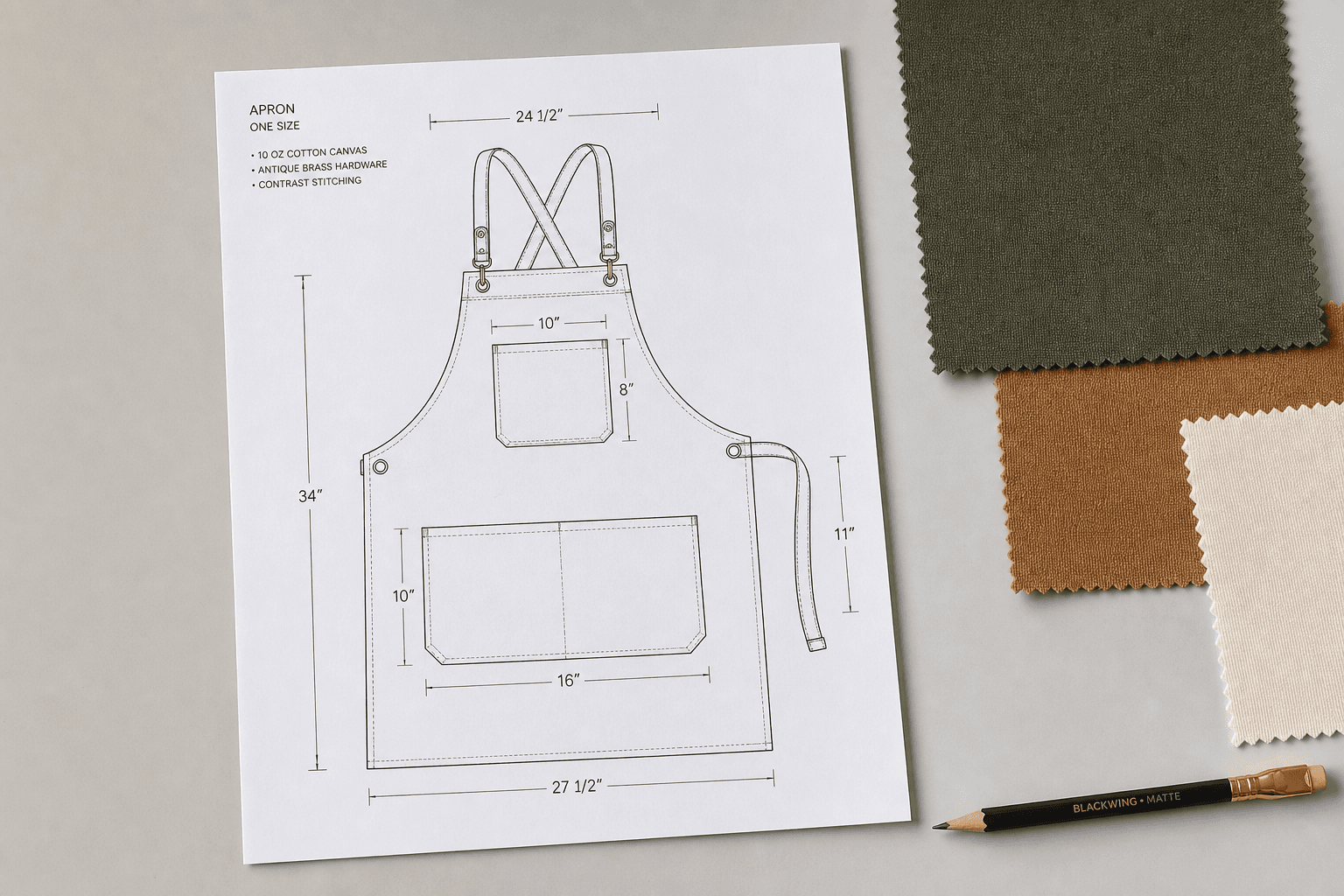
Straps and hardware are the next risk area. Cross-back systems can improve comfort on long shifts, but they add length, tangle more easily in bulk packing, and often require extra adjusters or rings. Neck-loop styles are faster to fold and issue. If cross-back is necessary, self-fabric straps or moderate-weight webbing with low-profile hardware are safer than oversized metal parts. Decorative rivets, carabiners, and thick D-rings rarely improve apron function, but they do add weight, cause pressure marks, and increase packing complexity.
- Keep strap width around 2.5-3.0 cm for a practical balance of comfort and fold bulk.
- Target pocket depth at 18-22 cm for service use without overbuilding the lower front.
- Avoid decorative hardware where possible; heavy metal trim can add 0.08-0.20 kg per dozen and mark adjacent panels.
- Request both a folded packing sample and a hanging recovery sample, not only an on-body fit sample.
4. Wrinkle-recovery standards for mobile bartending aprons approvals
Many buyers ask factories for 'wrinkle resistant' aprons without defining a pass standard. That wording is too subjective for OEM production. A better approach is to write a simple transit simulation into the approval file. For example, the factory folds the apron to final packing size, loads it under standard carton pressure for 24 hours, then hangs it for review at 30 minutes, 2 hours, and 12 hours. If field use is harsher, extend the fold period to 48 hours.
This matters because mobile teams often do not have a long prep window. If aprons must be presentation-ready within 20-30 minutes, the acceptable recovery threshold is much stricter than for uniforms stored overnight on hangers. Review the complete garment, not only the base fabric. Pocket edges, strap joints, bib top lines, and decorated areas can recover differently, and those are the zones guests notice first.
The test should also be repeated after care cycles. Some fabrics perform well when new but lose smoothness after repeated washing or high-heat tumble drying. A useful benchmark is to repeat the same fold-and-hang sequence after 3-5 laundry cycles. That gives a more realistic forecast for reusable apron programs and creates an objective basis for approval, correction, or rejection.
- Minimum simulation: 24 hours folded; use 48 hours when aprons sit in vans, venue storage, or humid transit routes.
- Recovery checkpoints: 30 minutes, 2 hours, and 12 hours on a hanger.
- Review zones separately: bib panel, pocket area, waist seam, strap attachment points, and logo zone.
- Repeat the transit test after 3-5 wash cycles for reusable programs.
- Attach recovery photos to the PP file and inspect appearance to AQL 2.5 major / 4.0 minor.
5. Logo visibility after transit: placement and decoration choices that hold up
Branding on aprons should be planned for event use, not just for artwork approval. The common failure is placing the logo too low, sizing it for a digital mockup, or choosing a decoration method that makes the fold zone too stiff. On most bib aprons, the most reliable branding area is the upper bib center or upper left chest, usually 8-12 cm below the top edge. That area stays visible when bartenders lean, carry tools, or work behind a portable bar counter.
Decoration method directly affects post-transit appearance. Large dense embroidery can look premium on a fresh sample, but on fabrics below about 240 GSM it often creates a rigid panel that exaggerates wrinkling around the logo after folding. The embroidery holds firm while the surrounding fabric creases, making the branded area look distorted. For many mobile bartending aprons, screen print or a quality heat transfer gives a cleaner first-use result because the logo panel stays flatter and more readable after unpacking.
Visibility also depends on contrast and viewing distance. Mobile bartenders often wear radios, badges, or tool holsters that compete with logo space. Under mixed hotel or event lighting, low-contrast branding can disappear even when print quality is technically acceptable. Buyers should approve logo size and placement for readability at 2-5 meters and should only sign off after the same folded transit simulation used for the apron body.
- Recommended chest logo width: 7-11 cm for most bib aprons used by mixed-size teams.
- Recommended statement logo width: 18-24 cm only when the lower front will not be blocked by hands, tools, or counters.
- Embroidery is safer on 220 GSM+ fabrics and for smaller marks rather than large filled shapes.
- Screen print and heat transfer usually keep better post-pack flatness on 180-240 GSM aprons.
- Approve decoration on a folded-and-recovered sample, not a freshly pressed sample only.
6. Packing density, carton yield, and the real cost per usable apron
Packing specifications shape both freight efficiency and event-day presentation. Over-compressing aprons to save carton count is a common false economy. A smaller fold may reduce CBM slightly, but those savings disappear if staff must steam dozens of aprons before setup. Bib aprons usually travel better with a wider, flatter fold that avoids driving pocket seams and logo panels into the main body.
Individual polybags remain practical for hygiene, counting, and issue control, but the bag should fit the apron instead of squeezing it tightly. On darker polyester-rich fabrics, a tissue sheet over the logo area can reduce friction shine during longer shipments. Carton quantity should reflect fabric weight, trim bulk, and the downstream handling route. A distributor sending aprons into warehouse storage may accept denser cartons than an operator who needs them to look serviceable the same day they arrive.
Quotations should be compared by landed cost per usable apron, not FOB alone. A style that is $0.30/pc cheaper at the factory gate may still cost more overall if it packs poorly, needs extra venue labor, or shows a higher first-use reject rate. For mobile bar programs, the best-value apron is usually the one that can be unpacked, hung briefly, and issued with no rework.
- Common folded size target: 28 x 32 cm to 30 x 35 cm, depending on strap length and pocket build.
- Typical export carton pack: 50-100 pcs per carton for bib aprons.
- Bulky pockets and heavy hardware can reduce carton yield by 10-18% versus simplified construction.
- Useful packing details: individual polybag, tissue over logo zone, size sticker, assortment label, and desiccant for humid routes.
7. MOQ, lead-time days, and repeat-order controls for apron buyers
Commercial planning is straightforward when the apron uses stock fabric, standard self-fabric ties, and one decoration method. In that case, MOQ commonly starts at 300 pcs per style per color, with bulk production in about 25-30 days after PP approval and deposit. Once the brief moves to custom-dyed fabric, branded hardware, woven tapes, or mixed decoration methods, MOQ usually rises to 800-1,500 pcs and lead time extends to 35-45 days. Those ranges are normal for apron OEM programs because fabric and trim coordination becomes the schedule driver.
To keep development efficient, buyers should freeze three variables early: fabric, logo method, and strap system. These choices determine most of the apron’s transit behavior, folded profile, and unit cost. Late changes, such as switching from neck-loop to cross-back or from print to dense embroidery, usually trigger re-costing, pattern adjustment, and another transit test. That is manageable, but it adds days and slows approval of the full order.
The cleanest repeat-order system is a written checklist tied to the PP sample and final inspection standard. For mobile bartending aprons, approval should cover GSM tolerance, blend ratio, color standard, fold size, logo position, transit-recovery photos, carton quantity, and spare overrun policy. Once those controls are locked on the first PO, reorders move faster, claim rates fall, and buyers can compare suppliers on measurable apron performance instead of sales language.
- Indicative MOQ: 300 pcs/style/color with stock fabric; 800-1,500 pcs for custom fabric, branded trims, or special dye lots.
- Indicative bulk lead time: 25-30 days for standard programs and 35-45 days for custom programs.
- Reasonable GSM tolerance request: +/-5% against approved bulk fabric.
- Useful repeat-order checklist: fabric spec, logo method, fold size, recovery result, packing detail, carton count, measurement tolerance, and inspection AQL.
- Critical planning question: must the apron be ready immediately, within 30 minutes, or after overnight hanging? That answer should set the whole specification.