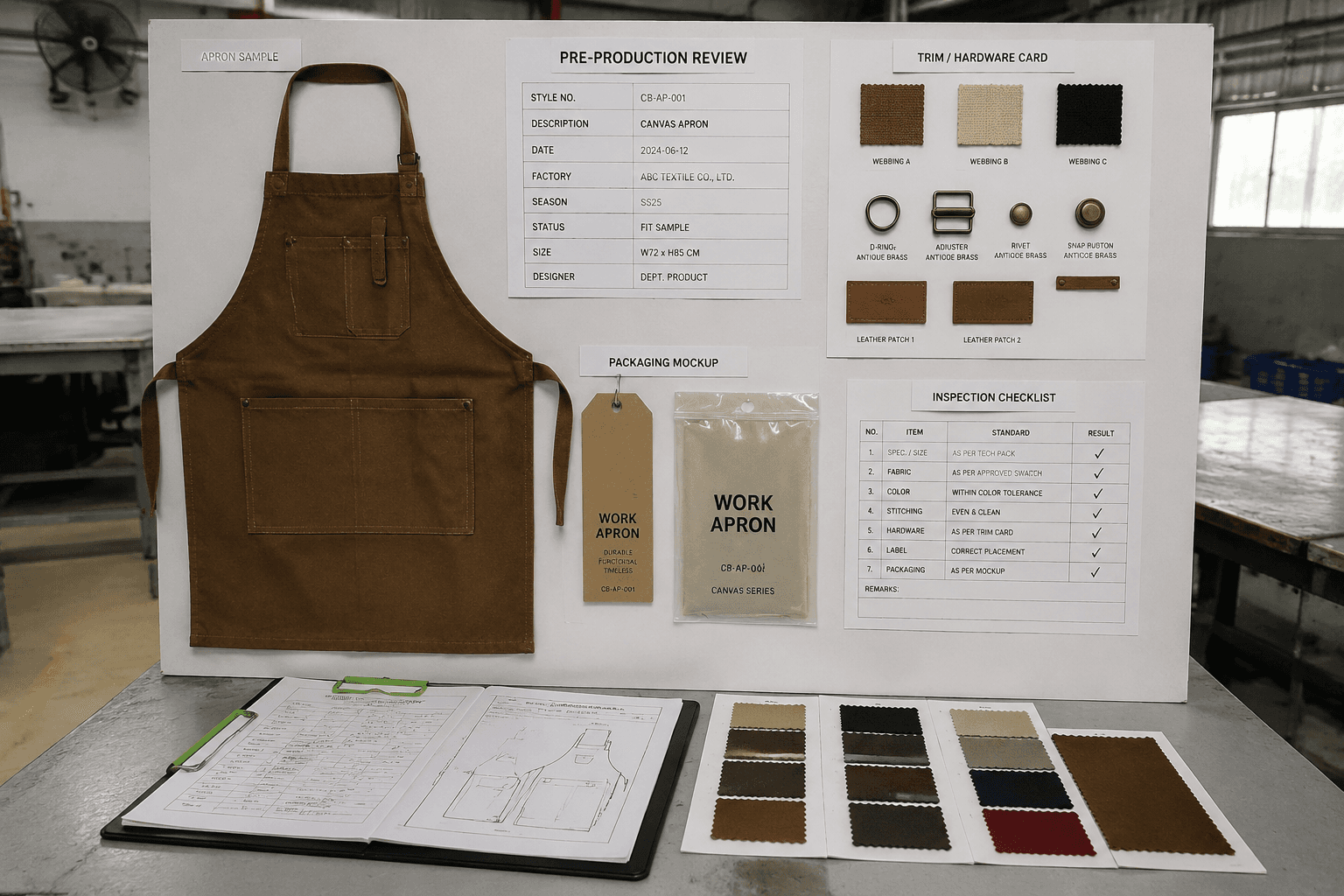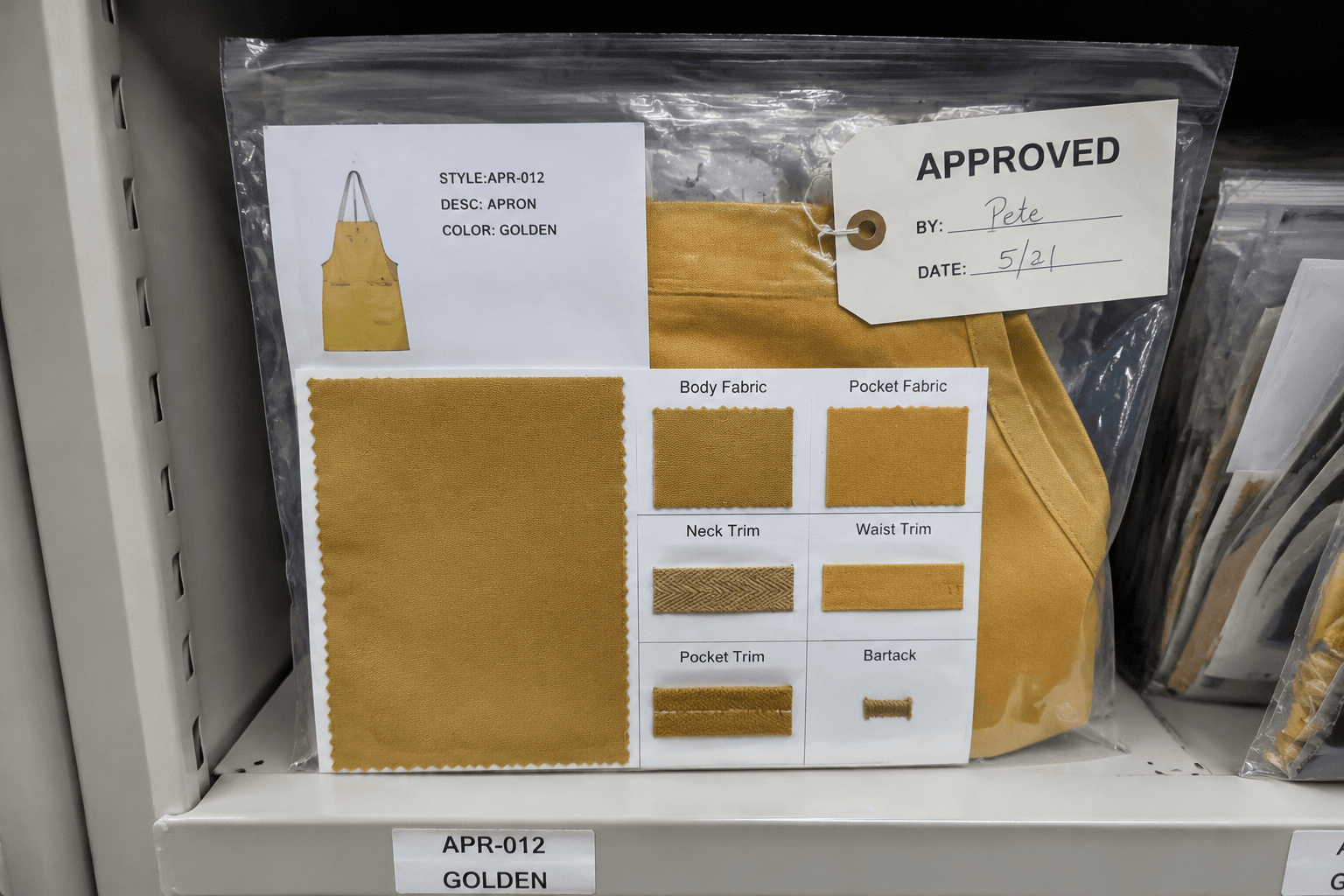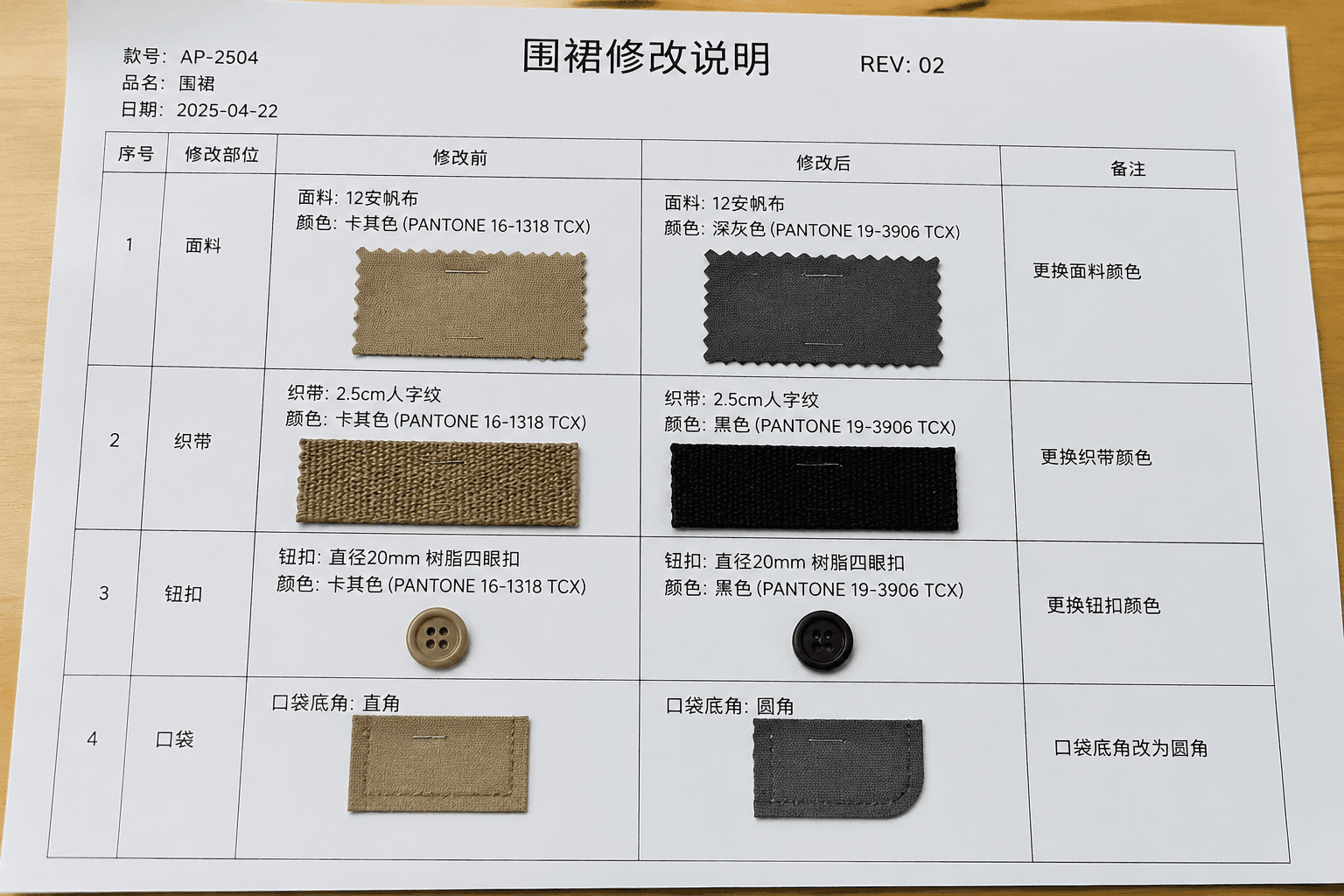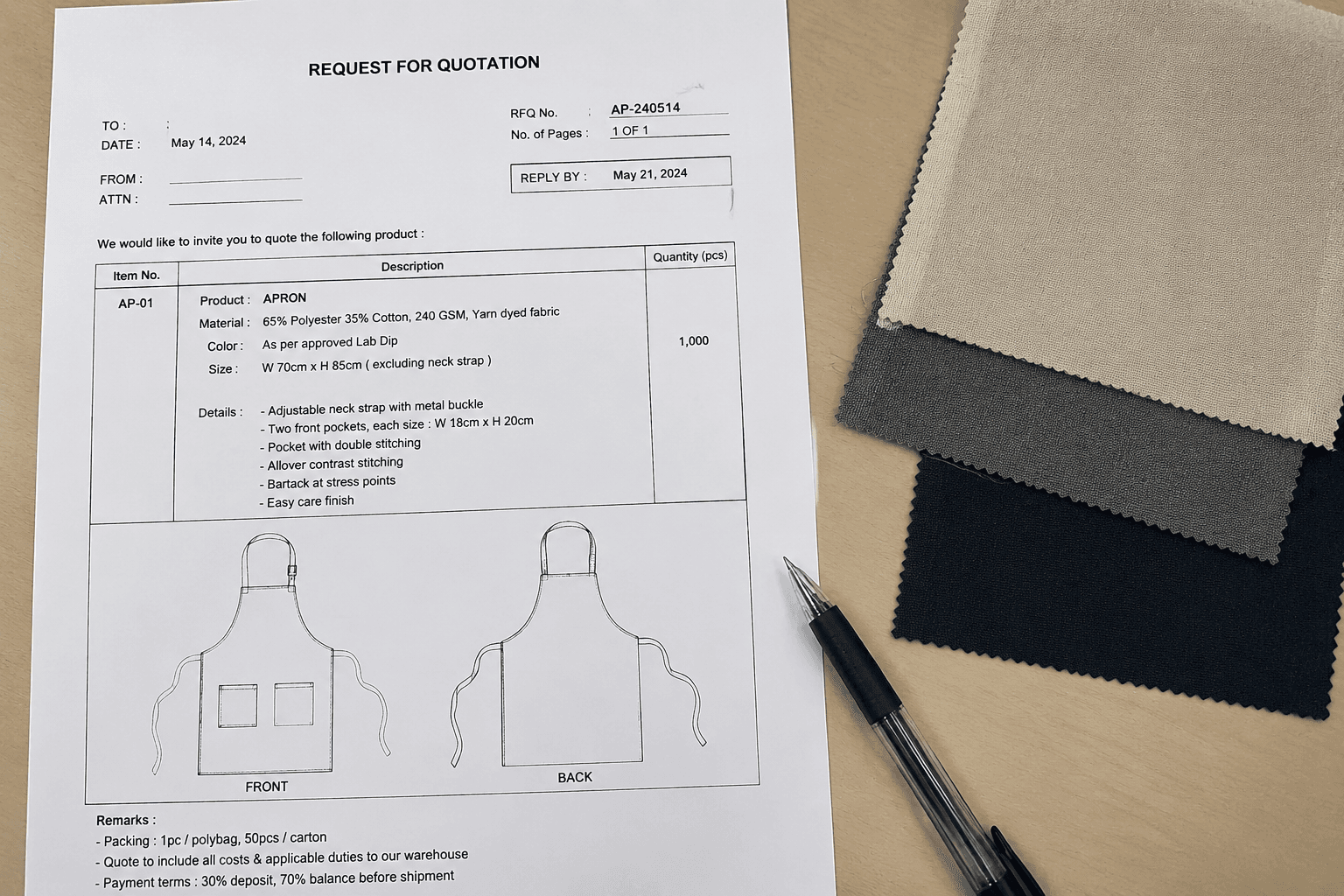
A well-written apron RFQ is not a formality. For a China apron factory, it is the document that determines whether we can quote in 24 hours, whether the price is comparable across suppliers, and whether the final bulk goods match the buyer’s commercial intent. When the inquiry only says “cotton apron, logo printed, 5,000 pcs,” the factory must guess the fabric weight, pocket construction, strap method, logo size, packaging, carton requirements, and testing level. Each guess changes cost.
For sourcing managers and product developers, the goal of an apron quote request is not to make the supplier work harder. The goal is to reduce interpretation. A precise request for quotation apron brief allows each vendor to price the same product assumptions: same GSM, same stitch standard, same logo process, same MOQ, same packing method, and same shipment terms. That is how buyers separate real cost differences from hidden specification gaps.
This article explains how to structure an apron sourcing inquiry so a factory in Zhejiang, Jiangsu, Guangdong, or another China textile cluster can respond quickly with a usable quotation. It also shows which details affect price most, what can be decided later, and where buyers should avoid leaving blanks.
- A complete apron RFQ should include style, fabric, size, logo method, quantity, packaging, compliance, and delivery terms.
- Fabric weight and composition are usually the largest price drivers after order quantity.
- Logo artwork must include size, position, color count, and process preference to avoid non-comparable quotes.
- Packaging details can change apron cost by USD 0.03-0.25 per piece depending on bag, insert card, barcode, and carton rules.
- Clear MOQ, sampling, and delivery expectations help suppliers quote realistic lead times instead of optimistic placeholders.
- Comparable quotes require fixed assumptions, not only a target price.
Why a detailed apron RFQ changes the quote quality
Aprons look simple, but the cost structure is layered. A bib apron may include one main fabric, two neck ties, two waist ties, one or two pockets, reinforced bartacks, folded hems, logo printing, individual polybagging, carton marking, and sometimes metal eyelets or an adjustable buckle. A waist apron may appear cheaper, but pocket layout, fabric width yield, and binding method can make two similar styles differ by USD 0.10-0.40 per piece at bulk scale.
When a buyer sends an incomplete apron rfq, the supplier has two choices. The first is to ask many clarification questions, which slows the quote. The second is to quote based on internal assumptions, which makes the price fast but not reliable. One factory may assume 180 GSM cotton twill, another may assume 240 GSM canvas, and a third may quote polyester-cotton because it is cheaper. On paper, the prices look competitive. In production, they are not the same apron.
A strong apron quote request removes most of this uncertainty before the quotation stage. It does not need to be a 20-page technical file. For early sourcing, a one-page RFQ template apron format is enough if it includes the right commercial and technical variables. The factory can then confirm cost, MOQ, sample lead time, bulk lead time, and any risk points in a single reply.
- A vague request such as “denim apron, leather patch, 10,000 pcs” can require 8-12 follow-up questions before pricing.
- A complete request with fabric weight, measurements, logo size, and packing can usually be quoted within 24-48 hours.
- A technical pack with artwork and packaging rules can support a more stable first quote, often within a +/-3% cost range before sampling.
Start the apron sourcing inquiry with product type and end use
The first line of the request should state what the apron is for. Restaurant service aprons, barista aprons, chef aprons, gardening aprons, salon aprons, workshop aprons, promotional aprons, and children’s aprons have different durability, washing, and safety expectations. End use affects fabric choice, strap construction, pocket reinforcement, and compliance. A 160 GSM polyester promotional apron may be acceptable for an event giveaway, but it is weak for a cafe uniform program that washes every week.
The style name should be specific. “Apron” is too broad. Use terms such as bib apron, cross-back apron, waist apron, bistro apron, cobbler apron, pinafore apron, chef apron, waterproof apron, denim apron, or kids apron. If the buyer has a reference photo, include it. If not, provide the basic construction in words: full bib, adjustable neck strap, two waist ties, one center pocket, hemmed edges, no lining.
Factories also need to know whether the product is a one-time promotional order or a repeat uniform program. For repeat orders, we may recommend more stable fabrics and trims that can be reordered from the same mill. For one-time campaigns, buyers may prioritize fast lead time and lower MOQ.
- State the apron type: bib, waist, bistro, cross-back, cobbler, chef, waterproof, denim, or kids.
- State the end use: cafe uniform, restaurant kitchen, retail merchandise, event giveaway, garden center, workshop, salon, or school activity.
- State the expected order pattern: one-time order, seasonal reorder, annual framework order, or rolling monthly call-off.
- Attach at least one front view image and, if possible, one back view or strap detail image.
Fabric details decide most of the apron RFQ cost
For aprons, fabric specification is usually the first cost gate. The difference between 180 GSM cotton twill and 280 GSM cotton canvas can be more than USD 0.35 per piece on a standard adult bib apron, depending on fabric width, dyeing method, and order quantity. Denim, yarn-dyed stripe, washed canvas, linen blend, and recycled polyester each require different sourcing channels and lead times.
Buyers should specify composition, weave, GSM or oz, color, and finish. If the exact fabric is not fixed, provide a target range. For example: “100% cotton twill, 220-240 GSM, black, reactive dyed, suitable for commercial washing” gives the factory a clear sourcing direction. For denim, use oz per square yard if available, such as 8 oz, 10 oz, or 12 oz. For canvas, GSM is more common in China quotations, though oz can also be converted.
Color details matter. Black, navy, white, natural, khaki, and grey are often easier to source from stock fabric, especially in 180-260 GSM cotton or polyester-cotton twill. Custom Pantone dyeing usually increases MOQ. For cotton twill, a mill may require 300-500 kg per color. Depending on apron size and fabric consumption, that may translate to roughly 2,000-5,000 adult bib aprons per custom color. If the buyer’s quantity is only 500 pcs per color, the factory may need to use available stock colors or charge a higher fabric premium.
- Composition: 100% cotton, 65/35 poly-cotton, 80/20 poly-cotton, cotton-linen, denim cotton, recycled polyester, TPU-coated polyester, or PVC-coated fabric.
- Weight: 160-180 GSM for light promotional aprons, 200-240 GSM for common service aprons, 260-320 GSM for heavier canvas uniforms, or 8-12 oz for denim styles.
- Construction: twill, canvas, plain weave, denim, yarn-dyed stripe, herringbone, coated fabric, or washed fabric.
- Color standard: stock color, Pantone TCX/TPX, buyer lab dip, or approved previous bulk reference.
- Finish: enzyme wash, stone wash, water repellent, anti-wrinkle, pre-shrunk, brushed, or no special finish.
Measurements, pockets, and strap construction must be fixed before quoting
Apron measurements affect fabric consumption directly. A bib apron at 70 x 85 cm has a different yield from one at 75 x 90 cm, especially when fabric width is 150 cm and the cutting layout must avoid twisting or visible shade variation. For a large order, a few centimeters can change fabric usage enough to move the price by USD 0.05-0.15 per piece.
The RFQ should include body size, pocket size, pocket quantity, pocket placement, strap length, strap width, and adjustment method. Adjustable neck straps can use metal sliders, plastic buckles, snap buttons, buttonholes, or D-rings. Cross-back aprons may use detachable straps with eyelets, sewn-in straps, or webbing tape. These options change material cost and sewing time. For example, a basic fixed neck strap may add very little cost, while a metal slider and buckle set may add USD 0.08-0.18 per piece depending on quality and plating.
Pocket construction is another common quoting gap. A single patch pocket is simple. A divided pocket with pencil slot, angled opening, rivets, and double topstitching is more expensive. Buyers should mention whether pockets need bartacks at stress points. In workwear and hospitality aprons, bartacks are a small cost but a practical reinforcement.
- Body dimensions: width at top bib, width at waist, bottom width if tapered, and full length.
- Pocket layout: no pocket, single center pocket, two lower pockets, chest pocket, divided tool pocket, or hidden phone pocket.
- Strap type: fixed neck strap, adjustable neck strap, cross-back straps, webbing ties, fabric ties, tape ties, or detachable straps.
- Reinforcement: bartacks, rivets, double stitching, pocket corner reinforcement, or stress-point stitching.
- Tolerance: common bulk tolerance is +/-1 cm for main dimensions and +/-0.5 cm for pocket and logo placement.
Logo and branding details in a request for quotation apron brief
Logo application is often where apron quotes become non-comparable. A one-color screen print on a 10 x 6 cm chest position is very different from a 4-color print across a 28 x 20 cm pocket panel. Embroidery, woven labels, PU leather patches, genuine leather patches, heat transfer, silicone badges, and metal labels all use different MOQ and setup costs. The apron rfq should not only say “with logo.” It should define the process or ask the supplier to quote two named options.
For screen printing, include artwork size, number of colors, print position, and fabric color. On dark fabrics, some prints need a white underbase, which increases cost and may affect hand feel. For embroidery, include stitch size or artwork dimensions. If the logo is dense, embroidery cost can rise quickly because embroidery is usually calculated by stitch count, not only by logo size. A small 7 x 3 cm text logo may be economical, while a filled 10 x 8 cm emblem can add significant machine time.
Brand labels and packaging branding also belong in the same RFQ. A woven neck label may cost USD 0.02-0.05 per piece at bulk scale, while a PU patch may cost USD 0.08-0.25 depending on size, debossing, and minimum order. Genuine leather patches require more care because color variation, edge finish, and wash performance must be approved.
- Logo process: screen print, digital print, embroidery, heat transfer, woven label, PU patch, leather patch, rubber patch, or metal plate.
- Logo size and position: for example, 9 x 5 cm centered on chest, 12 cm below top edge.
- Color count: one-color, two-color, CMYK, Pantone matched, tonal embroidery, or metallic thread.
- Artwork file: AI, PDF, EPS, or high-resolution PNG for early quoting, with vector artwork before sampling.
- Setup cost: printing screen, embroidery tape, mold fee, patch tooling, or label MOQ should be quoted separately when applicable.
Quantity, MOQ, price breaks, and realistic lead times
Quantity is not only a number for total order value. It decides fabric sourcing route, trim MOQ, printing efficiency, cutting efficiency, and carton planning. A factory may accept 300 pcs for a simple stock-fabric apron, but custom-dyed cotton canvas, custom hardware, or branded woven labels may push the practical MOQ to 1,000-3,000 pcs. For private label uniform programs, a useful apron sourcing inquiry should include both first order quantity and estimated annual volume.
Ask for price breaks that match your real buying plan. Common apron price breaks are 500 pcs, 1,000 pcs, 3,000 pcs, 5,000 pcs, and 10,000 pcs per style/color. If the style has multiple colors, specify whether the quantity is total or per color. “5,000 pcs assorted colors” is not the same as “5,000 pcs per color.” Factories need color-level quantities because fabric dyeing, cutting, and printing setup are organized by color.
Lead time should be separated into sample time and bulk production time. A typical apron proto sample may take 5-7 days after artwork and fabric confirmation. A pre-production sample with custom-dyed fabric, woven label, and printed packaging may take 12-20 days. Bulk production for 3,000-10,000 pcs often takes 25-40 days after sample approval and deposit, but peak season, fabric dyeing, washing, or complex branding can extend this to 45-60 days.
- Ask for unit prices at realistic levels: 500, 1,000, 3,000, 5,000, and 10,000 pcs where relevant.
- Separate quantity by style, color, size, and logo version.
- State whether the order is repeatable, because annual volume can affect fabric and trim pricing.
- Request sample lead time, bulk lead time, and the point from which each lead time starts.
- Clarify whether the delivery date means ex-factory date, FOB vessel closing date, or arrival at destination warehouse.
Packaging, carton, compliance, and shipment terms
Packaging can look minor in an apron RFQ, but it often changes both unit cost and packing labor. Bulk packed aprons in an export carton are the lowest-cost option. Individual polybags with suffocation warning, size sticker, barcode, hangtag, insert card, and retail carton marking add cost and require more inspection time. For retail or Amazon-style distribution, carton size, carton weight, barcode format, and master carton labels should be included before quoting.
Compliance requirements must also be stated early. For adult aprons sold in the EU, buyers may ask for REACH-related chemical control. For the US, some buyers require Prop 65 assessment depending on materials and sales channel. For children’s aprons, CPSIA, small parts, drawstring safety, and flammability considerations may apply. If the apron uses coated waterproof fabric, leather patch, metal trim, or recycled material claims, testing scope should be more carefully defined.
Shipment terms affect quote comparison. FOB Ningbo and FOB Shanghai are common for Zhejiang apron factories. EXW may look cheaper but excludes local export handling. DDP includes much more risk and cost, and the factory may need destination address, HS code confirmation, duty rate, and delivery method. A professional apron quote request should state whether the buyer wants EXW, FOB, CIF, DAP, or DDP, and which currency should be used.
- Packaging: bulk pack, individual polybag, biodegradable bag, hangtag, insert card, belly band, retail box, or hanger pack.
- Carton rules: pieces per carton, maximum carton weight, carton dimensions, shipping marks, barcode labels, and palletization if required.
- Compliance: REACH, OEKO-TEX, Prop 65, CPSIA, AZO-free dyes, colorfastness, shrinkage, or buyer-specific RSL.
- Testing targets: washing shrinkage under 3-5%, colorfastness to washing grade 3-4, rubbing fastness grade 3-4, or seam strength as required.
- Trade terms: EXW factory, FOB Ningbo, FOB Shanghai, CIF destination port, DAP warehouse, or DDP address.
A practical RFQ template apron buyers can adapt
The best RFQ template apron format is short enough for daily use but complete enough to prevent hidden assumptions. It should combine product specification, commercial requirements, packaging, compliance, and timeline in one document. Buyers can send it as an email table, spreadsheet, or attached brief. The important point is that every supplier receives the same information.
For early development, it is acceptable to leave some options open, but mark them clearly. For example, write “please quote 220 GSM cotton twill and 240 GSM poly-cotton twill as two options” instead of “good quality fabric.” Write “please recommend lowest-cost retail-ready packing” if packaging is not fixed. Factories can provide useful alternatives when the target is clear.
A disciplined apron rfq also helps buyers evaluate supplier replies. A good quotation should confirm assumptions, quote unit price and setup cost separately, state MOQ, sample time, bulk lead time, payment terms, validity period, and any exclusions. If two suppliers quote different fabrics or different packing, the buyer should not compare the unit price until those assumptions are normalized.
- Subject line: apron sourcing inquiry for adult bib apron, 5,000 pcs, FOB Ningbo, target delivery date.
- Product: adult bib apron, 72 x 86 cm, adjustable neck strap, two waist ties, one divided front pocket.
- Fabric: 100% cotton twill, 240 GSM, black and natural, stock color preferred, quote custom Pantone MOQ if needed.
- Branding: one-color screen print, 10 x 6 cm chest logo, vector artwork available, quote screen charge separately.
- Packaging: one piece per polybag with barcode sticker, 50 pcs per export carton, carton marks required.
- Quantity: 2,500 pcs black and 2,500 pcs natural, with price breaks for 3,000 pcs and 10,000 pcs total.
- Compliance: AZO-free dye, REACH suitable, washing shrinkage target under 5%, colorfastness report if available.
- Timeline and terms: proto sample in 7 days, bulk shipment within 35 days after PP sample approval, FOB Ningbo, quote in USD.