For bulk apron programs, logo position is not a small artwork decision made at the end. It affects pattern layout, pocket construction, print method, embroidery size, production speed and final unit cost. A 70 mm chest embroidery on a 240 GSM twill bib apron behaves very differently from a 220 mm screen print across the lower hem of a 10 oz canvas waist apron.
From a factory point of view, apron logo placement should be confirmed before sampling, because the logo area often intersects with seams, pocket openings, straps, bartacks, snap buttons or divided tool pockets. When the buyer sends artwork after the sample is approved, the pattern may still be technically correct, but the branding position may not be optimal for real production.
This article explains where to put apron logo artwork on chest panels, pockets, hems and straps, with practical comments on print area, embroidery limits, MOQ impact, lead time and common sourcing risks for custom aprons ordered from China.
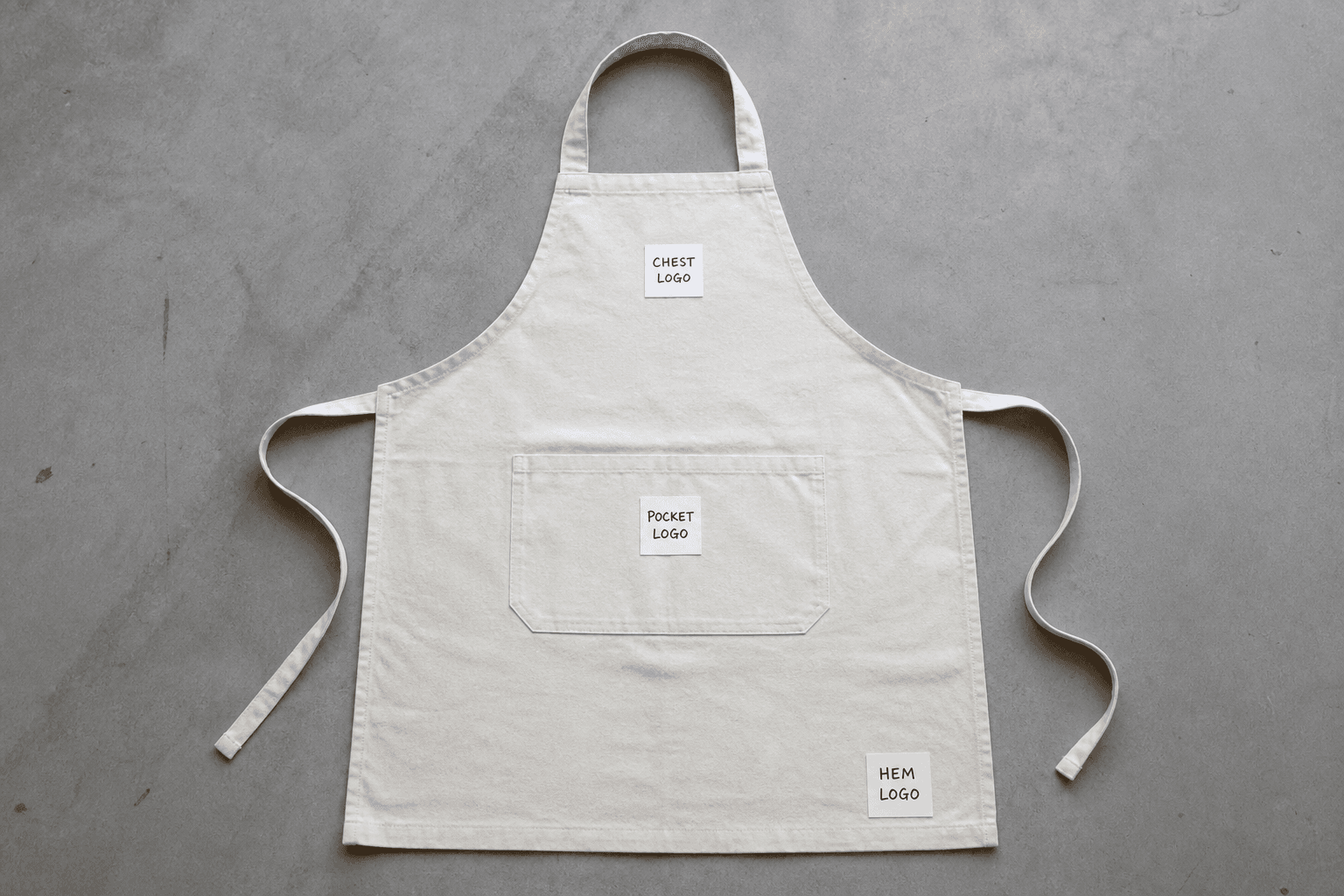
- Chest logo placement gives the strongest front-facing visibility, but it requires enough flat bib area above pockets and away from neck strap seams.
- Pocket logo placement is clean and retail-friendly, but embroidery and printing must avoid pocket openings, pen slots and tool divisions.
- Hem logo placement works well for large horizontal marks, especially on waist aprons, but it may fold or disappear when the wearer bends or ties the apron.
- Strap branding is possible but limited, with higher tolerance risk and lower visibility than body-panel logo positions.
- Artwork size should be matched to fabric weight and decoration method, because a dense embroidery can distort light 180 GSM fabric while a large print may crack on coarse canvas if the ink system is wrong.
- Logo placement should be locked before pre-production sample approval, because moving a logo by 20-30 mm can change pocket stitching, print jig setup or embroidery hooping.
Why apron logo placement must be decided before sampling
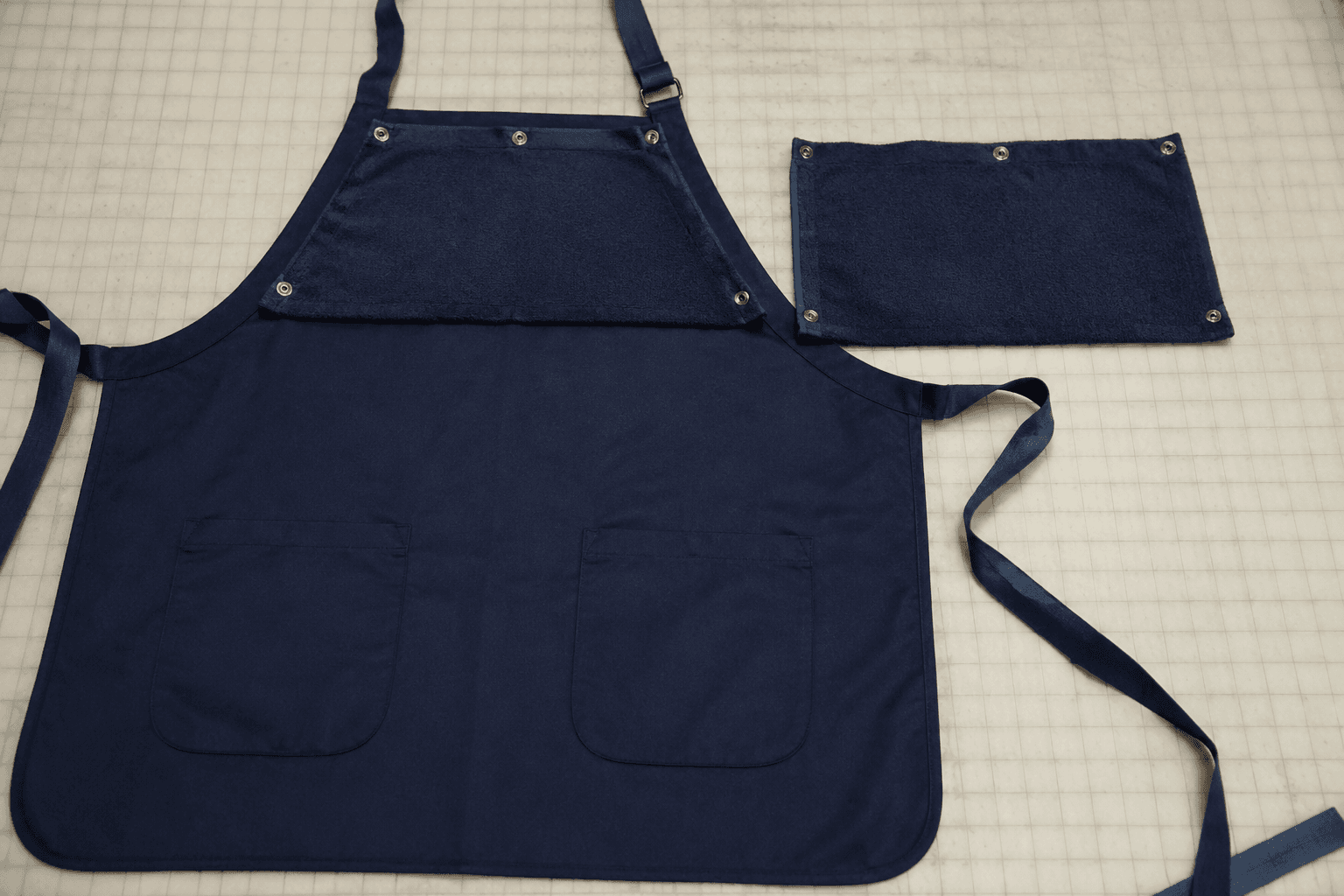
A custom apron is not a flat T-shirt panel. It has curved bib sides, waist ties, neck straps, pockets, reinforced corners, divided compartments and sometimes metal eyelets, PU tabs or towel loops. These construction points reduce the usable branding area. If a buyer approves the apron pattern first and then asks for a logo on a pocket or lower hem later, the factory may need to revise the pattern, move pocket height or change the decoration process.
For normal OEM apron production, we recommend confirming logo position at the same time as apron size, fabric and pocket design. A practical tech pack should show the logo center point from the top edge or pocket opening, plus finished logo width and height. For example, a chest logo may be specified as 90 mm wide, centered on the bib, with the top of the logo 95 mm below the bib top edge. This is clearer than saying “put logo on chest.”
In bulk production, decoration tolerance also matters. For screen print or heat transfer, normal placement tolerance is usually plus or minus 5 mm on a flat apron panel. For embroidery, tolerance can be plus or minus 3-5 mm depending on hooping stability. On narrow straps, tolerance may be plus or minus 5-8 mm because the strap width is small and fabric can stretch during handling.
- Confirm logo position before salesman sample or pre-production sample, not after bulk fabric cutting.
- Specify logo size in millimeters, not only percentage scale from a mockup.
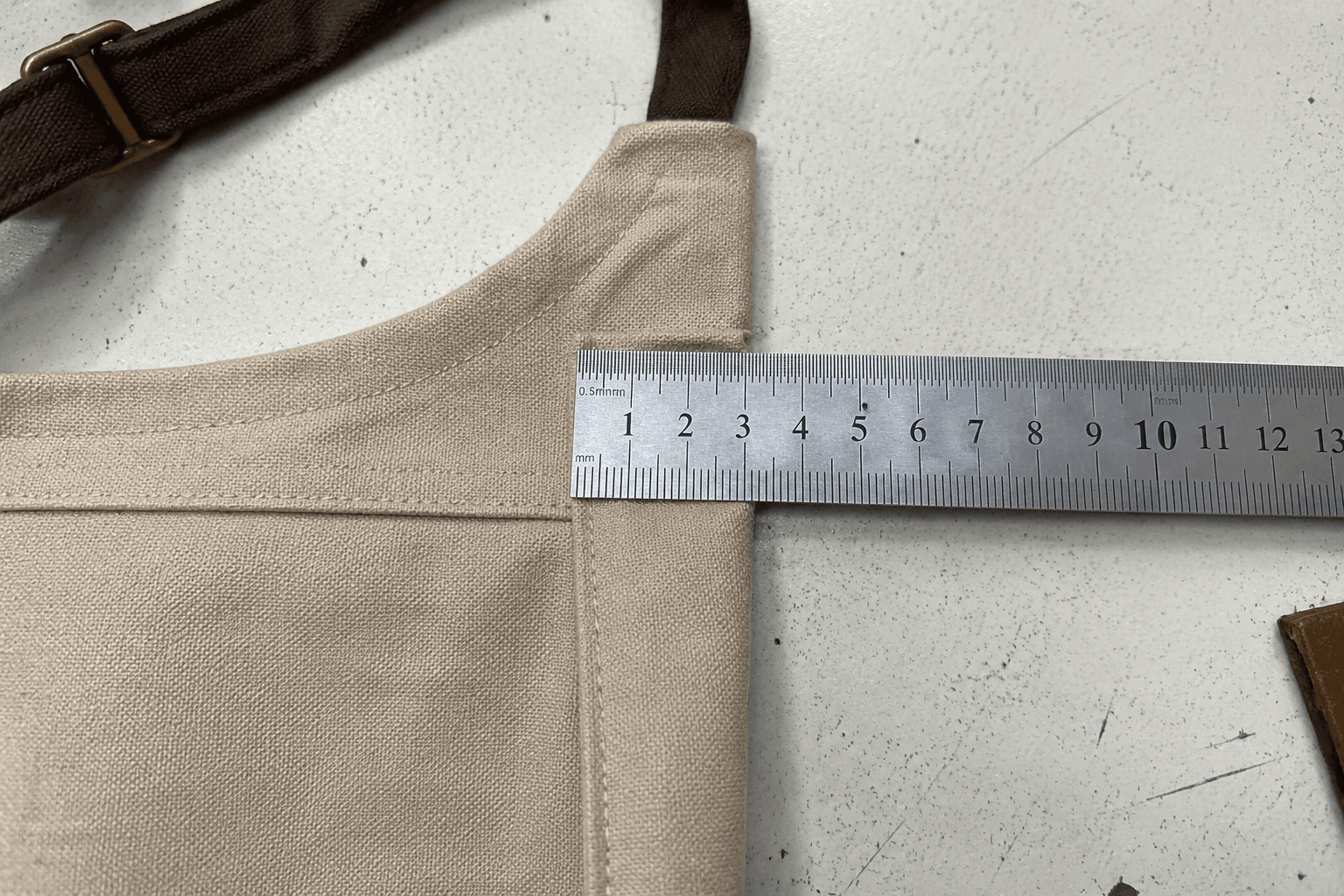
- Measure from fixed garment points such as bib top edge, pocket top edge, side seam or hem edge.
- Check whether the position crosses stitching, pocket openings, darts, eyelets, bartacks or strap attachments.
- Approve one physical decorated sample when order value or brand standard justifies the sample cost.
Apron logo placement on the chest bib
The chest bib is the most common apron branding position for restaurants, coffee chains, bakeries, salons and promotional uniforms. It is visible when the wearer stands behind a counter and it is less affected by waist-level work surfaces. For a full bib apron, the most used logo width is 70-100 mm for embroidery and 90-150 mm for print. A very large chest logo can look strong in a mockup but may feel stiff, especially if the apron uses dense embroidery or thick transfer film.
For standard adult bib aprons, the usable chest zone usually begins 70-100 mm below the top bib edge and ends above the upper pocket or waist seam. If the apron has a chest pocket, the logo must either sit on the pocket, above the pocket, or below it; trying to place a logo across the pocket seam is rarely clean. On a 75 cm wide by 85 cm long bib apron, a centered chest logo of 90 mm wide is normally safe if the bib width at the logo height is at least 220-260 mm.
Fabric also changes the decision. On 180-220 GSM cotton twill, embroidery above 8,000-10,000 stitches can cause puckering unless backing is used and the design is simplified. On 240-280 GSM TC twill or canvas, embroidery is more stable. For 10 oz or 12 oz cotton canvas, screen print can be attractive, but fine text below 3 mm height may lose sharpness because of the weave.
- Use chest placement for front-of-house aprons, barista aprons, chef bib aprons and salon aprons where the wearer faces customers.
- Keep embroidery logos around 70-100 mm wide for most uniform programs; increase only after checking stitch count and fabric stability.
- Use screen print or transfer for larger chest graphics from 100-180 mm wide when the design has solid shapes or multiple colors.
- Avoid placing chest artwork too high, because neck strap stitching and curved bib edges make alignment less stable.
- Check wearer height and apron length, because the same chest logo can sit too low on a short 70 cm apron and too high on a 95 cm apron.
Chest pocket logo and upper pocket branding
A chest pocket logo is common on premium cafe aprons, denim aprons, barber aprons and workwear-inspired retail aprons. It gives a neat branded detail without making the whole apron look promotional. The pocket can carry embroidery, woven label, leather patch, screen print or heat transfer. The best method depends on pocket size and fabric thickness.
For a typical chest pocket of 120 mm wide by 140 mm high, an embroidered logo of 50-70 mm wide is usually safe. If the pocket is divided into a pen slot, the decoration area becomes smaller. A buyer may want the logo centered on the whole pocket, but if there is a vertical stitch line for a pen compartment, the logo should be centered on the larger usable section, not across the stitch line. For this reason, pocket artwork must be reviewed together with the pocket construction drawing.
Pocket decoration can be done before the pocket is attached to the apron body, which often improves handling and accuracy. However, this also means the pocket panel must be printed or embroidered before sewing. If artwork changes after cutting or sewing, rework becomes slow and expensive. For woven labels, MOQ is often 1,000-3,000 pcs per label design, while embroidery can be economical from 100-300 pcs depending on logo complexity.
- A pocket logo should normally leave at least 15-20 mm from the pocket opening and side stitch lines.
- For embroidery on a pocket, keep small letters above 4-5 mm height to maintain readability after washing.
- For heat transfer on a pocket, avoid heavy film near the pocket opening because it can reduce flexibility.
- For leather or PU patches, confirm wash requirement first; industrial laundry may damage low-grade PU patches.
- For divided pockets, approve the logo position on the actual pocket pattern, not only on a flat digital mockup.
Lower hem apron print location for large marks
The lower hem is useful when the buyer wants a larger horizontal brand name, event mark or retail graphic. It is especially suitable for waist aprons, bistro aprons and half aprons where the chest area does not exist. A lower hem print can run 180-300 mm wide on many waist aprons, and sometimes up to 350 mm if the apron width is 700-900 mm. For embroidery, such large sizes are usually not economical because stitch count rises quickly.
The trade-off is visibility. A hem logo is often visible when the wearer is standing, but it may be hidden by the counter, customer line of sight, folded fabric or a hand towel. On kitchen aprons, the lower area also gets more stains and abrasion. For white, beige or light grey aprons, a lower hem print can look clean at packing stage but may become the first dirty area in real use. For restaurants that require frequent washing at 60 degrees Celsius, ink and transfer selection must be checked carefully.
When using this apron print location, the factory must leave enough distance from the bottom hem stitch. A print placed only 10 mm above the hem may look compressed and can be affected by hemming tolerance. For bulk production, 30-50 mm above the finished hem is usually safer. If the apron has rounded corners or side slits, the print should be centered on the flat bottom area rather than the full fabric width.
- Use lower hem placement for waist aprons, promotional aprons and simple logo-wordmark designs.
- Keep large hem prints mainly in screen print, pigment print, discharge print or transfer, depending on fabric and wash requirement.
- Allow at least 30 mm from the finished bottom hem for normal production tolerance.
- Avoid very fine text at the hem because the lower apron area bends, folds and rubs during use.
- Confirm whether the wearer will stand behind a counter, because a low logo may not be seen by customers.
Strap logo placement and narrow branding limits
Strap branding is attractive in a presentation drawing, but in production it has clear limits. Neck straps and waist ties are narrow, flexible and often twisted during use. A printed logo on a 25 mm or 30 mm strap can look premium when new, but visibility is inconsistent when the strap is tied, crossed or hidden under hair, collar or arm movement. For this reason, strap logo placement is normally used as a secondary brand detail, not the main brand mark.
The most realistic strap options are woven jacquard tape, repeated screen print, heat transfer on webbing, or small woven labels stitched to the strap end. If the apron uses self-fabric straps made from the same twill or canvas, printing before strap folding may be possible, but alignment risk increases after folding and stitching. If the strap uses cotton webbing, polyester webbing or herringbone tape, ink adhesion and wash resistance must be tested.
Cost can change quickly. A plain self-fabric neck strap may be included in the apron sewing cost, while custom jacquard webbing can require MOQ from 1,000-3,000 meters and 10-15 days for webbing production before apron sewing. For a 500 pc order, custom webbing may raise unit cost by USD 0.20-0.60 depending on width, color count and leftover tape. For a 5,000 pc order, the cost becomes more reasonable because setup is spread across more pieces.
- Use strap branding as a secondary detail for premium retail or hospitality programs, not as the only logo position.
- Choose repeated logos on webbing when brand consistency matters more than exact single-logo alignment.
- Avoid small strap prints below 20 mm wide if the logo has fine letters or thin lines.
- Budget additional lead time for custom woven tape, usually 10-15 days before sewing can start.
- Test wash resistance on the exact strap material, because webbing and apron body fabric may react differently.
Choosing where to put apron logo by apron style
The best answer to where to put apron logo depends first on apron style. A bib apron gives more vertical branding choices, while a waist apron mainly offers pocket, upper band or lower hem positions. A cross-back apron can make the front cleaner but may move attention to straps and hardware. A chef apron used in a hot kitchen should prioritize wash durability and comfort over decoration size.
For cafe and restaurant uniforms, the chest bib is usually the safest main position because it is visible above the counter and does not interfere with tools in lower pockets. For retail gift aprons, a larger center-front or lower-front print may sell better on shelf because the artwork reads clearly when folded or photographed. For industrial or workshop aprons, pocket patches or woven labels may last longer than large prints exposed to abrasion.
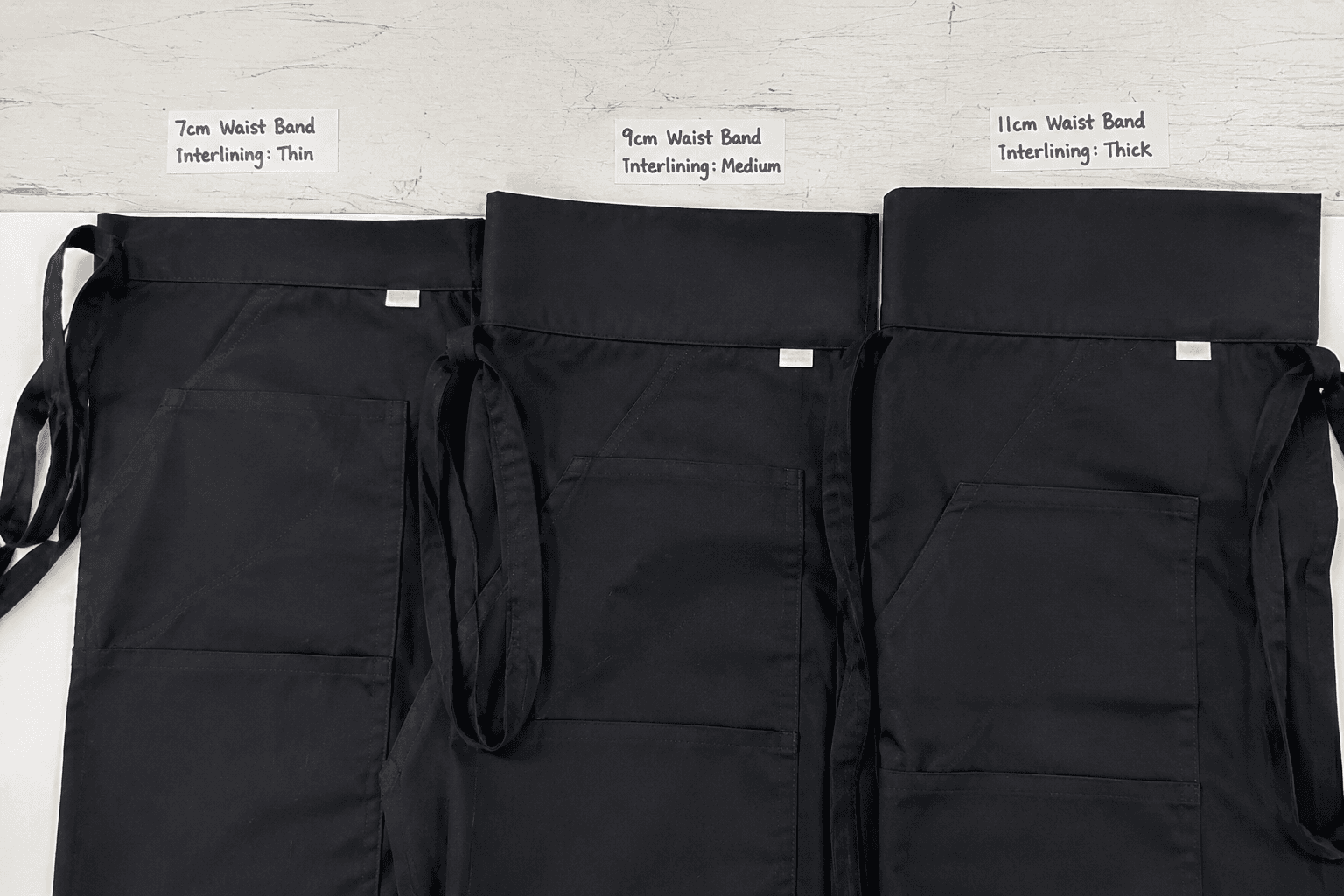
Pocket structure is often the deciding detail. A single large front pocket gives a strong decoration area, but divided pockets for tools, thermometers, order pads or pens reduce the clean surface. If the apron has a kangaroo pocket, printing above the pocket can look better than printing on the pocket because the pocket fabric may sag when loaded. If the apron has two lower patch pockets, a small logo on one pocket can feel balanced and avoids the center fold line.
- Bib apron: chest logo is the primary choice; pocket logo works when the design is small and refined.
- Waist apron: lower hem or pocket logo is practical; upper waistband logo is possible but may be hidden by folded fabric.
- Cross-back apron: chest or pocket logo is still clearer than strap-only branding.
- Denim or canvas apron: woven label, leather patch or embroidery often suits the heavier fabric better than glossy transfer.
- Disposable or low-cost promo apron: one-color screen print on chest or lower front usually keeps cost and lead time controlled.
- Kids apron: center-front print should be placed lower than adult chest placement because the bib height is shorter.
Decoration method, cost and lead time by logo position
Logo position cannot be separated from decoration method. Embroidery gives a durable, textured result for small to medium logos, but it is priced by stitch count and can add weight. Screen print is efficient for 1-3 color logos in larger areas, especially above 300 pcs per design. Heat transfer supports detailed multi-color artwork and gradients, but the hand feel and wash resistance depend strongly on transfer quality. Woven labels and patches are stable for repeated uniform orders, but they require label MOQ and extra sewing operation.
As a working reference from Zhejiang apron production, a simple one-color screen print on a chest or hem position may add around USD 0.08-0.25 per pc at 500-1,000 pcs, depending on print size and ink. Embroidery may add USD 0.15-0.60 per pc for a normal 5,000-12,000 stitch logo. A woven label sewn on a pocket may add USD 0.05-0.15 per pc after label setup, but the label MOQ can be higher than the apron MOQ. PU or leather patches may add USD 0.20-0.80 per pc depending on size, debossing and wash specification.
Lead time also shifts. A plain apron bulk order in standard fabric may take 25-35 days after sample approval and deposit. Adding screen print often fits within the same schedule if artwork is confirmed early. Embroidery may add 2-5 days for digitizing, strike-off and machine scheduling. Custom woven tape, special labels, metal badges or leather patches can add 7-20 days before sewing. For urgent orders, the simplest reliable solution is usually one chest print or one chest embroidery on available fabric.
- Screen print is efficient for larger chest and hem placements, especially one-color or two-color artwork.
- Embroidery is strongest for small chest logos and pocket logos but should be controlled for stitch density on light fabric.
- Heat transfer is useful for detailed multi-color logos but needs wash testing for restaurant and laundry programs.
- Woven labels are good for pocket edges, side seams and strap ends when the brand wants a subtle repeatable detail.
- Leather or PU patches suit denim, canvas and workwear aprons but require clear care-label and laundry approval.
- Decoration strike-off approval should be included in the timeline when logo color, size or fabric is new.
Production checklist for apron logo placement approval
Before bulk production, the buyer and factory should approve one clear logo placement document. This does not need to be complicated, but it must be measurable. A digital mockup is useful for communication, while a physical sample confirms real fabric behavior, color, stiffness and placement. For repeat orders, keeping the same placement specification avoids small differences between batches.
For color, buyers should specify Pantone or thread color, but also accept that cotton, polyester, canvas, denim and TC fabrics absorb or reflect color differently. A white print on black 12 oz canvas may require an underbase, while the same white print on 240 GSM black TC twill may be sharper. Metallic thread on an embroidered chest logo can look premium but may be less comfortable and slower to run. These are production details that should be decided before purchase order confirmation.
A good approval process reduces disputes. If the approved sample shows the logo 85 mm below the bib top and the bulk goods measure within plus or minus 5 mm, that is generally normal factory tolerance. If the buyer only approved a photo without measurement, both sides may have different expectations. For a 2,000 pc order, a 10-minute placement confirmation can prevent days of sorting, rework or commercial discussion later.
- Confirm finished apron size, fabric GSM or oz, pocket layout and strap type before finalizing logo position.
- Provide vector artwork such as AI, EPS or PDF, with fonts outlined and colors specified.
- Mark logo width, height and distance from fixed apron edges in millimeters.
- Approve decoration method, backing, thread color, print ink, transfer film or label material before bulk production.
- Request a decorated pre-production sample for new logo positions, new fabrics or orders above about 1,000 pcs.
- Record accepted placement tolerance, commonly plus or minus 5 mm for body prints and plus or minus 3-5 mm for embroidery.