Apron inventory management is often treated as a warehouse issue, but most shortages begin much earlier: during SKU planning, fabric selection, size grading, embroidery approval, or replenishment timing. For uniform programs, an apron is not just a garment in stock. It is a controlled workwear item tied to brand presentation, employee onboarding, hygiene standards, and replacement cycles.
From a factory perspective in Zhejiang, the most stable apron programs are those where the buyer gives clear SKU forecasts, reorder rules, and safety stock targets before the first bulk order is cut. This allows fabric booking, trim sourcing, cutting-room scheduling, and packing plans to match the real replenishment rhythm. Without this planning, even a simple waist apron in 7 oz cotton twill can become difficult to supply on time if the color is custom dyed, the logo thread is specific, or the buyer needs split shipments to many locations.
This article explains practical apron inventory planning for sourcing managers and product developers ordering custom aprons in bulk from China. The focus is on real variables: GSM, colorways, MOQ, lead time, defect allowance, carton packing, forecast accuracy, and reorder timing.
- Apron safety stock should be calculated by SKU, not by total program quantity.
- Replenishment lead time must include fabric, decoration, inspection, and freight days, not only sewing time.
- Low-volume colors and extended sizes need higher buffers because they are harder to replace quickly.
- MOQ decisions affect apron inventory cost more than unit price alone.
- A rolling apron stock forecast reduces emergency air freight and helps the factory reserve capacity.
- Inventory rules should be reviewed after each season or onboarding cycle, especially for hospitality and food-service programs.
Why apron inventory management is different from general apparel stock
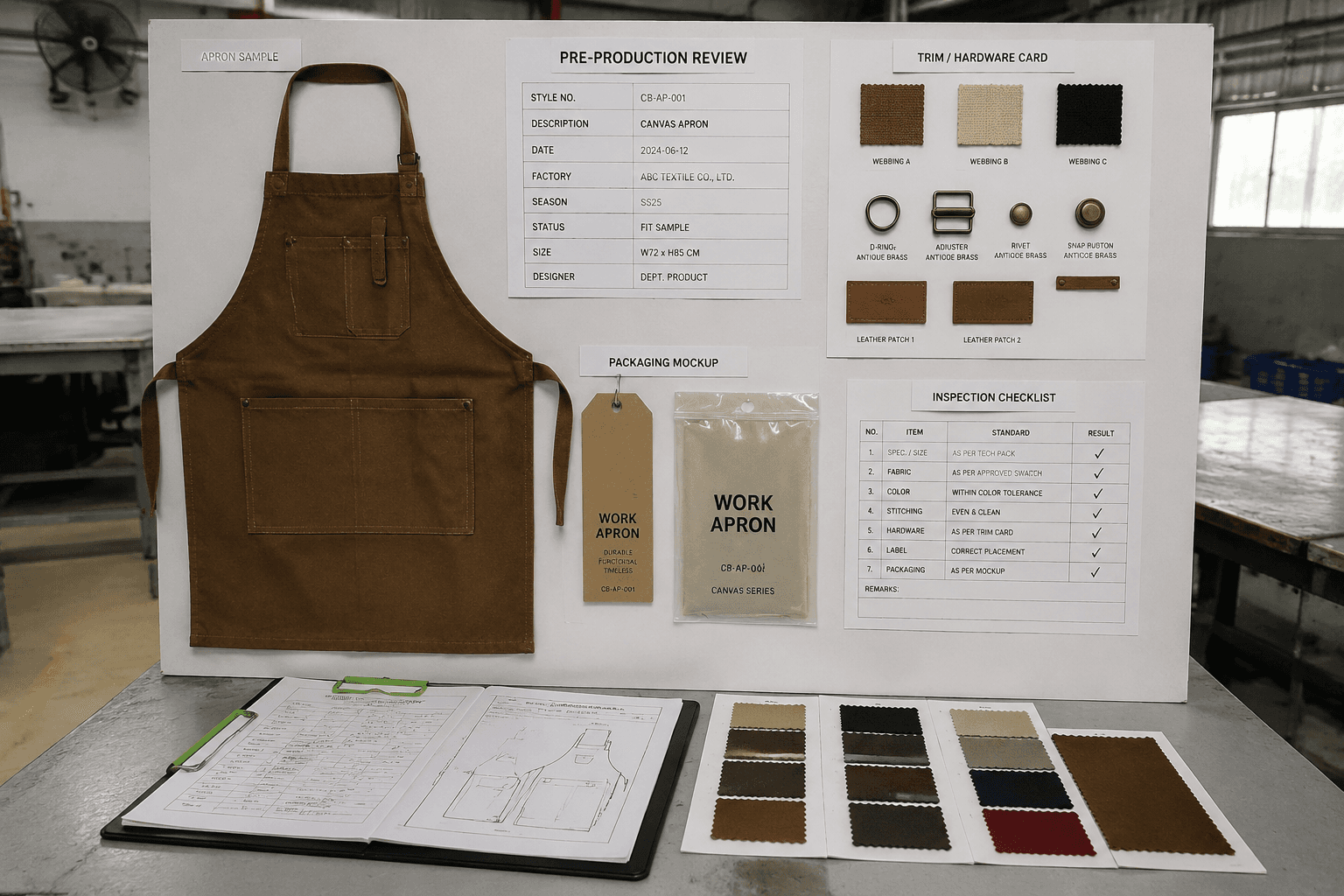
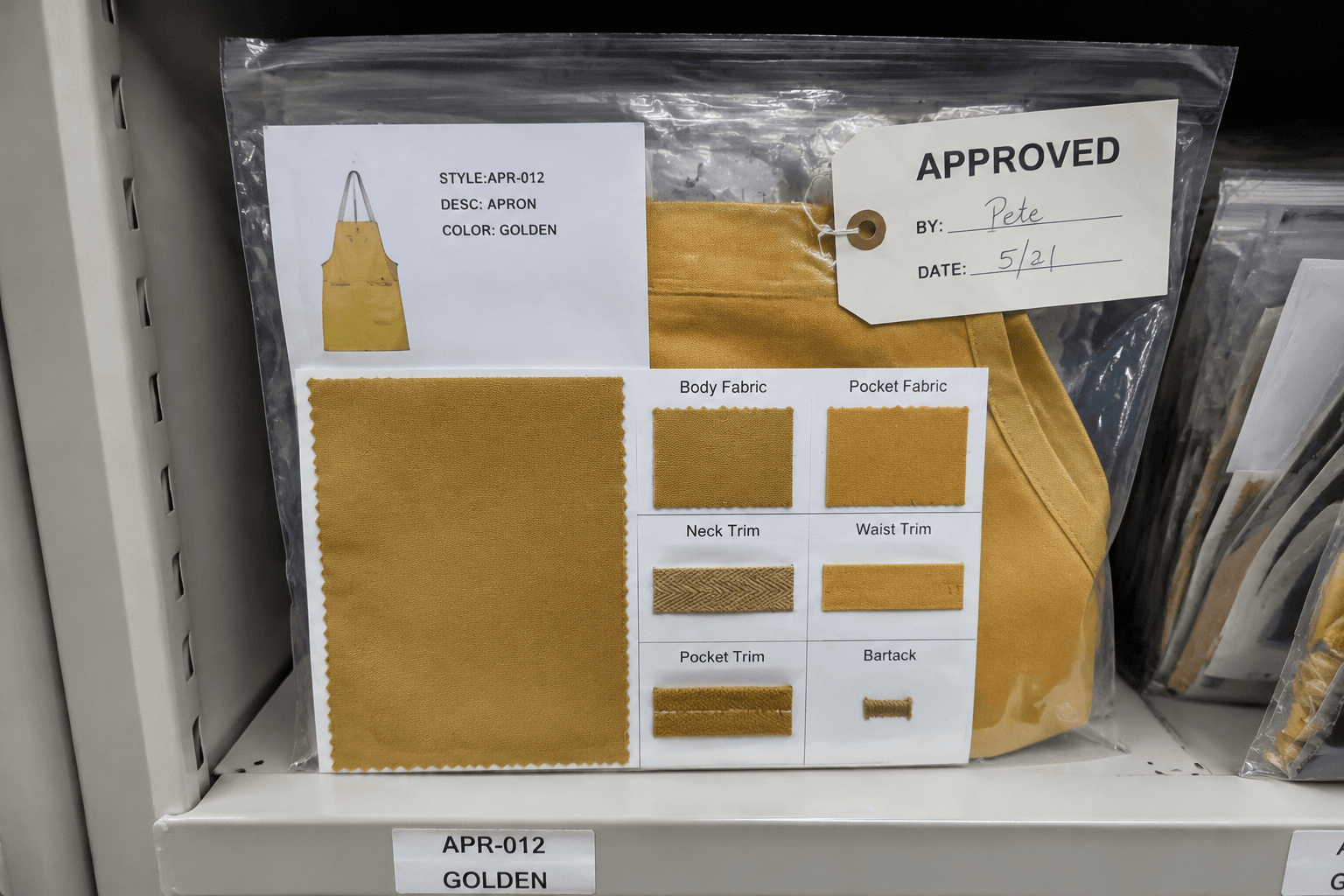
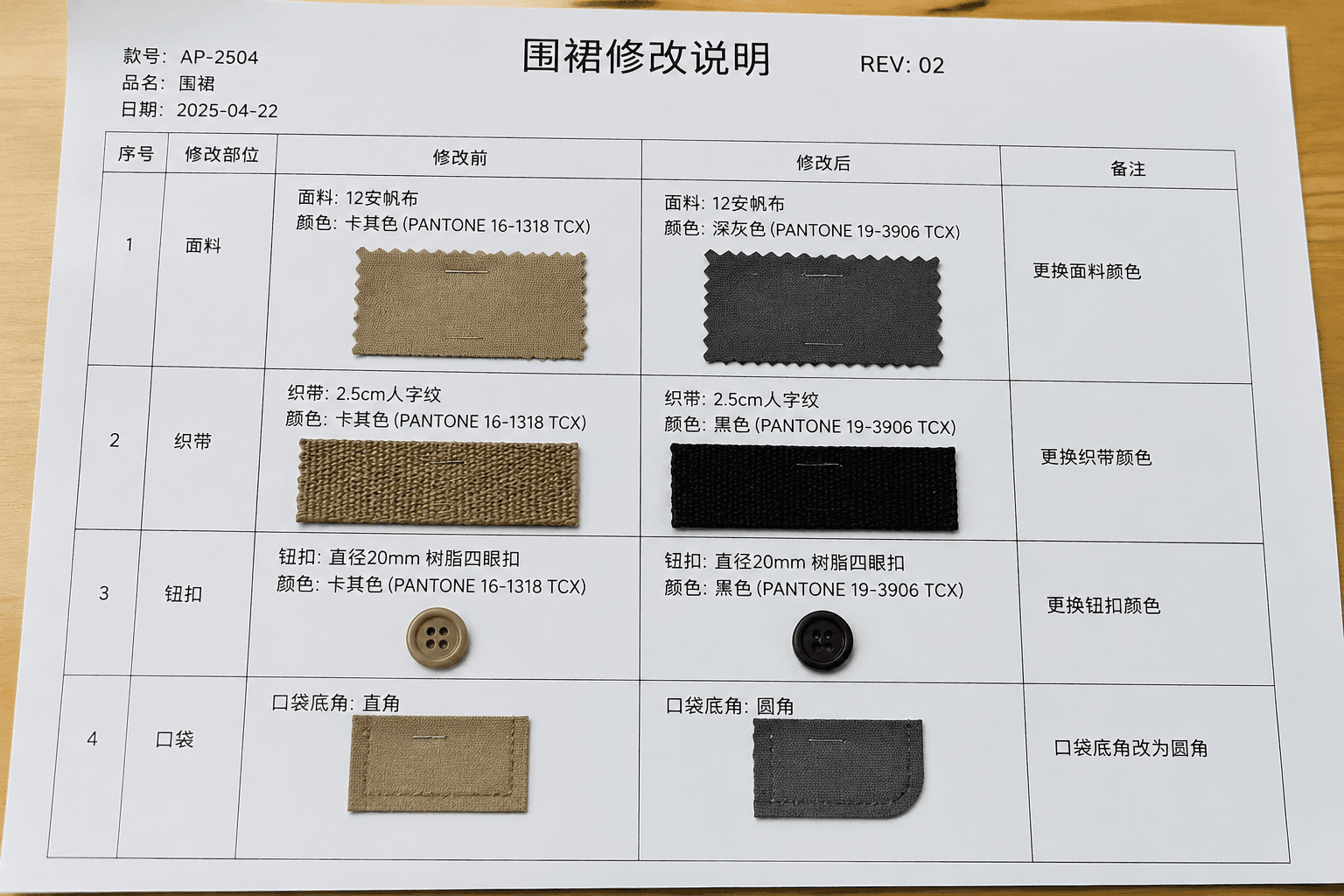
Aprons look simple compared with jackets, trousers, or chef coats, but inventory behavior is different. Many apron programs have fewer sizes, yet more decoration variables: logo embroidery, woven labels, contrast tape, pocket shape, color blocking, bartack positions, adjustable neck straps, and location-specific branding. A black bib apron in 240 GSM poly-cotton twill may be a core SKU, while the same apron with a regional embroidered logo becomes a separate inventory item that cannot always be shared across branches.
Usage patterns are also different. In restaurants, cafes, hotels, bakeries, salons, and factory visitor programs, aprons are replaced because of staining, fading, laundering damage, staff turnover, or hygiene rules. The consumption rate can be higher than expected. A denim apron at 10 oz may last longer in a retail setting but may fade unevenly after 30-50 industrial wash cycles. A 200 GSM polyester apron may dry quickly but may be replaced sooner if the surface pills or catches oil stains.
For a sourcing team, apron inventory management should combine garment durability, replenishment lead time, and operating behavior. If the buyer only looks at purchase price, the warehouse may hold the wrong stock: too many slow-moving customized pieces and too few core aprons needed for new employees.
- A plain apron and a logo apron should be treated as different SKUs when the decoration cannot be changed after production.
- A single fabric color can carry several stock risks if neck strap, pocket, label, or embroidery differs by department.
- Aprons used in kitchens, coffee chains, and workshops need higher replacement assumptions than aprons used for occasional promotional events.
- Factory MOQ for dyed fabric, contrast tape, or branded hardware can create hidden inventory beyond the finished apron count.
Building an apron stock forecast from real usage data
An apron stock forecast should start with the user base, not with the previous purchase order. The buyer should estimate how many people wear the apron, how many aprons each person receives, how often replacements are issued, and how many new staff members enter the program each month. For example, a cafe chain with 80 stores, 12 apron-wearing staff per store, and 2 aprons per staff member needs 1,920 aprons for initial issue. If monthly staff turnover is 8 percent and each new employee receives 2 aprons, the replacement demand from onboarding alone is about 154 aprons per month.
Replacement due to damage should be forecast separately. If kitchen aprons are replaced every 6 months, monthly wear-and-tear demand is about 16-18 percent of the active issue quantity. If front-of-house aprons are replaced every 12 months, the monthly demand may be closer to 8-9 percent. These numbers should be adjusted after receiving 3-6 months of actual issue data.
Factories can support better forecasting when buyers share a 3-month and 6-month view by SKU. The forecast does not need to be perfect, but it should show expected demand for core color, special color, size, decoration, and delivery window. With this information, we can advise whether to hold greige fabric, reserve dyed fabric, or produce finished apron inventory in advance.
- Calculate initial issue quantity as staff count multiplied by aprons per staff member, then add opening buffer.
- Track onboarding demand separately from damage replacement because the two patterns change for different reasons.
- Forecast each decorated apron separately if embroidery or heat-transfer logo cannot be reused across locations.
- Review monthly issue reports against the forecast and revise the next 90-day apron replenishment plan.
Setting apron safety stock by SKU risk
Apron safety stock is the buffer that protects the program when demand is higher than expected or replenishment is delayed. The mistake we often see is setting one safety stock percentage for the full program, such as 10 percent of total annual demand. This hides the real risk. A core black bib apron used in 200 stores may need a different buffer than a burgundy waist apron used in 12 premium locations.
A practical method is to calculate safety stock by SKU based on monthly demand, replenishment lead time, forecast error, and criticality. If a SKU sells or issues 500 pieces per month and total replenishment lead time from purchase order to warehouse receipt is 60 days, the buyer already needs about 1,000 pieces of cycle stock to cover the normal lead time. If demand variation is 20 percent, a safety stock of 200-300 pieces may be reasonable. For a low-volume custom color that issues 60 pieces per month but requires 45 days for fabric dyeing and 20 days for sewing, the safety stock may need to cover 2-3 months because emergency replenishment is difficult.
Criticality also matters. If an apron is required for food-safety compliance or customer-facing brand uniformity, stockout cost is higher than inventory carrying cost. For a promotional apron used only during seasonal campaigns, overstock risk may be more important. The buyer should assign each SKU a risk class and set the buffer accordingly.
- Core SKU: usually 4-8 weeks of safety stock when demand is stable and fabric is repeatable.
- Custom color SKU: usually 8-12 weeks of safety stock if fabric dyeing MOQ is high or lab dip approval is required.
- Location-specific logo SKU: usually 6-10 weeks of safety stock when embroidery cannot be converted to another branch.
- Seasonal or campaign SKU: safety stock should be limited, with stronger control on final order quantity and sell-through timing.
- New program SKU: start with a higher buffer for the first 90 days until actual issue rates are known.
Lead-time planning for apron replenishment from China
Apron replenishment lead time is more than sewing days. For repeat custom aprons, a normal factory timeline may be 25-35 days for production after all materials are ready. However, the full timeline can be 45-75 days depending on fabric, trims, decoration, inspection, consolidation, and shipping mode. If the buyer uses sea freight to North America or Europe, another 25-40 days may be required after goods leave the factory. For urgent air freight, transit may be 5-10 days, but the freight cost can remove the benefit of a lower FOB price.
A basic repeat order using stock black 240 GSM poly-cotton twill, standard webbing tape, and embroidery from an existing file may be completed in about 30-40 days before international transit. A custom-dyed 280 GSM cotton canvas apron may need 7-10 days for lab dip, 12-18 days for bulk fabric dyeing and finishing, and 25-35 days for cutting, sewing, embroidery, packing, and inspection. If the fabric mill has a 500 kg color MOQ, the buyer may need to decide whether to place a larger fabric booking or accept a higher fabric surcharge.
For uniform stock planning, the reorder point should be based on the longest realistic lead time, not the fastest order the factory has ever completed. Holidays also matter. Before Chinese New Year, factory capacity tightens from mid-January and normal output may not resume until late February or early March. For programs that cannot stock out in February or March, replenishment orders should usually be confirmed by November or early December.
- Use 45-60 days as a common repeat-order planning window for stocked fabric and sea-ready production.
- Use 60-90 days when custom-dyed fabric, new trims, lab dips, or new embroidery approvals are involved.
- Add 25-40 days for typical sea freight transit depending on destination port and routing.
- Plan Chinese New Year coverage at least 10-12 weeks before the holiday production slowdown.
- Confirm artwork, thread color, packaging, and carton marks before the production slot is booked.
MOQ, fabric booking, and the real cost of apron inventory
MOQ decisions are central to apron inventory management because the lowest unit price can create the highest inventory exposure. A factory may quote 1,000 pieces per color for a custom apron, but the real minimum depends on fabric and trim. If the apron uses stock black twill, 500 pieces may be workable. If it uses custom-dyed 300 GSM cotton canvas, the fabric mill may require 500-800 kg per color. Depending on apron consumption, that fabric could represent 2,000-4,000 finished pieces.
Buyers should separate finished-goods MOQ from material MOQ. Finished aprons are easier for the warehouse to issue but carry decoration and packaging risk. Undecorated fabric or semi-finished panels can sometimes give more flexibility, but only when the decoration and construction allow it. For example, holding greige fabric for dyeing later may help if color demand is unclear, but it does not solve an urgent order if lab dip approval and dyeing still need 20 days. Holding blank black aprons may help if multiple logos can be embroidered later near the destination, but it may create quality variation if local decoration differs from factory samples.
The cost of excess apron inventory includes storage, cash tied in stock, obsolete logos, color changes, packaging changes, and carton handling. If an apron costs $3.20 FOB and the buyer over-orders 5,000 pieces, the direct product value is $16,000 before freight, duty, warehousing, and possible markdown or disposal. Sometimes paying $0.15-$0.30 more per piece for a smaller repeat order is cheaper than carrying a large slow-moving color.
- Ask the factory to quote both the MOQ price and the next lower quantity with surcharge, such as 500 pieces and 1,000 pieces.
- Check whether the limiting factor is fabric, webbing tape, metal hardware, embroidery setup, printing plate, or packing material.
- Keep core colors in larger runs when demand is proven, and keep experimental colors in smaller controlled batches.
- Compare FOB savings against carrying cost, freight, duty, and obsolescence risk before increasing order quantity.
SKU design choices that simplify apron inventory management
Product development decisions can make apron inventory easier or harder to control. Every color, pocket layout, strap type, trim, size, and logo placement becomes a potential stock point. A program with one apron body and interchangeable embroidery is simpler than a program with separate fabrics for each department. A program using 240 GSM black poly-cotton twill across bib aprons and waist aprons can consolidate fabric consumption better than a program using many small-volume colors.
For many uniform buyers, the best approach is to standardize the base apron and vary only what is necessary for job function or brand level. A barista apron may need a chest pocket and adjustable neck strap. A kitchen apron may need stronger waist ties, darker color, and stain-resistant finish. A housekeeping waist apron may need wider pockets and lighter fabric for comfort. These differences are functional. By contrast, small decorative differences across branches often create avoidable inventory complexity.
Size planning also matters. Aprons are often sold as one size, but a real uniform program may need long length, short length, plus-size waist ties, or adjustable neck options. Instead of creating many full-size SKUs, buyers can use adjustable hardware, longer waist tapes, or graded lengths only where needed. A 90 cm bib apron with 100 cm waist ties may fit many users, while a separate 105 cm long version can be reserved for taller staff or premium departments.
- Use one base fabric across several apron styles when performance requirements are similar.
- Limit custom colors to SKUs with stable demand or strong brand requirement.
- Standardize logo size and placement so embroidery files can be reused across replenishment orders.
- Choose adjustable neck straps and longer waist ties to reduce size fragmentation.
- Avoid changing pocket shape or label position unless there is a practical operational reason.
Operational controls for warehouse and factory coordination
Good apron inventory control requires shared information between the buyer, warehouse, and factory. The warehouse sees actual issue and stock-on-hand data. The buying team sees future openings, campaigns, and brand changes. The factory sees fabric availability, production capacity, and component constraints. When these three views are not connected, replenishment orders are placed too late or in the wrong mix.
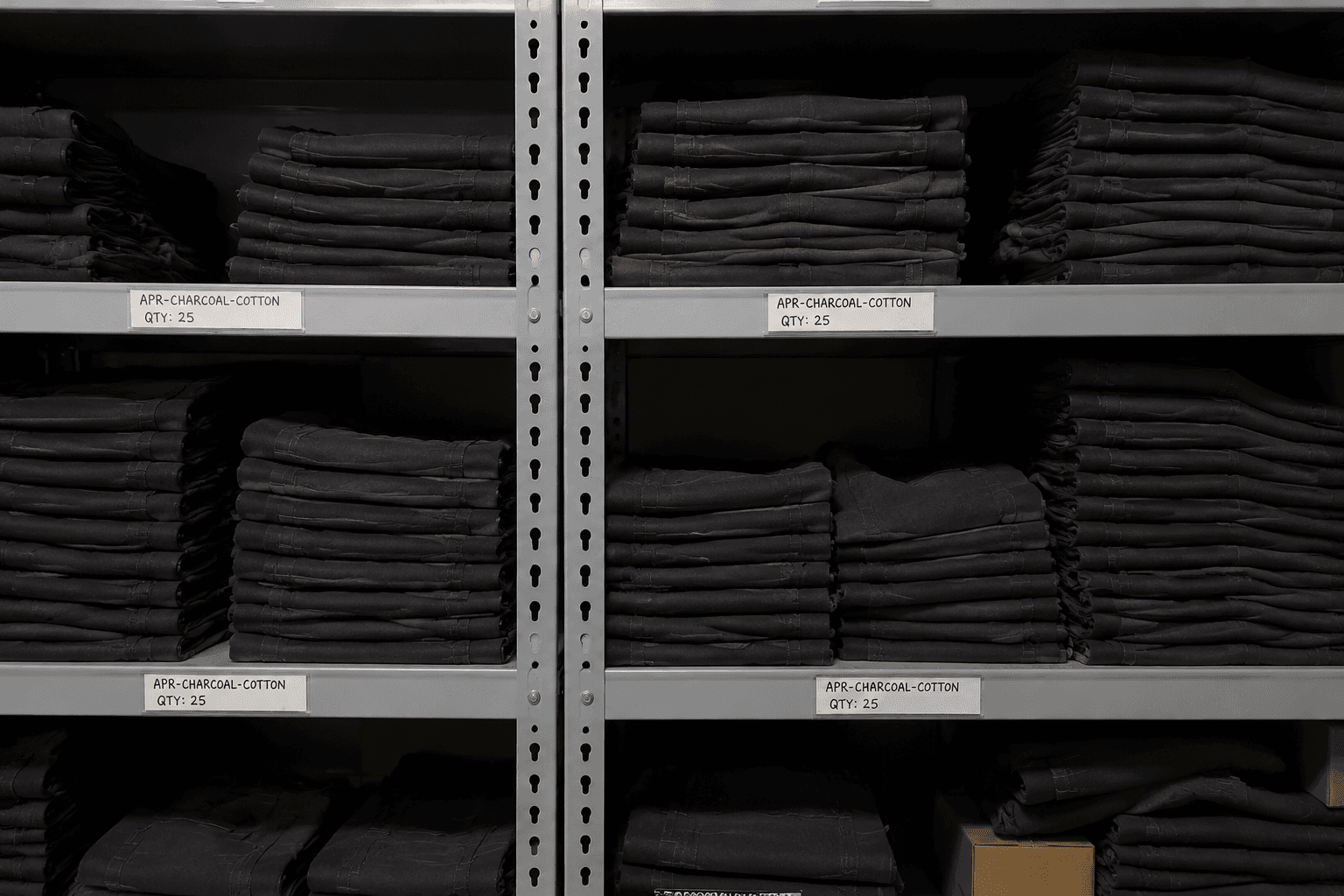
A useful monthly report should show opening stock, receipts, issues, adjustments, damaged stock, closing stock, and forecast demand by SKU. For aprons, it should also identify stock that cannot be transferred because of logo, department, or packaging language. A buyer may think there are 3,000 aprons in inventory, but if 1,200 pieces carry an old logo and 600 pieces are packed for a discontinued location, usable inventory is much lower.
Factory coordination should include a replenishment calendar. For stable programs, buyers can send a rolling 90-day forecast and a softer 180-day view. The factory can then advise when to book fabric, when to place embroidery thread orders, and when capacity may be tight. For example, if the buyer expects 12,000 black bib aprons and 3,000 denim cross-back aprons over six months, we may recommend producing black aprons in two 6,000-piece lots and denim aprons in one lot if the denim fabric MOQ and washing shade control are more sensitive.
- Share stock-on-hand and 90-day demand by SKU at least once per month.
- Separate usable stock from obsolete, damaged, blocked, or location-restricted stock.
- Give the factory early notice of new store openings, menu changes, rebranding, or seasonal campaigns.
- Lock carton quantity, barcode, polybag, and master carton marks before repeat production begins.
- Review defect allowance and spare button, buckle, or tie requirements before shipment.
Practical reorder rules for stable apron inventory
A practical reorder rule should be simple enough for the buying team to use every month. One common method is reorder point equals expected demand during lead time plus apron safety stock. If a SKU issues 400 pieces per month, total replenishment lead time is 2 months, and safety stock is 300 pieces, the reorder point is 1,100 pieces. When usable stock drops near 1,100 pieces, the next order should already be confirmed or in production.
For high-volume apron programs, buyers may also set minimum and maximum stock levels. The minimum is the reorder point. The maximum is the highest inventory the buyer wants to carry after receiving a replenishment order. If the same SKU has a minimum of 1,100 pieces and a maximum of 2,500 pieces, the order quantity should bring stock back toward 2,500, not simply repeat the last PO quantity. This helps avoid both shortages and slow-moving excess.
Reorder rules should be reviewed after the first bulk cycle. Initial forecasts are often wrong because staff usage, laundering behavior, and replacement discipline differ by customer. After 90-180 days, the buyer should compare actual apron issue against forecast, check which SKUs are moving faster, and adjust the next order. The factory can also review production feedback: fabric loss rate, embroidery defect rate, packing efficiency, and whether any component caused delay. Good apron inventory management is not a one-time spreadsheet; it is a repeat process that becomes more accurate with each shipment.
- Set reorder point as lead-time demand plus safety stock for each SKU.
- Use maximum stock levels to prevent repeat orders from creating excess inventory.
- Review actual issue data after 90 days for new uniform programs.
- Keep a separate reorder calendar for custom colors and holiday-sensitive production periods.
- Confirm whether urgent replenishment will use air freight, sea freight, or split shipment before a stockout occurs.