When a bib apron looks square at final inspection but twists after laundering, the cause is rarely one sewing mistake. In OEM apron production, apron bowing and skewing usually starts with residual distortion from dyeing and finishing, then gets worse when body panels, pockets, or straps are cut off grain or shrink at different rates. The issue shows up fastest on long bib aprons, dark twills, denim-look fabrics, and styles with contrast tape, broad hems, or centered patch pockets that make diagonal movement easy to spot.
For buyers sourcing 2,000 to 50,000 aprons per color, this is a commercial control point, not a minor appearance issue. On an 8,000-piece order, even a 3% complaint rate means 240 visibly distorted aprons in kitchens, cafés, bakeries, or retail floors. That level of field failure can trigger chargebacks, replacement requests, delayed replenishment, and extra mill or factory audits before the next PO is released.
The lowest-cost fixes are upstream. Bulk-fabric testing, finishing alignment, roll relaxation, marker-direction rules, and pre-production wash approval typically add 3 to 5 working days and around $0.10 to $0.28 per apron. That prevention cost is small compared with replacing shipped stock or discounting a uniform program after post-wash hang complaints.
- Set written skew and bow tolerances before bulk fabric approval; for most 210 to 310 GSM twill or canvas apron programs, a practical target is 2.0% to 2.5% skew after one wash, with tighter 1.5% to 2.0% control on premium cotton styles with centered pockets, contrast trim, or heavy topstitching.
- Protect grainline on the main apron body first; a body panel cut only 1.0 cm off grain over an 85 cm body length can pass pre-pack inspection and still torque after laundering.
- Approve sewn samples from actual bulk yardage, measured before wash, after 1 wash, and after 3 washes under the agreed care method; development swatches are not enough for bulk sign-off.
- Check component balance, not just the apron front; even when the body stays relatively straight, mismatched shrinkage in pockets, neck straps, or waist ties can pull the apron off level after wash.
- On many OEM apron orders, spending an extra $0.10 to $0.25 per piece on finishing control and pre-production testing is cheaper than a $4,000 to $12,000 post-shipment claim.
- If post-wash hang matters commercially, reserve 3 to 5 working days before bulk cutting for roll relaxation, wash testing, and PPS approval.
Why apron bowing and skewing is more visible on bib aprons after wash
Aprons reveal distortion faster than many other sewn products because they hang as long, flat panels from fixed support points. A work shirt can absorb torque through body movement and side seams, but a bib apron hangs vertically from the neck and waist ties. If the center front rotates, one side of the hem lifts 1.5 to 2.0 cm, or one edge walks forward after a 40°C wash, the defect is visible immediately during service.
Bib aprons are especially unforgiving because they combine several straight visual references in one piece: top bib edge, center front, pocket opening, waist seam, side edges, hem, and long ties. When one of those lines shifts off square, the whole apron looks wrong even if seam strength, stitch density, and garment measurements still pass inspection. Buyers often describe this as a post-laundry hang problem, but the technical cause is usually a combination of residual skew in the fabric and off-grain cutting in the body or pocket.
The commercial effect is easy to underestimate during development and expensive to ignore in use. A 5,000-piece hospitality order with a 4% visible post-wash distortion rate puts about 200 failed-looking aprons on staff. In an open kitchen, coffee chain, or branded retail program, that is enough to undermine a uniform look and force reorders, replacements, or claim negotiations.
- Bib aprons with 80 to 95 cm body length show torque faster than waist aprons with 45 to 60 cm length.
- Dark shades such as black, navy, charcoal, and indigo show uneven hang more clearly under store and kitchen lighting.
- Contrast pockets, bartacks, tape edges, and double-needle topstitching make even small diagonal movement visible.
- Visible twill lines, stripe effects, and denim-look surfaces expose skew earlier than flat solid weaves.
Where apron bowing and skewing starts: finishing tolerances buyers should request from the mill
Most apron hang problems are set before cutting begins. Common apron fabrics such as 220 to 260 GSM 65/35 poly-cotton twill, 240 to 300 GSM cotton twill, and 280 to 340 GSM cotton canvas can leave dyeing and finishing with residual bow, skew, and internal tension. If stenter width, overfeed, weft straightening, compacting, or heat-setting are not controlled tightly enough, the roll may appear acceptable on the inspection table but relax into distortion after laundering.
For apron sourcing, buyers need clear definitions. Bow means the filling yarns curve across the width; skew means the filling yarns sit at an angle to the selvage. On an 88 cm bib apron body, either condition changes the relationship between side edges, hem, and pocket line. A bow of 2.5 cm across a 150 cm cuttable width may be tolerated in some utility textiles, but on a long apron panel it can produce an uneven drop after one commercial wash.
Generic terms such as pre-shrunk or wash tested are not enough for a purchase order. For most apron programs, practical starting targets are warp shrinkage within 3.0%, weft shrinkage within 3.0%, and finished skew within 2.0% to 2.5% after one wash. If the apron uses centered patch pockets, contrast binding, or broad topstitched hems, many buyers tighten skew control to 1.5% to 2.0%. That level of control may add about $0.12 to $0.30 per meter in finishing cost, but it is usually cheaper than remaking finished aprons.
- Request lot data for finished GSM, usable width, warp shrinkage, weft shrinkage, bow, and skew.
- Confirm whether the finisher uses weft straightening on the stenter and post-finish compacting or sanforizing.
- Ask for results after 1 wash and 3 washes; one lab rinse is too limited for apron approval.
- Write actual percentages and wash conditions into the PO instead of using commercially acceptable.
Cutting direction controls that prevent acceptable fabric from becoming defective aprons
Even when bulk fabric passes inspection, the cutting room can turn borderline distortion into a visible post-wash problem. Aprons are less forgiving than many garments because the main body is long, simple, and easy to read visually. If the body panel is cut 1.0 to 1.5 cm off grain over an 85 cm length, it may still look straight before washing. After laundering, the panel relaxes toward yarn direction and the result shows as torque, hem drift, or a pocket that no longer sits level.
Marker efficiency is a common source of avoidable risk in OEM apron production. To improve yield, some factories rotate pockets, ties, facings, or allow slight drift in the main body to fit one more component into the marker. That may save 1% to 2% fabric, but it often creates mismatched movement after washing. A pocket cut off grain and sewn onto a straighter body can tilt after one wash; the reverse is also common, with the body twisting while the pocket appears relatively square and makes the defect more obvious.
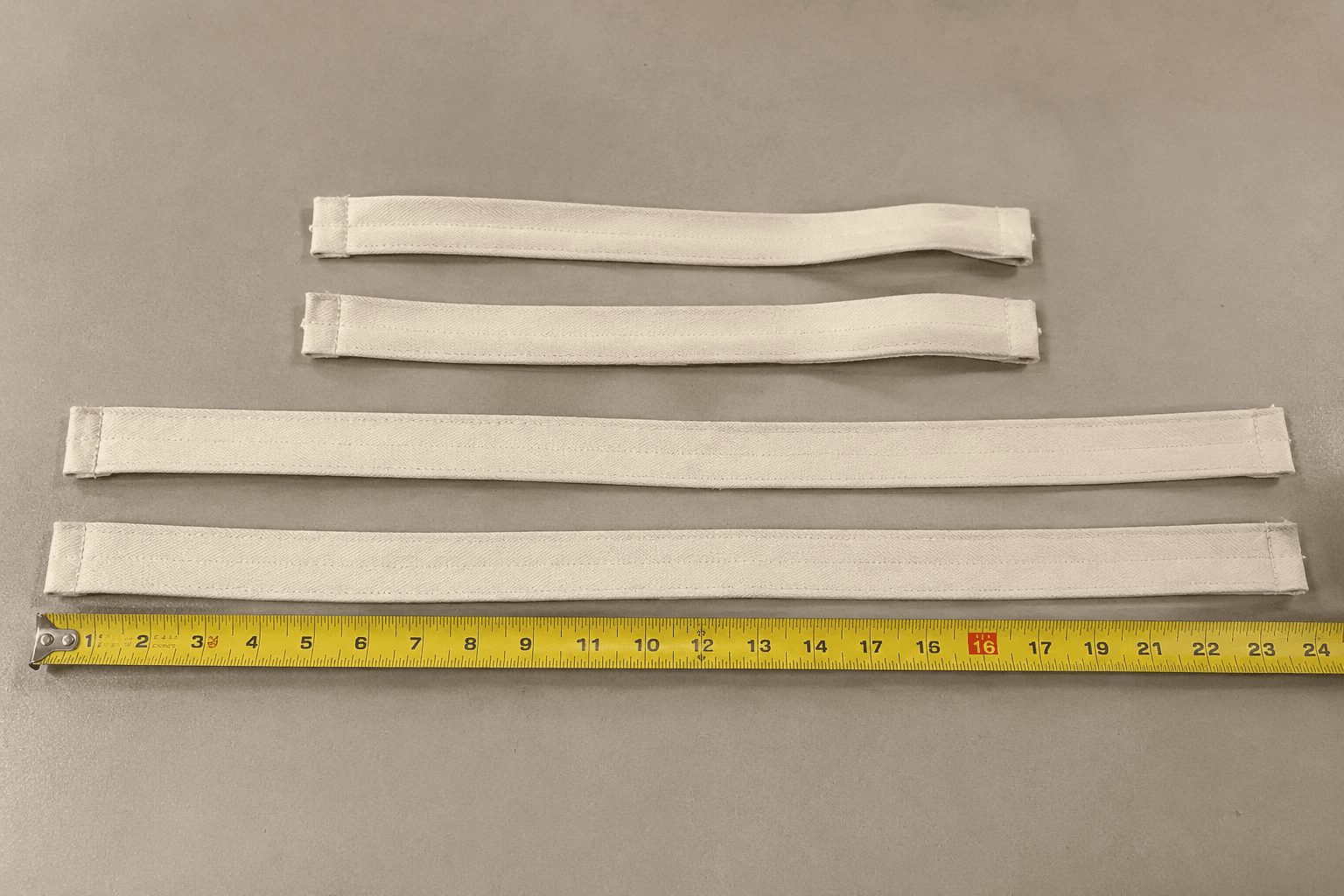
For most professional apron programs, the main body should follow warp direction unless the style is intentionally designed otherwise. Long waist ties over 70 cm and self-fabric neck straps should also be cut consistently by lot. Tightening these cutting rules may reduce marker yield by 1% to 3%, but on a $2.60 to $6.80 FOB apron the added cost is often only $0.03 to $0.11 per piece, which is a low premium for better wash stability.
- Set a maximum off-grain tolerance for the main body before first-cut approval, such as no more than 0.5 cm drift over 80 cm length.
- Keep all main apron bodies in one grain direction across bulk production; do not mix rotated body panels.
- Review every rotated pocket, tie, facing, and bib lining for post-wash appearance risk, not only for fabric yield.
- Record grainline checks during first cut and sign them in the pre-production meeting and cutting report.
- Do not insert replacement panels cut in a different direction into the same sewing bundle.
High-risk apron fabrics and constructions that need tighter wash approval
Fabric choice has a direct effect on post-wash apron stability. For chain-store, café, and uniform aprons, 65/35 poly-cotton twill at 235 to 255 GSM is often the safest commercial baseline because shrinkage is moderate, finishing is relatively repeatable, and the fabric cuts cleanly. By contrast, 100% cotton canvas at 280 to 340 GSM can deliver a more premium natural hand and heavier drape, but it usually needs tighter skew control, longer roll relaxation, and stronger wash testing because residual tension is easier to trigger.
Finishing route matters as much as fiber content. Enzyme wash, heavy softener, peaching, brushing, and garment-wash aesthetics can improve handfeel, but they also introduce more lot variation. Buyers should ask exactly how softness is created: chemical softener, enzyme process, mechanical peaching, compacting, or garment wash. These finishing routes do not behave the same after repeated laundering. Saving $0.18 per apron on a lighter finishing process can become expensive when claim handling, sorting, and replacements are counted.
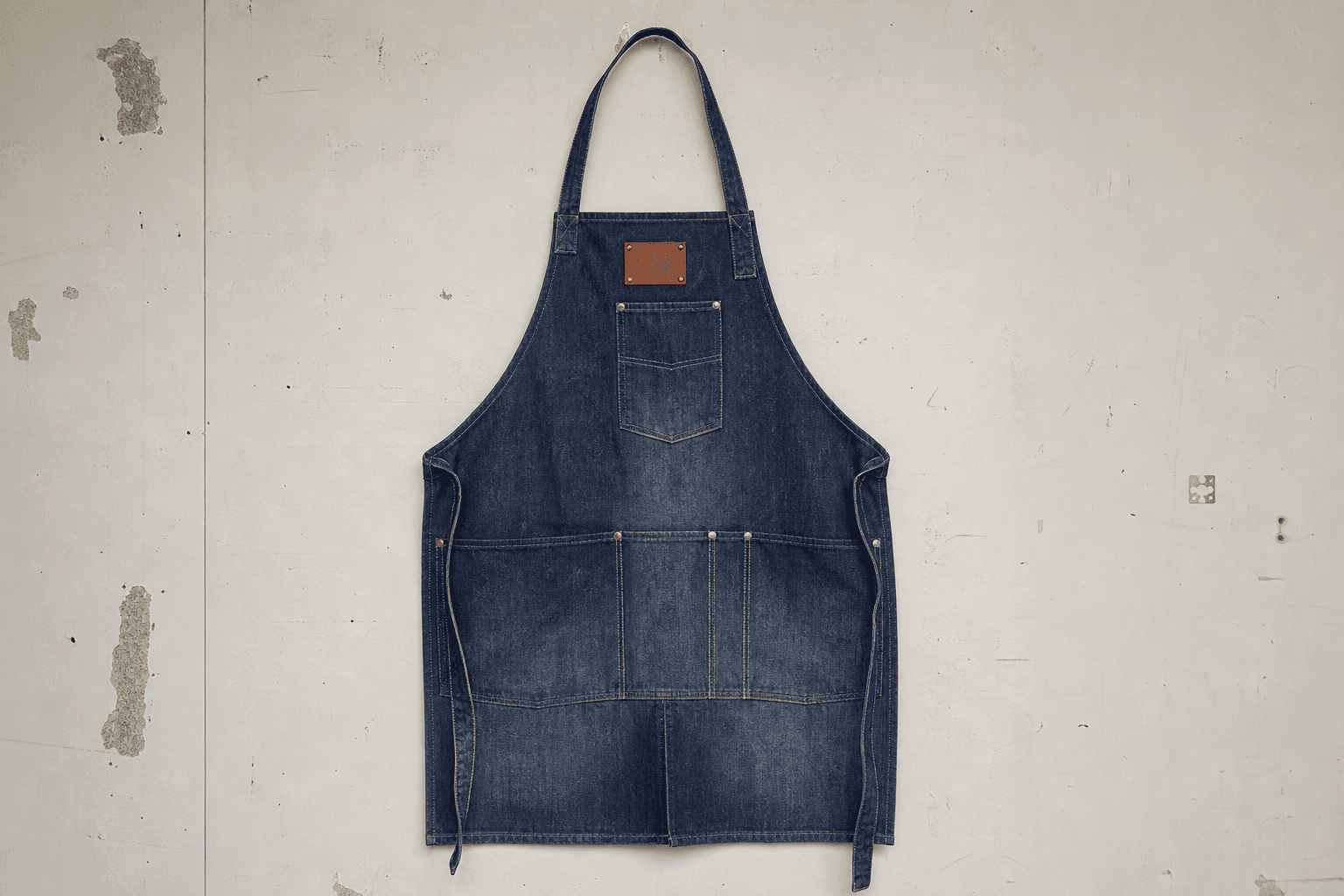
Construction details also change the risk level. Open-end cotton canvas may react differently from ring-spun twill, and strong twill lines make diagonal distortion easier to detect. Slub yarns, cross-dye effects, and denim-look surfaces should be treated as higher-risk choices for B2B apron programs unless the buyer accepts extra approval time and tighter lot control. For custom orders below 1,000 pieces per color, a proven stock twill with known wash data is often a safer sourcing decision than a novelty finish.
- Lower-risk baseline: 65/35 poly-cotton twill, 235 to 255 GSM, reactive or vat dyed.
- Higher-risk option: 100% cotton canvas, 280 to 340 GSM, especially with softened, peached, or washed handfeel.
- Visible twill lines, slub yarns, and denim-look surfaces make small skew easier to see after wash.
- Low-MOQ special colors and novelty washes usually show more lot variation than repeat black, navy, or natural programs.
Pre-production wash tests and AQL limits for apron bowing and skewing control
The most effective control system for apron bowing and skewing is built before bulk cutting, not at final packing. Buyers should approve fabric by lot, relax rolls before spreading, sew PPS samples from actual bulk yardage, and wash those samples under the agreed end-use condition. For standard retail kitchen aprons, a practical protocol is 40°C wash with standard detergent, line dry, and measurement before wash, after 1 wash, and after 3 washes. For restaurant, bakery, or industrial foodservice programs that use hotter care, a 60°C confirmation wash may also be necessary if that reflects real use.
Fabric relaxation is one of the lowest-cost controls available. For most 220 to 300 GSM twills, 12 to 18 hours of relaxation before spreading is usually sufficient. For 300 to 340 GSM canvases, tightly compressed export rolls, or winter-season stock stored under dry conditions, 24 hours is safer. Cutting on the same day rolls are opened preserves internal tension that often reappears later as hem rotation, side drag, or strap mismatch.
Inspection should combine measurement with visual review. AQL does not prevent the defect, but it helps define shipment acceptance. Many apron buyers use AQL 2.5 for major defects and AQL 4.0 for minor defects. If post-wash hang is contract-critical, visible torque, hem imbalance above the agreed limit, or pocket tilt after wash should be classified as major defects in the PPS standard. On an 85 cm bib apron, side-to-side hem rise above 1.5 cm after wash is often enough to trigger a field complaint even when overall length remains within tolerance.
- Relax twill 12 to 18 hours and heavy canvas up to 24 hours before spreading.
- Wash-test sewn PPS samples made from actual bulk fabric, not development leftovers or lab swatches.
- Measure center-front hang, side-edge shift, hem level, pocket angle, and strap symmetry after wash.
- Use AQL 2.5 major and AQL 4.0 minor unless the customer contract requires stricter inspection.
- Reserve 3 to 5 working days for fabric approval, wash testing, and PPS sign-off before bulk cutting.
How to write apron specs, MOQ, cost, and lead time so post-wash claims are less likely
Many apron claims begin with incomplete specifications. A PO that says only 8 oz cotton bib apron leaves too many technical decisions to the mill and factory. A stronger sourcing brief should state fiber content, target finished weight in GSM or finished oz, usable width, colorfastness expectation, care method, shrinkage tolerance, skew tolerance, required grain direction for the body panel, and the exact post-wash appearance points that matter. If the style includes a centered patch pocket, contrast tape, cross-back straps, or long self ties, those areas should be named as critical visual controls.
Commercial terms also need to match the required quality level. If the buyer wants below 2.0% skew on a 100% cotton canvas apron, plus 3-wash approval and pre-shrunk finishing, the lead time has to support that standard. For a custom order of 3,000 to 10,000 aprons, a realistic timeline is often 5 to 7 days for fabric booking and finishing alignment, 3 to 5 days for wash testing and approval, 18 to 28 days for bulk sewing depending on style complexity, and 3 to 4 days for final inspection and packing. Requiring shipment in 20 days while also asking for premium post-wash hang control creates a predictable sourcing risk.
The cost trade-off is usually modest when handled early. Better finishing and pre-production controls may add $0.08 to $0.25 per apron, tighter marker rules may add $0.03 to $0.10, and extra testing may add several working days. By contrast, a claim on 800 distorted units from a 10,000-piece order can easily cost $4,000 to $12,000 after replacements, discounts, sorting, and urgent freight. For professional B2B buyers, the practical rule is simple: write measurable specs, align MOQ with fabric complexity, and pay for prevention before bulk cutting starts.
- State finished fabric weight as GSM or finished oz with tolerance, not only a generic fabric name.
- Define pass/fail by wash method, skew percentage, shrinkage percentage, and visible hang criteria.
- For MOQ below 500 pieces per color, expect limited finishing customization and fewer mill options.
- Budget about $0.11 to $0.35 per piece for prevention on higher-risk natural-fiber apron programs.
- Treat post-wash appearance as a contract item for hospitality, uniform, and branded retail orders.