For professional buyers running apron programs across restaurant groups, hotel chains, supermarket teams, bakery counters, and retail service staff, shade drift is not a cosmetic detail. It creates mixed stock in the field, rejected replenishment, and avoidable markdowns. A black bib apron reordered 90 to 150 days after first shipment can show a red or green cast under warm LED lighting. A navy waist apron can return visibly lighter because the reorder used a different 220 to 235 GSM 65/35 polycotton twill than the original bulk. A natural cotton cross-back apron can shift from clean cream to yellow cream when the greige yarn blend changes between seasons.
That is why apron reorder shade consistency has to be managed as a sourcing system, not a final inspection argument. Pantone is only a reference. Real shade control on aprons depends on fabric composition, weave, GSM, mill, dye class, finishing chemistry, wash route, pressing temperature, and the trims attached to the body panel. A 300 GSM 100% cotton canvas black bib apron and a 210 GSM polycotton twill black waist apron will not repeat shade the same way, even when the nominal target name is identical.
The sourcing challenge is usually scale. Many repeat apron orders are only 500 to 1,500 pcs per color, while mills often need 300 to 500 meters minimum per dyed lot and may need 7 to 12 days for dyeing and finishing alone. If the reorder misses the original greige lot, tape lot, or wash route, shade variation becomes much more likely. The safest B2B approach is to lock the first approved bulk standard, define an acceptable commercial tolerance before PO release, and approve the actual production fabric and finished apron that will be used for the reorder.
- Apron reorder shade consistency depends on controlling fabric composition, GSM, mill, dye route, finish, wash process, and trims, not just approving a color reference.
- Black apron programs should be checked under D65, TL84, and warm LED 3000K to 3500K because undertone shifts often appear only in end-use lighting.
- Navy apron continuity is more stable when annual demand above 5,000 to 10,000 pcs is concentrated with one mill and supported by reserved greige or continuity fabric.
- Natural apron programs need a written cream range because cotton origin, bleaching level, and storage age can move the base tone materially.
- Emergency reorders under 800 to 1,000 pcs per color usually carry higher mismatch risk, longer approval negotiation, and a higher ex-factory cost per piece.
- For shade-sensitive aprons, bulk approval should include the finished sewn apron, especially when the program uses enzyme wash, garment wash, silicone softener, or heavy pressing.
Where apron reorder shade consistency usually fails after a good first bulk
Most reorder shade problems start because the first apron order was approved visually, but the technical inputs behind that result were never frozen. On aprons, color is affected by fiber blend, yarn source, weave density, GSM tolerance, dye class, finish chemistry, wash time, drying temperature, and pressing heat. Change one variable and the next lot can drift enough to be obvious on a large bib front or waist panel.
Black, navy, and natural fail differently. Black tends to shift in undertone, reading red-black, blue-black, or green-black depending on store or kitchen lighting. Navy commonly comes back 0.5 to 1.0 shade lighter because the reorder runs on a nearby recipe instead of the original formula. Natural cotton often shifts from cream to yellow cream or grey cream when the greige cotton blend or bleaching level changes. For a live uniform program, the issue is not whether the new apron looks acceptable by itself. The issue is whether it matches stock already in use.
A common sourcing pattern explains the problem. The first order is 3,000 pcs of bib aprons using one mill, one dyed lot, and one tape supplier. The reorder is only 700 pcs placed 120 days later. The original base cloth is no longer open, the neck tape lot has changed, and the factory buys the nearest available substitute. The style number stays the same, but the mismatch shows immediately on the body panel, pocket, neck strap, or waist ties.
- Highest risk usually appears on reorders placed 90 to 180 days after shipment of the previous lot.
- The most visible mismatch points on aprons are bib fronts, waist panels, patch pockets, neck straps, waist ties, and cotton tapes.
- Programs split between two factories without one sealed apron standard usually produce more shade complaints than single-factory continuity programs.
- Small top-up orders below 800 pcs often force substitute lot decisions unless continuity fabric has already been reserved.
Set a real approval standard for apron reorder shade consistency before the next PO
A workable standard for apron reorder shade consistency starts with retained bulk fabric from the first approved production lot, not a paper card. For core apron shades, buyers should keep at least 1 to 2 running meters of approved bulk. For annual continuity programs above 8,000 pcs, keeping 5 to 10 meters is safer because it allows side-by-side review over multiple reorders and gives enough material for dispute checks.
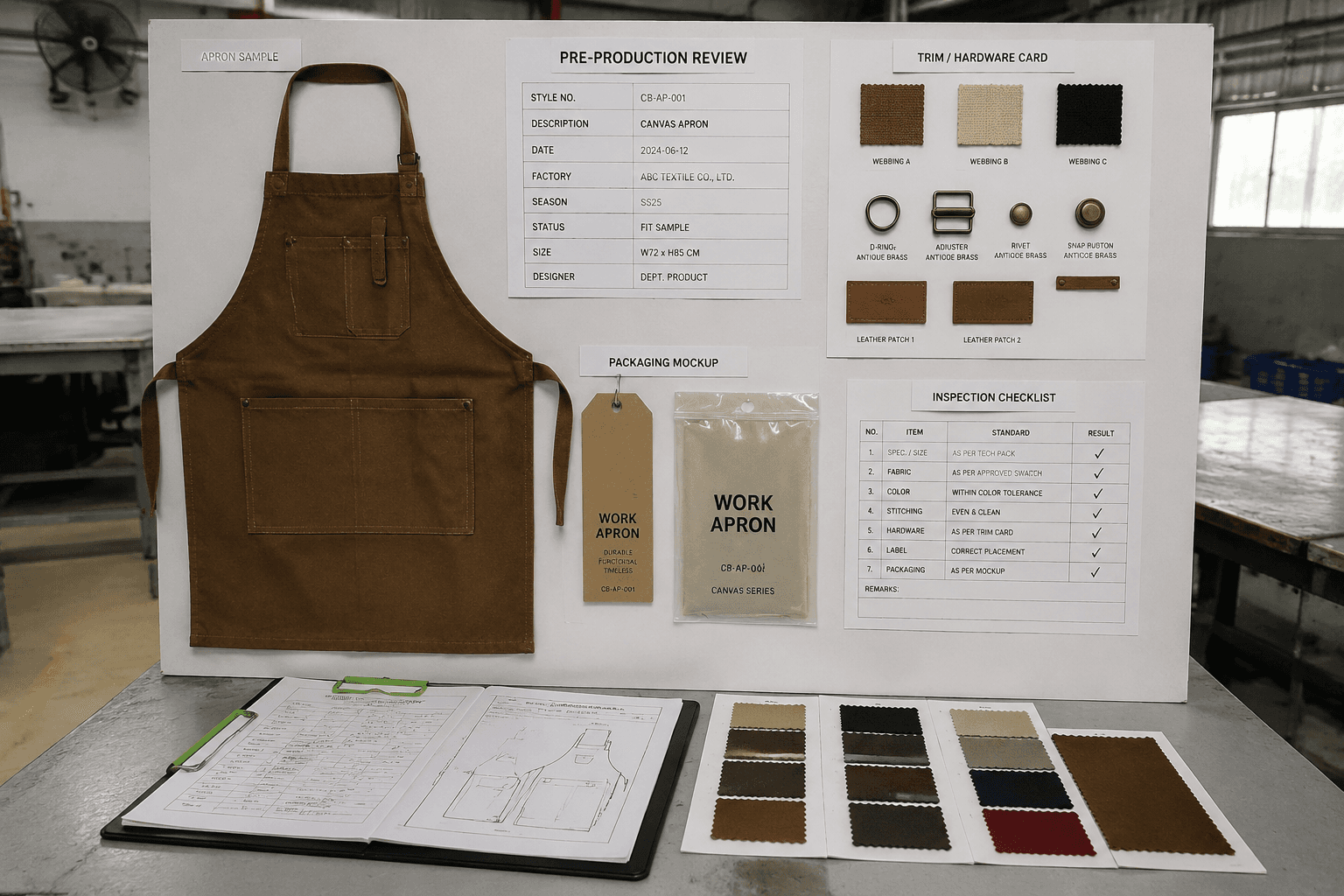
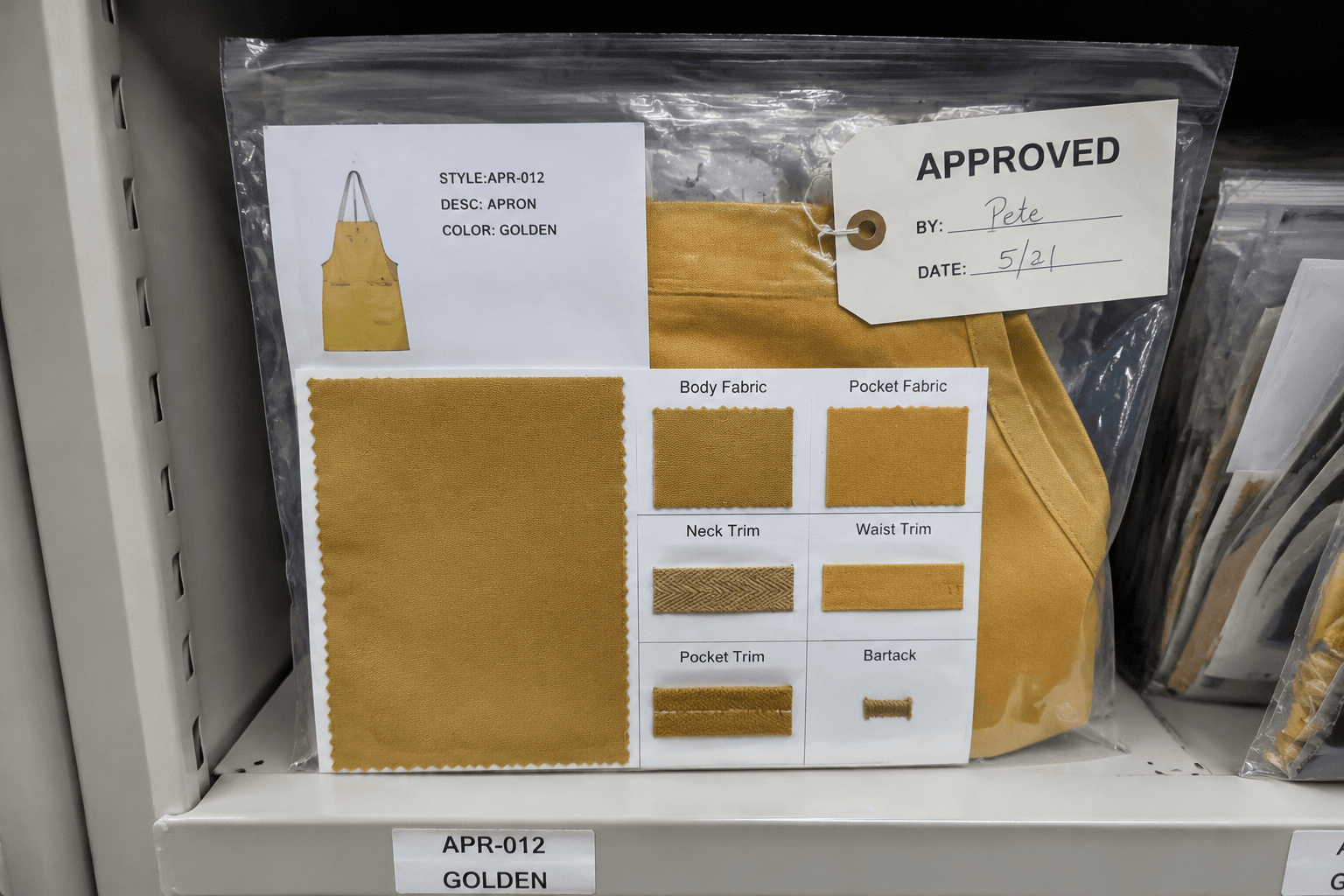
Each standard should be labeled with style code, composition, weave, GSM, mill, PO number, dye lot, finish, wash route, and approval date. For example, a useful record is: Style BA-104, 300 GSM 100% cotton canvas, reactive dyed black, enzyme wash + silicone softener, approved 2025-02-18. Without that level of detail, the factory can reproduce only the idea of the color, not the original result.
Pantone, TCX, or archive swatches still have value, but they should sit behind the retained bulk standard rather than replace it. A 220 GSM 65/35 twill and a 10 oz cotton canvas will reflect light differently, hold dye differently, and age differently in laundry. Natural apron programs are even less suited to chip-only approval because buyers are usually targeting a commercial cream range rather than a bright paper white.
The most practical tolerance method for apron sourcing is instrument screening followed by visual approval on both flat fabric and a sewn panel. Instrument data can eliminate clear misses early. Visual review then confirms how seam density, topstitching, washing, pressing, and trim attachments affect the final look of the apron in service.
- Retain one sealed bulk standard for each core apron color: black, navy, and natural.
- Record full fabric data such as 300 GSM cotton canvas, 10 oz canvas, or 220 GSM 65/35 polycotton 2/1 twill.
- Store standards in closed polybags away from direct daylight and high humidity so the approval sample does not yellow or fade.
- Approve shade on both bulk fabric and a sewn apron panel; if washed after sewing, approve the finished washed apron.
- If trims are visible, keep approved swatches for neck tape, waist ties, pocket fabric, and sewing thread with the body standard.
Black apron reorder shade consistency: control undertone, finish, and wash loss
Black is the core color in many apron programs, but it is rarely the easiest to repeat. In production, black is not one fixed color. It is a combination of depth, undertone, and finish. Two black aprons can both look dark enough in a carton and still fail when worn side by side under service lighting. On bib aprons with a large uninterrupted front panel, these differences are easy to spot.
Fabric base changes how black must be built. A 280 to 300 GSM cotton canvas may use a reactive or vat route depending on wash-fastness target and budget. A 210 to 235 GSM 65/35 polycotton twill needs balanced coloration across the polyester and cotton components; if balance is weak, the cotton side can fade faster and the apron starts to look brown-black or uneven after laundering. Enzyme wash, silicone softener, peach finish, and strong pressing all reduce apparent depth, which is why approving an unfinished black lab dip often creates trouble later.
For professional B2B buyers, black approval should include review under D65, TL84, and warm LED 3000K to 3500K. It should also include at least a quick wash check before bulk release on hospitality or foodservice aprons expected to see regular laundering. Adding 3 to 4 approval days at this stage is cheaper than replacing mixed black replenishment after delivery.
On simple black bib aprons, ex-factory pricing commonly lands around $2.40 to $5.20/pc depending on fabric weight, pocket count, hardware, embroidery, and order quantity. The lower end usually assumes larger runs and continuity fabric. A rush reorder of 600 pcs on a new black dye lot often costs more and still carries a higher mismatch risk.
- Allow 4 to 7 days for first black lab dips and another 2 to 3 days if undertone correction is needed.
- Confirm whether the apron fabric uses reactive dye, vat dye, or a blended route, especially on polycotton bases.
- Check black approval fabric after at least 3 home or commercial wash cycles when the apron is intended for repeat laundering.
- Heavier black canvases in 280 to 320 GSM usually need a different build from lighter twills in 200 to 240 GSM.
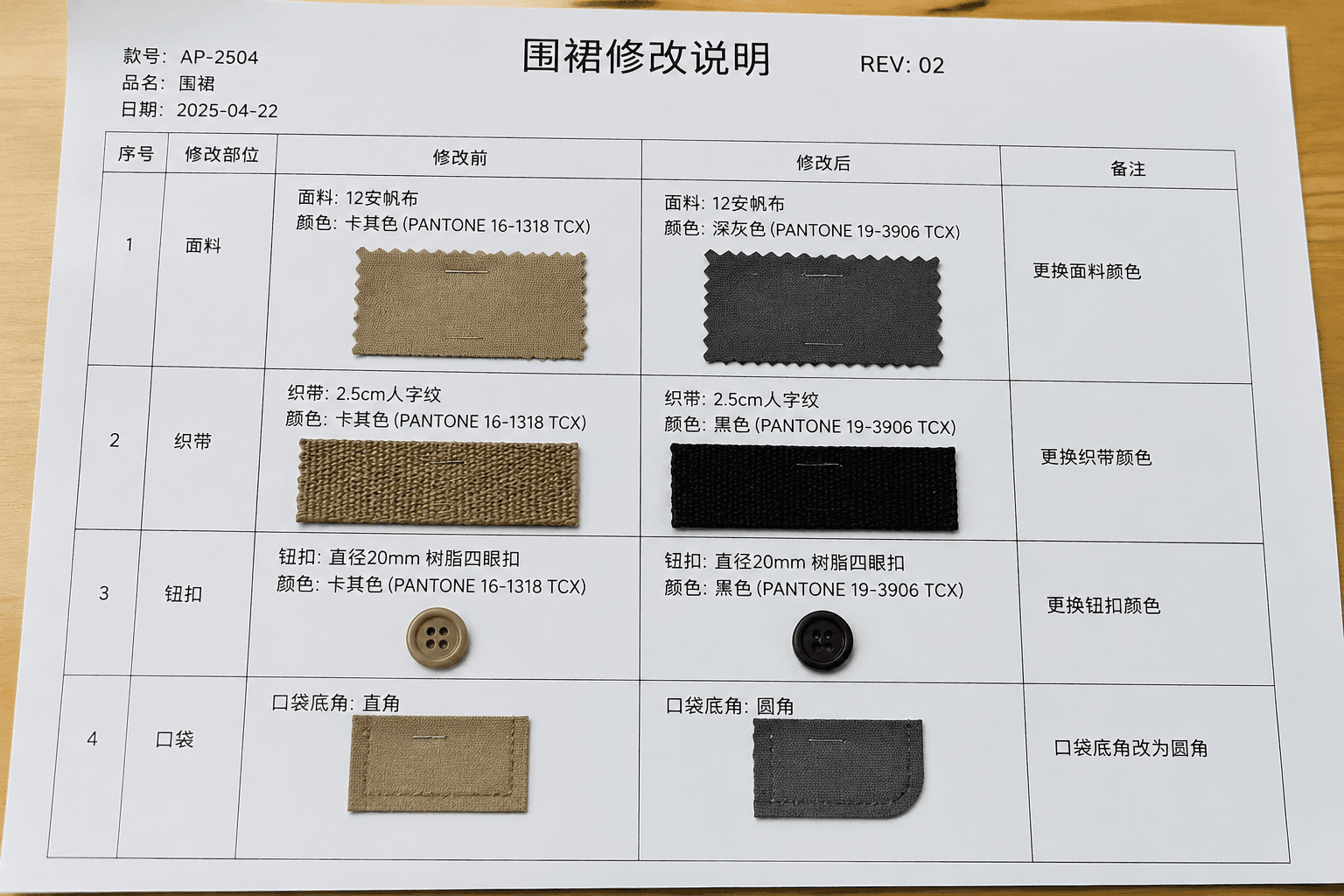
- Do not approve black body cloth without matching visible trims such as tape, webbing, thread, and pocket fabric.
Navy apron reorder shade consistency: stop lighter repeats and trim mismatch
Navy often causes more commercial disputes than buyers expect because small drift is highly visible when old and new aprons are worn together. A reorder that is only slightly lighter can pass warehouse review and still fail in store or on the restaurant floor. This is common on replacement orders of 500 to 1,200 pcs, when the dyehouse groups the lot with a similar recipe instead of rebuilding the original conditions exactly.
Construction changes the way navy reads. A 210 to 230 GSM 65/35 polycotton twill usually gives stronger laundry life and better crease recovery, but can appear flatter or cooler indoors. A 280 to 300 GSM 100% cotton canvas often looks richer at first issue, yet it may frost sooner at seams, pocket corners, and tie edges. The correct specification depends on whether the buyer prioritizes exact visual continuity, softer handfeel, or longer laundry life.
The most stable sourcing method for navy is annual planning with one mill and one agreed base cloth. If forecast demand is 8,000 to 15,000 pcs over 12 months, reserving greige or continuity capacity materially reduces lot drift. It can also shorten repeat lead time. A navy reorder that normally needs 35 to 45 days ex-factory can often move in 20 to 30 days if body cloth and matching trims are already reserved.
Component control matters as much as body cloth. On navy aprons, a pocket that is slightly darker or a neck strap that is slightly greener than the body is often more obvious than a small body-to-body shift. Buyers should therefore reserve or approve strap, pocket, tie, and tape materials together with the body fabric, not after the main cloth has already been selected.
- Reorders below 800 pcs per navy color usually carry the highest shade risk and highest unit cost.
- Continuity planning often becomes commercially worthwhile once annual demand reaches about 5,000 pcs or more.
- Typical ex-factory pricing for simple navy bib aprons is roughly $2.20 to $4.80/pc; urgent small repeats usually land near the high end.
- Reserve neck straps, waist ties, pocket cloth, thread, and tape with the navy body fabric.
- If the program is shade-sensitive, review a sewn PPS against the retained standard before cutting bulk.
Natural and ecru aprons: define the cream range instead of writing only 'natural'
Natural, ecru, and lightly bleached aprons are often treated as simple because they are not deep dyed colors. In reality, they are among the hardest shades to repeat cleanly across seasons. Cotton origin, harvest timing, spinning blend, bleaching intensity, optical brightener level, enzyme wash, and storage age all influence the final tone. One lot may read pink cream, another yellow cream, and another slightly grey. If the PO says only natural, the supplier is being asked to interpret a moving target.
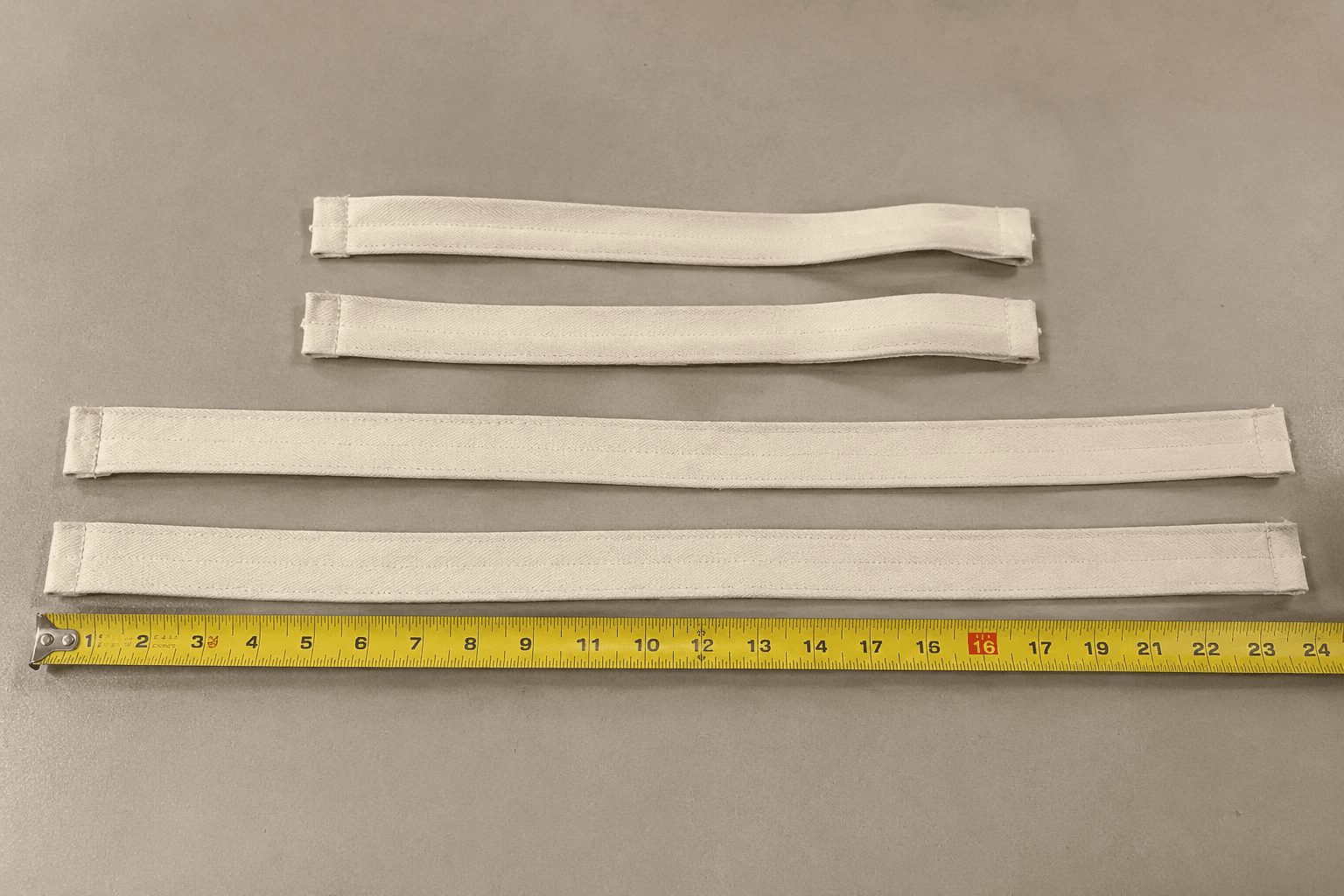
This is especially visible on 260 to 340 GSM cotton apron fabrics where broad body panels and textured weaves expose small variation clearly. Internal mismatch is also common. If the body cloth is one cream, the pocket another, and the herringbone tape a third, the apron can look inconsistent before it leaves the factory. For chain hospitality and retail programs, that weakens the perceived quality immediately.
The practical solution is to define the target by retained physical standard plus a written commercial range. Some buyers deliberately position the product as a washed natural apron and allow controlled variation from lot to lot. Others need stronger continuity because old and new stock are mixed in daily use. In those programs, a lightly bleached or mildly optical-brightened base is often easier to control than a raw natural cotton target.
Lead-time planning matters here as well. A natural apron reorder placed at the last minute may force the factory to buy whatever greige lot is available, and a small greige difference can become a visible cream difference after finishing. Sharing a 60 to 90 day forecast gives the mill a better chance to match the original base more closely.
- Specify whether the apron target is natural, ecru, light bleached, or optical brightened.
- Write down the acceptable cast: cream, yellow-cream, pink-cream, or grey-cream.
- Review matching across body, pocket, neck strap, waist ties, and tape before bulk cutting.
- If the apron is garment washed after sewing, approve the finished washed apron, not only raw fabric.
- For continuity programs, keep retained standards in sealed storage and replace archive standards every 12 to 18 months if they show aging.
MOQ, lead time, AQL, and approval timing that keep reorder apron programs commercially stable
Good shade control has to fit production reality. The safest process is to submit lab dips or strike-offs on the actual production base cloth, from the same mill where possible, with the same finish and wash route planned for bulk. For more shade-sensitive apron programs, approving 1 to 3 meters of candidate bulk fabric is more reliable than signing off a hand swatch because undertone, levelness, and surface reflection are easier to judge on apron-width material.
Commercial limits should be discussed early. Many mills require dyed-fabric MOQs of 300 to 500 meters per color. A reorder for 400 bib aprons may consume only 180 to 240 meters depending on marker efficiency, pocket layout, and strap cutting. That gap creates either excess cloth cost or pressure to accept substitute lots. Buyers normally get better consistency by grouping black, navy, and natural replenishment into workable dye lots instead of placing frequent emergency top-ups every few weeks.
Typical dyed-apron reorder timing is 28 to 45 days from PO to ex-factory when fabric must be dyed fresh. A practical breakdown is 4 to 7 days for lab dips, 7 to 12 days for dyeing and finishing, 3 to 5 days for cutting and sewing prep, 7 to 12 days for sewing and finishing, and 2 to 3 days for final inspection and packing. Rush requests for shipment in 15 to 20 days usually push the factory toward stock fabric or substitute lots, which increases mismatch risk immediately.
Inspection must support the sourcing plan. For shade-sensitive apron programs, pre-production approval should cover body fabric, pocket fabric, strap fabric, thread, tape, and any binding under the agreed lighting conditions. Bulk fabric inspection can follow AQL 2.5 major / 4.0 minor, but shade should have its own approval gate because it is not simply a defect-count issue. In practice, continuity improves when buyers share forecasts 60 to 90 days ahead, approve the sewn PPS against the retained standard, and release bulk only after all color points are closed.
- Typical dyed reorder lead time: 28 to 45 days ex-factory.
- Typical dyed-fabric MOQ: 300 to 500 meters per color, sometimes higher for deep black or specialty finishes.
- Recommended inspection flow: bulk fabric review, sewn PPS approval, inline shade check, final random inspection.
- Use AQL 2.5 major / 4.0 minor plus a separate shade approval standard against retained bulk fabric.
- If the reorder is below workable dye MOQ, evaluate whether to group colors, hold continuity stock, or accept excess fabric carryover before releasing the PO.