For buyers sourcing aprons from China, OEKO-TEX is usually discussed late in the project, after fabric weight, color, pocket layout and target price. That is risky. Certification can affect fabric selection, dyeing route, trims, printing method, label wording, testing documents, MOQ and lead time. A supplier can often make a visually identical apron with certified or non-certified inputs, but the compliance position and cost structure are not the same.
An oeko-tex apron should be understood as a finished product or material system made from components that meet the relevant OEKO-TEX chemical safety requirements. In apron manufacturing, the main risk points are dyed fabric, coated fabric, printed logos, sewing thread, binding tape, metal hardware, plastic buckles and packaging contact. If only the base cloth is certified, that does not automatically mean the finished apron with PU coating, pigment print and metal eyelets is fully covered.
This article explains what professional sourcing teams should check before ordering custom certified aprons in bulk: what OEKO-TEX Standard 100 means, how certificates are read, which apron fabrics are commonly available, where costs increase, and how to write a purchase specification that a factory can actually produce against.
- OEKO-TEX Standard 100 controls harmful substances in textiles, but buyers must confirm whether the certificate covers fabric only or the finished apron.
- Certified apron fabric is easiest to source in cotton twill, poly-cotton twill, canvas and polyester, while special coatings and washed effects need earlier checking.
- MOQ is usually driven by certified fabric availability; stock-certified colors may start around 300-500 pcs, while custom dyed fabric often starts at 1,000-3,000 pcs.
- Printing and embroidery can change the compliance position, especially for plastisol, silicone, reflective inks, metallic thread and transfer films.
- A realistic lead time is 25-45 days after sample approval for most bulk certified apron orders, longer if new lab testing or custom dyeing is required.
- Buyers should request certificate number, holder name, product scope and validity date before confirming bulk production.
What an oeko-tex apron certification actually means
OEKO-TEX Standard 100 is a textile safety certification that tests for regulated and harmful substances, including certain azo colorants, formaldehyde, heavy metals, phthalates, pesticides, PFAS-related substances in some scopes, and other residues depending on material type and product class. For aprons, the relevant category is normally Product Class II for articles with direct skin contact, or sometimes Product Class I if the apron is intended for babies or toddlers, such as children's cooking aprons. Product Class II is the common requirement for adult kitchen aprons, chef aprons, barista aprons, salon aprons and craft aprons.
The key point for sourcing managers is that OEKO-TEX is not a fabric weight, not an organic claim and not a quality grade. A 180 GSM poly-cotton apron and a 340 GSM cotton canvas apron can both be OEKO-TEX certified if the tested materials meet the limit values. Equally, a heavy 12 oz canvas apron can fail chemical requirements if the dyeing, finishing or coating contains restricted substances. Certification sits beside physical quality, not above it.
In factory practice, there are three common situations. The fabric mill holds an OEKO-TEX certificate for a certified apron fabric. The trim supplier holds certificates for tapes, thread or buckles. Or the finished apron producer arranges certification or testing for a specific product. Each route has different cost and timing implications. Buyers should not assume that the sewing factory owns the certificate, because many apron factories produce with certified inputs supplied by mills.
- Ask whether the certificate covers raw fabric, dyed fabric, printed fabric, trims or finished apron.
- Check the product class; adult apron programs normally require Product Class II, while children's aprons may require Product Class I.
- Confirm the validity date; OEKO-TEX certificates are renewed annually and expired documents should not be used for new claims.
- Match the article description on the certificate to the material being purchased, such as cotton twill, polyester fabric, woven tape or sewing thread.
Where OEKO-TEX matters most in apron sourcing
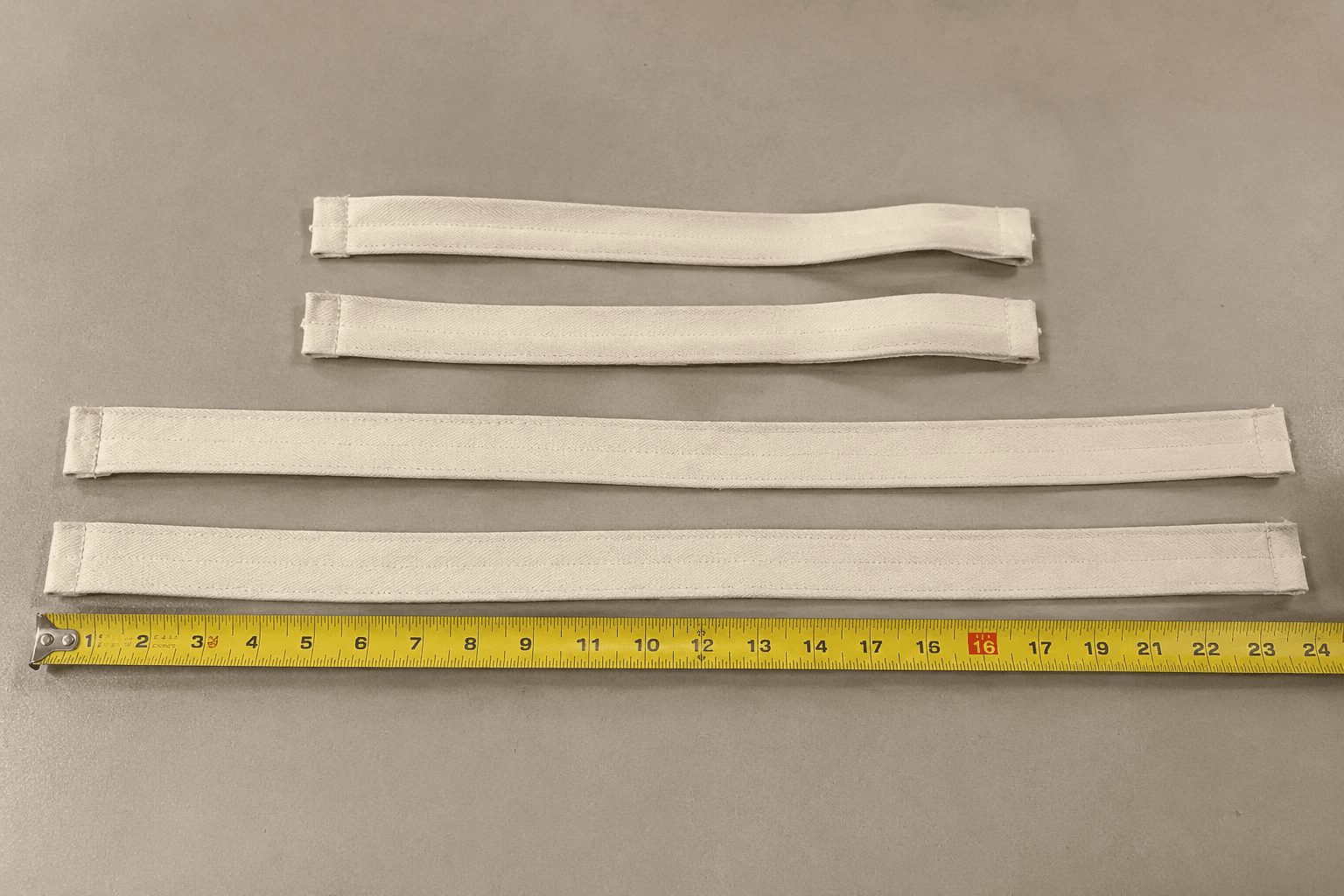
Aprons are simple products compared with jackets or technical workwear, but they still combine multiple textile and non-textile components. A basic bib apron may include main fabric, neck strap, waist ties, sewing thread, care label and carton packaging. A higher-value work apron may add cross-back webbing, metal eyelets, brass-look rivets, PU leather patches, PVC name holders, printed branding, towel loops and reinforced pockets. Every added component creates another compliance question.
For food service, hospitality and home kitchen retail, buyers often use OEKO-TEX as a customer-facing reassurance that the textile is a safe apron textile for regular body contact and repeated washing. For beauty, barber and tattoo sectors, chemical safety is also relevant because aprons may be worn for long shifts and may contact skin at the neck and arms. For children's aprons, the requirement is stricter, and many importers combine OEKO-TEX with additional CPSIA, EN71 or REACH testing depending on market.
The biggest practical issue is claim control. If a brand plans to sell a non toxic apron and print OEKO-TEX wording on packaging, the documentation must support that wording. A supplier-side recommendation is to separate internal purchasing language from public label language. Internally, buyers can specify "fabric must be OEKO-TEX Standard 100 certified." Publicly, claims should be reviewed against the actual certificate scope and the certifier's labeling rules.
- For restaurant and cafe aprons, certified dyed fabric and colorfast washing performance are usually the main checks.
- For salon and barber aprons, coating, water resistance and dark color rubbing fastness need attention.
- For children's aprons, Product Class I, drawstring safety, small parts and print chemistry should be reviewed together.
- For retail gift aprons, packaging claims, hangtags and private label wording should be aligned with the certificate scope.
Common certified apron fabric options and realistic specifications
Certified apron fabric availability changes by mill, season and color, but several materials are commonly workable in Zhejiang and nearby textile markets. Cotton twill is widely used for kitchen and hospitality aprons, often in 180-240 GSM for lighter retail aprons and 260-320 GSM for more durable chef or barista styles. Cotton canvas is preferred for heavier work aprons, usually 10-12 oz, roughly 340-410 GSM, though some buyers request 14 oz canvas for tool or craft aprons. The heavier the fabric, the more the unit cost and sewing difficulty increase.
Poly-cotton twill is often the most stable option for uniform programs because it balances cost, shrinkage and color consistency. Common compositions include 65/35 polyester-cotton at 190-240 GSM, or 80/20 polyester-cotton for lower shrinkage and faster drying. Polyester plain weave or twill is used for promotional aprons and budget hospitality programs, typically 150-220 GSM. If the buyer needs an oeko-tex apron at a controlled price, stock-certified polyester or poly-cotton is often easier than custom dyed cotton.
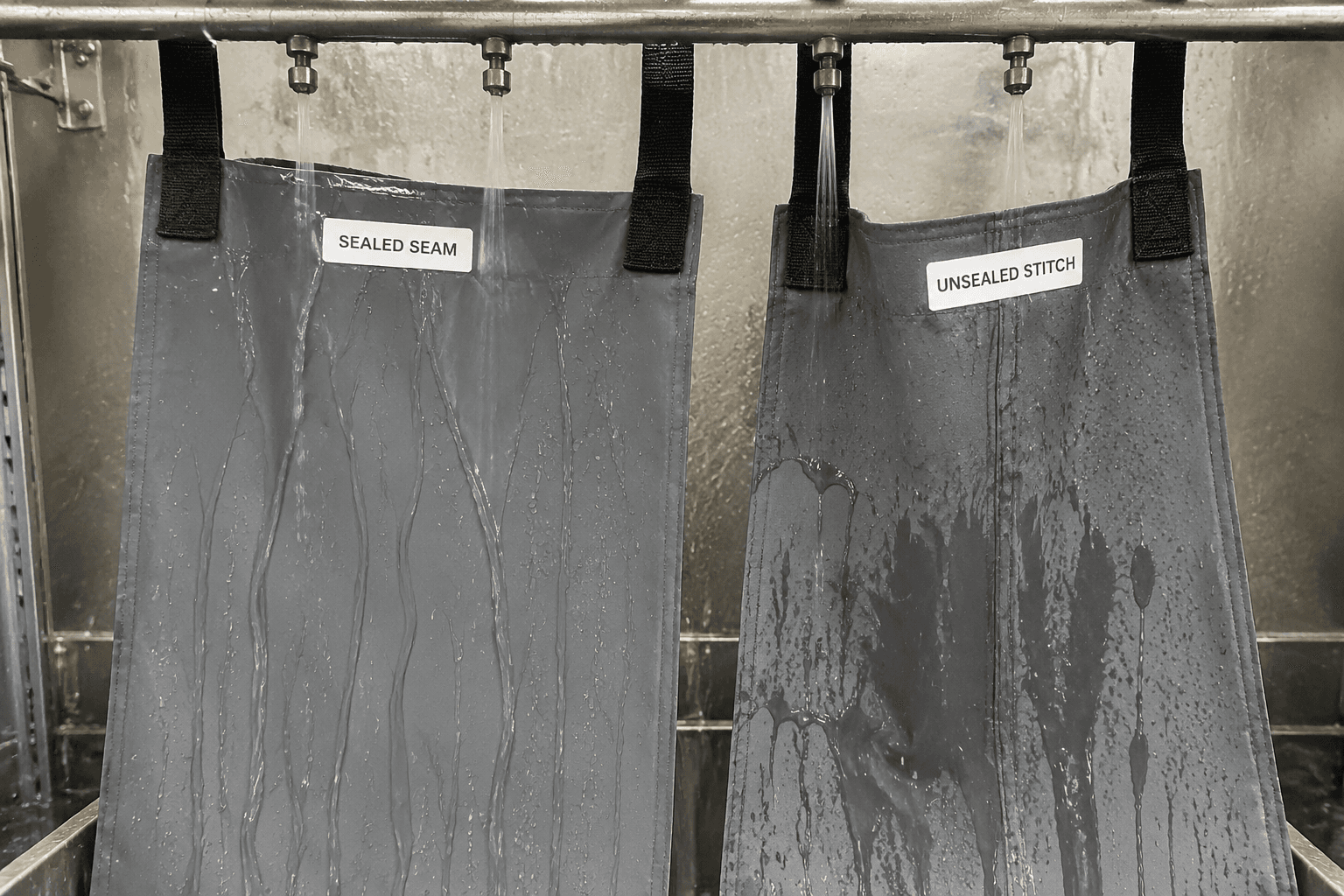
Washed cotton, pigment-dyed canvas, waxed-look finishes and PU-coated aprons need more caution. These finishes can be certified, but they are not always available from stock. Pigment washing can create shade variation and higher shrinkage. PU coating can affect breathability and may require separate testing. Waxed cotton may involve chemistry outside a standard mill certificate. If the apron must be both visually aged and certified, the sampling route should include compliance confirmation before sales samples are approved.
- 180-220 GSM cotton twill: suitable for light kitchen, promotional and retail aprons, with lower fabric cost and softer handfeel.
- 240-280 GSM cotton or poly-cotton twill: suitable for cafe, restaurant and uniform aprons, with better durability for repeated laundering.
- 300-340 GSM cotton twill or light canvas: suitable for barista, maker and premium kitchen aprons, with higher sewing and freight cost.
- 10-12 oz cotton canvas: suitable for workwear-style aprons, tool pockets and reinforced construction, but requires stronger needle and thread setup.
- 150-220 GSM polyester: suitable for price-sensitive or quick-dry programs, but buyers should check heat tolerance for ironing and transfer printing.
How to verify an oeko-tex apron certificate before ordering
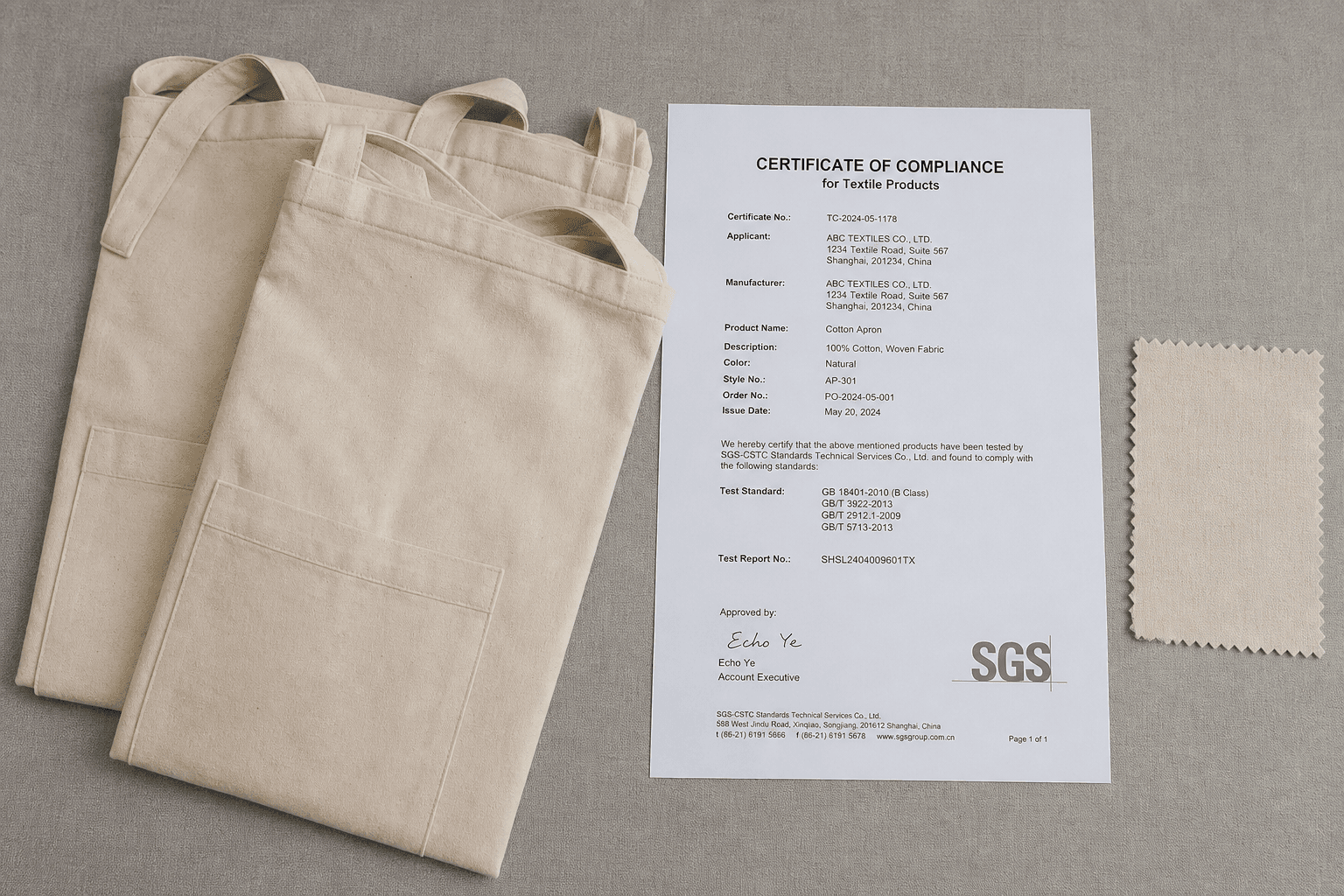
A certificate should be treated as a controlled document, not as a decorative PDF. Buyers should request the certificate number, holder name, product description, product class, appendix if available, issue date, expiry date and the certifying institute. The holder may be a fabric mill, dyeing factory, trim supplier or finished product manufacturer. If the holder is not the apron factory, the supplier should identify how the certified material flows into production and how batches are controlled.
The most common misunderstanding is assuming that one certificate covers all colors and materials. In reality, a certificate may cover specific fiber compositions, dye classes, finishes or article groups. For example, a certificate for 65/35 polyester-cotton dyed fabric does not necessarily cover 100% cotton canvas with pigment wash. A certificate for black cotton twill may not automatically cover waterproof PU-coated fabric. This is why buyers should send the exact fabric specification and ask the supplier to confirm certificate coverage in writing.
For large programs, especially 5,000-50,000 pcs, a buyer may request batch test reports in addition to OEKO-TEX certification. OEKO-TEX certification provides an audited framework, while batch testing confirms the actual goods or fabric lot. For high-risk colors such as deep black, navy, burgundy, fluorescent tones or pigment prints, batch testing gives extra control. Testing normally adds 5-10 working days if samples are sent to SGS, Intertek, Bureau Veritas, TÜV or a similar lab.
- Verify that the certificate number is valid and that the certificate has not expired before PO placement.
- Compare the fiber content and finish on the certificate with the purchase specification.
- Confirm whether all selected colors are covered, especially dark colors, neon colors and garment-washed shades.
- Keep a copy of the supplier's batch traceability statement for the fabric lot used in production.
- For retail claims, check whether the buyer is allowed to use OEKO-TEX hangtag or wording under the applicable labeling rules.
Cost impact, MOQ and lead time for certified apron fabric
The cost impact of OEKO-TEX depends on whether certified material is already available. If a mill has stock-certified fabric in standard black, white, natural, navy or beige, the price difference may be small, often around USD 0.05-0.20 per apron for light to medium aprons. If the project requires custom dyed certified cotton canvas, the cost increase can be larger because dyeing, finishing, testing and wastage are all linked to a smaller controlled lot.
For a simple 220 GSM poly-cotton bib apron with one pocket and no print, a non-certified FOB price might sit around USD 1.20-1.80 per pc depending on construction, quantity and season. Using certified stock fabric may add about USD 0.05-0.15 per pc. For a 300 GSM cotton twill apron with adjustable neck strap, metal buckle, two pockets and embroidery, the FOB range may be USD 2.60-4.20 per pc, with certification-related material control adding USD 0.10-0.35 per pc if certified trims are also required. For a heavy 12 oz canvas cross-back apron, the FOB range may be USD 5.00-9.50 per pc, where certified canvas availability has a bigger effect.
MOQ is usually less about sewing and more about fabric sourcing. A sewing factory may accept 300 pcs per design, but the certified fabric mill may require 500-1,000 meters per color for dyeing. One meter may produce roughly 1.1-1.8 aprons depending on apron size, width, pockets and cutting efficiency. For stock fabric, 300-500 pcs per color can be workable. For custom dyed certified fabric, 1,000-3,000 pcs per color is more realistic. For heavy canvas or special finishes, the practical MOQ can rise to 3,000-5,000 pcs.
Lead time should also be planned honestly. Sampling from available certified fabric usually takes 5-10 days for a plain apron and 10-15 days with logo development. Bulk production after sample approval is commonly 25-35 days for standard aprons up to around 5,000 pcs. Custom dyed certified fabric adds 10-20 days. New third-party testing can add 5-10 working days. During March-May and August-October, capacity pressure can stretch these ranges, especially for export uniform programs.
Printing, embroidery and trims can change the compliance position
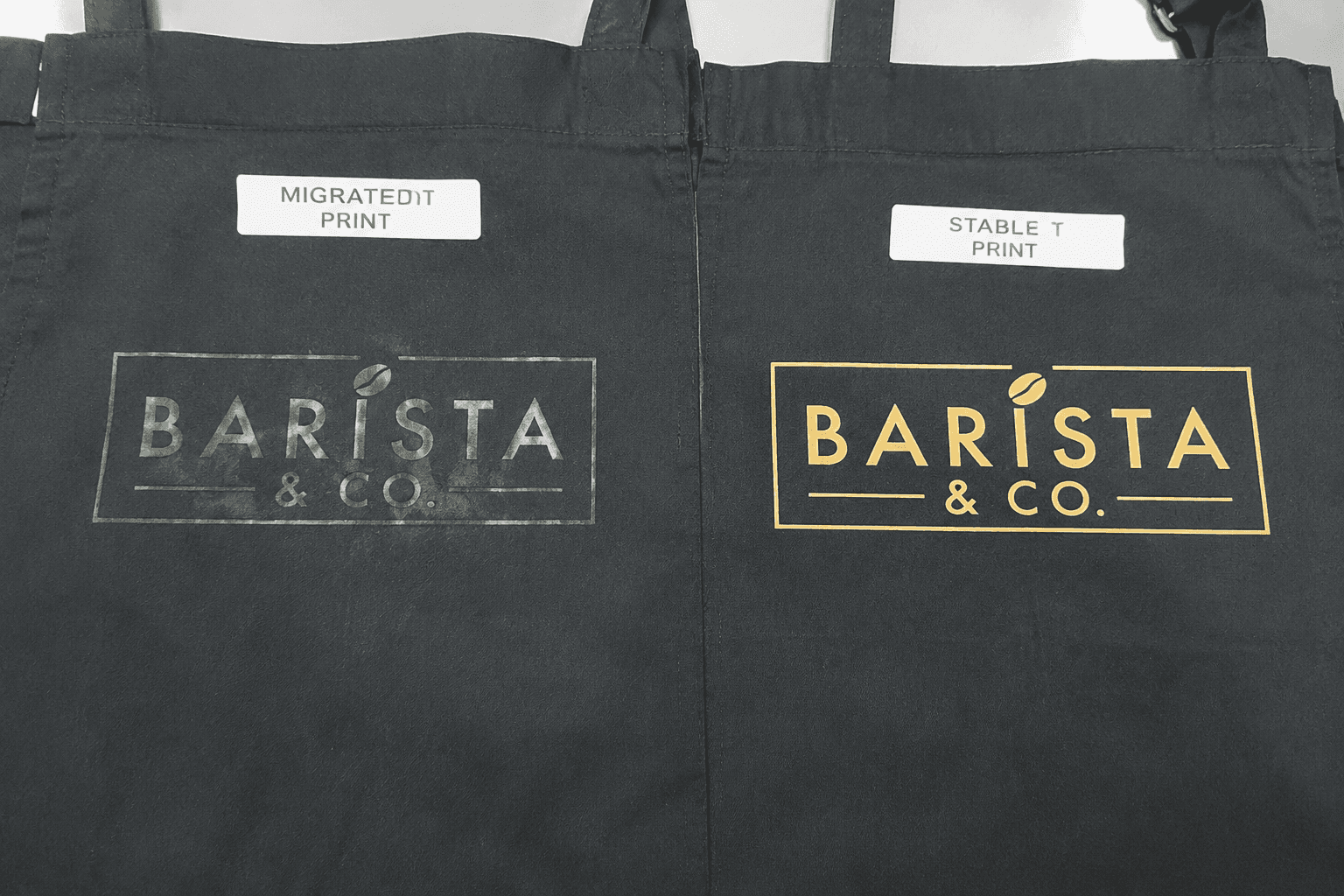
Many buyers focus only on the base fabric, but decoration and trims are often where compliance becomes unclear. A certified apron fabric can lose its clean claim position if a large plastisol print, rubber patch or coated transfer is added without checking chemistry. Water-based screen printing is often easier to align with a safe apron textile requirement, but ink supplier documentation is still needed. Heat transfers can be efficient for small MOQs and multicolor logos, yet the transfer film, adhesive layer and release paper system should be reviewed.
Embroidery is usually lower risk than printing, but thread composition and dye compliance still matter. Standard polyester embroidery thread can be OEKO-TEX certified if sourced correctly. Metallic embroidery thread, glow thread and specialty textured thread require separate confirmation. For private-label retail aprons, brand patches are another control point. Cotton labels, woven polyester labels, PU leather patches and genuine leather patches each have different compliance considerations. Genuine leather is outside normal textile certification and may require separate chemical testing if used.
Hardware is also part of the finished product risk assessment. Metal buckles, D-rings, rivets and eyelets are not always covered by OEKO-TEX textile certificates. For EU or UK markets, nickel release, lead and cadmium may be relevant depending on use and contact. Plastic buckles may require phthalate and heavy metal checks. If the buyer's specification says "non toxic apron," the factory should not be asked to rely only on the cotton fabric certificate while unverified metal and plastic parts are added.
- Use water-based print inks where possible for food service and children's apron programs.
- Request ink or transfer film declarations when the logo covers more than 10-15% of the apron surface.
- Specify certified polyester or cotton sewing thread if the finished product claim requires broader component control.
- Check metal hardware separately for nickel, lead and cadmium where the destination market requires it.
- Avoid last-minute trim substitutions after approval, because a cheaper buckle or tape can invalidate the documented compliance route.
Writing a purchase specification for an oeko-tex apron
A good purchase specification should make certification measurable. Instead of writing only "OEKO-TEX required," specify the standard, product class, component scope, documents required and timing. For example: "Main fabric must be OEKO-TEX Standard 100 certified, Product Class II or better, certificate valid through bulk shipment date. Supplier to provide certificate copy and fabric lot traceability before production." This gives the factory a clear basis for quotation and production control.
The specification should also define fabric parameters. Include fiber content, weave, GSM or oz, color standard, shrinkage tolerance, colorfastness, print method, apron dimensions, pocket size, strap material and packaging. Certification does not replace performance testing. A certified fabric can still shrink 6% if not pre-shrunk, or fade after 20 industrial washes if the dyeing route is not suitable. For hospitality and workwear programs, buyers should set wash requirements at the quotation stage, not after bulk fabric is dyed.
For custom apron OEM projects, the cleanest workflow is to approve compliance before approving the final sales sample. First, confirm fabric certificate and trim route. Second, make a fit and construction sample. Third, approve logo method and decoration chemistry. Fourth, issue a pre-production sample from confirmed bulk materials. Fifth, start cutting only after the buyer has signed off. This process may feel slower at the beginning, but it prevents the expensive situation where 3,000 pcs are sewn from fabric that cannot support the label claim.
- State the exact requirement as OEKO-TEX Standard 100, Product Class II unless a stricter class is needed.
- Define whether certification must cover main fabric only or fabric, thread, straps, labels and trims.
- Set physical requirements such as GSM, shrinkage, colorfastness and washing method separately from chemical safety.
- Require supplier notice before any material, dye lot, trim or print ink substitution.
- Ask for certificates and test documents before deposit or before bulk fabric purchase, depending on the order size.
Factory-side advice for buyers sourcing certified aprons from China
From the supplier side, the most efficient certified apron projects are the ones where the buyer separates must-have requirements from preferences. If OEKO-TEX certification is mandatory, decide early whether the target price can support certified cotton canvas, or whether a certified poly-cotton twill gives better value. If a special washed vintage look is mandatory, allow more sampling and testing time. If the retail claim is mandatory, let the supplier see the intended packaging wording before bulk production.
Buyers should also avoid mixing very small color quantities with custom certified fabric requirements. A request for 100 pcs each in eight Pantone colors with OEKO-TEX certified custom dyed cotton is usually not realistic at normal apron pricing. A more workable structure is to use stock-certified black, navy, white or natural for small repeat orders, and reserve custom colors for 1,000 pcs or more per color. For launch programs, many brands start with 500 pcs per color in available certified fabric, then move to custom dyeing after sell-through data is clear.
The best commercial result usually comes from matching certification level, fabric choice and end use. A restaurant uniform apron washed weekly does not need the same fabric as a retail gift apron used at home twice a month. A children's painting apron needs stricter chemical and drawstring control than an adult warehouse packing apron. An oeko-tex apron program works well when the buyer treats certification as one controlled part of the full specification, alongside durability, wash performance, fit, branding and price.