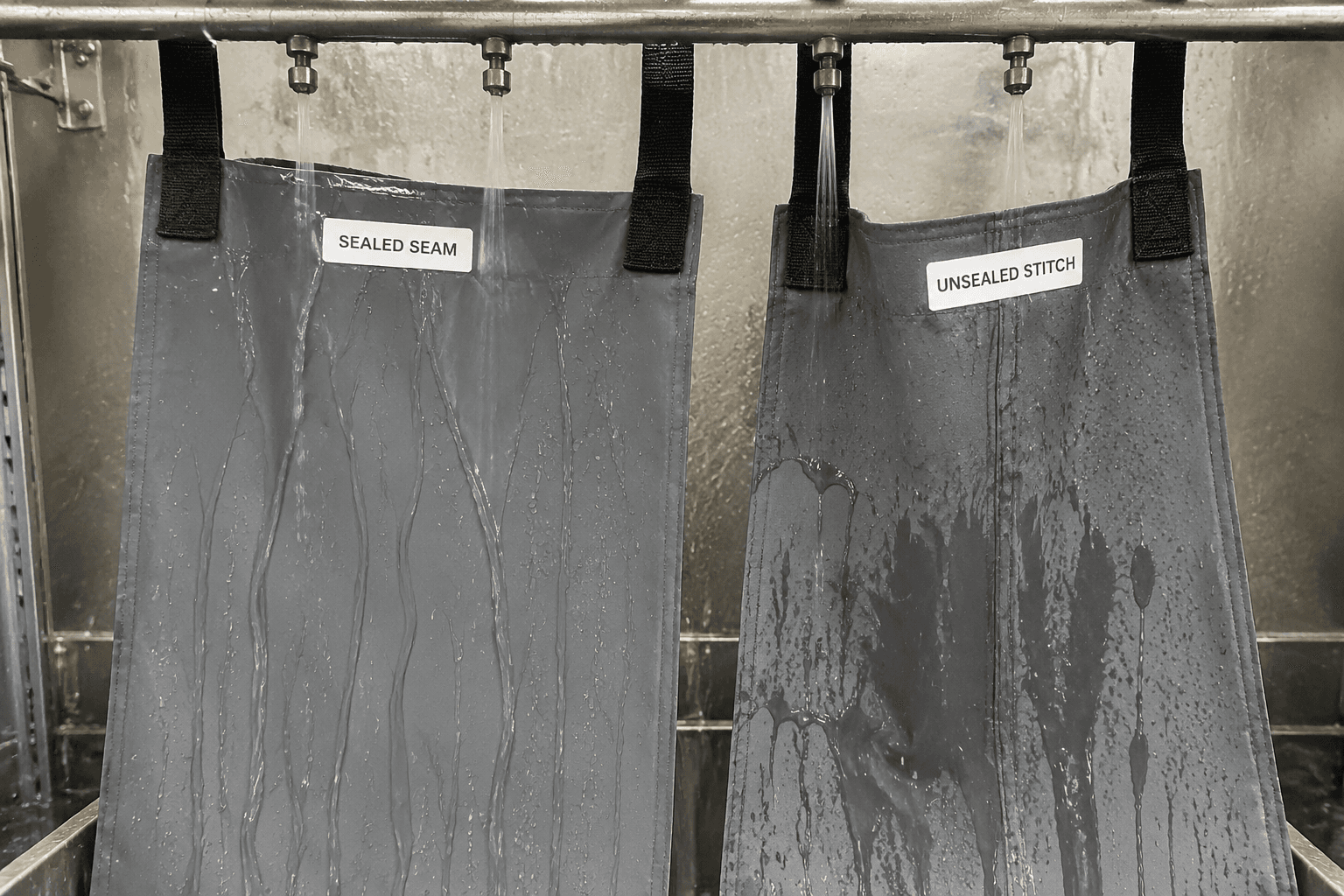
For uniform, hospitality, foodservice and promotional programs, apron laundering trials are a pre-production control, not a courtesy check after sample approval. Before PO release, buyer and factory should agree what the apron must still look like after 5, 10 or 20 wash cycles under the real care route. That means fixed limits for body length change, width change, strap distortion, shade movement, seam puckering, print loss and trim failure, so approval rests on measured data rather than preference.
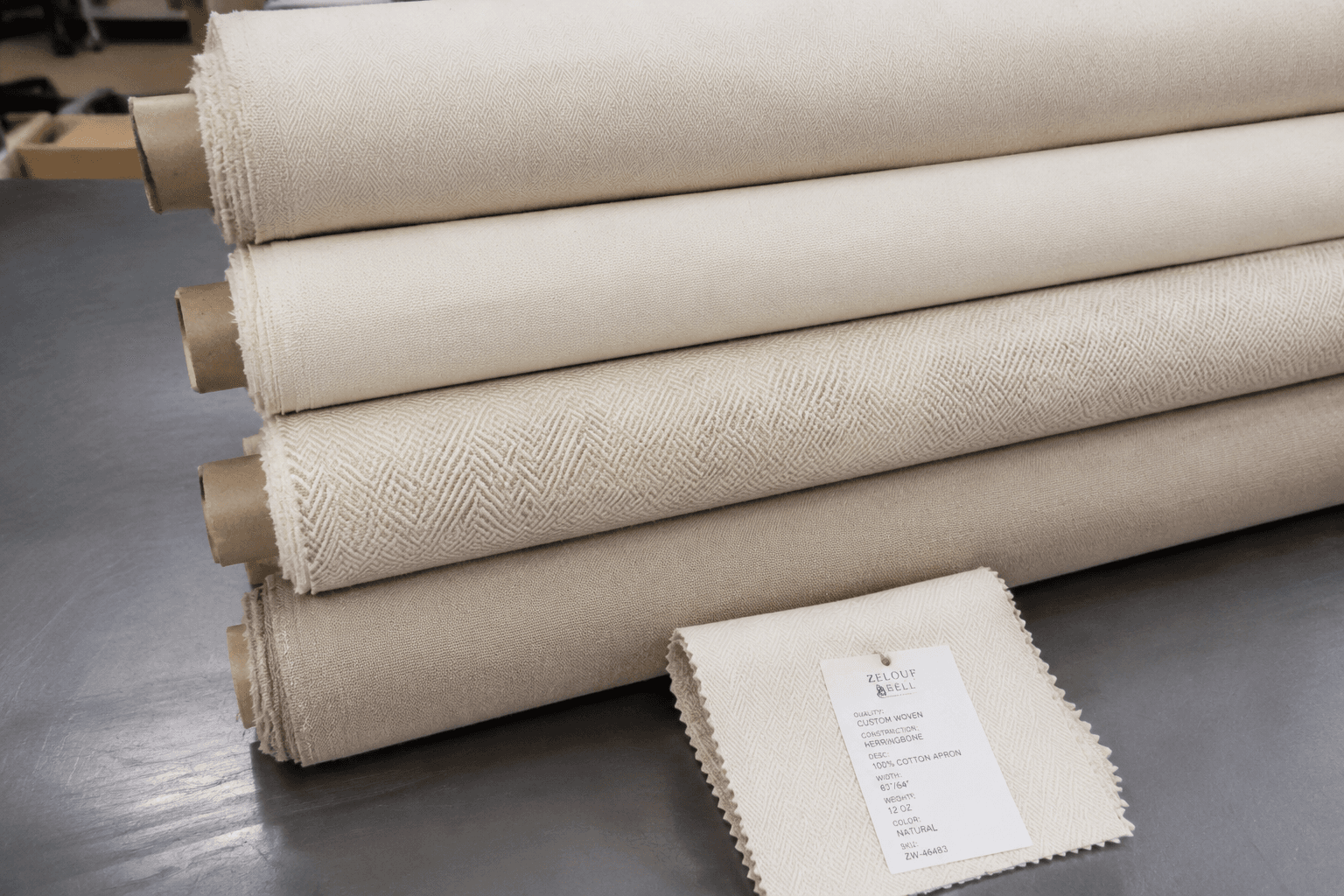
The trial must use the final apron build. A 210 GSM 65/35 poly-cotton twill waist apron, a 285 GSM cotton canvas bib apron and an 11 oz cotton denim cross-back apron will not behave the same way in laundering. Results also change sharply between a 40 degrees C home-style wash, a 60 degrees C hospitality wash and a 75 degrees C contract-laundry route with alkali, extraction and tumble finishing. Testing substitute fabric, lab dips without bulk finishing, or a softer internal method gives weak approval evidence for a B2B apron launch.
For sourcing teams, the target is a written release standard: tested fabric lot, trim set, thread ticket, decoration method, wash recipe, drying route, cycle count, sample quantity, measurement points, appearance scores and pass-fail limits. That record protects both sides. It helps the buyer reduce field claims and helps the factory show whether a later failure came from production variance or laundering outside the approved window.
- Apron laundering trials should use the exact bulk fabric, trim set, thread ticket, labels and decoration method planned for production
- For many woven apron programs, a practical dimensional target is within 2.5 percent to 3.0 percent on main body measurements after the agreed wash count; cotton-rich apron styles often need a wider approved band unless sanforizing or compacting is confirmed
- Appearance should be scored by defect type, including color change, seam puckering, tie twist, edge curl, print cracking, embroidery distortion, hardware oxidation and pocket deformation
- A realistic launch trial usually tests 6 to 12 aprons per style-color, with at least 1 retained unwashed control and staged reviews at wash 1, 5, 10 and, when relevant, 20
- For post-wash review, many buyers use AQL 2.5 for major defects and AQL 4.0 for minor defects so the trial aligns with shipment inspection language
- Adding 7 to 14 calendar days for wash trials is usually cheaper than replacing an 8,000 to 20,000 piece apron order after field failure
Why apron laundering trials belong before bulk cutting
Aprons usually face harsher wash frequency than many other uniform items. In cafes, bakeries, hotel kitchens and central food-prep sites, one reusable apron may be laundered 2 to 6 times per week. A single first-wash check is rarely enough for a launch decision. The point of apron laundering trials is to confirm whether the approved apron still meets the buyer's dimensional and appearance standard after the cycle count that matters commercially: commonly 5 cycles for event or campaign aprons, 10 cycles for standard hospitality issue and 20 cycles where service-life claims are part of the tender.
That matters because apron failure is driven by construction details as much as by nominal fabric weight. A buyer can approve an 8 oz cotton canvas bib apron at sample stage and still face claims if the bulk fabric was not sanforized, if bartacks were reduced from 28 stitches to 18, if plated D-rings replaced stainless hardware, or if 3.2 cm waist ties were cut slightly off-grain. The apron may look acceptable in packed form and still fail after laundering through tie twist, pocket-mouth curl, hem roping or body skew above 3 percent.
The launch gate should match risk. A 600-piece event apron at FOB $2.25 per piece can justify a lighter protocol than a 15,000-piece hospitality rollout at FOB $4.90 per piece with reactive black dye, embroidery and industrial laundry exposure. Both programs need documented criteria before cutting, but the larger order needs more evidence, a larger sample set and stricter sign-off because the replacement cost is materially higher.
- Use 5 wash cycles for short-life promotional aprons, 10 cycles for standard reusable hospitality aprons and 20 cycles where wash-life claims affect award decisions
- Lock the trial only after shell fabric, trims, thread, labels and decoration are frozen to the final BOM
- Retain at least 1 unwashed control apron per style-color-size for side-by-side visual and dimensional comparison
Dimensional standards in apron laundering trials: measurement map, tolerances and rest time
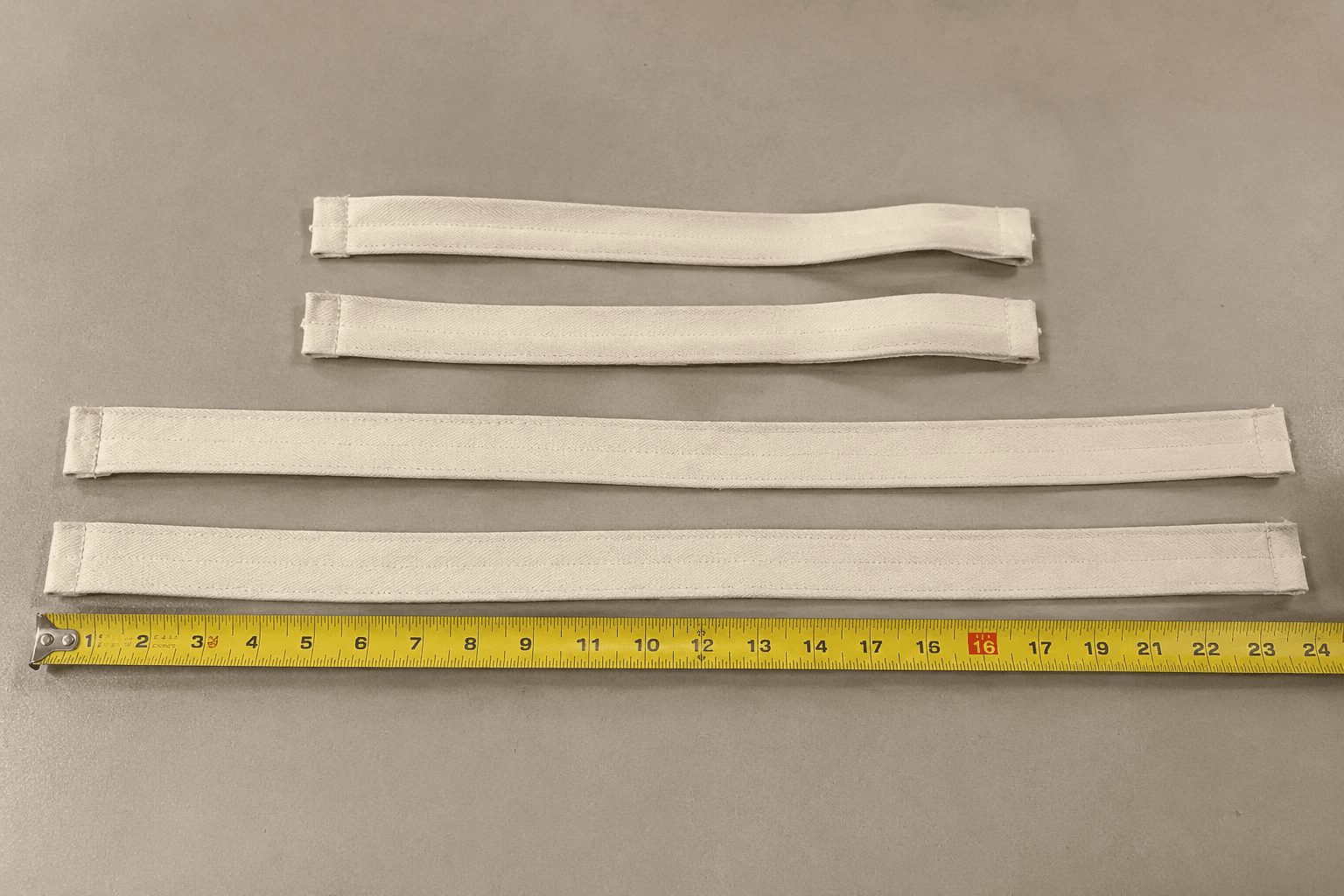
Dimensional control starts with a measurement map that every team uses the same way. For a bib apron, common points are finished body length, chest width, hem width, neck strap length, each waist tie length, pocket width and pocket depth. For a waist apron, the usual set is body width, drop length, tie length and pocket opening width. If the apron has curved hems, cross-back straps, contrast joins or divided pockets, buyer and factory should approve a sketch with exact start and stop points. Without that, different teams will measure the same apron differently and the pass-fail call becomes unreliable.
In practice, many apron buyers set laundering limits within 3.0 percent on main body length and width after the agreed cycle count. That is realistic for a stable 190 to 240 GSM 65/35 poly-cotton twill with standard resin finish. It is often too tight for cotton-rich aprons unless pre-shrink finishing is confirmed. A 280 to 320 GSM cotton canvas or 10.5 to 12 oz denim apron may need an agreed limit of up to 4.0 percent after 5 washes if it has not been compacted, sanforized or pre-washed before shipment. The correct limit should fit end use, wash route and price point rather than simply look strict on a worksheet.
Keep sewing tolerance separate from laundering tolerance. If a bib apron body length specification is 86 cm with a production tolerance of plus or minus 1.0 cm, the wash trial should calculate the additional change from the approved starting measurement. Combining cut-and-sew tolerance with post-wash shrinkage into one number makes supplier responsibility harder to prove and weakens claim handling.
Conditioning rules matter as much as the percentage cap. Measurements should be taken after a fixed post-dry rest, usually 12 to 24 hours laid flat in a conditioned room at stable temperature and humidity. Aprons measured warm from the dryer often show temporary distortion around ties, hems and pocket corners. A fixed rest period gives more repeatable data and reduces false failure calls.
- Record both absolute change in cm and percentage change; a 2.0 cm loss in body length can matter operationally even when the percentage looks moderate
- Set separate limits for shell body, straps and pocket geometry because those parts do not move at the same rate in laundering
- For cotton canvas aprons above 280 GSM, verify whether the fabric is sanforized, compacted or pre-washed before agreeing to a shrinkage cap below 3.0 percent
- Rest washed aprons flat for 12 to 24 hours before final measurement and use the same rest rule at every wash stage
Appearance scoring in apron laundering trials after 5, 10 and 20 washes
Dimensional stability alone does not make an apron acceptable for launch. Many failed programs involve aprons that still measure inside tolerance but no longer look clean enough for guest-facing use. Buyers should review appearance at wash 1, wash 5, wash 10 and, when relevant, wash 20. Each washed apron should be compared against an unwashed control and against the agreed commercial standard for the use case, whether that is back-of-house kitchen, front-of-house cafe service or retail merchandise.
The most usable system is an itemized score sheet. Core apron categories are shade change, surface abrasion, seam puckering, hem roping, panel skew, tie twist, pocket-mouth curl, print cracking, embroidery distortion, hardware corrosion and edge fray. Some buyers use a 1-to-5 visual scale with grade 4 as the minimum pass on visible surfaces after 5 washes. Others prefer direct thresholds such as no rust staining, no broken bartacks, no open seam longer than 3 mm and print coverage loss of not more than 10 percent. Either system works if it is defined before the trial starts and used consistently.
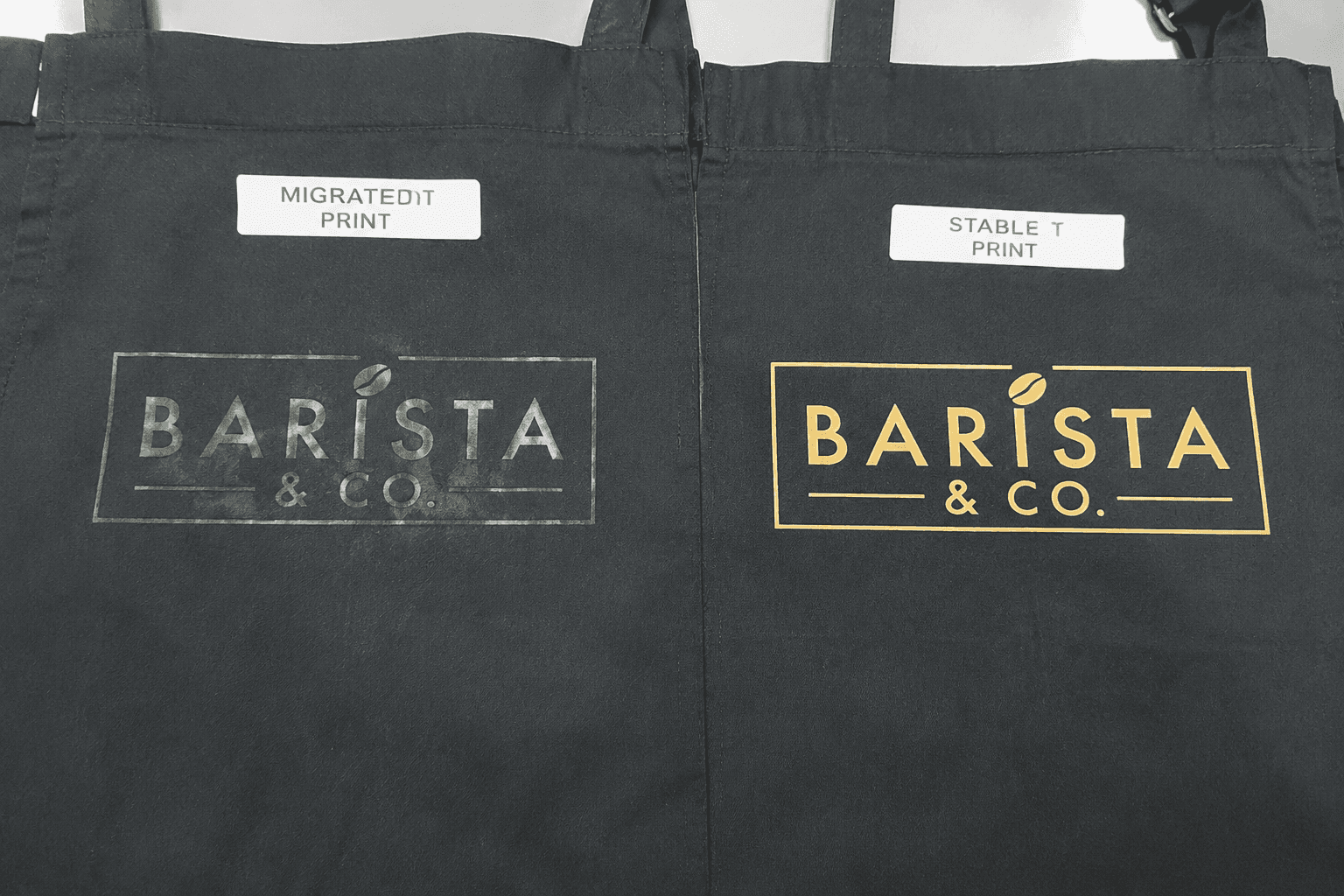
Different apron constructions fail in different ways. Reactive-dyed cotton canvas often gives better color depth than pigment dye, yet dark black, navy and forest green can still shift visibly under hot alkaline laundering. Screen print on 300 GSM canvas can crack if the ink film is too rigid or under-cured. Embroidery on 200 GSM twill may pucker if backing weight and stitch density are mismatched. Faux leather patches can harden, peel or stain adjacent fabric after repeated tumble drying. These are sourcing issues with direct commercial impact because they affect brand presentation at store level.
Post-wash review should align with bulk acceptance language. Many buyers apply AQL 2.5 for major appearance defects and AQL 4.0 for minor defects on the washed sample set. That keeps the laundering trial connected to the same defect framework later used for shipment release.
- Score shade change separately from abrasion; a buyer may accept slight tone movement but still reject visible face wear on the front panel
- Inspect bib aprons both laid flat and on a form because strap twist and chest drape are easier to judge when worn
- Check D-rings, rivets, sliders and eyelets after drying heat for oxidation, burrs and staining transfer
- Photograph the same apron positions at wash 0, 1, 5, 10 and 20 to support objective approval records
How to design apron laundering trials: wash route, sample size and timeline
The most common sourcing mistake is using a wash recipe that does not match actual service conditions. An apron that passes a 40 degrees C home wash with line dry may fail quickly in a hospitality route using 60 to 75 degrees C washing, medium alkali, extraction and tumble or tunnel finishing. If the buyer uses a contract laundry, the factory should reproduce that route as closely as practical. Where exact chemistry cannot be shared, the parties should still lock wash temperature, detergent class, liquor ratio, cycle time, extraction level and drying method before the trial begins.
A practical protocol usually includes one baseline route and one stress route. For example, a 210 GSM 65/35 twill cafe apron can be tested under a baseline of 60 degrees C wash, mild alkaline detergent, 35 to 40 minute cycle, 800 to 900 rpm extraction and tumble dry low for 5 and 10 cycles. The stress route may raise wash temperature to 75 degrees C with a 40 to 45 minute cycle and medium tumble finishing for 5 cycles to expose edge cases. A 300 GSM cotton canvas bib apron may need a lower dry-temperature baseline if the sewn care label prohibits aggressive heat, but the stress route should still reflect likely over-processing in the field.
Sample quantity should match risk and construction complexity. For simple aprons with stock fabric and no decoration, 6 pieces per style-color is usually enough for a launch trial. For aprons with embroidery, transfer print, contrast binding, multiple fabric panels or metal hardware, 10 to 12 pieces is a safer minimum. A common split is 1 unwashed control, 2 pieces assessed after wash 1, 2 after wash 5, 2 after wash 10 and the balance held for seam checks, appearance review or repeat testing if one result looks abnormal.
Trial timing should be built into the sourcing calendar. Internal factory laundering and evaluation usually add 7 to 12 calendar days. If the buyer requests third-party colorfastness checks, comparative laundry methods or contract-laundry participation, the added time is more often 12 to 18 days. Those days should be planned before ex-factory booking rather than absorbed later through rushed approvals.
- Baseline route: the exact care-label wash and dry method intended for normal apron use
- Stress route: a harsher but credible commercial route reflecting probable over-processing
- Minimum launch sample size: 6 aprons for simple styles, 10 to 12 for decorated or hardware-rich styles
- Typical added timeline: 7 to 12 days for internal trials, 12 to 18 days when external validation is included
Common failures found in apron laundering trials and the corrective actions that matter
Most apron wash failures repeat across programs. Excess shrinkage remains the most common issue on cotton canvas and denim, especially when buyers reduce cost by dropping compacting, sanforizing or garment-wash preparation. For many cotton-rich aprons, anything above 3.0 to 4.0 percent body shrinkage after the agreed cycle count will trigger complaints because tie position, pocket height and overall balance shift visibly.
The second failure group involves construction distortion rather than fabric shrinkage alone. Pocket mouths flare when turn-backs are too narrow or topstitch tension is unbalanced. Long waist ties rope and twist when they are cut off-grain or folded too narrowly to save labor. Cross-back straps become asymmetrical when shell fabric and webbing shrink at different rates. Hem roping often points to a mismatch between shell stability, stitch density and drying heat. In these cases, changing fabric alone does not solve the problem; the sewing method has to change as well.
Decoration and trim defects are the third major group. Screen prints can crack on heavy canvas if curing is incomplete or the binder is too rigid. Heat transfers may lift after repeated drying. Embroidery can distort lighter twill when underlay and backing are not balanced. Plated hardware may oxidize after only a few industrial cycles, while stainless steel or better-finished alloy usually holds longer. Low-grade coated trims and faux leather patches can harden or delaminate under commercial drying temperatures.
The financial logic is direct. A custom apron FOB can range from about $2.20 per piece for a basic waist apron in stock twill to $6.80 per piece for a heavier bib apron with custom dye, embroidery and hardware. On an 8,000-piece order, a failed $3.80 FOB program represents $30,400 before freight, duty, disposal, rework and replacement handling. That is why corrective action during sampling is materially cheaper than resolving claims after rollout.
- High shrinkage on cotton aprons usually points to finishing limits, not only sewing variation
- Pocket curl is often improved by a wider fold-back, balanced topstitch tension and stronger corner reinforcement
- Tie twist is reduced by straight-grain cutting, stable width and avoiding overly narrow folded constructions
- Rust or staining around hardware should trigger a trim-spec review, not only a fabric review
Turning apron laundering trials into binding launch approval records
A laundering trial has value only when the result becomes a release document used by merchandising, QA and production. The record should identify style number, sample code, fabric composition, GSM or oz weight, color, trim specification, thread ticket, decoration method, wash route, drying method, cycle count, measurement results, appearance scores, sample size, AQL criteria and final decision. If the apron passes only conditionally, such as approval limited to 5 cycles rather than 10, that exception should be stated plainly.
The same record should define change control. If the trial passed on 240 GSM sanforized cotton canvas with reactive dye and 20/3 topstitch thread, the factory cannot later switch to 220 GSM open-width finished fabric or lighter thread without revalidation. Buyers often negotiate cost after sample approval by changing fabric source, hardware grade or decoration method. That is normal sourcing practice, but once any wash-relevant component changes, the original trial no longer proves the bulk apron.
Responsibility boundaries should be written just as clearly. If the apron passes at 60 degrees C wash with tumble dry low and then fails because the end user launders at 90 degrees C with chlorine and high-heat tunnel finishing, that sits outside the approval window. If it fails inside the approved route, the issue belongs back with production or raw-material control. A signed report reduces argument because the accepted operating conditions were fixed before launch.
For professional apron buyers, the rule is simple: do not release full bulk cutting until the laundering report is signed against the final BOM. Holding production for an extra 7 to 10 days is usually cheaper than disputing a failed shipment after packing and export booking.
- Include front, back, pocket, strap and trim photos before wash and after each agreed cycle stage
- Write the exact care instruction that will appear on the sewn label, carton marking and buyer specification sheet
- State re-test triggers clearly: fabric lot change, trim supplier change, print-process change, hardware change or finishing change
- Do not issue final bulk approval until the signed report matches the final BOM and production method