For a retail apron, the care label is often treated as a compliance detail. For a commercial laundry apron, it is part of the product specification. The label decides how the apron will be washed, dried, ironed, sorted, and retired after repeated use in restaurants, hotels, food service, workshops, and rental laundry programs.
From the factory side, we see care labeling problems most often when the apron fabric, trim, print, and end-use laundry method are specified separately. A buyer may approve a 240 GSM cotton twill, add PU leather straps, request a discharge print, and then ask for 75 C tunnel washing after bulk production. The apron may still look correct at shipment, but the apron care label no longer matches the real service conditions.
A reliable apron care label should be written before bulk cutting, not after packing. It should reflect fiber content, fabric construction, dyeing method, trims, print process, shrinkage allowance, and whether the apron will face domestic washing, on-premise laundry, or industrial laundry cycles.
- Commercial laundry care labels must be based on the weakest component, including straps, buckles, print, eyelets, and thread.
- Apron washing instructions should match actual wash chemistry, not only the fabric supplier's standard care recommendation.
- Industrial laundry aprons need pre-production wash testing for shrinkage, colorfastness, seam strength, and hardware performance.
- Care symbols reduce language risk, but written temperature and drying limits still help laundry operators avoid mistakes.
- Label placement affects sorting speed, especially for rental programs handling thousands of aprons per day.
- A small label error can become a claim when 3,000 to 20,000 pieces are washed under the wrong condition.
Why the apron care label must be fixed before bulk production
In apron sourcing, the care label is not an isolated sewing accessory. It is connected to material selection, pattern allowance, trim choice, print method, packing, and after-sales risk. For a 5,000-piece order, a buyer may spend weeks approving fabric color and logo placement, but leave care wording until the final pre-production sample. That timing is risky because the correct apron care label may require changes to fabric or trims.
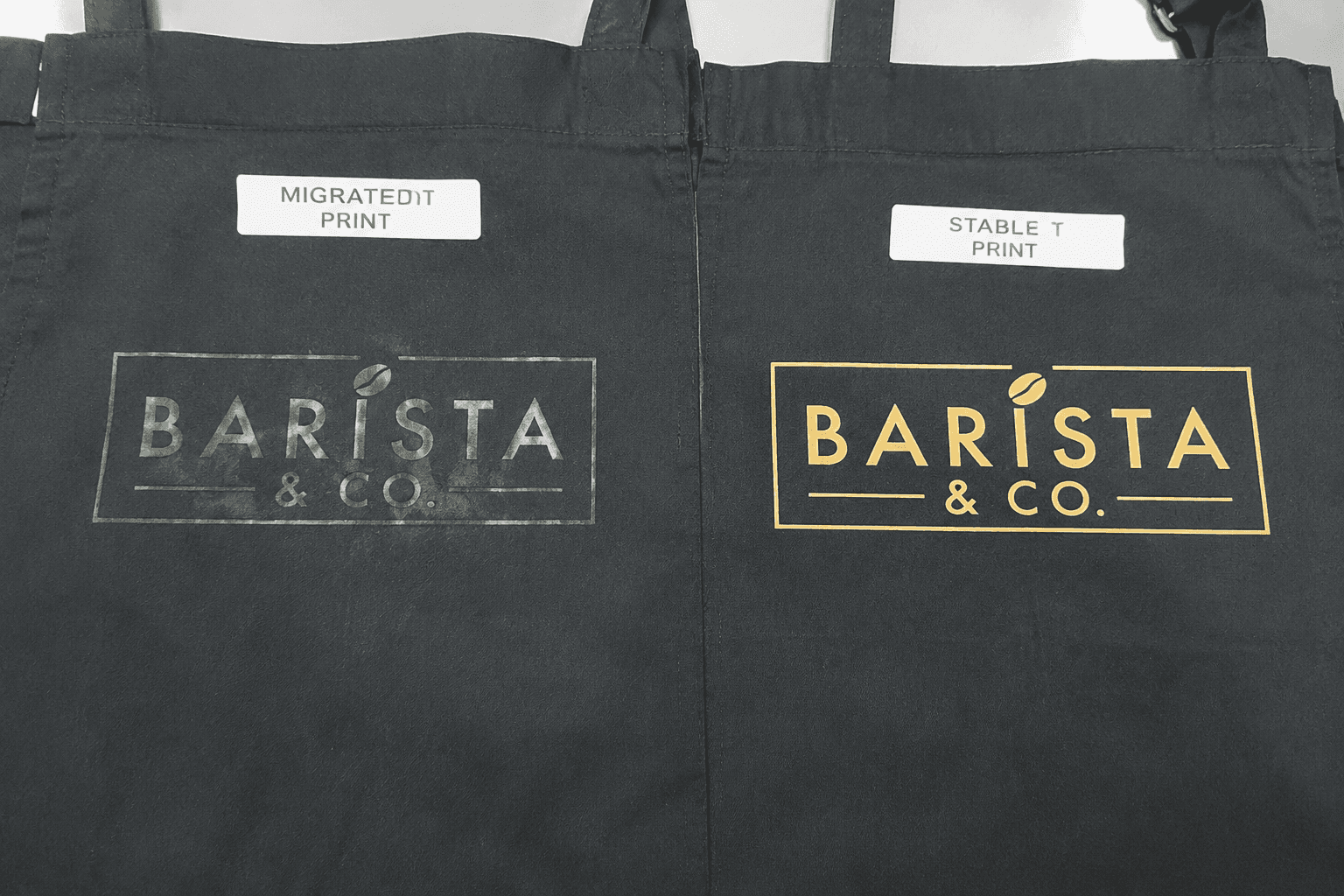
For example, a 200 GSM polyester-cotton plain weave can usually tolerate more aggressive washing than a 280 GSM enzyme-washed cotton canvas with antique brass hardware and contrast cotton tape. A bib apron with detachable PU straps may need separate strap care instructions or a lower drying temperature. A waist apron with a large plastisol print may pass 40 C domestic washing but crack after repeated 75 C commercial tumble drying. These are not labeling problems only; they are product engineering problems.
At factory quotation stage, we normally ask three laundry questions: who will wash the apron, at what temperature, and how will it be dried. If the buyer cannot answer, we specify a conservative care label suitable for general hospitality use, often 40 C machine wash, low tumble dry or line dry, warm iron on reverse, no chlorine bleach, and wash with similar colors. If the buyer confirms industrial washing, we need stronger evidence from testing and may recommend polyester-rich fabric, reactive dyeing, reinforced stitching, and heat-stable trims.
- Care wording should be approved together with the pre-production sample, not added after bulk sewing.
- The care instruction must follow the most sensitive part of the apron, not only the main fabric.
- Laundry assumptions should be written into the purchase order, tech pack, or approval comments.
- If the end user uses a rental laundry service, domestic wash wording is usually insufficient.
Choosing apron care label wording for domestic, commercial, and industrial washing
The phrase machine washable is too broad for professional apron programs. A cafe chain washing aprons in-store at 40 C has very different conditions from a hotel laundry using alkaline detergent, oxygen bleach, hydro-extraction, and tunnel finishing. A food processing customer may need 60 C or 75 C wash cycles for hygiene control. The apron care label should make these differences visible.
For standard branded hospitality aprons, a common instruction is: machine wash cold or warm at 30 C to 40 C, wash dark colors separately, do not bleach, tumble dry low, warm iron if needed. This is suitable for many cotton, polyester-cotton, and denim aprons when shrinkage is controlled to around 3 percent to 5 percent after three washes. For commercial laundry apron programs, we often move to 60 C wash tolerance, stronger colorfastness, and tighter trim control. For industrial laundry apron use, the label may need to state maximum wash temperature, chlorine restrictions, drying temperature, and whether pressing is allowed.
The buyer should also decide whether the wording is permissive or restrictive. Wash up to 60 C gives the laundry operator a maximum. Wash at 60 C implies a target condition. Do not tumble dry protects delicate trims but increases operating cost for the end user. Tumble dry low may be acceptable for store washing, but unclear for a professional dryer measured by outlet temperature and dwell time. Clear wording reduces arguments after the first laundry cycle.
- Domestic wash apron: normally 30 C to 40 C, mild detergent, low mechanical action, low claim risk if the end user follows instructions.
- Commercial laundry apron: often 40 C to 60 C, stronger detergent, batch washing, tumble drying, higher shrinkage and color-loss risk.
- Industrial laundry apron: may face 60 C to 85 C washing, alkaline chemistry, tunnel washing, high extraction, and repeated thermal drying.
- Food service hygiene programs may require wash conditions that conflict with decorative trims, garment-dyed colors, or leather-like accessories.
Fabric, GSM, and construction details behind the apron care label
The apron care label should be supported by the fabric specification. GSM alone does not decide wash durability, but it affects shrinkage, drying time, hand feel, and cost. A 180 GSM T/C 65/35 twill is economical and dries quickly, but may feel light for premium restaurant use. A 240 GSM cotton twill gives a more traditional hand feel, but shrinkage control must be managed. A 320 GSM cotton canvas looks durable on the table, yet may become stiff, fade faster, and take longer to dry in high-volume laundry.
Fiber composition matters. Polyester improves dimensional stability, drying speed, and color retention, especially in black, charcoal, navy, and dark green aprons. Cotton improves hand feel and heat comfort, but it shrinks more and can fade under alkaline detergent. Linen blends look premium but are rarely ideal for industrial laundry apron programs because creasing, shrinkage, and abrasion are harder to control. For heavy-duty work aprons, canvas or duck fabrics can perform well, but the care label may need lower drying heat if waxed, coated, or enzyme washed.
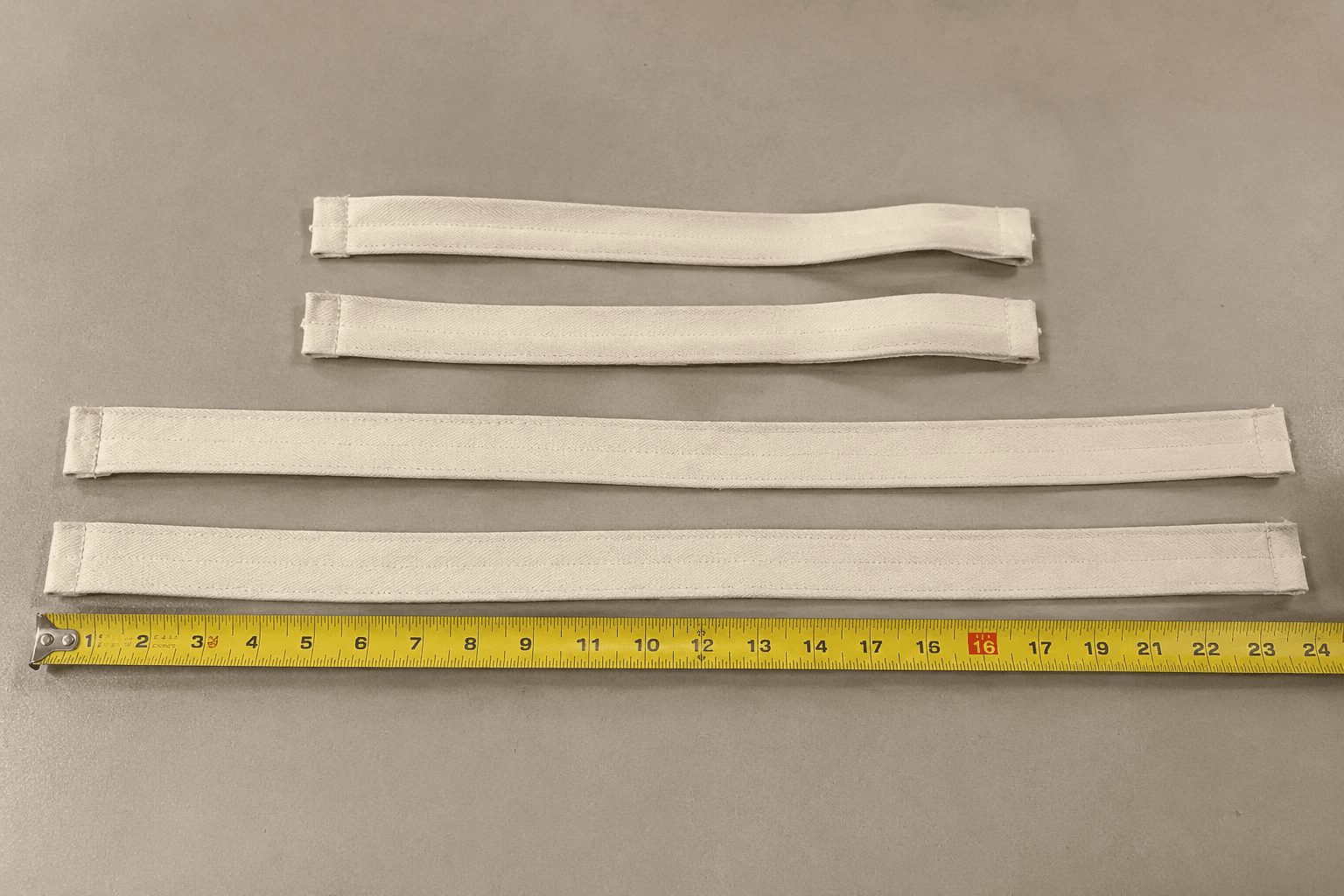
Construction also affects care performance. A bib apron with neck strap, waist ties, pocket corners, pen slot, bar-tacked stress points, and metal eyelets has more failure points than a simple waist apron. If the apron is designed for commercial washing, we prefer lockstitch seams with proper SPI, reinforced pocket corners, colorfast sewing thread, and pre-shrunk tape. If cotton webbing ties are attached to a polyester-cotton body, the label must consider the higher shrinkage of the ties. Uneven shrinkage can twist the apron even when the body fabric passes testing.
- 160-200 GSM polyester-cotton is common for economical service aprons and faster drying.
- 220-280 GSM cotton or T/C twill is common for restaurant bib aprons with better coverage and hand feel.
- 300-360 GSM canvas or duck is suitable for workshop and barista aprons, but drying time and shrinkage must be tested.
- Dark dyed cotton may require stricter washing instructions than the same construction in natural or light colors.
- Pocket stress points and tie attachments should be tested after washing, not only checked on the unwashed sample.
Apron care symbols and written instructions should work together
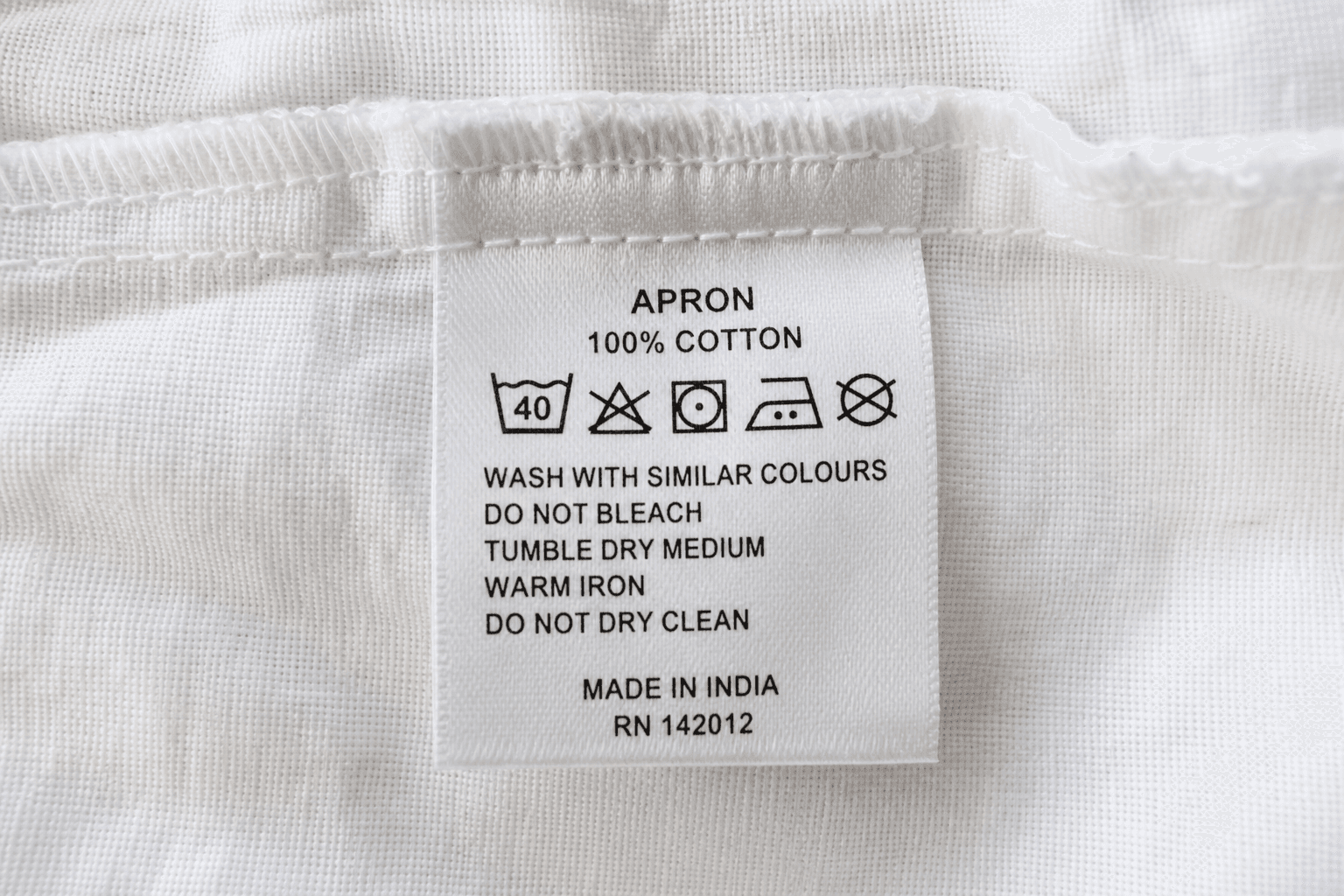
Apron care symbols are useful because they reduce translation issues across markets. A standard wash tub symbol, triangle, square dryer symbol, iron symbol, and professional cleaning symbol can communicate the basic care method quickly. However, symbols alone may not give enough detail for commercial laundry operators. A buyer sourcing for the EU, UK, US, Australia, Japan, or the Middle East may need different label formats, but the technical message should remain consistent.
For apron programs, the most important symbol decisions are wash temperature, bleach permission, tumble dry level, ironing level, and dry-cleaning relevance. Many aprons do not need dry cleaning, and allowing it can create unnecessary confusion. Chlorine bleach is another sensitive point. White cotton aprons may tolerate chlorine under controlled conditions, but colored aprons, black aprons, logo-printed aprons, and polyester-cotton blends often perform better with non-chlorine oxygen bleach only, if bleaching is allowed at all.
Written wording should explain the limits behind the symbols. For example, a label may show 60 C wash, no chlorine bleach, tumble dry low, iron medium, do not dry clean. The text can add: wash with similar colors, remove promptly, iron on reverse if printed, close metal hardware before washing, or remove detachable straps. These short notes are practical for aprons because operators often wash them with uniforms, towels, table linen, or kitchen cloths. Mixed loads can transfer lint, oil, dye, or odor.
- Use a maximum wash temperature when the laundry method is not fully controlled.
- Specify no chlorine bleach for dark, printed, denim, enzyme-washed, or contrast-trim aprons.
- Use low tumble dry only when trims, print, and shrinkage testing support it.
- Add iron-on-reverse wording when the apron has screen print, heat transfer, embroidery backing, or coated fabric.
- Include removable strap instructions when leather, PU, metal clips, or premium cotton tape are used.
Testing an apron care label before approving bulk shipment
A care label is only as reliable as the test behind it. For repeat buyers, we recommend testing at material stage and again on the pre-production sample. Lab testing can follow ISO, AATCC, GB, or buyer-specific methods depending on destination market. Factory wash testing is also useful, but it should not replace formal testing when the order value or claim exposure is high. For a 10,000-piece commercial laundry apron order at USD 3.20 to USD 6.80 per piece, one failed laundry condition can exceed the cost of testing many times over.
The basic test package for apron care labeling usually includes dimensional stability to washing, colorfastness to washing, colorfastness to rubbing, appearance after laundering, seam strength or seam slippage where relevant, and print durability. For food service or rental laundry, we add repeated wash testing, for example 5, 10, or 25 cycles depending on buyer requirement. A single wash result is not enough for an apron expected to rotate through weekly laundry for six to twelve months.
Shrinkage targets must be realistic. For cotton twill aprons, 3 percent to 5 percent after washing is common if fabric is sanforized or pre-shrunk. For lower-cost cotton fabrics, shrinkage can exceed 6 percent if not controlled. Polyester-cotton may stay around 1.5 percent to 3 percent, but tape, pocket lining, and thread must be checked. If the buyer requires exact finished size after laundry, we can add pattern allowance, but this must be confirmed before cutting bulk fabric.
- Dimensional stability should be checked on body length, body width, neck strap, waist ties, and pocket position.
- Colorfastness should be tested for both washing and rubbing, especially on black, indigo, red, and dark green aprons.
- Print testing should include cracking, peeling, fading, and ironing resistance if ironing is allowed.
- Hardware testing should include corrosion, deformation, noise, and fabric tearing around eyelets or rivets.
- Repeated wash testing should reflect the buyer's real cycle temperature, detergent, drying method, and load type.
Commercial laundry apron risks: trims, branding, and finishing
Many apron failures begin with trims rather than fabric. PU straps, imitation leather patches, antique brass buckles, painted snaps, cotton herringbone tape, rubber labels, and decorative rivets may look correct on the sample, but they behave differently after high-temperature washing and drying. For this reason, the apron care label must be checked against every non-fabric component. If one trim cannot survive 60 C wash and tumble dry, the whole apron cannot honestly carry that instruction unless the trim is removable.
Branding method is another common source of mismatch. Embroidery is generally durable for commercial laundry, but dense embroidery can pucker after shrinkage if the base fabric is not stable. Screen printing can work well, but ink type, curing temperature, print thickness, and fabric finish matter. Heat transfer labels and large logos are more sensitive to dryer heat and ironing. Woven patches may fray or curl if the edge treatment is weak. For industrial laundry apron programs, we usually suggest embroidery, woven labels with strong edge sealing, or tested high-temperature screen print instead of delicate transfer printing.
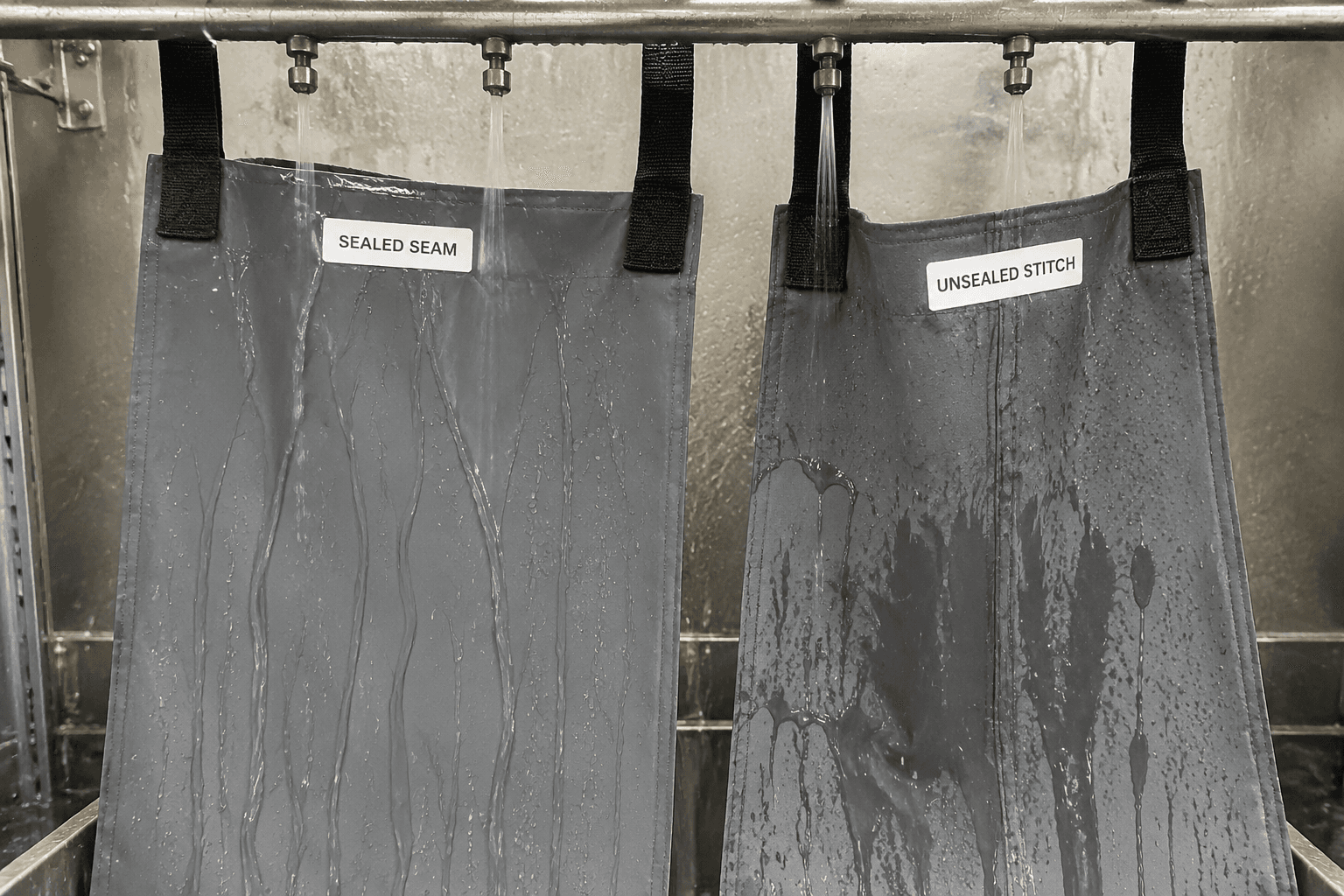
Finishing also influences care. Enzyme washing, garment dyeing, stone washing, water-repellent coating, wax coating, and softener treatment can all affect the final instruction. A waxed canvas apron may be strong, but it is not suitable for normal machine washing. A water-repellent apron may lose repellency after repeated laundry unless the finish is specified as durable water repellent and tested. A garment-dyed apron may have attractive shade variation, but the label should warn about washing with similar colors and avoiding bleach.
- PU or leather-like trims should be removable if the buyer expects regular machine washing.
- Metal hardware should be nickel-safe, corrosion-resistant, and tested against dryer impact.
- Heat transfer logos should not be approved for high-temperature industrial drying without wash-cycle evidence.
- Garment-dyed aprons need stricter color sorting instructions than piece-dyed polyester-cotton aprons.
- Coated, waxed, or water-repellent aprons may need wipe-clean or low-temperature care instead of standard wash wording.
Cost, MOQ, and lead-time impact of correct apron care label planning
Care label planning has a cost impact, but late correction is more expensive. A standard printed satin care label may cost only USD 0.015 to USD 0.05 per piece depending on size, color, and order quantity. A woven care label, multi-language label, or recycled-content label can cost more, often USD 0.04 to USD 0.12 per piece. These numbers are small compared with the cost of relabeling finished aprons, repacking cartons, or replacing goods after laundry failure.
MOQ depends on label type. Printed care labels can often be produced from 1,000 to 3,000 pieces per design, while woven labels may require 3,000 to 5,000 pieces for efficient pricing. If the buyer needs several markets in one order, such as English-French, English-Spanish, and English-Arabic versions, label quantities should be split carefully before bulk sewing. Late label version changes can delay packing by 3 to 7 days even when the aprons are already finished.
Lead time should include care label approval. For a normal custom apron order from Zhejiang, a practical schedule is 3 to 5 days for artwork and label layout, 5 to 10 days for fabric and trim sourcing, 7 to 12 days for sample making and approval, and 25 to 40 days for bulk production after deposit and final approval. If commercial laundry testing is required, add 7 to 15 days for basic lab tests and longer for repeated wash cycles. Buyers working toward a launch date should approve the care instruction before purchase fabric is dyed or cut.
The cleanest process is to include care wording in the tech pack from the first inquiry. We can quote the apron more accurately when we know the required wash temperature, drying method, label language, and test standard. If the buyer asks for a low target price, for example USD 2.50 to USD 3.50 per bib apron, but also requires 75 C industrial washing, colorfast dark fabric, metal hardware, and 25-cycle testing, the specification will need adjustment. Either the price must increase, or the design must become simpler and more laundry-focused.
- Printed care label cost is often around USD 0.015 to USD 0.05 per piece for bulk apron orders.
- Woven or multi-language care labels commonly require higher MOQ and longer approval time.
- Commercial laundry testing can add 7 to 15 days before final production approval.
- Relabeling finished goods can add labor cost, carton disruption, and 2 to 5 extra working days.
- Care label versions should be locked before bulk sewing if the order ships to multiple markets.
A practical apron care label checklist for sourcing managers
Before approving an apron care label, sourcing managers should compare the label against the actual order specification line by line. The label must match the main fabric composition, contrast fabrics, trims, thread, print, embroidery, coating, and intended user. It should also match the commercial agreement: if the buyer's customer expects industrial laundry performance, the label cannot quietly describe domestic washing only.
For product developers, the best approach is to design from the laundry condition backward. If the apron must survive 60 C commercial washing and tumble drying for 50 cycles, start with a stable polyester-cotton twill, tested thread, minimal delicate trims, and durable branding. If the brand needs a soft washed cotton look with leather details, accept a more conservative care label and avoid promising industrial laundry use. Both products can be good aprons, but they are not the same product.
For brand buyers, the care label is also a communication tool. Store teams, restaurant operators, and laundry vendors will follow what is sewn into the apron more often than what is written in the original purchase email. A clear apron care label reduces misuse, protects the brand's uniform appearance, and gives both buyer and supplier a factual basis for handling any claim. In bulk sourcing, that small label is one of the cheapest ways to prevent a large laundry dispute.
- Confirm whether the apron will be home washed, store washed, commercially laundered, or industrially laundered.
- Set the maximum wash temperature before fabric booking, especially for cotton, denim, garment-dyed, or coated aprons.
- Check whether bleach is allowed, restricted to oxygen bleach, or fully prohibited.
- Confirm tumble drying temperature and whether line drying is realistic for the end user.
- Review all trims and branding methods against the same wash and dry conditions as the main fabric.
- Approve care symbols, written wording, label language, label position, and label size before bulk sewing.