Work Apron Wholesale Supplier Product Development Capability for United Arab Emirates Buyers
Editorial author: Vincent Xi, Editorial Author, Linwa Apron (author profile). This page is a procurement brief for United Arab Emirates B2B buyers evaluating a work apron wholesale supplier's product development capability. It does not claim factory visits, laboratory tests, named customers, unpublished Linwa production statistics, or wear trials. Attribution is limited to the named Editorial Author role on the Linwa Apron author profile.
Decision first. For United Arab Emirates buyers, product development capability is the first work apron wholesale-supply gate—ahead of a unit-price spreadsheet. A supplier qualifies for this RFQ path only if it can convert a specification into a buyer-owned tech pack, a dated sample trail, a pre-production sample (PPS) cut from bulk-approved materials, and a written QC method, then scale without changing fabric, stitch, hardware, or print placement.
Public manufacturer pages used only as comparison sources advertise 48-hour 3D digital sampling, 7-day physical samples for new designs, 7–10 day prototyping, and custom runs from 50 pieces or 100 units. Those figures are self-reported, the excerpts show no publication date, and they must be restated on the quotation that will actually ship. They are RFQ comparison signals, not performance claims for Linwa Apron.
Minimum viable RFQ (do not skip). (1) Destination country: United Arab Emirates. (2) Tech-pack ownership and a point-of-measure chart. (3) Separate clocks for 3D/layout, development sample, and PPS. (4) MOQ defined per colour–size–artwork combination. (5) Written PPS freeze and AQL before bulk cut. If a supplier returns only a price and a headline MOQ, product development capability has not been answered.
Three concrete data points illustrate the range buyers should interrogate:
- 7-day samples for new designs, as stated for industrial work aprons on the Nanmeiyi exporters page (unit: days as written; working versus calendar days not defined on the page; scope: new designs / industrial work aprons as that page states; as-of: undated public page—verify on the current quote) (Nanmeiyi).
- 48-hour 3D digital sampling plus 7–10 day prototyping, as stated on the Lantao Work homepage (units: hours and days as written; scope: custom workwear including aprons as that page states; as-of: undated public page—verify on the current quote) (Lantao Work).
- Low custom MOQ from 50 pcs, as stated on the ApparelLots manufacturer page, and from 100 units, as stated on the Lantao Work homepage (unit: pieces/units; scope: custom/private-label workwear and aprons as each supplier defines a style or order; as-of: undated public pages—verify on the current quote) (ApparelLots; Lantao Work).
Related plant-level figures on the same pages—also self-reported and undated—include 28 automatic production lines (Nanmeiyi; unit: production lines; scope: plant-level as written, not a named work-apron SKU), 12 in-house production lines and 50,000+ monthly capacity (Lantao; units: lines and pieces/units per month as written; scope: plant-level, not a named work-apron SKU), and more than $1 million annual R&D investment (Nanmeiyi; unit: US dollars per year as written; scope: R&D as the exporter states). Treat every number as a quote-line item to lock, not as a catalogue promise and not as a Linwa Apron figure.
How figures were read. The clocks, MOQs, line counts, and process labels in this brief are copied as written from the three public manufacturer pages named above. The source excerpts include no independent audit, mill visit, or lab report.
Limits at a glance. Self-reported capabilities can change. A website sentence about ISO or product standards is not a certificate. The cited pages do not publish United Arab Emirates import documentation packs, Incoterms to UAE ports, required label language, landed-cost worksheets, or climate-specific fabric data. Put those in the RFQ as buyer-owned fields. Confirm every number on the supplier quotation before deposit.
Specifying work apron wholesale supply for United Arab Emirates operations
Keep the product and the RFQ decision primary. A United Arab Emirates food-service, facilities-maintenance, warehouse, or industrial-safety buyer is still buying a work apron: bib or waist, pocket map, strap hardware, fabric mass, colour, size run, and brand marks. Product development capability is the supplier's ability to lock those variables before bulk fabric is cut.
Ask the quote to name destination country as the United Arab Emirates, the workplace, and staff-issue versus resale versus branded program. Cited manufacturer pages do not list UAE labelling rules, care-label language, HS classification, or landed-cost worksheets; treat those as buyer-owned RFQ fields.
Freeze the following in the first specification pack:
- Silhouette: bib, waist, cross-back, split-leg, or tabard; finished length and wrap.
- Fabric: fibre, construction, mass in g/m², colour standard, and any stated finish. Do not assume heat, humidity, oil, or wet-work performance unless a named test method and current report are attached.
- Construction: stitch type, stitches per inch or per 3 cm, bartacks, pocket-bag fabric, edge finish, and reinforcement at strap joins.
- Hardware: buckle, slide, D-ring, or tie; metal versus polymer; colour and corrosion expectation.
- Branding: print, embroidery, or patch; placement coordinates; thread or ink; wash durability method.
- Size set: grade rules, measurement chart, and tolerance (example to verify on the tech pack, not a tested result: ±1 cm on length unless specified otherwise).
- Packing: piece fold, polybag, carton quantity, and receiving marks the buyer's United Arab Emirates warehouse requires.
A wholesale-supply order that skips this pack typically fails at sample approval, not at sewing. Development work is writing the pack, sampling against it, and recording deviations in writing.
Product development capability gates: tech pack, sample, and PPS freeze
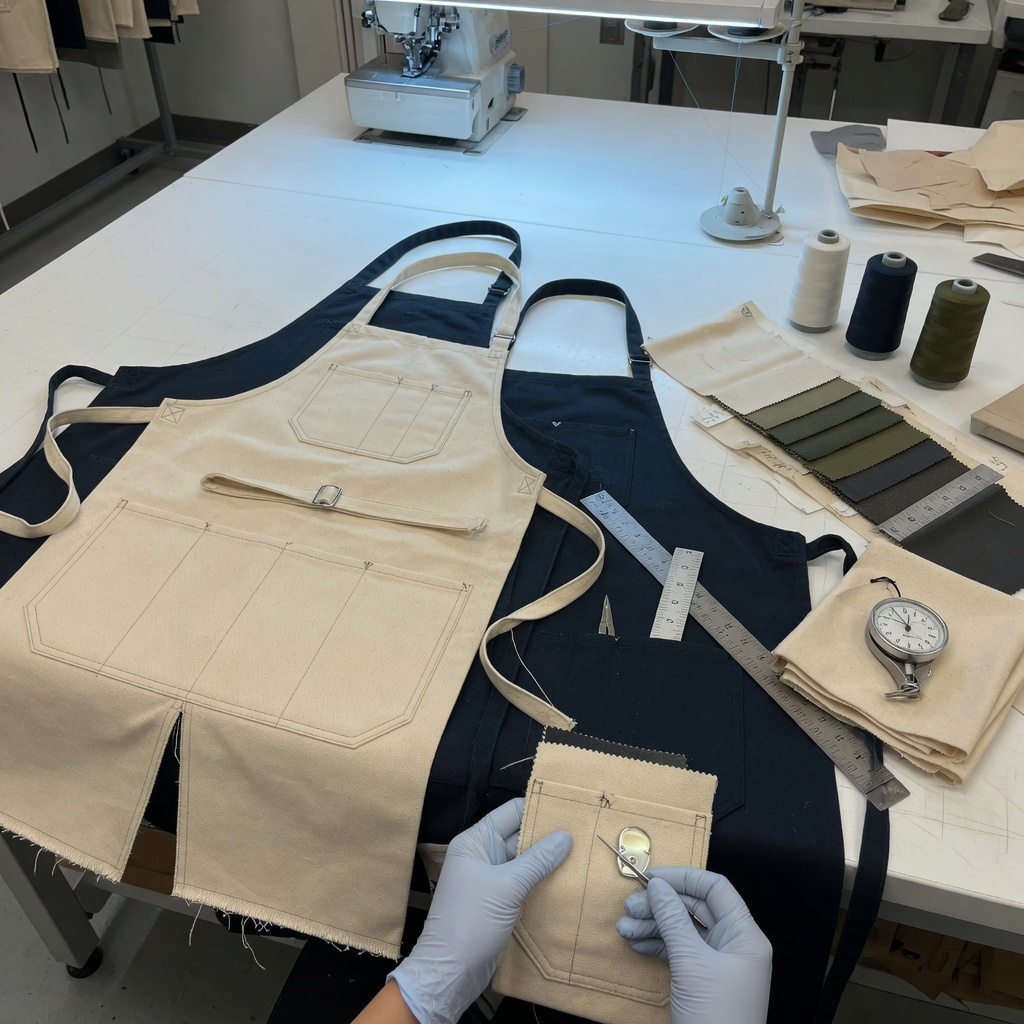
For a work apron wholesale supplier, product development capability is a sequence of gated artefacts—not a slogan. The three source pages describe overlapping services: OEM/ODM/R&D, 3D design, tech pack development, private-label branding, pre-production samples, and quality control through bulk (Nanmeiyi; Lantao Work; ApparelLots).
Use four gates. Each gate should produce a dated file the buyer can approve or reject.
- Input package. Artwork, a reference sample, or a factory-built tech pack covering BOM, measurements, grade rules, stitch callouts, pocket coordinates, hardware, artwork, and packing. Development from a sketch still requires a written tech pack the buyer owns.
- Digital or 3D review. One manufacturer states 48-hour 3D digital sampling for custom workwear including aprons (Lantao Work; unit: hours as written; scope: custom workwear including aprons; as-of: undated public page—verify on the quote). Digital review is useful for pocket layout and branding coordinates. It does not prove fabric hand, shrinkage, hardware bite, or stitch density. Treat 3D as a reject filter for layout, not as a substitute for a sewn sample.
- Physical development sample. Advertised windows include 7-day samples for new designs (Nanmeiyi; unit: days as written; scope: new designs; as-of: undated—verify on the quote) and 7–10 day prototyping (Lantao Work; unit: days as written; scope: custom workwear prototyping; as-of: undated—verify on the quote). Define working versus calendar days, bulk versus substitute fabric, and real versus mock-up branding. Leftover-fabric samples are fit/construction checks only.
- PPS and bulk freeze. ApparelLots states development through bulk, pre-production samples for fit, fabric, and branding, and low MOQ from 50 pcs (ApparelLots; unit: pieces; scope: custom workwear/aprons as that page states; as-of: undated—verify on the quote). Cut PPS from bulk-approved fabric, bulk trims, and approved artwork. Approve in writing (measurements, bartack and print photos, deviation list). Do not release bulk cut without that freeze.
3D can flag a wrong pocket map before cloth is cut. It cannot show whether a stated fabric mass (example to confirm on the mill card, not a lab result: 280 g/m² twill) will hold a metal slide. A sewn development sample is still not a PPS if fabric is a substitute. Skipping PPS is how wholesale supply gets a second, unbudgeted cut.
Nanmeiyi additionally states 3D design, OEM/ODM/R&D, custom logos, more than $1 million annual R&D investment, 28 automatic production lines, and ISO 9001/14001/45001 plus ANSI/ISEA and EN ISO claims (Nanmeiyi; R&D unit: US dollars per year as written; lines unit: production lines; scope: plant-level / R&D as the exporter states, not a named work-apron SKU; as-of: undated public page—verify on the quote). Those are the exporter's own statements, not Linwa Apron claims. Treat management-system and product-standard sentences as document requests, not as certificates; the next section states how to distinguish them.
Sampling speed versus construction risk
Lead time is only useful when the sample's purpose is named. Separate three clocks in the RFQ.
| Clock | What it should prove | What it does not prove |
|---|---|---|
| 3D / digital (48 hours as advertised on Lantao Work, undated—verify; unit: hours; scope: custom workwear including aprons) | Layout, branding, silhouette | Fabric mass, shrinkage, hardware bite, wash |
| Development sample (7 days / 7–10 day proto as advertised on Nanmeiyi and Lantao Work, undated—verify; unit: days; scopes: new designs / custom workwear prototyping) | Stitch, pocket bag, strap join, one body size | Bulk dye lot, production-ink durability |
| PPS from bulk materials | The goods intended to ship | Ongoing bulk AQL unless inspection is specified |
Price these trade-offs:
- Digital versus sewn. Digital is cheaper to iterate. Load-bearing pockets still need a sewn sample with the stated pocket-bag fabric.
- Substitute versus bulk fabric. Substitute cloth can hide shrinkage and colour. Reserve fabric or accept a failed PPS restarting the calendar.
- Branding timing. Approve construction blank, then a branded PPS.
- Size set. One M sample does not prove XL strap length. State sampled sizes and who pays.
Lantao states factory-direct custom workwear with 7–10 day prototyping, 12 in-house production lines, 50,000+ monthly capacity, and low-MOQ custom designs starting from 100 units with verified QC (Lantao Work; units: days, production lines, pieces/units per month, and units as written; scopes: prototyping / plant-level capacity / custom MOQ as that page states, not a named work-apron SKU for the line and capacity figures; as-of: undated public page—verify on the quote). ApparelLots states low MOQ from 50 pcs and QC throughout for hospitality, workshops, and uniforms (ApparelLots; unit: pieces; scope: custom workwear/aprons as that page states; as-of: undated—verify on the quote). Verified QC and QC throughout are process labels. Replace them in the RFQ with incoming fabric inspection (width, mass, shade), in-line stitch checks, and a final AQL with inspection level. If the supplier will not write the method, advertised sample speed is not a development system.
MOQ, private label, and capacity figures to interrogate
Wholesale supply for a work apron program is a function of MOQ per colour–size–artwork combination, not a single headline number. The cited low-MOQ figures are 50 pcs (ApparelLots; unit: pieces; scope: custom/private-label workwear and aprons as that page defines a style or order; as-of: undated—verify on the quote) and 100 units (Lantao Work; unit: units; scope: custom/private-label workwear including aprons as that page states; as-of: undated—verify on the quote). Confirm whether that is per colour, per size run, or per total style; whether embroidery setup is extra; and whether leftover branded pieces are the buyer's liability.
Capacity figures on the same pages—28 automatic lines; 12 in-house lines and 50,000+ monthly capacity—are plant-level claims (Nanmeiyi and Lantao respectively; units: production lines and pieces/units per month as written; scope: plant-level, not a named work-apron SKU; as-of: undated public pages—verify on the quote). They do not tell the apron line's weekly slot. Ask for: (a) the sewing-line plan for the SKU, (b) fabric mill lead time in days, (c) whether the quoted ship date is ex-works or to a named United Arab Emirates port/airport, and (d) what happens if PPS fails.
Private label is part of development. Specify mark type, placement in centimetres from seams, wash-method number if required, colour from a pantone or thread card, and embroidery-file ownership after payment. Nanmeiyi states custom logos as part of OEM/ODM/R&D (Nanmeiyi); still attach vector artwork and a placement drawing.
Branded runs at the cited 50-piece or 100-unit MOQs can hide a setup line. Do not mix a pilot MOQ with a later forecast unless the quote states a price break and a fabric-commitment rule. Example calculation to verify on the quote (not a market price and not a Linwa figure): setup per piece = setup ÷ 50 on a 50-piece first order, or setup ÷ 500 on 500 pieces. Require that line on the quote.
Safety standards versus a supplier's own QC practice
Name standards only when they map to the apron's actual hazard. A kitchen grease apron, a welding apron, and a warehouse picking apron are not the same product even if all are called work aprons. State the workplace hazard in the RFQ; do not copy a homepage standards sentence onto a different use.
The Nanmeiyi page states precision work aprons meeting ANSI/ISEA and EN ISO standards, plus ISO 9001/14001/45001 certifications for industrial safety apparel (Nanmeiyi). Distinguish:
- Management-system certificates (ISO 9001 quality, ISO 14001 environment, ISO 45001 occupational health and safety) describe how a plant says it is managed. They do not grade pocket tear strength. They are the exporter's stated certificates, not a Linwa Apron claim.
- Product or test standards (specific ANSI/ISEA or EN ISO numbers) describe performance if a sample was tested to that number. The excerpt does not list exact codes, editions, or labs. Require the designation, year, test report, and bulk-lot coverage.
- The exporter's own practice (in-line inspection, 3D design, automatic lines) is not a substitute for a named test.
Do not imply that Linwa Apron, or any unnamed factory, holds those certificates. If a certificate matters to a United Arab Emirates tender, the RFQ should demand a current PDF, the legal entity name on the certificate, and the expiry date. Expired or entity-mismatched certificates are a fail.
QC that protects a wholesale work-apron order is measurable: fabric mass within a stated g/m² tolerance, shade banding against an approved dip, stitch density, bartack presence, strap pull, measurement against the chart, and branding registration. Put those on the PPS form. If the supplier only offers the words strict QC, they have not yet shown product development capability.
RFQ checklist for United Arab Emirates work apron wholesale supply
Send one document the supplier must fill. Advertised clocks and MOQs above must be re-stated on the quotation; they are not Linwa lead times.
Specify
- Buyer entity, bill-to, ship-to in the United Arab Emirates, and factory legal entity on invoices and certificates.
- Work apron silhouette, workplace, size block, and any reference-sample photo.
- Tech-pack ownership, file types, BOM, stitches, artwork, and packing.
- Point-of-measure chart, grade rules, and tolerances (example to verify, not a tested result: length ±1.0 cm, chest ±1.5 cm).
- Fabric fibre, construction, g/m², colour standard, mill card or lab dip, thread, and hardware spec.
- Branding coordinates, durability method, file ownership, carton marks, and import documents the buyer's broker requires. Cited pages do not supply a United Arab Emirates document pack.
Compare two quotations
- 3D/digital hours versus advertised 48-hour 3D digital sampling (Lantao Work; unit: hours as written; scope: custom workwear including aprons; as-of: undated—verify), revisions, and file format.
- Development-sample sizes, fabric source, working days, and air-freight to the United Arab Emirates versus advertised 7-day new-design samples and 7–10 day prototyping (Nanmeiyi; Lantao Work; unit: days as written; as-of: undated—verify).
- PPS from bulk fabric, trims, and artwork; who pays if it fails; no bulk cut without written PPS approval.
- MOQ per colour, size run, and artwork versus advertised 50 pcs and 100 units (ApparelLots; Lantao Work; units: pieces/units; as-of: undated—verify), plus setup fees and leftover branded-cut policy.
- Weekly output for this SKU, mill days, and Incoterm to a named United Arab Emirates airport or seaport. Do not accept only plant-wide monthly capacity (advertised plant-level signals: 28 automatic lines; 12 lines; 50,000+ monthly; Nanmeiyi and Lantao; units: lines and pieces/units per month; as-of: undated—verify).
Verify and release
- Incoming, in-line, and final QC; AQL and inspection level; inspector; defect photos.
- Exact standard number and year if a product standard is required; current PDF and matching legal entity if a management-system certificate is required; otherwise state that none is required. Name test methods rather than climate; cited pages do not publish United Arab Emirates climate data.
- Deposit, balance, failed-PPS cost, and a written no-cut-without-PPS-approval rule.
- Dated construction and branding photos, signed measurements, and a PO that cites PPS ID, tech pack revision, colour standard, AQL, Incoterm, and United Arab Emirates ship-to.
If those lines cannot be filled, product development capability has not been shown. Do not compare bulk price until the four gates have named clocks, owners, and artefacts.
Evidence method, source contexts, and what to verify
Source contexts. (1) Nanmeiyi Work Apron Exporters for Industrial Safety page: automatic production lines, 3D design, OEM/ODM/R&D, 7-day samples, R&D investment claim, ISO 9001/14001/45001 statements, and ANSI/ISEA and EN ISO claims for industrial work aprons (https://www.nmyworkwear.com/work-apron-exporters-for-industrial-safety.html). (2) Lantao Work homepage: tech pack development, 48-hour 3D digital sampling, private label, 7–10 day prototyping, line count, monthly capacity, and MOQ from 100 units (https://www.lantaowork.com/). (3) ApparelLots manufacturer page: development from tech packs or designs, MOQ from 50 pcs, pre-production samples, embroidery/printing, QC for workwear and aprons (https://www.apparellots.com/). Units, scopes, and as-of context for those figures are as the undated public pages state; verify on the current quote.
Method. Editorial extraction of self-published capability statements. Numbers were copied with their units (days, hours, pieces/units, production lines, monthly capacity, USD R&D). No factory trial is claimed. Vincent Xi is named as Editorial Author only, per the Linwa Apron author profile; this brief does not add credentials, years of experience, client names, or factory-visit stories.
Limitations / verify before PO. Excerpts are undated; figures may be obsolete. They are not Linwa Apron capabilities and not United Arab Emirates regulatory advice. ISO and product-standard sentences are not certificates. Monthly plant capacity is not the SKU's slot. 48-hour 3D is not a sewn proof. 7-day samples may use substitute fabric. MOQ of 50 or 100 may exclude colour/size/artwork splits. Landed cost, label language, and import-document ownership for the United Arab Emirates are not on the cited pages. Confirm every number, certificate, test report, Incoterm, leftover-branded-cut rule, and PPS freeze on the supplier's written quotation, then approve a PPS before bulk cut.
This brief is for United Arab Emirates buyers running a work apron wholesale supply RFQ that tests product development capability—tech pack, sample clocks, PPS freeze, QC method, and order release—rather than a slogan on a factory homepage.
Discuss Your Requirements
Review our manufacturing capabilities, then share your specifications for a supplier-fit review.