Work Apron Wholesale Supplier Minimum Order Quantity for UAE Buyers
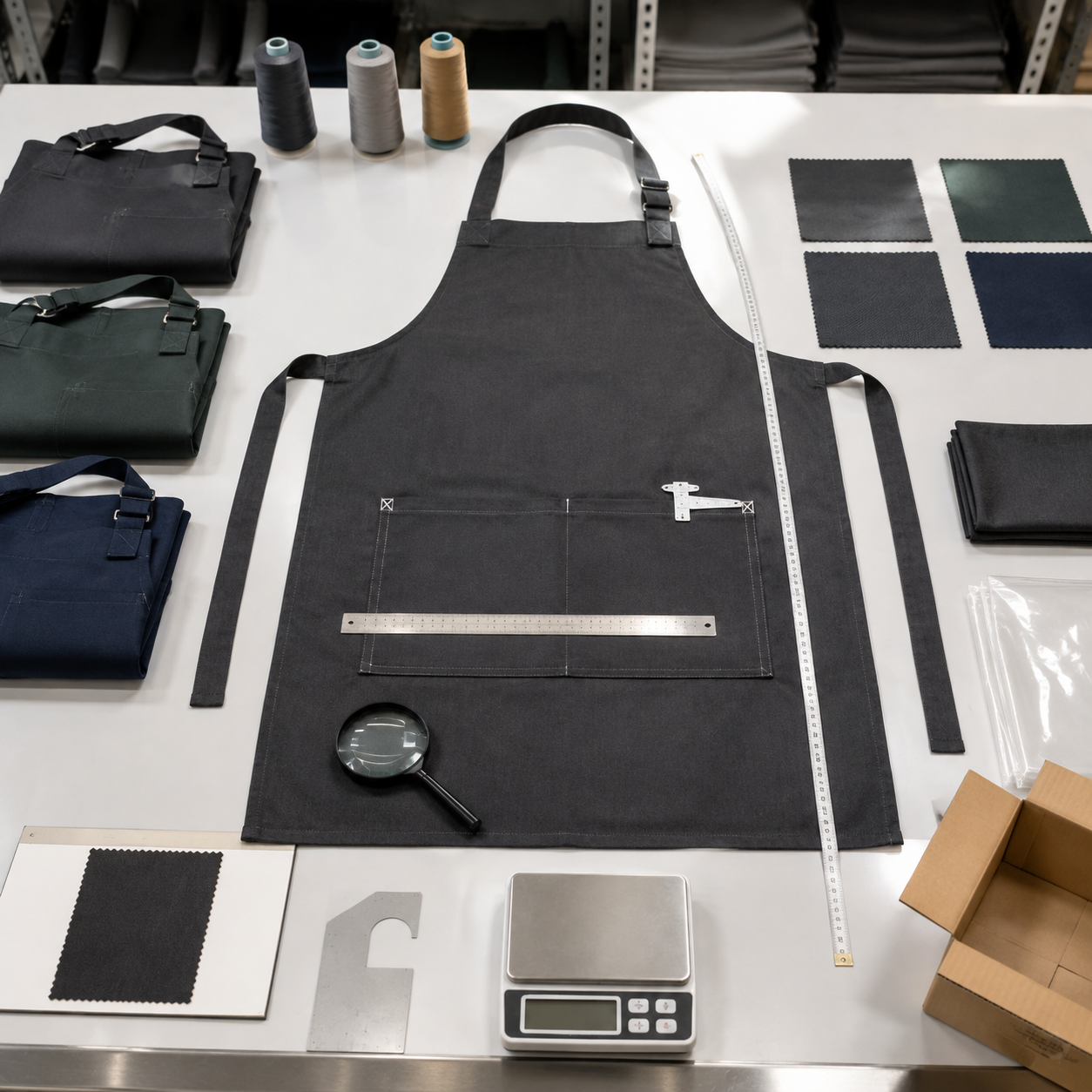
Work Apron Wholesale Supplier Minimum Order Quantity for United Arab Emirates Buyers
By Vincent Xi, Editorial Author
First-hand experience note: The cited author profile identifies Vincent Xi as an Editorial Author but does not document first-hand manufacturing, testing, sourcing, factory-visit, or United Arab Emirates import experience. No such experience is claimed here.
For a United Arab Emirates B2B buyer, a work apron wholesale supplier minimum order quantity becomes useful only when the supplier translates it into a finished quantity for every approved SKU. A headline MOQ cannot show whether separate thresholds apply to colors, materials, sizes, decoration, packaging, or repeat orders.
The RFQ should therefore ask for the complete MOQ hierarchy, counting rules, permitted SKU mixing, quantity increments, linked charges, and proposed finished allocation. The buyer can then compare the required allocation with approved demand and identify surplus before accepting the quote.
The supplied evidence does not establish a current Linwa Apron MOQ, price, material specification, production capacity, lead time, or SKU-mixing policy. Those terms require a current written quote for the exact work-apron configuration.
Evidence boundary
| Source | How it is used | What it does not establish |
|---|---|---|
| Vincent Xi author profile | Author name, role, and profile URL | Manufacturing, testing, sourcing, factory-visit, customer-outcome, or UAE import experience |
| Bulk-apron buyer guide | General sourcing context involving intended work, fabric, cut, decoration, proofing, MOQ, and delivery | Linwa Apron capabilities, current supplier terms, universal thresholds, or UAE-specific requirements |
| Fabric-specification sourcing page | Context for requesting technical fabric fields instead of relying only on style descriptions | A specification, performance result, or material available for the proposed work apron |
The decision controls below are RFQ requirements a buyer can set. They are not statements about a supplier's current practices.
United Arab Emirates minimum order quantity decision
Begin with an approved demand schedule. Give every configuration that may be counted separately its own line, including the work-apron style, material, color, size, decoration, and packaging option.
Each demand line should record:
- approved finished quantity
- intended work activity and required coverage
- apron cut, pocket layout, straps, hardware, seams, and reinforcement points
- material composition, fabric structure, finished fabric weight, finish, and color reference
- finished dimensions, measurement methods, and tolerances
- decoration method, artwork version, finished dimensions, placement, and position tolerance
- United Arab Emirates receiving destination and required receipt window
List optional colors, materials, features, or artwork versions as quote alternatives. This makes it possible to see whether an option creates another MOQ, setup charge, or independently counted SKU.
The supplier response should then provide:
| Decision record | Required response | Buyer action |
|---|---|---|
| MOQ hierarchy | Every applicable order, style, material, color, size, decoration, packaging, and reorder threshold | Hold the quote if an applicable threshold is missing |
| Counting rules | Counting unit, permitted SKU mixing, increments, rounding method, and treatment of surplus or shortage | Confirm how each rule changes the orderable quantity |
| Finished allocation | Proposed finished quantity for every approved SKU | Reject unapproved SKUs and unapproved surplus |
| Specification | Material, dimensions, construction, decoration, packaging, and acceptance criteria covered by the quote | Compare MOQ and price only across equivalent specifications |
| Commercial schedule | Itemized product, setup, sampling, packing, inspection, freight, and other applicable charges | Record exclusions and buyer responsibilities |
| Approval route | Sample or proof relationship to bulk production, inspection criteria, evidence records, and remedies | Release production only against an approved record |
Use this quantity rule:
Required purchase quantity = smallest supplier-confirmed finished-SKU allocation that satisfies every applicable quoted MOQ rule
The complete finished allocation is the binding quantity for comparison. Do not assume that a total-order MOQ overrides a separate color, material, size, decoration, or packaging minimum.
What the work apron minimum order quantity quote must disclose
Ask the supplier to separate these possible MOQ layers:
- Total-order MOQ: Minimum finished quantity accepted for the quoted purchase order.
- Style or SKU MOQ: Minimum for each separately produced cut, pocket layout, strap system, or construction.
- Material MOQ: Minimum linked to a stock or order-specific fabric, weave, finish, or finished fabric weight.
- Color MOQ: Minimum for each stock or custom-matched fabric color.
- Size MOQ: Minimum for each finished size or pattern configuration.
- Decoration MOQ: Minimum for each embroidery, print, patch, artwork version, or other decoration route.
- Packaging MOQ: Minimum created by order-specific bags, inserts, cartons, or labels.
- Reorder MOQ: Minimum and conditions that apply to repeat production.
For every applicable layer, request the threshold and counting unit, affected SKU, permitted mixing, order increment, rounding rule, linked charge, material-availability condition, quote validity, and treatment of surplus, shortage, rejection, and rework.
A response such as "MOQ applies per color" is incomplete unless it also states what counts as a color SKU, whether approved sizes or artwork versions may be mixed, and what finished allocation the supplier proposes.
Worked minimum order quantity comparison
Example basis: Every exact figure in this section is an article-created assumption or derived calculation as of 1 March 2026 for a single hypothetical United Arab Emirates RFQ. The figures are not supplier terms, market benchmarks, or evidence of product availability. Verify every input in the current supplier quote and buyer demand record.
| Example input or result | Quantity and scope | Source or derivation |
|---|---|---|
| Approved demand | 240 finished work aprons across 3 approved color SKUs, with 80 finished work aprons per color SKU | Hypothetical buyer-demand assumption as of 1 March 2026 for this UAE RFQ; replace with approved demand |
| Quote A rule | 100 finished work aprons per color SKU | Hypothetical supplier-rule assumption as of 1 March 2026 for this UAE RFQ; verify in the written quote |
| Quote A allocation | 300 finished work aprons, consisting of 100 finished work aprons per approved color SKU | Derived by applying the hypothetical Quote A rule to the hypothetical demand mix |
| Quote A surplus | 60 finished work aprons above the approved demand, equal to 25.00 percent of the 240-finished-work-apron demand assumption | Derived as of 1 March 2026 from the hypothetical Quote A allocation and demand |
| Quote B rule | 250 finished work aprons per total order, with at least 50 finished work aprons per color SKU | Hypothetical supplier-rule assumption as of 1 March 2026 for this UAE RFQ; also assumes approved colors may be mixed and no additional increment applies |
| Quote B allocation | 250 finished work aprons: 80 charcoal finished work aprons, 80 dark-green finished work aprons, and 90 navy finished work aprons | Hypothetical feasible allocation as of 1 March 2026 derived from the Quote B assumptions; verify supplier acceptance and buyer approval |
| Quote B surplus | 10 finished work aprons above the approved demand, equal to 4.17 percent of the 240-finished-work-apron demand assumption | Derived as of 1 March 2026 from the hypothetical Quote B allocation and demand |
The calculation method is:
Surplus quantity = required purchase quantity - approved demand quantity
Surplus rate = surplus quantity / approved demand quantity, expressed as a percentage
Under these hypothetical quantity assumptions alone, Quote B creates less surplus. That result does not identify the better commercial offer. Product equivalence, quality controls, remedies, charges, packaging, and delivery responsibilities still need to be compared.
Attach a measurable specification to the MOQ request
An MOQ is not comparable when suppliers are quoting materially different work aprons. Attach a controlled specification and require the quote to identify the revision it covers.
| Specification area | Fields to request |
|---|---|
| Material | Fiber composition by mass, fabric structure, finished weight in grams per square metre, finish, color reference, tolerance, and stock status |
| Finished dimensions | Body length, body width, bib width, strap range, tie length, pocket size, pocket position, measurement method, and tolerances in centimetres |
| Construction | Seam and edge finish, reinforcement locations, strap attachment, pocket divisions, hardware, and thread requirements |
| Decoration | Method, artwork version, finished dimensions in millimetres, color reference, placement from fixed seams, position tolerance, setup charge, and MOQ |
| Packaging | Units per pack and carton, packaging materials, carton dimensions in centimetres, net weight in kilograms, gross weight in kilograms, and packaging MOQ |
| Reorder basis | Repeat MOQ, retained-material conditions, artwork or tooling retention, color-continuity process, and quote conditions |
The cited fabric-specification sourcing page supports requesting technical fabric fields. It does not provide the composition, finished weight, finish, availability, or tolerances for the work apron being quoted.
Descriptions such as "heavy-duty," "standard size," "cotton blend," or "embroidered logo" are not measurable approval criteria by themselves. Ask for the corresponding material, dimension, construction, artwork, and tolerance fields before accepting an MOQ tied to those descriptions.
United Arab Emirates MOQ cost and delivery controls
Compare commercial offers only after each supplier has returned a feasible finished-SKU allocation. The comparison schedule should identify:
- finished quantity and unit price by SKU
- setup and artwork charges
- sample and sample-freight charges
- packaging charges
- buyer-requested inspection or testing charges
- freight and insurance responsibilities
- payment charges and milestones
- quote currency, exclusions, and validity conditions
- buyer-verified import, clearance, tax, and final-delivery charges where applicable
Use a defined responsibility scope for every comparison:
Comparable acquisition cost = total verified charges within the stated buyer responsibility scope
Comparable acquisition cost per planned-use work apron = comparable acquisition cost / planned-use quantity
Do not label a figure as landed cost unless the shipping point, UAE delivery point, responsibility split, and included charges are recorded. Keep production duration separate from transport, clearance, and final-delivery estimates.
The supplied sources do not establish current UAE customs classifications, duties, taxes, labeling rules, import documents, clearance charges, or other local requirements for the proposed work apron. Verify the actual product description, material, origin, shipment route, importer responsibilities, and applicable requirements through competent official or buyer-appointed import channels before order approval.
MOQ-linked sample and quality controls
MOQ acceptance should remain conditional on a defined sample and inspection route. The supplier should identify which sample or proof becomes the approved reference and whether it represents the proposed bulk material, construction, decoration, and packaging.
The inspection plan should state:
- purchase-order specification and approved reference sample
- production lot covered by the inspection
- inspection stage and location
- sample-selection method and sample quantity
- dimensions, measurement methods, and tolerances
- material, color, construction, and functional checks
- decoration size, placement, color, and workmanship checks
- packing and carton checks
- required photographs, measurements, and report records
- process for containment, rework, replacement, credit, or rejection
A general quality statement does not define measurable acceptance criteria. Link acceptance to the purchase order, controlled specification, approved sample, and supplier acknowledgement.
If a quote cites a test method, standard, or certification, keep the standard's requirement, the supplier's claimed production practice, and certification status separate. Request a current document identifying the relevant product or material, issuer, date, scope, and result. No specific standard is named here because the supplied evidence does not establish one as relevant to the proposed work apron.
Work apron wholesale supplier minimum order quantity RFQ checklist
- [ ] State the buying entity, RFQ reference, and United Arab Emirates delivery destination.
- [ ] Attach approved demand by style, material, color, size, and artwork SKU.
- [ ] Separate required configurations from optional quote alternatives.
- [ ] Request every applicable order, style, material, color, size, decoration, packaging, and reorder MOQ.
- [ ] Request the counting unit, mixing rule, increment, and rounding method for each MOQ.
- [ ] Ask whether MOQ layers apply at the same time.
- [ ] Require a proposed finished quantity for every approved SKU.
- [ ] Identify unapproved SKUs and surplus before comparing prices.
- [ ] Attach the controlled product specification and finished-dimension tolerances.
- [ ] Request sample types, charges, preparation duration, freight responsibility, and relationship to bulk production.
- [ ] Require itemized SKU prices, setup charges, packaging charges, freight responsibilities, currency, exclusions, and quote validity.
- [ ] Separate production duration from transport, clearance, and final delivery.
- [ ] Request packing quantities, carton dimensions, and net and gross carton weights.
- [ ] Add only buyer-verified UAE labeling, packing, import, and shipping-document requirements.
- [ ] Define inspection scope, sample selection, measurable acceptance criteria, evidence records, and remedies.
- [ ] Request current, scope-relevant documents for any test, standard, or certification claim.
- [ ] Confirm how specification changes, shortages, rejected units, and rework affect MOQ, price, invoices, and timing.
- [ ] Request the reorder MOQ and any retained-material or artwork conditions.
- [ ] Obtain a final supplier acknowledgement showing the approved finished quantity by SKU.
Methodology and limitations
Methodology: The author profile was used only to verify the visible author identity, role, and profile URL. The bulk-apron guide was used only for general sourcing context involving intended work, fabric, cut, decoration, proofing, MOQ, and delivery. The fabric-specification page was used only to support requesting technical fabric fields. Neither commercial source was treated as proof of Linwa Apron capabilities, current terms, universal MOQ thresholds, or UAE requirements. The RFQ controls were derived by converting those sourcing topics into written fields and decision checks. The worked comparison uses only the explicitly labeled hypothetical assumptions and displayed formulas.
Limitations and verification: The cited evidence does not establish a current supplier MOQ, SKU-mixing rule, price, material, production capacity, lead time, sample result, inspection result, certification, packaging arrangement, delivery record, or defect remedy. It also does not establish current UAE customs, tax, labeling, import-document, or clearance requirements. Before ordering, verify the complete MOQ hierarchy, finished-SKU allocation, controlled specification, approved sample relationship to production, inspection criteria, evidence documents, charges, packing data, delivery responsibilities, quote validity, and applicable UAE requirements in current records.
Discuss Your Requirements
Review our manufacturing capabilities, then share your specifications for a supplier-fit review.