Work Apron Sourcing Customization Options for Europe
By Vincent Xi, Editorial Author
For European B2B procurement teams, work apron customization options become useful only when each choice is translated into a quoted field, an approval sample, or a measurable release criterion. Start with the intended task and European destination, then define the apron format, material, finished measurements, straps, pockets, decoration, care conditions, packing, evidence, and commercial terms. Require every bidder to answer the same fields and list assumptions, exclusions, and deviations.
The supplied bulk-order source connects fabric, cut, and decoration choices with the intended job and cautions against selecting on price alone (Dirt Cheap Product). The supplied material-selection source discusses cotton, denim, and poly-cotton as categories to consider in relation to the work setting, including wet or dry conditions (Gallant International). These are limited qualitative source contexts. Neither source verifies a particular supplier's customization capability, material availability, product performance, certification, minimum order, price, capacity, or lead time.
Work Apron Customization Options for Europe
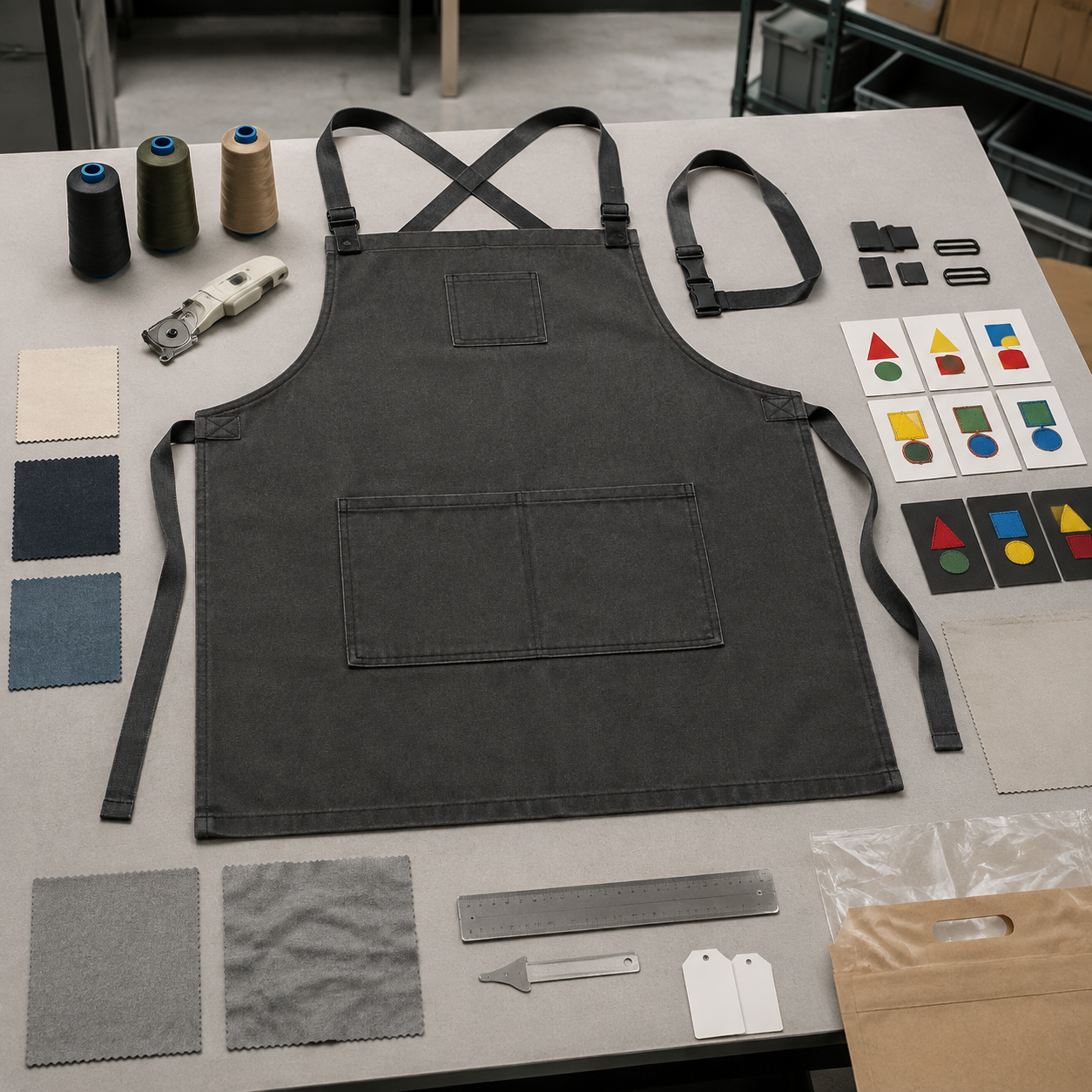
This buyer-created matrix converts customization decisions into comparable RFQ returns. The listed choices are specification prompts, not claims that any supplier offers them.
| Customization area | Buyer-defined RFQ field | Required supplier return | Approval evidence |
|---|---|---|---|
| Intended use and destination | Wearer task, work setting, planned product claims, delivery country, and intended European countries of sale or use | Scope confirmation, destination assumptions, exclusions, and deviations | Buyer-approved scope register and destination-review record |
| Apron format and fit | Selected format, dimensioned pattern, finished measurements, adjustment range, clothing worn underneath, and tolerances | Pattern reference, points of measurement, proposed tolerances, development charges, and sample plan | Approved fit sample and measurement report |
| Body material and colour | Fibre composition, fabric construction, nominal mass, finish, colour reference, care conditions, and tolerances | Quoted material specification, shade-control basis, material minimums, substitutions, and verification method | Approved swatch linked to the quote and technical pack |
| Straps and hardware | Neck or cross-back arrangement, ties, webbing, adjustment, hardware, dimensions, and attachment method | Component materials, adjustment range, construction details, availability basis, charges, and deviations | Approved trim set and construction sample |
| Pockets and reinforcement | Pocket purpose, dimensions, placement, opening, divisions, closures, and marked stress points | Dimensioned construction proposal, seam details, reinforcement method, charges, and minimums | Approved sample checked at named measurement points |
| Decoration | Controlled artwork revision, finished size, placement, colour reference, proposed method, and care criteria | Named method, production location, setup and application charges, artwork constraints, tolerances, controls, and subcontracting | Approved decoration test and decorated pre-production sample |
| Care validation | Laundering, drying, pressing, and relevant workplace-contact conditions | Proposed validation method, sample identity, result format, limitations, and charges | Buyer-approved result for the exact quoted material, colour, finish, construction, and decoration |
| Packing and identification | SKU structure, pack quantity, assortment, destination allocation, carton requirements, and traceability fields | Packing materials, carton assumptions, batch-identification method, charges, and deviations | Approved packing sample and batch-linked packing record |
For this RFQ framework, a fabric name alone is treated as incomplete. Cotton, denim, and poly-cotton are source-supported selection categories, but the bid still needs a defined composition, construction, nominal mass, finish, colour reference, tolerances, and verification method. Record every proposed substitution in the supplier's deviation list rather than allowing it to remain inside a general product description.
If the intended work apron will carry a safety or protective claim, pause the ordinary garment approval path until a qualified reviewer has assessed that claim for each destination. Put the exact intended claim in the RFQ and request the evidence identified by that review. Supplier marketing language should not replace product classification or conformity evidence.
Route Customization Evidence by European Destination
Do not use “Europe-compliant” as a complete RFQ requirement or accept it as a complete supplier response. The procurement file should separate the EU, non-EU EEA destinations, Great Britain, Northern Ireland, and other European countries so that the responsible reviewer can assess the quoted product and route to market.
| Destination lane | RFQ action | Procurement control |
|---|---|---|
| EU destination | Name every intended EU country and the responsible destination reviewer | Obtain current advice for the specified product, claims, materials, decoration, labels, packaging, supply chain, and relevant country-level requirements |
| Non-EU EEA destination | List the country separately from the EU destination list | Require a country-specific conclusion rather than carrying over an EU review without confirmation |
| United Kingdom: Great Britain | Record Great Britain as a separate review lane | Review the quoted product and route to market without substituting an EU or Northern Ireland conclusion |
| United Kingdom: Northern Ireland | Record Northern Ireland separately from Great Britain | Review the quoted product and route to market without assuming that the Great Britain conclusion is interchangeable |
| Other European country | Name the destination country explicitly | Assign a qualified reviewer to identify applicable product, claims, material, language, traceability, packaging, importer, and documentation controls |
The supplied commercial sources are not legal authorities and do not establish requirements for these destination lanes. The buyer's designated reviewer should identify the required evidence. The supplier should then return documents matched to the exact quoted product, production route, and intended destination.
For each document, record the covered material, colour, finish, decoration, production location, subcontractor, destination, document holder, scope, issue date, and current validity status. If a report covers only a component or test sample, label that boundary instead of presenting it as finished-product evidence.
When a bidder names a standard, require the quote to state whether it is being used as a test method, a product requirement, or the supplier's own internal inspection reference. These uses are not interchangeable. Do not describe a product, site, or management system as certified without a current document whose holder, scope, site, issuer, and validity can be checked.
Turn Customization Options Into Measurable RFQ Fields
Every numerical value in the following table is a buyer-created illustrative assumption or example calculation. None is source-derived, a market benchmark, a legal threshold, a Linwa Apron specification, a test result, or evidence of supplier capability. Replace or confirm each value for the actual role and European destination, then verify it in the supplier's dated quote and the stated approval sample.
| Control field | Illustrative assumption or calculation | Procurement use |
|---|---|---|
| Apron-body fabric | Buyer-created illustrative RFQ assumption to verify in the supplier's dated quote and material approval sample: nominal 240 grams per square metre for the quoted body fabric, with a buyer-set mass tolerance of +/- 5 percent for that fabric | Gives bidders the same material-mass basis and requires them to return the verification method and any deviation |
| Finished apron body | Buyer-created illustrative RFQ assumption to verify in the supplier's dated quote and fit sample: 85 centimetres finished centre-front length by 70 centimetres finished width at buyer-named measurement points, with a buyer-set tolerance of +/- 1 centimetre for each measurement | Replaces a generic size description with inspectable finished dimensions |
| Finished lower pocket | Buyer-created illustrative RFQ assumption to verify in the supplier's dated quote and construction sample: 30 centimetres finished width by 20 centimetres finished depth at buyer-named measurement points, with a buyer-set tolerance of +/- 0.5 centimetres for each pocket measurement | Connects pocket size and placement to a measurable approval record |
| Decoration envelope | Buyer-created illustrative RFQ assumption to verify in the supplier's dated quote and decorated sample: a maximum finished chest-artwork envelope of 90 millimetres in width by 60 millimetres in height for the named artwork revision | Lets the bidder assess method, placement, setup, and artwork constraints on a common basis |
| Buyer-defined care trial | Buyer-created illustrative RFQ assumption to verify in the supplier's dated quote and tested approval sample: 10 complete wash-and-dry cycles for the named sample at 60 degrees C, with a buyer-set maximum dimensional change of 3 percent at the named finished measurements | Defines the sample, cycle count, temperature, drying stage, measurement points, and acceptance limit |
| Quantity planning | Buyer-created illustrative calculation to verify in the supplier's dated quote: 600 units of base demand plus a 5 percent operational allowance, calculated as 30 additional units and 630 total units before supplier minimum-order rounding | Makes the planning calculation visible and requires minimums to be returned by material, colour, style, size, decoration method, and artwork |
The technical pack should show every point of measurement, how the apron is positioned, the measurement method, and whether a requirement applies before or after the defined care trial. Require the supplier to disclose any measurement or test method that differs from the RFQ.
Approve Decoration on the Quoted Material
The bulk-order source treats the job, fabric, cut, and decoration as connected selection considerations (Dirt Cheap Product). It does not establish how a particular decoration method will perform on a quoted apron. Approval should therefore use the exact material, colour, finish, construction, artwork revision, and care process being purchased.
The buyer's artwork package should contain:
- A controlled artwork file and revision identifier.
- Finished decoration dimensions and orientation.
- Placement measured from stable, named garment seams.
- A buyer-controlled colour reference.
- The required method, or an instruction for the supplier to propose and price a named method.
- Appearance, edge, surface, reverse-side, attachment, and care-trial acceptance criteria.
The supplier's return should identify the proposed method, production location, setup charge, application charge, artwork constraints, colour-control method, placement tolerance, production controls, and any subcontracted operation. Any proposed change should be disclosed before revised tooling, files, or samples are produced.
Use a digital placement proof to approve artwork revision, orientation, scale, and intended position only. Approve physical colour, texture, attachment, distortion, substrate interaction, and care response on the decorated physical sample.
Compare Quotes Before Award
A comparable customization quote should separate:
- Unit price by style, colour, size, decoration, quantity break, and named delivery point.
- Fabric, custom colour, pattern development, trim, decoration setup, decoration application, samples, testing, packing, and logistics.
- Minimum quantity at every applicable level, including material, colour, style, size, decoration method, and artwork.
- Currency, quote validity, tax and duty assumptions, payment milestones, exclusions, and unresolved decisions.
- Sample type, charge, revision charge, approval dependency, and dispatch basis.
- Production lead-time trigger, approval dependencies, and working-day or calendar-day basis.
- Delivery term, named place, freight mode, carton assumptions, and included shipping documents.
- Tooling and artwork-file ownership, storage, reuse, and replacement terms.
- Production location and subcontracted customization operations.
- Reorder controls for pattern revision, material reference, colour master, trims, artwork, packing, and retained samples.
- All proposed substitutions and departures from the RFQ.
Keep an unanswered field open as a technical or commercial exception. Do not compare headline unit prices until the included scope, variant-level minimums, setup charges, testing, packing, delivery assumptions, and approval dependencies have been normalised.
Hold Production Behind Approval Gates
| Release gate | Decision to close | Required record |
|---|---|---|
| Material and trim review | Body material, colour, finish, thread, straps, hardware, closures, labels, and decoration substrate | Approved physical reference set linked to supplier references and recorded deviations |
| Construction and fit sample | Pattern, finished measurements, strap geometry, pocket placement, reinforcement, movement, and adjustment | Measurement report, annotated decision record, and approved sample revision |
| Decorated pre-production sample | Final material, construction, artwork revision, method, placement, colour interaction, care response, and packing presentation | Signed approval record, controlled technical pack, and retained reference sample |
| Bulk inspection | Measurements, construction, decoration, shade, contamination, SKU identity, traceability, and packing against approved references | Batch-linked inspection result, disposition, and reinspection record where required |
| Shipment release | Approved quantity, assortment, cartons, destination marking, documents, and unresolved deviations | Buyer-authorised release linked to the purchase order and inspection result |
Define observable defects and measurable acceptance criteria instead of requesting “good quality.” The RFQ should identify the inspection method, sampling rule, defect categories, acceptance and rejection criteria, deviation authority, rework process, and responsibility for reinspection. Each inspection record should identify the batch, inspected characteristics, result, date, and disposition.
For each test report, request the tested sample identity, method, testing party, date, result, and relationship to the quoted material, colour, finish, construction, and decoration. A fabric-only report should be recorded as fabric evidence unless the buyer's stated requirement concerns only that fabric.
Send-Ready Customization RFQ Checklist
- [ ] State the buying entity, delivery country, intended European destinations, and destination-review owner.
- [ ] Describe the wearer task, work setting, contact conditions, movement, and clothing worn underneath.
- [ ] Record every product, safety, environmental, or material claim planned for the apron, label, or packaging.
- [ ] List forecast demand by style, colour, size, decoration, destination, and reorder pattern.
- [ ] Attach a dimensioned drawing and define every point of measurement.
- [ ] Specify fibre composition, fabric construction, nominal mass, finish, shade reference, care conditions, and tolerances.
- [ ] Define apron format, coverage, straps, adjustment, ties, hardware, pockets, and reinforcement.
- [ ] Supply controlled artwork, colour reference, finished dimensions, orientation, and placement.
- [ ] Require a named decoration method and a decorated sample on the quoted material.
- [ ] Define laundering, drying, pressing, and relevant workplace-contact conditions for validation.
- [ ] State material, fit, decoration, pre-production, inspection, and shipment approval gates.
- [ ] Define measurement methods, defect criteria, sampling rules, disposition, rework, and reinspection.
- [ ] Request evidence matched to the quoted product, production route, and each European destination.
- [ ] Specify SKU identification, packing, assortment, carton requirements, and batch traceability.
- [ ] Require an itemised quote, variant-level minimums, assumptions, exclusions, and deviation list.
- [ ] Define change control for materials, shades, patterns, trims, artwork, production locations, and subcontractors.
- [ ] Record who may approve samples, substitutions, deviations, production release, and shipment.
Claim-to-Source Methodology and Limitations
| Source context | Supported use in this article | Boundary applied |
|---|---|---|
| Dirt Cheap Product bulk-order article | Qualitative context connecting job requirements with fabric, cut, decoration, and price consideration | Not used as evidence of supplier capability, product performance, testing, commercial terms, or destination compliance |
| Gallant International material-selection article | Qualitative context for considering cotton, denim, and poly-cotton in relation to the work setting, including wet or dry conditions | Not used as comparative test data, a complete material specification, or evidence that a supplier offers a particular material |
| Vincent Xi author profile | Supports the visible author name, role, and profile URL | Does not support a factory visit, product test, customer outcome, supplier-capability claim, or other first-hand experience claim |
Methodology. The two supplied commercial sources are used only for the qualitative selection points attributed to them. The article converts those limited points into a buyer-created procurement framework of RFQ fields, supplier returns, approval evidence, commercial comparisons, and change controls. No numerical value was derived from those sources. Every numerical value is labelled as an illustrative buyer assumption or calculation that must be verified in the supplier's dated quote and applicable approval sample.
Limitations and what to verify. The supplied commercial pages are not independent laboratory reports or legal authorities. They provide no support for a Linwa Apron product specification, manufacturing site, capacity, certification, test result, price, minimum order, lead time, or customer outcome. Before award, verify the contracting supplier, production location, subcontractors, quoted materials, colours, finishes, components, decoration, samples, commercial terms, test-report scope, document holder, issue date, and validity. Obtain current destination-specific advice for every intended EU country, non-EU EEA country, Great Britain, Northern Ireland, or other European country rather than applying a blanket conclusion across Europe.
Author note. The approved profile identifies Vincent Xi as the Editorial Author. That attribution is not presented as evidence of first-hand product, factory, testing, customer, or supplier experience.
Discuss Your Requirements
Review our manufacturing capabilities, then share your specifications for a supplier-fit review.