Work Apron Sourcing Communication Workflow Review for Europe
By Vincent Xi, Editorial Author Author profile
Approve a work apron sourcing communication workflow only when it is fail-closed. For European procurement, every critical node—tech-pack comments, fabric approval, pre-production sample (PPS) acceptance, and bulk release—needs a named owner, a deadline, dual written sign-off, and photo or video evidence, plus a weekly work-in-progress (WIP) report that states item status, owner, deadline, and comments. Until those records exist, do not approve cutting, logo application, or shipment. Chat is not approval until it is exported into the same record as the locked tech-pack revision.
This communication workflow review is a work apron procurement control for a named destination: an EU member state, an EEA country (Iceland, Liechtenstein, or Norway), or the United Kingdom (Great Britain versus Northern Ireland). Name that destination in the RFQ. Do not copy one marking or dossier rule across Europe.
Vincent Xi is named as Editorial Author; the approved experience basis is limited to that role on the author profile linked above. This page does not claim factory visits, laboratory tests, awards, certifications, or named customer outcomes.
How this review was derived
WIP fields, dual sign-off, photos or videos, and comment-template practice are taken from the Ninghow supplier communication SOP. Four QC layers and manufacturer-selection criteria—material quality and stitching, safety-standard compliance, logo and strap customisation, production capacity, deadline reliability, and not selecting on price alone—are taken from the SfaTec work apron manufacturers guide. Tech-pack and scorecard start, structured audit including video tour, PPS with named tear-resistance and colourfastness lab tests, and an AQL pilot before bulk are taken from the Lantao custom workwear sourcing article. Apply those gates to a work apron purchase order only when they are written into the same communication SOP.
Where this page specifies extra RFQ fields (chat export, 7-day WIP file, bill-of-materials dual sign-off, destination register, quote-stage artefacts, example AQL figures, example extra days, example retain period), those items are labelled as buyer risk controls or example assumptions to verify in the supplier quote. EU, EEA, and UK instrument names are public law titles, not evidence that any factory, mill, or SKU holds a current certificate.
Limitations and what to verify
The cited blogs describe typical SOP patterns, not an audited process for a named factory, and they are not legal advice. Confirm each source page’s publish or update date. Confirm Official Journal and UK legislation texts, harmonised or designated standards, and notified-body or approved-body scope on the date goods are placed on the market. Distinguish EU member states, the EEA (Iceland, Liechtenstein, Norway), and the United Kingdom (Great Britain versus Northern Ireland). Example lead times, AQL numbers, and retention periods below are planning assumptions to verify in the supplier quote.
Lock the communication workflow before any work apron bulk cut
Specify, compare, and verify the communication system that will run the purchase order before unit price is treated as decisive. Pocket placement, strap hardware, bartacks, hem allowance, pocket-bag fabric, and logo position are easy to misread from a photo if the SOP does not force a numbered comment on a locked tech pack. Extra confirmation nodes add calendar time; skipping them transfers cost into bulk rework and disputed liability.
Evidence used in this review (unit, scope, as-of context, and source stated; extra RFQ rules labelled):
- Weekly WIP cadence. The cited Ninghow SOP describes weekly WIP reports with item status, owner, deadline and comments. Buyer RFQ operationalization to verify in the quote: one WIP file per 7-day period; unit: 7-day period; scope: apparel-production communication SOP as described by Ninghow; required fields: item status, owner, deadline, comments; as-of: the cited page (verify its publish or update date). The 7-day file rule is a buyer specification derived from “weekly,” not a measured factory KPI.
- Dual written sign-off. The cited Ninghow SOP describes dual written sign-off plus photos or videos at fabric approval and at PPS acceptance; unit: two authorised written approvals per named node; scope: those two confirmation nodes as described by Ninghow; as-of: the cited page (verify its date). Extending dual sign-off to bill-of-materials changes is a buyer risk control in this RFQ, not an extra node quoted from that page.
- Four sequenced gates. As described by Lantao Work: tech pack and supplier scorecard; structured factory audit including video tours and QC checks; PPS validation with third-party tear-resistance and colourfastness tests; AQL pilot before bulk; unit: four sequenced gates; scope: custom-workwear sourcing sequence applied here as work apron PO gates; as-of: the cited page (verify its date).
- Four QC hold points. Incoming materials, in-process craftsmanship, durability tests, and final inspection, as described by SfaTec for work apron manufacturer selection; unit: four hold points; scope: manufacturer assessment in that guide; as-of: the cited page (verify its date).
- PPE instrument date (public law title only). Regulation (EU) 2016/425 was published in the Official Journal of the European Union (OJ L 81, 31.3.2016) and has applied since 21 April 2018 to placing PPE on the EU market; unit: calendar application date; scope: PPE placed on the EU market, not automatically every EEA or UK placement and not a factory certificate; as-of: the cited OJ reference (confirm the consolidated text on the placement date).
Example assumption to verify in the supplier quote: a dual-sign-off PPS gate plus third-party colourfastness and tear-resistance testing adds 7 to 14 calendar days versus an un-gated sample email. Compare that hold with the cost of recutting the lot. Name roles in the RFQ: buyer technical owner, buyer commercial owner, factory merchandiser, factory QC, and deputies. Digital tools do not replace dual written sign-off.
Write these buyer-specified stop-rules into the RFQ; they are risk controls, not findings from the cited blogs: no fabric bulk purchase until fabric dual sign-off is filed; no cutting until PPS dual sign-off is filed; no logo bulk until the PPS includes the production-intent logo process; no ship booking until final inspection records and any specified AQL results are filed; a missed weekly WIP stops schedule claims for that week.
Communication workflow review: confirmation nodes, dual sign-off, and weekly WIP
This communication workflow review uses three node types drawn from the Ninghow SOP pattern, plus export rules specified by the buyer.
Specification lock. The tech pack—construction, bill of materials, stitch types, stitches per inch, bartack map, pocket coordinates, hardware, care-label language, packaging—is the master. Comment templates should force one decision per comment: approved, approved-with-deviation, or rejected, with a revision number. Visual aids travel with the comment.
European work apron procurement fails when the use case is not translated into cut-make-trim language a template can lock. Specify, in the contract language and in a production working language if different: garment type (bib, waist, cross-back, or split-leg); length and width; pocket count; strap geometry and hardware; fibre content; mass per unit area in g/m²; construction; any functional finish as a testable claim; stitch type; stitches per inch; bartack locations; stress-point map; logo method; placement from defined points; wash claim; fibre, care, and size labels, with PPE marking only if the product is placed on the market as PPE; inner pack; carton quantity; and marks for the named European destination.
A merchandiser accepting cheaper pocketing while the technical owner still assumes the original mill is a preventable communication failure. Extend dual sign-off to any bill-of-materials change, not only fabric and PPS—this extension is a buyer risk control. A heavy template slows sample rounds; a light template produces un-auditable decisions. For regulated European buyers, un-auditable decisions are usually the worse cost.
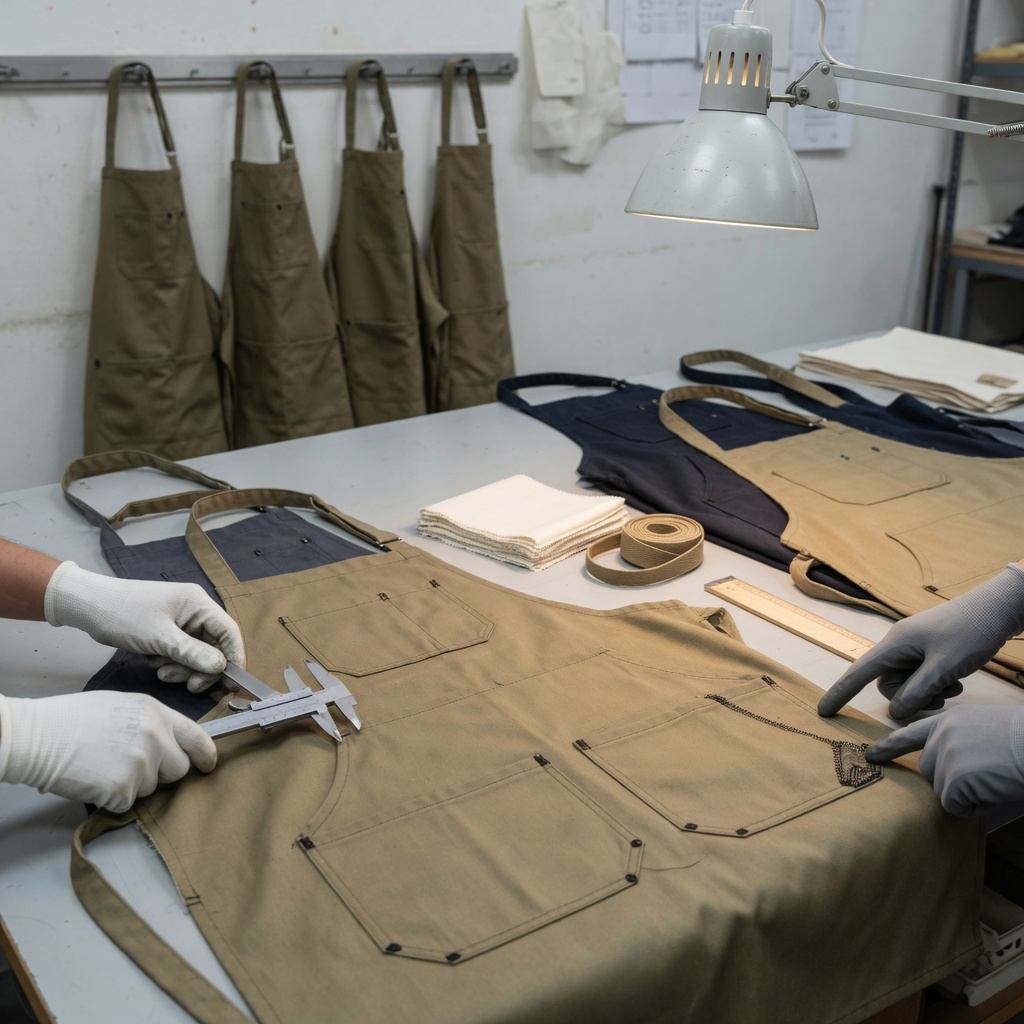
Material and PPS confirmation. Fabric approval and PPS acceptance are the two confirmation nodes named in the Ninghow SOP article. Dual written sign-off means two authorised people record the same decision. Photos or videos must use consistent lighting and a scale reference. If logo application is in the order, the PPS must include the actual process (embroidery, print, or patch), not a mock-up.
Production control. Weekly WIP reports are the cited Ninghow cadence. Each row needs SKU or PO line, process step, quantity, owner, deadline, comments, and an exception flag. A WIP that only states “on track” is not a WIP. The exception-flag field is a buyer risk control. Dual sign-off reduces undocumented verbal approval; name deputies to avoid a travel bottleneck. Weekly WIP is lighter than a daily dashboard. A daily exception log near ex-factory may be added as a quote item—that extra cadence is not a cited SOP requirement.
Artefacts the SOP must file. Store source-described gates as records; do not treat the list as a six-step certificate from one page. From Lantao: tech pack and supplier scorecard (hours-to-acknowledge and named QC owners may be added as scorecard fields to request; those extra fields are RFQ specifications, not published SLAs); structured factory audit with date, attendees, processes seen, video-tour file if used, and open non-conformities; PPS validation with a measurement report, photos, and third-party tear-resistance and colourfastness tests—flame-resistance or chemical-protection claims need their own methods; a pilot run under AQL inspection before bulk. From Ninghow: comment templates on the locked tech pack; fabric-approval and PPS-acceptance dual written sign-off with photos or videos; weekly WIP during production. From SfaTec: incoming fabric and trims, in-process stitching and straps, specified durability tests, and final inspection as hold points. Compare promised versus actual PPS and ex-factory dates as a deadline-reliability check. SfaTec names deadline reliability; it does not publish a numeric on-time percentage in the claim used here.
Do not treat a factory audit as a product certificate. Do not treat a lab test on one colourway as approval of all colourways. A video tour is a communication artefact, not process certification.
Buyer decision table for work apron manufacturer communication
Every row is a control a European procurement buyer can specify, compare, verify, or use to approve or reject a work apron manufacturer. Score quotes on this table before awarding. Rows combine source-described SOP patterns with buyer-specified risk controls. They are not a certificate of any factory.
| Communication control | Specify in the RFQ | Compare across manufacturers | Verify with evidence | Approve or fail-closed |
|---|---|---|---|---|
| Tech-pack comment template | Mandatory fields, revision control, working language | Sample thread on a dummy pocket change | Redlined pack with unique comment IDs | Reject replies that only say “OK” |
| Fabric confirmation node | Fibre, g/m², mill, colour standard, lab-dip due date | Time to acknowledge; photo quality | Dual written sign-off plus dated photos or videos | No bulk fabric buy without dual sign-off |
| PPS confirmation node | Full-size PPS in production-intent materials and logo process | Measurement variance versus spec; sample lead time | Dual written sign-off, measurement sheet, photos | No cutting without PPS dual sign-off |
| Weekly WIP | One report per 7-day period; status, owner, deadline, comments | SKU-level detail versus slogans | Dated WIP files from a current or anonymised PO | A missed WIP week voids “on schedule” claims |
| Role assignment | Named technical, commercial, merchandiser, QC, and deputies | Named people versus a generic inbox | Owner list with backups | Stop if a named owner is missing |
| Four-layer QC | Incoming, in-process, durability, and final inspection checklists | Documented in-line checks versus end-of-line only | Lot-numbered reports and bundle-ticket records | Quarantine lots that lack a layer |
| Lab tests | Named methods for tear, colourfastness, and any FR or chemical claim | Lab identity, method, colourway coverage | Third-party reports matching the PPS lot | Do not extrapolate one colourway to all |
| AQL pilot | Inspection level and AQL as quoted (example figures to verify) | AQL on pilot, bulk, or both | AQL sheets with lot size and defect codes | No ship booking without filed results |
| Capacity and dates | Capacity for this construction; separate PPS, cut, and ex-factory dates | Quoted versus evidenced dates | WIP exceptions; overlapping PO disclosure | Reject unexplained date movement |
| Safety-claim pack | PPE or non-PPE status; applicable instrument | Documents listed without over-claiming | Destination document register | Ban PPE marking on a non-PPE apron |
| Logo and strap customisation | Method, placement, hardware spec | Actual process sample, not a mock-up | PPS includes production-intent process | No bulk logo until PPS shows that process |
| Price versus control | Unit price plus labs, extra PPS, and weekly reporting | Landed risk, not unit price alone | Quote line items for SOP labour and tests | Do not award on unit price with an empty SOP |
| Destination register | EU member state, EEA country, or UK (GB vs NI) named | Document list matched to that destination | Register of supplied and not-supplied files | Reject a single “Europe pack” for all destinations |
| Quote-stage artefacts | Sample WIP, sample comment thread, named QC owner | Completeness and specificity | Files returned with the quote | Fail the review if these three artefacts are missing |
RFQ checklist for work apron procurement communication in Europe
Copy these lines into the RFQ. Tick an item only when evidence exists. Each item is for specifying, comparing, verifying, approving, or ordering. Keep the product a work apron and the control a communication SOP; do not treat this list as a full country-law manual.
- Name the product as a work apron (bib, waist, or cross-back) and attach a locked tech-pack revision.
- State the destination customs territory: named EU member state, named EEA country, or United Kingdom (Great Britain or Northern Ireland). Do not write “Europe” as a legal destination.
- State PPE or non-PPE status; do not mix document packs.
- State contract language and production working language if different; require ISO 8601 dates and a named time zone on every deadline.
- Name one system of record; require chat and markup exports into that record.
- Require comment templates with comment ID, tech-pack page or measurement, observed value, required value, photo ID, decision (approve / approve-with-deviation / reject), owner, ISO 8601 date, and revision.
- Ban “OK” as a standalone reply.
- Name fabric-approval and PPS-acceptance nodes, each with dual written sign-off plus photos or videos; extend dual sign-off to any bill-of-materials change (buyer risk control).
- Require a photo/video protocol: consistent lighting, scale reference, production-intent logo process on the PPS, and file IDs that match comment IDs.
- Require weekly WIP (one file per 7-day period) with SKU or PO line, process step, quantity, item status, owner, deadline, comments, and an exception flag.
- Name owners and deputies on buyer and factory sides (technical, commercial, merchandiser, QC).
- Require incoming, in-process, durability, and final inspection as four named QC layers, with retain samples.
- Require a factory-audit artefact: date, attendees, processes seen (cutting, sewing, logo, finishing, inspection), video-tour file if used, and open non-conformities. A video tour is a communication artefact, not process certification.
- Require PPS in production-intent fabric, hardware, and logo process; reject mock-ups as PPS.
- Name third-party tests: tear resistance and colourfastness; add FR or chemical methods only if claimed. Do not treat one colourway as approval of all colourways.
- Require a pilot under a quoted AQL plan before bulk; treat AQL numbers as quote items to verify (example assumption to verify in the supplier quote: ISO 2859-1, General Inspection Level II, AQL 2.5 for major defects and AQL 4.0 for minor defects on the pilot lot). That pair is not a legal default, not a requirement of Regulation (EU) 2016/425, and not a factory certificate.
- Require strap and logo details: hardware spec, stitch map, placement coordinates, wash claim.
- Require capacity for this construction and separate dates for PPS, bulk cut, and ex-factory; require disclosure of overlapping POs that share the same line.
- Require a document register for the destination regime and an explicit list of documents that will not be supplied.
- Require stop-cut or stop-ship actions for missed WIP, failed incoming lots, out-of-tolerance PPS measurements, lab fails, and any post-PPS BOM change (which must re-open dual sign-off).
- Require quote line items for SOP labour, extra PPS, lab tests, and audit time; define verbal approval as non-approval; example assumption to verify in the quote: retain samples and photo archive for 24 months after last shipment.
- Require three quote-stage artefacts before award: a sample WIP, a sample comment thread on a dummy pocket or strap change, and a named QC owner. If any one is missing, the manufacturer has failed this review.
EU, EEA, and UK rules in the work apron communication pack
Do not copy one marking or dossier rule across Europe. The SOP must name the destination and the legal status of the apron. These instrument names are public law titles; they are not evidence that a factory, mill, or SKU is certified. Keep this section a communication-pack register, not a substitute for counsel.
Non-PPE work aprons. Many kitchen, warehouse, and workshop aprons are occupational garments, not personal protective equipment. If no PPE claim is made, do not request an EU declaration of conformity under Regulation (EU) 2016/425. Forcing a CE PPE mark onto a non-PPE garment is a communication error.
PPE work aprons. If the apron is placed on the market as PPE, Regulation (EU) 2016/425 applies to placing PPE on the EU market. The regulation was published in the Official Journal of the European Union (OJ L 81, 31.3.2016) and has applied since 21 April 2018. Category, applicable harmonised standards, EU declaration of conformity, notified-body involvement where required, and user information become communication artefacts. They are not the same as an ISO 9001 factory certificate, and they are not proved by a weekly WIP file.
EEA. Iceland, Liechtenstein, and Norway are not EU member states. EEA-relevant EU acts apply through the EEA Agreement when incorporated. Do not assume every EU guidance note is an EEA obligation on the same date. Ask for the document list for the destination country, not for “Europe.”
United Kingdom. Great Britain and Northern Ireland are not interchangeable. UKCA and CE acceptance rules have changed over time; cite the UK instrument in force on the placement date. Do not write “UK equals CE” or “UK equals UKCA only” from memory of earlier easements.
REACH. Regulation (EC) No 1907/2006 is not a stitching SOP. If restricted substances or Annex XVII issues are relevant to fabric or trims, put chemistry evidence on the document register, separate from measurement sign-off.
Country-specific tenders. A public tender in one member state may add language, labour-clause, or ecolabel requirements that do not exist in another. File those as destination annexes. Do not treat one member state’s tender clause as an EU-wide or EEA-wide rule. Name EN ISO 13688 only when the SKU is specified against it; a cited standard is not a SKU certificate without a current document.
The SOP should prevent three errors: using one CE/UKCA story for all destinations, hanging a PPE mark on a non-PPE apron, and accepting a factory certificate in place of SKU-level test and inspection records.
Approve the communication system first—locked tech pack, dual sign-off nodes, weekly WIP, four QC layers, PPS/lab/AQL artefacts, destination register, and named owners—then score the manufacturer on the decision table, then issue the purchase order with those controls as schedules. If a factory cannot produce a sample WIP, a sample comment thread, and a named QC owner during quoting, it has already failed this work apron sourcing communication workflow review.
Discuss Your Requirements
Review our manufacturing capabilities, then share your specifications for a supplier-fit review.