Work Apron OEM Customization Options for Buyers in Canada
By Vincent Xi, Editorial Author
Canadian procurement teams evaluating work apron OEM customization options need an RFQ that suppliers can answer line by line. Define the intended work, construction, appearance, approval evidence, pricing basis, and delivery responsibility before comparing offers. Issue the same dated specification revision to every bidder and require written exceptions against the relevant RFQ fields.
The available sources provide limited design context, not evidence about a proposed order. Ambro Manufacturing discusses pocket reinforcement and strap construction in an industrial custom-apron setting (Ambro Manufacturing). Gallant discusses apron material categories and selecting materials with wet or dry work in mind (Gallant). These points can help frame RFQ questions, but they do not establish performance, availability, price, or compliance for a Canada-bound product.
Canada work apron customization options: decision sequence
| Decision gate | Define in the RFQ | Require before approval |
|---|---|---|
| Use case | Wearer role, movement, work environment, carried items, uniform layers, coverage, and care process | Supplier assumptions, suitability comments, and disclosed exceptions |
| Construction | Fabric, pattern, finished dimensions, pockets, seams, reinforcement, straps, and hardware | Completed specification, component details, and a production-intent sample plan |
| Appearance | Colour reference, decoration, artwork, placement, labels, and packing presentation | Swatches, artwork proof, decorated sample, and proposed tolerances |
| Quality control | Measurement method, tolerances, functional checks, defect definitions, sample selection, and inspection stage | Agreed inspection document and traceable approval records |
| Commercial terms | Quantity basis, setup, samples, unit price, packing, payment terms, validity, and exclusions | Itemized quotation tied to the current specification revision |
| Canadian delivery | Quote currency, manufacturing location, shipment origin, named destination, schedule basis, and responsibility split | Included charges, exclusions, and responsibility for each delivery stage |
A general acknowledgement of the RFQ should not override an unresolved specification field. Keep every unresolved requirement visible as an exception until it is accepted, revised, or rejected.
Work apron manufacturing customization options to specify
| Customization area | Buyer specification | Supplier evidence or response |
|---|---|---|
| Apron format | Bib or waist format, coverage, wearer role, uniform layers, and adjustment range | Pattern proposal and fit-sample plan |
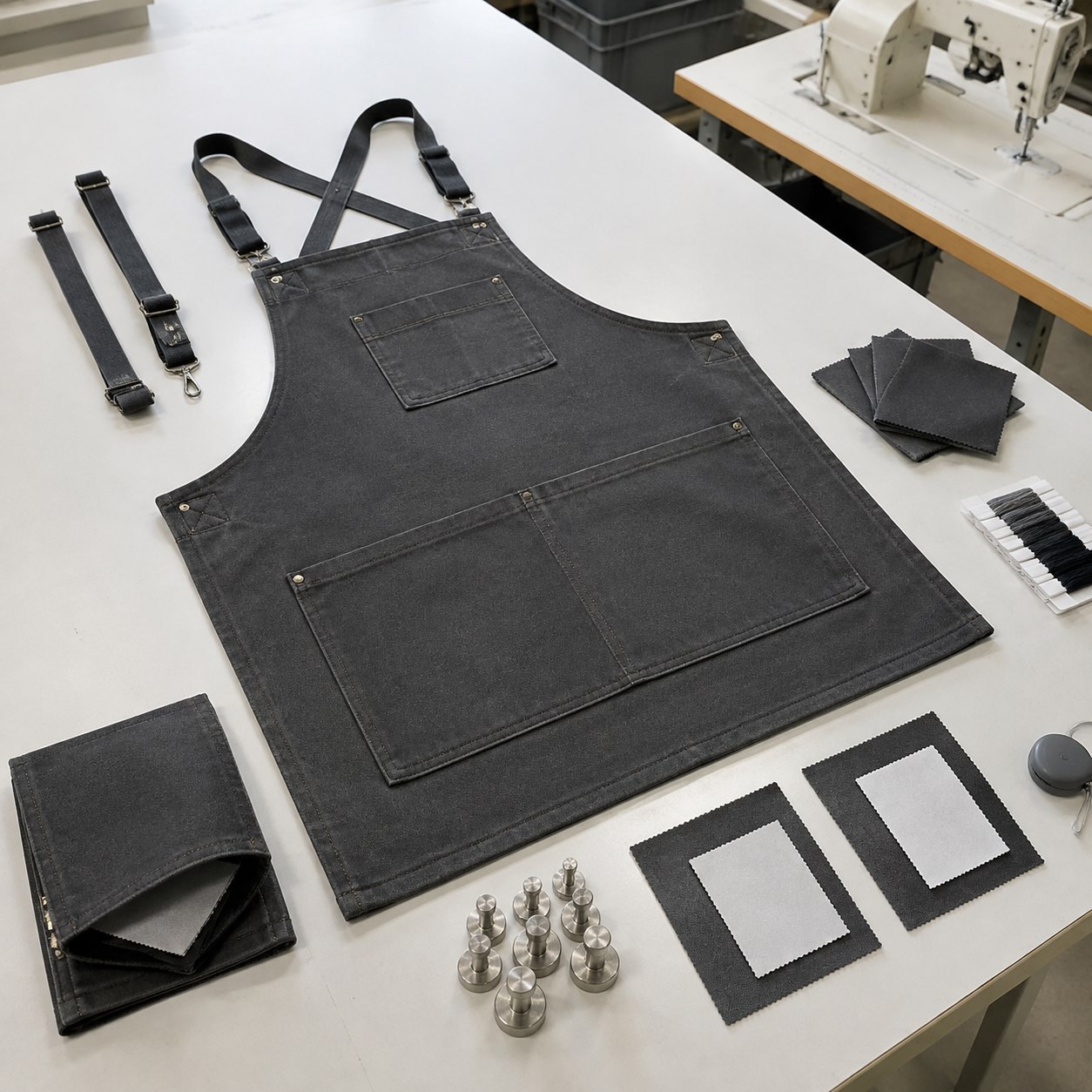
| Fabric | Fibre composition, construction, finished mass in grams per square metre, finish, colour reference, usable width, and hand-feel target | Fabric declaration, physical swatch, measurement method, and substitution disclosure |
| Pattern | Dimensioned front and back drawings, measurement points, finished tolerances, and grading rules | Completed measurement table and pattern exceptions |
| Pockets | Opening, depth, dividers, location, access direction, intended contents, and load-check method | Pocket drawing and loaded-sample record |
| Seams and reinforcement | Seam locations, reinforcement points, backing, bartacks, and acceptable edge condition | Construction sample showing external and internal details |
| Straps | Material, width, attachment, adjustment range, removable or fixed construction, and replacement requirement | Component sample and fit-check result |
| Hardware | Material, finish, colour, edge condition, attachment, and approved alternatives | Component reference and substitution controls |
| Decoration | Method, artwork, finished size, colour references, placement dimensions, backing, and care check | Artwork proof and decorated production-intent sample |
| Labels | Buyer-approved content, material, fold, placement, attachment, and care wording | Label proof and attached sample |
| Packing | Folding, individual protection, assortment, carton fields, and packing-list format | Packed approval sample and proposed pack specification |
Use case and apron format
Record the wearer's task, movement, contact conditions, carried items, coverage requirement, underlying clothing, and intended care process. Provide dimensions and loaded mass for tools or components that must fit in a pocket rather than requesting a generic utility pocket.
Deluxe presents occupational apron uses and includes a cotton-canvas waist-apron example for trade work (Deluxe). Use that example as role-selection context only. It does not establish the required material or performance of the apron being quoted.
Fabric, finish, and colour
Gallant lists organic cotton, denim, and poly-cotton among its material categories and discusses material choice in relation to wet or dry work (Gallant). Those categories can organize an RFQ comparison, but they are not interchangeable performance specifications.
Ask whether the declared fabric mass applies before or after finishing and whether the submitted swatch represents production-intent material. Approve fibre content, construction, finish, colour, hand feel, care assumptions, and proposed substitutions as separate fields.
Do not infer flame, heat, chemical, cut, or other protective performance from canvas construction, fabric mass, reinforcement, or marketing terms such as industrial or heavy-duty. If protective performance is required, identify the applicable requirement and request current, scope-matched evidence for the ordered construction.
Pockets, reinforcement, straps, and hardware
Ambro Manufacturing discusses durability, pocket reinforcement, and strap construction where carried items are relevant (Ambro Manufacturing). Translate those topics into dimensioned pocket drawings, defined contents, reinforcement locations, and buyer-approved sample checks. The cited discussion does not prove that a proposed pocket, seam, or strap will meet the buyer's requirement.
The Apron Place discusses apron styles by employee role and presents cross-back straps as an option in longer-shift contexts (The Apron Place). Use this as a prompt to compare fit samples. Strap geometry, adjustment retention, hardware edges, and fit over the intended uniform layers still require order-specific approval.
Decoration, labels, and packing
Define the decoration method, artwork revision, finished size, colour references, placement measurements, backing, surface appearance, and nominated care procedure. The Apron Place discusses embroidery in a repeated commercial-washing context and presents printing for larger-order or multicolour artwork scenarios (The Apron Place). This is buying context rather than proof of durability for the nominated fabric, thread, ink, artwork, or wash process.
Supply approved label content instead of asking the manufacturer to infer it. Keep label wording, attachment, placement, folding, individual protection, assortment, carton identification, and packing-list format under revision control.
Buyer-created control values to verify
The figures below are buyer-created example assumptions for the current RFQ. They are not sourced findings, supplier tolerances, or industry-standard requirements. Each value is scoped to the nominated pre-production sample as of the RFQ issue date recorded by the buyer and must be replaced or explicitly confirmed in the dated supplier quotation and approval documents.
| Control point | Example assumption | Approval record |
|---|---|---|
| Finished body size | 85 cm centre-front length and 70 cm maximum body width for the nominated bib-apron pre-production sample; buyer-created assumption as of the buyer-recorded RFQ issue date, to verify in the dated supplier quote | Flat-measurement report using buyer-defined reference points |
| Pocket retention | 2.0 kg total distributed load held for 30 minutes on the nominated pocket set; buyer-created procedure assumption as of the buyer-recorded RFQ issue date, to verify in the dated supplier quote | Setup photographs and observations for seam opening, detachment, and buyer-defined unacceptable distortion |
| Care evaluation | 10 wash-and-dry cycles at 40 degrees Celsius for the nominated fabric, colour, and decoration sample; buyer-created procedure assumption as of the buyer-recorded RFQ issue date, to verify in the dated supplier quote | Before-and-after dimensions and recorded appearance observations |
| Decoration control | 100 mm finished artwork width with placement tolerance of plus or minus 5 mm from buyer-defined reference points on the nominated decorated sample; buyer-created assumption as of the buyer-recorded RFQ issue date, to verify in the dated supplier quote | Decorated approval sample and production measurement report |
These procedures are not named external standards. The supplier should document the setup, method, equipment, deviations, and result. The buyer should confirm that the dimensions fit the intended wearer population, the pocket check represents the nominated contents, the care procedure matches the intended laundry process, and the decoration tolerance is commercially acceptable.
Sample approval and production controls
Use sample stages that match the customization risk:
| Approval stage | Decision controlled | Release evidence |
|---|---|---|
| Material swatch | Construction, finish, colour, and hand feel | Identified swatch tied to the specification revision |
| Component sample | Straps, adjusters, hardware, thread, and labels | Approved component references and alternatives |
| Fit and construction sample | Coverage, adjustment, pocket access, seam bulk, reinforcement, and edge condition | Measurement record and signed sample status |
| Decorated sample | Artwork, colour, placement, backing, and surface appearance | Approved proof and physical sample |
| Production-intent sample | Combined materials, components, pattern, decoration, labels, and packing | Final reference sample with known deviations listed |
Every submitted sample should identify its status, specification revision, material reference, colour reference, artwork revision, and known deviations. State which changes require resubmission and prohibit unapproved substitutions in fabric, components, colour, decoration, pattern, construction, labels, or packing.
The inspection plan should define measurement points, tolerances, sample-selection method, visual defect categories, functional checks, inspection stage, and required report evidence. Photographs can support the record, but a physical reference remains necessary when fit, hand feel, shade, seam bulk, or hardware operation must be assessed.
Canada quote and delivery controls
Request the quotation currency, manufacturing location, shipment origin, and named Canadian destination as separate fields. Require the supplier to identify included charges, exclusions, payment conditions, quote validity, and the event that starts each schedule stage. Separate sample timing, approval dependencies, manufacturing timing, inspection allowance, and transit assumptions in calendar days.
For commercial comparison, a buyer can use this example worksheet structure:
evaluated quoted cost = goods + setup + samples + inspection + packing + freight + import-related charges assigned to the buyer
This formula is a buyer-created comparison method, not evidence that any listed charge applies to a particular shipment. Confirm every amount, responsibility, and treatment in the supplier quotation and with qualified advisers for the actual product, origin, destination, and import arrangement.
The supplied sources do not establish Canadian duty, tax, customs, labeling, language, or workplace-safety requirements. They should not be used to approve those matters. Obtain current, product-specific advice before finalizing labels, claims, import assumptions, or delivery responsibilities.
If a quotation refers to a standard, test report, or certification, request the document, issuer, edition, validity period, named facility, product scope, and applicable result. A supplier's internal procedure is company practice, not an external standard. Do not imply certification without a current document that matches the ordered construction and claim.
Compare quotations and release the order
Build a deviation matrix before comparing price. Mark each RFQ line as accepted, excepted, awaiting evidence, or not offered. Ask each bidder the same clarification questions. When an alternative material, construction, tolerance, component, or decoration method is proposed, require its effect on appearance, sample status, cost, and schedule to be stated.
Release the order only after mandatory technical fields are accepted or approved as deviations, required samples and documents are available, change controls are agreed, quoted charges are normalized, and Canadian delivery responsibilities are explicit.
RFQ release checklist
- [ ] Define the wearer role, environment, movement, carried items, coverage, uniform layers, and care process.
- [ ] Issue a dated specification revision and require every quote, sample, proof, and approval record to reference it.
- [ ] Attach dimensioned pattern, pocket, strap, reinforcement, decoration, and label drawings.
- [ ] Specify fabric composition, construction, finished mass, finish, colour reference, and swatch approval method.
- [ ] Define measurement points, tolerances, functional checks, defect categories, and report evidence.
- [ ] Approve artwork, decoration, labels, packing, and all allowed substitutions.
- [ ] Request itemized pricing, sample charges, payment terms, quote validity, schedule assumptions, and exclusions.
- [ ] Confirm manufacturing location, shipment origin, named Canadian destination, and delivery responsibility.
- [ ] Obtain current, scope-matched documents for any standard, test, compliance, or certification claim.
- [ ] Record final approval against the current specification and identified physical reference samples.
Evidence method, source boundaries, and limitations
| Cited source | Context retained | What the source does not establish |
|---|---|---|
| Ambro Manufacturing | Industrial custom-apron discussion involving durability, pocket reinforcement, and strap construction | Ordered-product performance, test results, tolerances, or a named supplier's capability |
| Gallant | Material categories including organic cotton, denim, and poly-cotton, plus wet or dry work context | Material equivalence, availability, performance, or suitability for the proposed order |
| The Apron Place | Role-based apron styles, cross-back strap context, and embroidery or printing guidance | Universal fit, wash durability, decoration results, or Canadian compliance |
| Deluxe | Occupational apron examples and a cotton-canvas waist-apron example for trade work | Required material, protective performance, or an order-specific specification |
| Vincent Xi author profile | Identification of Vincent Xi as Editorial Author | Personal factory visits, product testing, certifications, or customer outcomes |
Methodology: The supplied pages were reviewed by RFQ decision topic. Qualitative source statements were retained only with an adjacent citation and converted into specification fields, sample requests, or approval controls. The numerical examples were created solely as buyer-side RFQ assumptions and were not derived from the cited pages.
Limitations and verification: The cited commercial resources are not independent laboratory reports, Canadian legal opinions, or evidence of a named supplier's manufacturing capability. They do not substantiate inventory, minimum order conditions, pricing, lead time, factory location, tolerances, test results, certification, Canadian compliance, or customer outcomes. Verify those matters through the current supplier quotation, production-intent samples, order documents, qualified advisers, and scope-matched evidence.
Author basis: The linked Vincent Xi profile identifies Vincent Xi as an Editorial Author. No first-hand factory, testing, certification, or customer-outcome claim is made.
Discuss Your Requirements
Review our manufacturing capabilities, then share your specifications for a supplier-fit review.