Salon Apron OEM Quality Control Inspection for New Zealand RFQs
By Vincent Xi, Editorial Author
For a New Zealand B2B order, a salon apron OEM quality control inspection should produce a documented decision about an identified production lot: release it, correct it, accept a recorded deviation, or keep it on hold. The manufacturing RFQ should connect that decision to the quoted style, specification revision, approval reference, inspection evidence, packing data, remedies, and dispatch authority.
These are buyer-authored contract controls, not claims about a supplier's current procedures or capabilities. The RFQ should require a response against each control instead of relying on broad assurances such as strict QC. Any measurement or test value must also be confirmed in the supplier quote before it becomes a purchase-order requirement.
New Zealand salon apron quality control inspection release gates
Separate the commercial and production decisions so that approval at one stage does not silently release another. Assign a decision owner, required evidence, affected lot, and response to missing or conflicting records at each gate.
| Release gate | Control to place in the RFQ or purchase order | Evidence to request | Buyer decision |
|---|---|---|---|
| Quote alignment | Require a line-by-line response to the specification, inspection scope, evidence, packing, cost, and remedy fields | Compliance matrix marking each line as conforming, deviating, assumed, excluded, or pending clarification | Keep unresolved lines open before supplier selection or order release |
| Approval reference | Put the specification, sample, material schedule, artwork, labels, and packing instruction under revision control | Approved identifiers, approval record, annotated measurement diagram, material schedule, and change log | Do not authorise manufacturing while controlling references conflict |
| In-process checkpoint | Identify material and construction hold points in the production schedule | Lot identity, actual readings, photographs, defect records, affected quantity, and corrective-action status | Continue, contain, repair, or pause under the agreed contract rule |
| Finished-lot inspection | Define the production lot, unit-selection method, inspection checks, defect classes, acceptance rule, and concession authority | Report tied to the inspected lot, selected units, readings, defects, photographs, and result | Release only the quantity covered by an accepted result or written concession |
| Packing and dispatch | Reconcile accepted units with carton contents, packed dimensions, weights, identification, documents, and freight scope | Packing record, carton data, photographs, document drafts, freight quotation, and written dispatch release | Hold affected goods while a release-critical discrepancy remains unresolved |
Evidence basis and methodology
The evidence method used here is to take only the purchasing or inspection context represented by each cited page, map that context to a buyer-controlled salon apron RFQ field, and exclude unsupported claims about products, suppliers, certifications, inspection outcomes, or New Zealand legal requirements.
| Source context | How it is used | Boundary on use |
|---|---|---|
| Aurora Craft supplier checklist | Supports procurement prompts concerning supplier due diligence, sample approval, quality inspection, independent checks, and lead-time verification | Its furniture context does not establish salon apron materials, tolerances, manufacturing performance, or New Zealand requirements |
| Sancong Kitchenware OEM sourcing guide | Supports structured RFQ fields for material, size, colour, packaging, quality expectations, quantity, destination market, and timing | Its cookware context does not establish salon apron specifications, supplier capability, inspection limits, or shipping requirements |
| Indsource quality control and inspection page | Supports the distinction between checks during production and final inspection before delivery | It does not supply a salon apron sampling plan, acceptance threshold, test method, or supplier practice |
| Apron inspection checklist | Supplies visible-condition prompts involving fabric damage, stains, shape, straps, fasteners, pockets, and missing components | It does not establish manufacturing requirements, mandatory tests, performance claims, certification, or New Zealand compliance |
The cited pages do not provide the salon apron measurements or test values below. Those values are presented only as buyer-set example assumptions to verify in the supplier quote.
Freeze the manufacturing approval reference
Attach a revision-controlled product specification to the RFQ and require the supplier to return every field as accepted, deviating, or pending clarification. The controlled reference should cover:
- Style code, order reference, specification revision, intended salon use, ordered quantity, colour, and New Zealand destination.
- Requested face fabric, backing or coating when applicable, thread, binding, straps, adjusters, closures, pocket components, labels, and packaging materials.
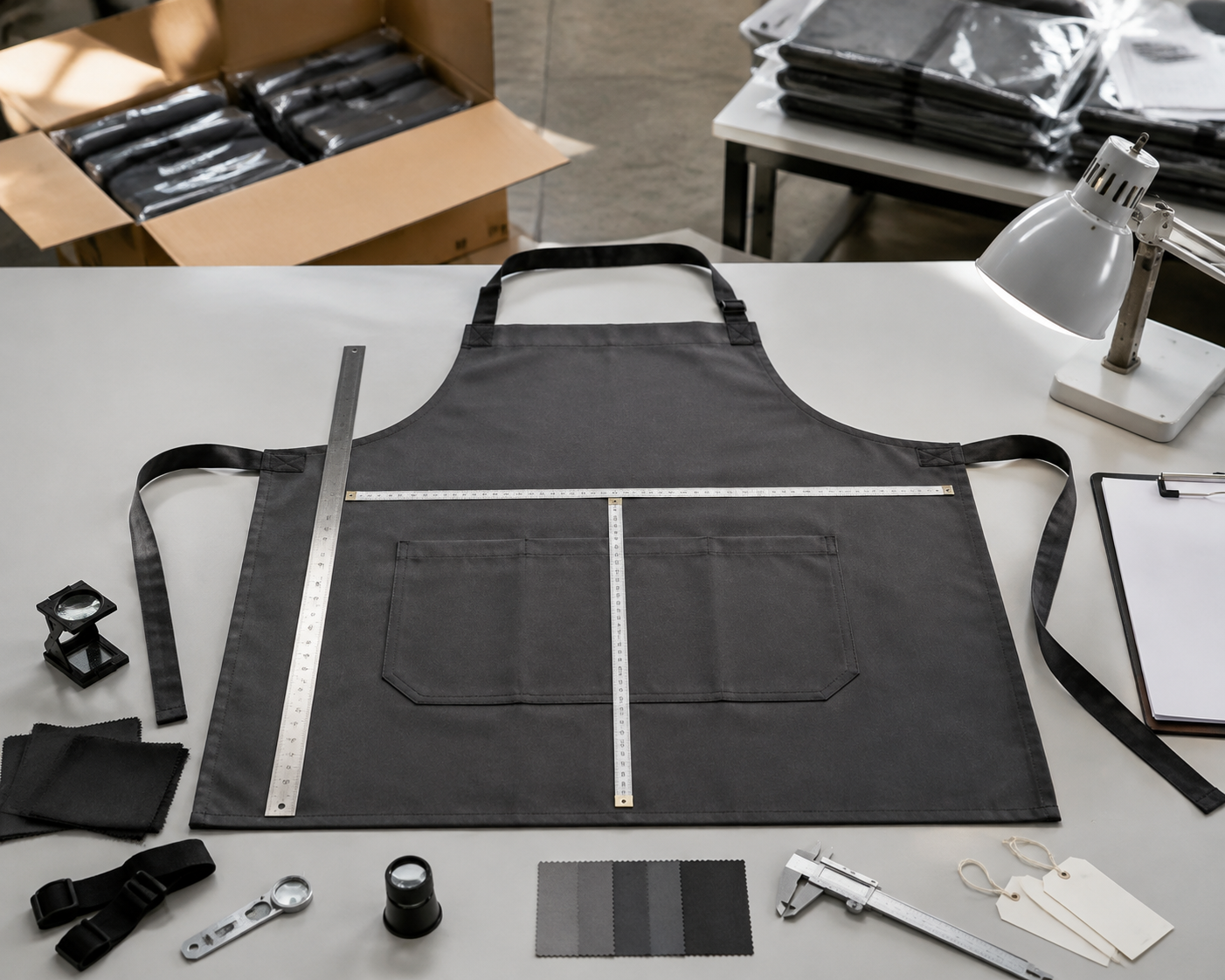
- Measurement landmarks, targets, tolerances, garment condition during measurement, equipment, recording precision, and treatment of borderline readings.
- Seam routes, reinforcement locations, binding coverage, raw-edge treatment, strap arrangement, pocket geometry, and closure orientation.
- Approved colour, artwork, label, and placement references.
- Unit packing, carton configuration, carton identification, count controls, and lot-to-carton traceability.
- Controlled sample identifier and the characteristics that the sample is authorised to approve.
- Document precedence where the purchase order, written specification, sample, artwork, label file, or packing instruction conflicts.
- Written change approval for any proposed material, dimension, component, construction detail, production location, subcontractor, artwork, label, or packing substitution.
Do not let the approval sample control an unspecified feature by implication. Record which characteristics it approves and which remain governed by drawings, written requirements, material declarations, or other evidence.
What the quality control inspection should check
The inspection plan should distinguish incoming, in-process, finished-product, and packed-goods evidence. The checks below are proposed buyer controls to confirm in the RFQ; they are not source-reported industry requirements.
| Stage | Salon apron checks to define | Evidence to request | Possible lot decision |
|---|---|---|---|
| Incoming materials | Material and component identifiers, declared composition or construction records, approved colour boundary, visible condition, finish identifier, and batch traceability | Declarations, batch records, swatches, component photographs, and separately agreed test evidence | Approve, quarantine, replace, or seek a written concession before cutting or assembly |
| Cutting and assembly | Pattern orientation, measurement landmarks, pocket position, seam route, stitch formation, binding, raw-edge control, strap anchoring, closure orientation, and unauthorised substitutions | In-process measurements, close photographs, defect log, affected-quantity record, and corrective-action status | Continue production, contain affected work, repair, or pause |
| Finished product | Body measurements, strap adjustment, pocket construction, seams, attachments, closures, surface condition, colour comparison, labels, artwork, and missing components | Selected-unit identifiers, readings, defect classifications, photographs, and lot result | Accept, sort, repair, replace, reinspect, reject, or consider a written concession |
| Packed goods | Correct style and colour, unit packing, carton contents, protection, carton identification, weights, dimensions, and traceability | Packing sample, carton data, count record, packed-carton photographs, and reconciliation to the accepted quantity | Release packing or hold affected cartons for correction |
The visible-condition prompts for damage, stains, shape, straps, fasteners, pockets, and missing components come from the supplied apron inspection checklist. A visual inspection cannot substantiate liquid resistance, chemical resistance, flame resistance, antimicrobial performance, durability, or protective-equipment status. Any such claim needs separately defined, product-scoped evidence.
Buyer-set measurement and test assumptions
Every value in this table is a buyer-set example assumption to verify in the supplier quote. Each value is current only as of the RFQ issue date printed on the buyer's document. None is a source-derived benchmark, supplier specification, inspection result, or industry requirement.
| Checkpoint | Buyer-set example assumption | Scope and verification required |
|---|---|---|
| Finished body dimensions | As of the buyer's RFQ issue date, buyer-set example assumption to verify in the supplier quote: target body length 72 cm and body width 68 cm, each with a plus or minus 1 cm tolerance | Scope: every finished salon apron selected for measurement under the agreed sampling instruction. Confirm landmarks, garment condition, measuring surface, equipment, precision, and borderline-reading rule |
| Pocket position | As of the buyer's RFQ issue date, buyer-set example assumption to verify in the supplier quote: pocket top 38 cm below the highest bib point, with a plus or minus 1 cm tolerance | Scope: every selected finished unit assigned to this measurement. Confirm the reference points and whether the garment is relaxed, flattened, or tensioned |
| Main-seam stitch density | As of the buyer's RFQ issue date, buyer-set example assumption to verify in the supplier quote: 4.0 stitches per cm, with a plus or minus 0.5 stitches per cm tolerance | Scope: buyer-designated main assembly seams on every selected unit. Identify included seams, counting length, fractional-count treatment, and handling of skipped or malformed stitches |
| Strap attachment check | As of the buyer's RFQ issue date, buyer-set example assumption to verify in the supplier quote: apply 40 N for 10 s to a selected strap attachment | Scope: each attachment selected under a separately agreed functional-test sample. Confirm fixture, pull direction, conditioning, destructive status, observable pass criterion, recording method, and replacement of tested units |
| Export-carton quantity | As of the buyer's RFQ issue date, buyer-set example assumption to verify in the supplier quote: 25 salon apron units per export carton | Scope: every export carton in the order. Confirm the unit-pack method, carton dimensions, net weight, gross weight, count-control evidence, and effect on the freight quotation |
Replace these assumptions with values justified by intended use, the controlled approval sample, material and construction evidence, and the buyer's commercial risk. The supplier response should identify any value it cannot manufacture, measure, test, or document as written.
Define the production lot and defect rules
An inspection result is useful only when its scope and decision rule are explicit. Before inspection is booked, agree:
- How the production lot is defined and whether styles, colours, material batches, production periods, lines, subcontractors, or packing runs may be combined.
- What quantity must be complete and available for inspection, and how incomplete production affects the result.
- Who selects cartons and units, where selection occurs, how selection is recorded, and how opened cartons are restored.
- The sample size, selection method, measurement sample, functional-test sample, defect classes, acceptance values, and retest conditions.
- Whether workmanship, measurement, packing, and functional checks use the same units or separately identified units.
- Which checks may damage a unit and whether tested units must be replaced before dispatch.
- Who may approve a concession and how its lot, quantity, defect, evidence, remedy, commercial effect, and duration are recorded.
Create a contract-specific defect catalogue instead of relying on undefined labels. Buyer-defined release-blocking examples could include the wrong style, wrong declared material, an unauthorised component, an exposed sharp part, severe contamination, unauthorised branding, or failure of an expressly critical attachment. Buyer-defined major examples could include a functional measurement outside the agreed tolerance, an open seam, an unusable closure, a materially misplaced pocket, colour outside the approved comparison boundary, or packing that creates an order-identity error. Limited cosmetic variation within the agreed function and saleability criteria could be treated as a buyer-defined minor defect. These are drafting examples, not universal classifications.
If the contract incorporates a sampling or test standard, identify its exact title, edition, applicable clause or table, inspection level, lot treatment, acceptance values, and retest or switching rules. Keep the standard's requirements separate from buyer-added criteria and the supplier's own procedures. A general statement that standard QC is used does not establish certification or conformity. Do not rely on certification without checking a current document's holder, issuer, validity, product scope, production-site scope where relevant, edition, and limitations.
Evidence for material and performance claims
Add an evidence field for every requested material or performance statement. The supplier response should identify:
- The exact proposed claim and intended salon use.
- The covered style, material, component, colour, finish, production batch, and manufacturing location where relevant.
- The selected test method and edition when the contract requires one.
- Sample conditioning, equipment, exposure, duration, direction, and pass criterion where applicable.
- Report issuer, report date, sample identifier, result, exclusions, and document status.
- Traceability from the evaluated sample to the material allocated to the purchase order.
- Whether the evidence is a supplier declaration, internal record, or independent report.
Treat the claim as unresolved if the evidence covers a different material, finish, style, batch, holder, site, method edition, or validity period. The contract should state the response: narrow or remove the claim, provide matching evidence, replace the affected material, request a written concession, or hold the lot.
New Zealand freight and dispatch quality control inspection
For a New Zealand order, define cargo-ready status separately from the estimated production-complete point. Cargo-ready status should depend on the accepted lot, completed corrective work, approved packing, reconciled packed data, reviewed document drafts, and written dispatch authority.
| Area | Request in the supplier quote | Evidence before dispatch |
|---|---|---|
| Final packed data | Unit count, carton count, carton dimensions, net weight, gross weight, packing method, identification, and pallet or wood-packaging details when applicable | Final packing record and photographs reconciled to the accepted production quantity |
| Freight scope | Handover point, named New Zealand delivery point, inclusion or exclusion of the local delivery leg, transport mode, selected trade term and version, services, exclusions, validity period, and route assumptions | Freight quotation matched to final packed data, with its source and quote date identified |
| Transit estimate | Route, mode, service scope, start event, end event, exclusions, estimate source, and as-of date | Written estimate from the selected freight provider after final packed data is available |
| Document drafts | Product description, style code, declared material description, quantity, carton data, weights, values, origin data, seller, buyer, consignee, and any fields requested by the buyer or its adviser | Reconciled invoice draft, packing-list draft, transport-document draft, and other contractually requested records |
| Product-specific review | Questions covering classification, origin treatment, entry data, product or care-labelling position, packaging, treatments, and biosecurity applicability for the actual goods and route | Current written direction from the New Zealand buyer's customs broker or another appropriately qualified adviser |
| Dispatch authority | Named decision owner and the required treatment of open inspection, packing, freight, or document discrepancies | Written release tied to the accepted lot, final packed quantity, freight scope, and reviewed document set |
These are purchasing and reconciliation controls, not a statement that the listed records are legally sufficient for entry into New Zealand. The cited sources do not provide a current New Zealand customs classification, tariff treatment, origin ruling, mandatory document set, product-labelling decision, consumer-law assessment, biosecurity decision, freight price, transit commitment, or customs-clearance outcome.
Before relying on a route or compliance position, provide the actual material construction, coatings, treatments, origin information, packaging, intended use, and shipment route to the buyer's customs broker or another appropriately qualified adviser. Treat any freight price or transit estimate as a quoted assumption until its shipment scope, route, service, source, as-of date, validity, inclusions, and exclusions are documented against final packed data.
Failed-lot remedies and reinspection
Agree remedies before manufacturing and apply them to an identified lot and affected quantity.
| Finding | Contract response to define | Evidence required before reconsidering release |
|---|---|---|
| Wrong identity, revision, declared material, or component | Hold shipment, contain affected goods, replace them, request a concession, or apply another agreed contractual remedy | Lot trace, affected-quantity record, corrected identity evidence, cause record, and reinspection result |
| Measurement or workmanship failure | Sort, repair, replace, request a concession, and reinspect as agreed | Unit-level disposition, repair instruction, post-repair evidence, and updated inspection result |
| Unsupported performance claim | Remove or narrow the claim, provide matching current evidence, replace the affected material, or hold release | Product-scoped evidence and traceability to the supplied material or batch |
| Packing or document discrepancy | Repack, recount, correct identification under approved instructions, or revise document drafts | Updated packing evidence and reconciled final shipment data |
| Repeated inspection failure | Apply additional containment, agreed cost allocation, schedule recovery, replacement, or another contractual remedy | Corrective-action record, responsible owner, completion evidence, and revised cargo-ready basis |
A corrective-action response should identify the finding, affected scope, immediate containment, cause analysis, correction, preventive action, responsible owner, completion evidence, and schedule effect. Keep reworked units traceable. The reinspection instruction should state whether corrected units, the wider lot, or both are subject to renewed selection and review. A concession should apply only to its recorded lot, quantity, defect, and commercial terms; it should not alter future requirements by implication.
What the salon apron manufacturing quote must return
For a comparable RFQ decision, require the supplier to return:
- Quoting legal entity, proposed production location, subcontracting proposal, and responsible contact.
- Style code, specification revision, quantity, colour, intended use, and New Zealand destination.
- Declared materials, components, supplier codes, finishes, and proposed substitutions.
- Sample type, manufacturing route, material status, timing, cost, and approval-record method.
- Measurement capability, tolerances, methods, equipment, construction details, labels, and artwork controls.
- Proposed incoming, in-process, finished-product, and packing checkpoints, including access and evidence.
- Lot definition, selection method, sample sizes, defect catalogue, acceptance values, and retest conditions.
- Product-scoped evidence for any requested material or performance claim.
- Unit packing, carton construction, counts, dimensions, weights, protection, identification, route assumptions, and freight-quote validity.
- Product, sample, tooling, testing, inspection, reinspection, packing, documentation, and remedy costs, with exclusions stated.
A general acknowledgement should not close a field that contains a deviation, assumption, exclusion, or unresolved evidence request.
Limitations and what to verify
The cited evidence does not include a supplier quotation, production-site audit, bill of materials, controlled production sample, current certificate, laboratory report, lot inspection report, corrective-action record, customer outcome, freight-provider quotation, or New Zealand authority ruling. This article therefore does not establish any supplier's manufacturing capability, quality control practice, certification, salon apron performance, legal compliance, lead time, freight cost, transit time, or customs outcome.
Before placing an order, verify the supplier's legal identity, production location, subcontracting plan, capability for the controlled construction, material traceability, sample-to-production controls, inspection access, evidence scope, document currency, corrective-action process, packing data, commercial terms, and failed-lot remedies. For the actual New Zealand shipment, obtain product-specific advice covering the goods, materials, treatments, origin, packaging, route, and intended use.
Author and experience basis
The first-party Vincent Xi author profile identifies Vincent Xi as Editorial Author. It does not document first-hand factory visits, product testing, inspection execution, freight handling, certification review, or customer outcomes, so no such first-person experience claim is made.
Discuss Your Requirements
Review our manufacturing capabilities, then share your specifications for a supplier-fit review.