Salon Apron OEM Compliance Requirements for Canadian Buyers
By Vincent Xi, Editorial Author
For a Canada-bound salon apron OEM order, compliance should be a documented manufacturing release decision, not a general supplier assurance. The Canadian buyer's RFQ should connect each applicable obligation, sales-channel condition, product specification, and supplier control to the exact SKU revision, required evidence, responsible party, due stage, and hold rule.
Start with a signed product baseline covering intended salon use, materials, components, construction, dimensions, claims, artwork, packaging, inspection, traceability, and change control. Then require every report, declaration, sample, and supplier response to identify the scope it covers. Evidence for another material, finish, facility, revision, or production lot should remain unresolved until its applicability has been reviewed and recorded.
The supplied sources do not establish a product-specific Canadian statutory checklist, bilingual-label conclusion, import procedure, customs treatment, or landed-cost amount for a salon apron. They also do not establish Linwa Apron materials, facilities, manufacturing practices, testing, certifications, prices, lead times, or capacity. Those points must be verified for the actual SKU, sales channel, supplier quote, and transaction before production approval.
Release decision: authorize bulk production only after the mandatory requirements have approved dispositions, the product baseline is signed, the evidence matches the ordered scope, the lot-acceptance rule is defined, and responsibility for failures or changes is allocated in writing.
Salon apron OEM compliance requirements for Canada manufacturing RFQs
The controls below are RFQ and production-release fields for the buyer to define. They are not presented as Canadian legal requirements. The buyer's qualified reviewers should determine what applies to the actual product and then convert those conclusions into measurable supplier obligations.
| Decision area | Put this in the RFQ | Require from the supplier | Hold condition |
|---|---|---|---|
| Requirement basis | Classification as an applicable legal conclusion, channel condition, buyer specification, or supplier control; source; owner; status; and approver | Acceptance, exception, or a documented question for each row | A mandatory row has no applicability decision, source, owner, or approval |
| Product baseline | SKU, specification revision, intended salon task, excluded uses, bill of materials, construction, dimensions, claims, artwork, and packaging | Signed acknowledgement and sample identifiers tied to the quoted revision | The quote, sample, declaration, or report identifies a different or incomplete scope |
| Labels and claims | Buyer-approved content, language version or versions after applicable review, placement, attachment method, artwork revision, and required substantiation | Artwork proof and physical sample using the current approved revision | Content, language, claim, placement, or revision remains unapproved |
| Evidence scope | Required document, accepted issuer, relevant material or product identity, facility scope where applicable, issue status, and submission stage | Complete records linked to the ordered material, finish, SKU, facility, or lot as specified | Evidence is missing, contradictory, expired, incomplete, or outside the ordered scope |
| Manufacturing scope | Approved production site, disclosed subcontracted processes, notice duties, and approval sequence | Site and process disclosure plus written acceptance of change controls | A material, process, facility, or subcontractor changes without required approval |
| Quality release | Controlled reference sample, lot definition, sample-selection method, defect definitions, measurement points, acceptance rule, and reinspection process | Lot-specific report with actual observations, measurements, lot identity, and disposition | The identified lot has not passed the signed acceptance rule |
| Traceability | Required links among purchase order, SKU, specification revision, material batch, production lot, inspection report, and evidence | Records connecting each required identifier to the shipment | The evidence or inspection result cannot be connected to the shipment lot |
| Commercial responsibility | Quote scope, currency, quantity basis, evidence, inspection, rework, retesting, replacement, and schedule effects | Itemized quote and written allocation of failure costs and corrective actions | Mandatory compliance work is excluded or responsibility remains ambiguous |
Keep the requirement classes separate. A legal obligation, retailer condition, buyer specification, and supplier production control can all affect release, but one should not be represented as another.
Source boundaries for the salon apron RFQ
The supplied pages provide contextual procurement principles rather than a Canadian salon-apron legal determination.
| Supplied source | Supported use | Boundary for this article |
|---|---|---|
| Capacity beauty and apparel compliance guide | States that its compliance list is not exhaustive and that requirements can differ by brand | Supports requirement-by-requirement scoping; it does not establish a Canadian salon apron checklist |
| Barnes & Noble vendor requirements | Provides a retailer-specific context for factory verification, product-document review, and remediation responsibilities within that retailer's program | Supports an example of buyer-controlled verification; it is not Canadian law or evidence about another supplier |
| Ross sourcing and human-rights policy | Describes that company's vendor expectations concerning labour, working conditions, forced labour, environmental protection, product safety, corruption, and contractor or subcontractor obligations | Supports contractual ownership and flow-down fields; it does not verify another company, facility, or product |
| Vincent Xi author profile | Identifies Vincent Xi and the Editorial Author role | Supports the byline and role attribution only |
None of these sources supports a claim about the composition, dimensions, finish, performance, compliance status, certification, price, production site, or delivery performance of a Linwa Apron salon apron.
Freeze the salon apron specification before evidence review
Reports and samples are useful only when they can be matched to a controlled product scope. Attach a specification revision to the RFQ and require the quote, approved sample, evidence matrix, and inspection report to reference it.
The controlled specification should cover:
- Intended salon task, intended user, excluded uses, and approved or prohibited claims.
- Main material, fibre composition to be declared, fabric construction, colour reference, finish, coating if any, and buyer material code.
- Thread, straps, adjusters, pockets, hardware, labels, and packaging.
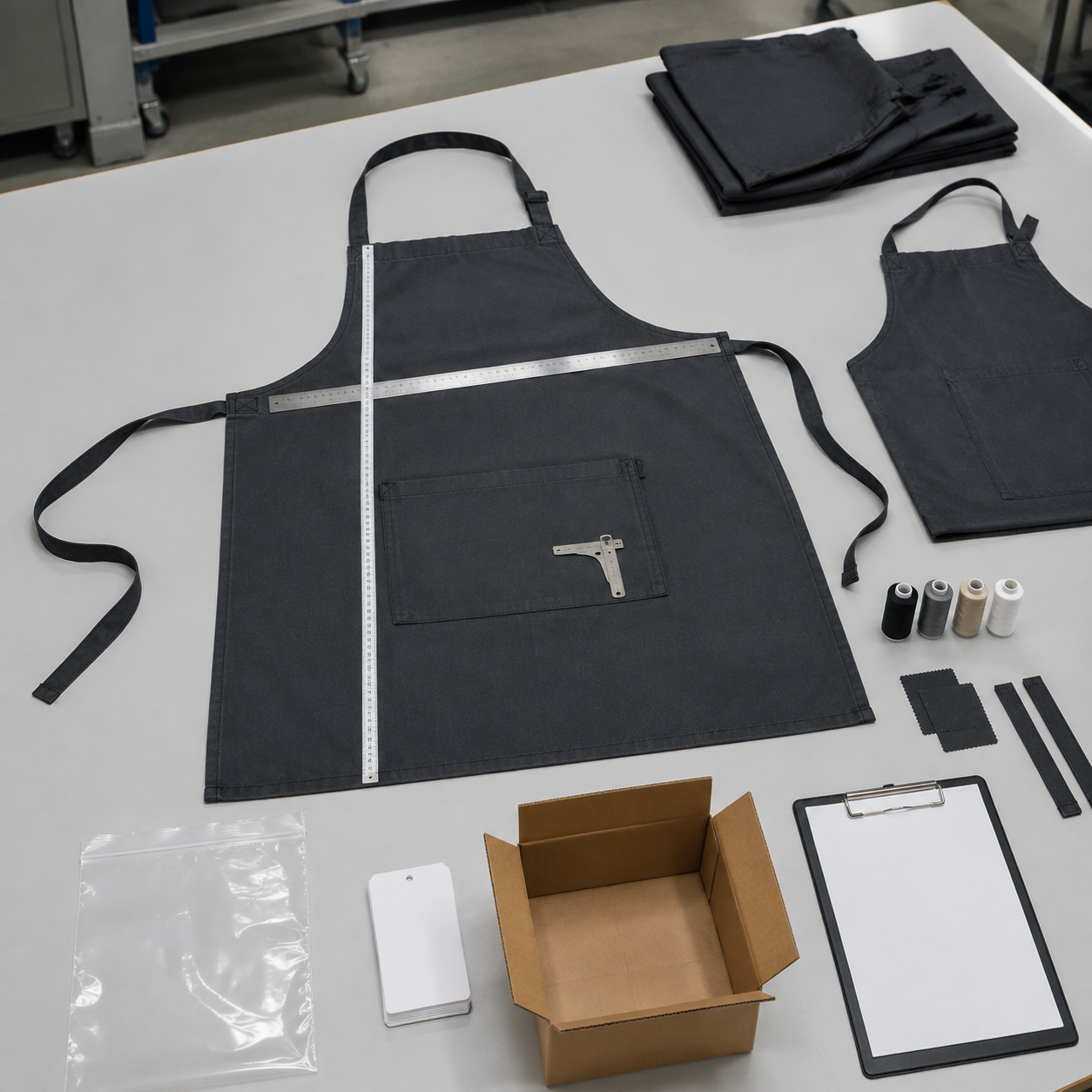
- Finished dimensions, tolerances, measurement datums, seam and edge construction, and reinforcement points.
- Artwork files, approved language version or versions, placement, attachment, and revision status.
- Sample approval, inspection method, traceability, evidence requirements, and change-approval steps.
The following values are example RFQ assumptions created for one hypothetical finished salon apron SKU and must be verified in the supplier quote, controlled drawing, approved sample, and signed inspection rule. They are not sourced product facts, Canadian legal thresholds, market norms, or Linwa Apron specifications.
| Product control | Example assumption for the hypothetical SKU | Verification status |
|---|---|---|
| Finished body width | 70 cm per finished salon apron unit | Example RFQ assumption to verify in the supplier quote and approved sample |
| Finished body length | 80 cm per finished salon apron unit | Example RFQ assumption to verify in the supplier quote and approved sample |
| Front pocket | 30 cm wide by 20 cm high per finished salon apron unit | Example RFQ assumption to verify in the supplier quote, drawing, and approved sample |
| Neck-strap adjustment | 45 cm to 70 cm of usable adjustment per finished salon apron unit | Example RFQ assumption to verify in the supplier quote and functional sample check |
| Waist ties | 75 cm finished length per tie on each finished salon apron unit | Example RFQ assumption to verify in the supplier quote and approved sample |
| Body dimension tolerance | +/- 1 cm from the approved body width and length per finished salon apron unit | Example RFQ assumption to verify against supplier capability and the signed inspection rule |
| Pocket-position tolerance | +/- 0.5 cm from the buyer-defined datum per finished salon apron unit | Example RFQ assumption to verify in the drawing and signed inspection rule |
Do not infer fibre composition, fabric mass, coating, liquid resistance, chemical performance, durability, or colourfastness from a photograph or an unverified sample description. When a property matters to the order, state the property, method, acceptance threshold, sample-selection rule, evidence scope, and change trigger in the RFQ.
Treat any proposed change to fabric, finish, coating, colour process, trim, component, or construction as a new decision. The supplier response should identify its effect on price, samples, evidence, inspection, and schedule before the buyer approves it.
Canada compliance requirements for labels, claims, and evidence
The supplied evidence does not determine whether a particular Canada-bound salon apron requires bilingual content or what any required wording must say. The buyer should obtain the applicable Canadian and sales-channel conclusion, provide approved artwork and language versions, and identify the physical proof required for release. The supplier should be asked to reproduce approved content, not to make an unsupported legal determination for the buyer.
For each report, declaration, or supporting record, define these acceptance fields before requesting it:
- Document title and type.
- Issuing legal entity or organization.
- Holder and facility where relevant.
- Product, material, colour, finish, or lot identifier.
- Test method and edition where applicable.
- Acceptance threshold and actual result where applicable.
- Issue and validity status.
- Connection to the ordered SKU and specification revision.
- Due stage and buyer review decision.
A pass-only summary should remain unresolved when the RFQ requires sample identity, method, threshold, and actual result. Evidence covering a different material, colour, finish, facility, product revision, or lot should be accepted only after a documented applicability review.
When a qualified review identifies a relevant standard, state its exact title, edition, applicable clauses, test method, and acceptance threshold. Keep the standard's requirements separate from company practices created by the buyer, such as inspection frequency, report format, approval sequence, and production hold points.
Do not describe a product, facility, process, or management system as certified unless a current document identifies the holder, issuer, scope, relevant standard, validity status, and covered product or facility. The supplied sources do not establish a Linwa Apron certification.
Control manufacturing inspection, traceability, and changes
Define the inspection plan before bulk production begins. The plan should identify the production-lot definition, sample-selection method, observable defect categories, measurement points, visual and functional checks, packaging checks, acceptance values, failure disposition, and reinspection rule.
If the buyer selects a recognized sampling standard, the RFQ should identify the exact title and edition, lot basis, inspection level, sampling parameters, and chosen acceptance values. A generic reference to standard inspection does not tell the supplier or inspector which release rule applies.
Write defect definitions as observable conditions. Include the affected location, measurement method where relevant, severity classification, and release consequence. Require actual findings and measurements in the inspection report instead of an unsupported pass statement.
The traceability record should connect the purchase order, SKU, specification revision, material batch, production lot, inspection report, and required evidence package. Define record-retention and reference-sample retention according to the buyer's approved policy; the supplied evidence does not support a default retention period.
Require advance written notice for proposed changes to materials, finishes, coatings, components, artwork, production sites, subcontracted operations, construction, claims, packaging, or evidence scope. The buyer should decide whether the change requires a revised quote, new sample, updated report, amended inspection instruction, or renewed approval. Earlier evidence should not transfer automatically to an altered scope.
Compare salon apron manufacturing quotes on compliant scope
Use one quote template for every candidate supplier and compare responses only when the SKU revision, material scope, evidence package, inspection plan, and acceptance rule are equivalent.
| Quote field | Supplier entry required | Buyer decision use |
|---|---|---|
| Base salon apron | Currency per accepted finished unit, order-quantity basis, specification revision, included materials, and construction | Confirms that base amounts cover the same product scope |
| Labels and packaging | Currency per unit, setup charges, artwork revision, and included pack configuration | Separates customization from the base garment amount |
| Samples | Sample type, charge, approval sequence, and completion time in calendar days | Identifies the cost and timing required to freeze the product baseline |
| Testing and evidence | Charge by document, material, product, or lot; covered scope; payer; and completion time in calendar days | Shows whether mandatory evidence is included or excluded |
| Inspection | Charge by lot or visit, sampling basis, included report, reinspection terms, and report timing | Makes the quality-release scope comparable |
| Proposed changes | Quantity effect, price effect, evidence effect, and approval time for each option | Shows whether a variant creates a different manufacturing or evidence scope |
| Failure response | Allocation for rework, retesting, reinspection, replacement, cancellation, and document correction | Identifies remediation exposure omitted from the initial unit amount |
| Schedule | Sample, evidence, production, inspection, correction, and document-release durations in calendar days | Identifies which approval gate controls manufacturing completion |
| Commercial scope | Currency, quote validity, included work, exclusions, and payment milestone basis | Prevents comparison across incompatible commercial assumptions |
Calculate a comparable manufacturing amount per accepted unit only from supplier-entered amounts covering the same approved scope. The calculation may combine the quoted base unit amount, customization amount, allocated evidence cost, allocated inspection cost, and contractually assigned remediation amount, divided by the expected accepted-unit quantity. This article supplies no price assumption.
The supplied evidence does not support a Canadian landed-cost amount or the transaction-specific inputs needed to calculate one. Keep landed cost outside the published comparison until the responsible customs and commercial reviewers have verified the actual shipment inputs.
RFQ release checklist for compliance requirements
- [ ] Identify Canada as the sales destination and record the exact sales channel for the SKU.
- [ ] Define the intended salon task, user, excluded uses, and approved or prohibited claims.
- [ ] Separate legal conclusions, channel conditions, buyer specifications, and supplier controls.
- [ ] Record the source, owner, applicability decision, evidence, due stage, approver, and hold rule for every mandatory requirement.
- [ ] Issue a controlled SKU specification and use the same revision for the quote, sample, evidence, and inspection.
- [ ] Define materials, finishes, components, construction, dimensions, tolerances, labels, and packaging.
- [ ] Provide only artwork and language versions approved through the applicable Canadian and channel review.
- [ ] Map every proposed product claim to required substantiation or remove it from scope.
- [ ] Define each required document, accepted issuer, scope, method, edition, threshold, sample rule, and due stage where applicable.
- [ ] Require production-site and subcontracted-process disclosure for the ordered scope.
- [ ] Approve an identified pre-production sample as the controlled manufacturing reference.
- [ ] Define the lot, sampling method, defect categories, measurements, acceptance rule, and reinspection process.
- [ ] Connect the purchase order, product revision, material batch, production lot, inspection report, and evidence package.
- [ ] Require written approval before changes to materials, processes, facilities, subcontractors, construction, claims, artwork, or packaging.
- [ ] Itemize samples, evidence, inspection, reinspection, rework, and retesting in the quote.
- [ ] Allocate responsibility for failed tests, rejected lots, missing documents, corrections, replacements, and cancellation.
- [ ] Reject certification claims that lack a current document matching the claimed holder, scope, standard, status, product, and facility.
- [ ] Keep production or shipment on hold while a mandatory response is missing, contradictory, out of scope, or unapproved.
Methodology, limitations, and author scope
Methodology: The supplied pages were reviewed according to their source owner and context. Supported principles were mapped to buyer-controlled salon apron RFQ fields covering requirement classification, evidence applicability, product approval, facility and subcontractor disclosure, inspection, change control, and remediation. Retailer and corporate policies were kept separate from Canadian legal conclusions. Unsupported company, product, certification, legal, price, performance, and logistics claims were omitted. Technical values appear only as explicitly labeled example assumptions requiring supplier verification.
Source contexts: The Capacity guide supports non-exhaustive, brand-dependent scoping. The Barnes & Noble requirements provide a retailer-specific example of verification, documentation, and remediation controls. The Ross policy provides a company-policy example of vendor responsibilities and contractor or subcontractor flow-down. These sources do not establish Canadian salon apron law or verify Linwa Apron, another supplier, or a specific facility.
Limitations and what to verify: The supplied evidence does not establish the current Canadian product classification, label wording, language obligation, chemical restriction, test method, import treatment, mandatory document set, or sales-channel condition for a particular salon apron. It also does not establish supplier materials, facilities, pricing, capacity, testing, certifications, delivery performance, or source publication and retrieval dates. Before ordering, verify the applicable Canadian requirements with qualified legal, product-compliance, customs, and channel reviewers. Verify the supplier's current quote and facility scope, match every document to the ordered material and product, and approve the physical sample, artwork, inspection plan, change terms, and remediation terms in writing.
Author scope: The Linwa Apron author profile supports Vincent Xi's identity and Editorial Author role. It does not document product testing, factory visits, client outcomes, or other first-hand experience, so no such experience is claimed.
Discuss Your Requirements
Review our manufacturing capabilities, then share your specifications for a supplier-fit review.