Salon Apron OEM Communication Workflow Review for United States Buyers
Editorial review by Vincent Xi, Editorial Author (author profile). This page synthesizes publicly described OEM/ODM process steps from the cited manufacturer pages. It does not claim factory visits, laboratory tests, named customers, awards, current mill certificates, or first-person production experience.
Decision first for United States buyers: do not treat chat history as a salon apron specification. The manufacturing control that decides whether bulk fabric is cut is a written, dated packet: tech pack, sample type, named approver, inspection points, English and origin labeling, packing marks, and Incoterms to a named United States destination. Quotes are comparable only when those gates match.
Source context 1. An OEM/ODM page for salon capes and barber aprons describes a sequence of specification, quantity, price, delivery, and quality negotiation, then design, raw-material purchase, pre-production sample confirmation, quality inspections during production, and delivery. Finetex
Source context 2. A customizable-apron how-to page tells buyers to inquire, before orders, about MOQs, size/color combining, logo fees, sampling policies, lead times, DDP export, delay handling, and attributes such as BSCI or OEKO-TEX. Example MOQ language on that page is 100–1000 pieces for customizable aprons as a category. Shanghai Garment
Source context 3. A wholesale page for OEM leather aprons aimed at barbershops and salons publishes a 10-piece branded MOQ, a 1-day inquiry reply, a 1–2 week sample window, 3–5 week in-house production after spec approval, and worldwide shipping. leatherapron.shop
Those figures are manufacturer-page examples, not current quotes. Each number in this review keeps its unit, scope, and as-of context. Confirm fabric, SKU, packing, inspection, Incoterm, and named United States door in the supplier quote before using any figure on a purchase order.
Lock these five items in the first written exchange and keep them in one packet:
- Specify — dimensions, fabric/construction, color standard, logo method, packing, and care/origin marks.
- Compare — itemized quotes under the same Incoterm, packing, inspection plan, currency, and validity date.
- Verify — a look-alike sample is not a pre-production sample (PPS) cut from bulk-intent material.
- Approve — named signer, backup, freeze date, and the photo/measurement set that counts.
- Order — change control, delay notice, inspection reject rules, and a named United States door on the PO.
This page stays on that OEM handoff for the salon-apron product family. It is not a complete guide to every apron category.
Why a communication workflow review belongs in salon apron manufacturing
A salon-apron program fails in predictable ways when the mill and the United States buyer do not share one frozen pack: bib width and length, neck-loop or slider type, waist-tie length, pocket placement, edge binding, hardware, logo method, fabric construction, color standard, care/origin mark, carton marks, and the person allowed to say the sample is approved. If those items live only in a thread, a later merchandiser, a second shift, or a substitute fabric lot can change the product without a change order.
Score mills on restatement, not on chat speed. A mill that answers in hours but never restates dimensions, units, packing, and Incoterms in the quote leaves the order open to silent change. A mill that returns an itemized spec sheet is the lower-risk path if that sheet can be frozen. A prototype photo is faster than a production-representative sample, but a photo does not prove stitch type, seam construction, or whether logo placement survives a production marker.
United States teams should freeze language and units in the first packet: dual metric/imperial measurements on the tech pack; English commercial documents, packing lists, and carton marks for receiving. The product family in scope is the salon apron specified for professional salon or barber use—including wipe-down or wash method and any chemical-splash expectation—when the buyer is comparing mills on process control rather than on slogan language.
United States RFQ controls for salon apron manufacturing
Keep the product and the order decision primary. The United States is the sales market this page addresses; this is not a tour of import law. For a salon apron OEM run destined for a named United States door, force labeling, landed-cost architecture, and the document pack into the first written exchange.
Labeling and marks. State fiber content, country of origin, and any care information the buyer’s brand or receiving DC requires, plus whether those marks appear on a sewn-in label, a hangtag, the polybag, or the master carton. Ask for an artwork proof before print. Do not assume a mill’s export carton is already United States-receiving ready. Treat labeling as an RFQ field with a proof gate, not as a mill default.
Landed-cost architecture. A DDP quote to a named United States door is comparable only if the mill states what is included (export clearance, main freight, United States customs, duties, last-mile) and what is excluded (unloading, inside delivery, storage). A parallel FOB or FCA quote lets the buyer’s forwarder price the same SKU. Third-party copy lists DDP export among the items buyers should inquire about before orders. Shanghai Garment That is an inquiry prompt on that page, not a landed-cost offer for this SKU.
Document pack. Require a commercial invoice, a packing list that matches the PO size/color breakdown, and any restricted-substance or social-compliance documents the buyer’s vendor-setup file requires. Names such as BSCI or OEKO-TEX appear in manufacturer how-to copy as attributes of “reliable” custom-apron sources. Shanghai Garment Those names are not a substitute for a current certificate tied to the producing site and the fabric lot. Distinguish a standard’s published requirement from any company’s claimed practice, and do not treat a website sentence as certification.
Also name the importer of record, the currency, the quote validity date, and the mill owner of the file (sales versus merchandiser versus QC). Unit prices are comparable only when packing, inspection, and Incoterms are identical.
From inquiry to pre-production sample
The useful sequence is the one a mill will put on a timeline with named owners. Map the cited process steps onto gates a United States buyer can audit.
Inquiry completeness. The first message should carry end use (salon floor, chemical-splash expectation, wash versus wipe-down), size run, color standard (Pantone code or physical swatch ID), logo method, target quantity by SKU in pieces, requested Incoterm, named United States destination, and packing intent (pieces per polybag, inner pack, master-carton marks). Incomplete inquiries produce incomplete quotes. A fast first reply is not a complete quote.
Itemized quote. A usable quote restates fabric (fiber and construction; GSM or leather thickness if applicable), trims, print/embroidery location measured from a named seam, packing, MOQ logic in pieces, sample cost and whether it is creditable, production calendar, currency, and validity date. If size/color combining is commercially important, it must appear as a quote rule, not as a later chat concession. Customizable-apron how-to copy tells buyers to inquire about MOQs, size/color combining, logo fees, sampling policies, lead times, DDP shipping, and delay handling prior to orders. Shanghai Garment
Tech-pack freeze. Require dual units on every dimension field: bib width and length in mm and in, with a numeric tolerance in mm; neck opening or slider spec in mm; waist-tie length each side in mm; pocket width × height in mm and stitch type named; logo placement in mm from a defined seam; color as Pantone or swatch ID. Put a version number and freeze date on every PDF. Without freeze dates, “the latest file” becomes the production file.
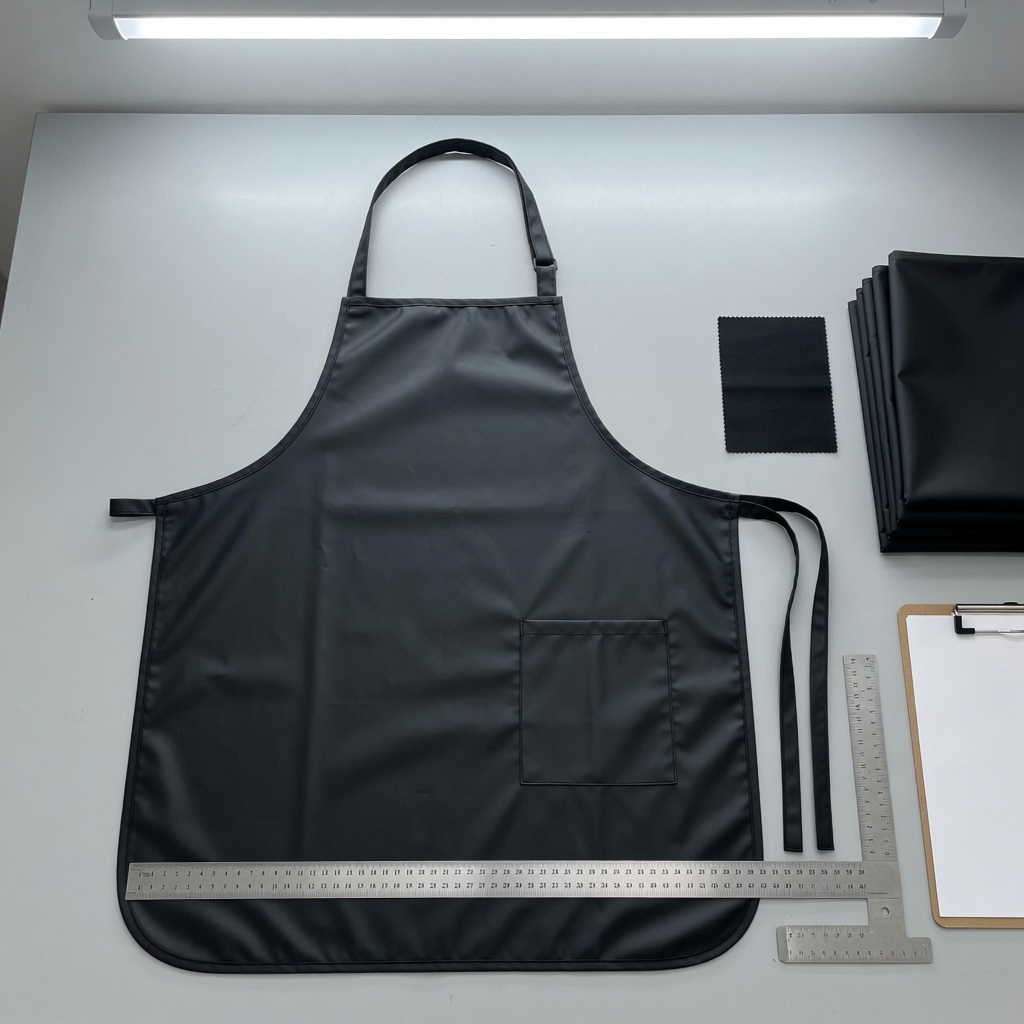
Sample type and photo protocol. A counter sample or salesman sample can confirm look. A PPS should be cut from the bulk-intent fabric, with production stitch, hardware, and branding. Require a dated photo set: flat lay with a ruler on the hem, logo close-up, pocket and hardware close-up, and neck-loop detail.
Written approval. Name the approver, the backup, and the rule for silence (silence is not approval). Require dated photos of the approved sample plus a retained physical reference if the order will repeat. After approval, any change is a paid engineering change, not a quick tweak. Production may not start without a dated approval that references the sample ID.
MOQ, combining, lead time, and landed-cost trade-offs
Numbers only help if they keep their units and scope. The figures below are published examples on undated manufacturer pages, not current capacity and not a Linwa production quote.
- 100–1000 pieces — MOQ range a customizable-apron manufacturer guide tells buyers to inquire about; unit = pieces; scope = customizable aprons as a category; as-of that undated page. Shanghai Garment
- 10 pieces — branded MOQ example on a wholesale page for OEM leather aprons aimed at barbershops and salons; unit = pieces; scope = that seller’s leather construction, branding method, and capacity; as-of that undated page. Do not transfer it to a woven or coated salon apron without a new quote. leatherapron.shop
- 1 day — inquiry-reply example on the same leather-apron page; unit = calendar day as written; scope = that seller’s branded leather-apron offer; as-of that undated excerpt.
- 1–2 weeks — sample window on that page; unit = weeks as written; scope = that seller’s leather-apron offer; as-of that undated excerpt. It does not state that the sample is cut from bulk-intent fabric.
- 3–5 weeks — in-house production window on that page after spec approval; unit = weeks as written; scope = in-house production only; as-of that undated excerpt. It does not, on that excerpt, include fabric procurement, embroidery queue, export booking, or transit to a named United States door.
Trade-offs to score in writing:
Combining sizes or colors toward MOQ. Combining can reduce stranded inventory for a United States salon group that needs S–XL and two house colors. Ask, in the quote, whether combining is allowed, whether combined SKUs are cut from the same dye lot, and whether leftover short sizes still ship or are held. If the mill cannot freeze dye-lot identity in writing, treat shade variation as an open order risk.
Low MOQ versus unit cost and sampling rigor. A 10-piece branded leather example may be viable for a program that is already patterned. A 100–1000 piece range for customizable aprons is inquiry language for cutting-marker, sewing-line, and fabric-mill minima as described on that how-to page. Pushing MOQ down without changing construction needs a written explanation of unit-price change, PPS timing, and whether a fabric lot will be held.
Sample speed versus representativeness. Even a published 1–2 week sample window does not prove production-line construction. For a United States rollout, budget time for a PPS after bulk fabric arrives, not only a first look-alike. Retain one approved sample in the United States for DC training and later claims.
Production calendar versus DDP promise. DDP can hide segments unless the mill publishes a dated milestone chart: fabric in-house, cutting, sewing, finishing, final inspection, on-board, and ETA at the named United States door. Delay-handling language belongs in the PO: what event triggers notice, whether air upgrade is offered, and who pays.
Example calculation to verify in the supplier quote (not a price, not a published MOQ). If a mill quotes 800 pieces across four SKUs as one combined MOQ, ask for unit price at 800 pieces combined versus 200 pieces per SKU uncombined, plus the extra days for separate markers. Treat any arithmetic on this page as an assumption to test, not as an offer.
Inspections, certification language, and shipping terms
Quality language has to be operational. “Good quality” is not an AQL. Ask where inspections occur (incoming fabric, in-line sewing, finished goods), who performs them (mill QC, buyer’s agent, or both), and what happens to rejected cartons. The Finetex OEM/ODM description includes quality inspections during production as a stated process step, without publishing an AQL number on the excerpt used here. Finetex
For United States programs, specify the reference sample that inspectors will hold, the photographic standard for logo placement, and whether needle detection or metal detection is required if the receiving DC demands it. If a chemical-resistance or wipe-down claim matters to the salon use case, require the test method and the lab name on the PO; do not infer performance from a fabric nickname.
Certification names should be treated as document requests. Request the PDF, the site name, the expiry, and the scope. If the mill cannot attach it, do not write the acronym into marketing copy or into the vendor master. A how-to page grouping BSCI or OEKO-TEX with production capacity is not evidence that any mill currently holds a certificate, that a certificate covers the salon-apron SKU, or that a particular United States retailer accepts it.
Shipping terms should name the place. “DDP United States” is incomplete. DDP a named Dallas warehouse, DDP a named 3PL in New Jersey, and DAP a named Los Angeles port are different cost and risk stacks. Confirm who is importer of record, who files security filings, and how shortage or damage at the United States door is evidenced. Worldwide-shipping language on a wholesale page is not a transit-time quote to a United States interior point. leatherapron.shop
Buyer decision table: communication gates versus order risk
Use this table to compare mills on the primary buyer task: specify, compare, verify, approve, or order a salon-apron OEM run. Every row is a control, not a slogan.
| Communication gate | Require in writing | Pass criterion (compare quotes) | United States check | Order risk if left in chat |
|---|---|---|---|---|
| Inquiry completeness | End use, sizes, colors, logo method, Incoterm, destination | Quote restates every field | Dual units; named United States door | Wrong bib or tie length in bulk |
| MOQ rule | Pieces per SKU vs. combined | Combining yes/no; same dye lot yes/no | Inventory plan by salon size run | Shade variation or stranded sizes |
| Sample type and clock | Proto vs. PPS; days or weeks stated; who pays | PPS from bulk-intent fabric | Sample retained in the United States for DC training | Look-alike sample that sewing line cannot copy |
| Approval authority | Named approver, backup, freeze date | Signed form or dated email with photo set | Time-zone and holiday calendar stated | Bulk cut without a freeze |
| Inspection plan | In-line and final; defect list | Location, method, and reject rule | Agent access if used; carton photos | Hidden stitch failure after transit |
| Label and origin pack | Sewn-in, polybag, carton marks | Artwork proof before print | Origin and fiber content as required for the SKU | Relabel at a United States 3PL |
| Packing configuration | Pieces/polybag; inner pack; carton marks | Matches PO size/color breakdown | English packing list for receiving | Mis-picks at the United States door |
| Incoterms and delays | DDP/FOB named place; delay notice | Milestone dates, not only weeks | Duties and last-mile inclusion stated | Surprise brokerage or missed launch |
| Change control | Engineering-change fee and lead-time add | Written ECO only | Re-approval if label or claim changes | Silent substitution of fabric or hardware |
Practical RFQ checklist for United States salon apron OEM orders
Send this as a single packet. Do not split critical rules across chat apps.
- State product family and use: salon apron for professional salon/barber use, wipe-down or wash method, and chemical-splash expectation.
- Attach a tech pack with bib, neck, ties, pockets, numeric tolerances, and logo placement measured from a named seam, in mm and in; put version and freeze date on every PDF.
- Name colors with a standard (Pantone or physical swatch) and ask whether sizes and colors may be combined toward MOQ, same dye lot or not.
- Ask the mill to restate MOQ in pieces, by SKU and combined, with the fabric and construction named; treat 10-piece and 100–1000-piece figures on third-party pages as examples to challenge, not as this order’s terms.
- Specify sample type: salesman sample versus PPS from bulk-intent material, quantity in pieces, cost, whether cost is creditable, and the photo/measurement set required for approval.
- Require a sample clock and a production calendar from written PPS approval to goods-in, then to a named United States destination, with fabric-in-house, cutting, sewing, finishing, final inspection, on-board, and ETA called out separately.
- Name the buyer approver and backup, name the mill file owner, and state that production may not start without a dated approval referencing the sample ID; silence is not approval.
- List inspection points and the defect classification the mill will use; ask whether a third-party inspection can be booked against that same list.
- Request copies, not names, of any social-compliance or restricted-substance documents the mill proposes to rely on, with site, scope, and expiry.
- State Incoterm, named place in the United States, importer of record, what is included in DDP if offered, and a parallel FOB/FCA number for landed-cost comparison.
- Require English commercial documents, carton marks, packing configuration (pieces per polybag and inner pack), and a packing list that matches the size/color breakdown on the PO.
- Add delay and substitution rules: notice period, air-upgrade option, and prohibition on fabric/trim substitution without a new PPS.
- Ask for logo method, stitch or print durability expectation, and whether a wash or wipe test is included before bulk; if a performance claim matters, name the test method and lab on the PO.
- Freeze the file set: one folder of the approved pack, with version and date on every PDF, plus a retained physical sample for repeat orders.
- Require the quote validity date and the currency, and state that unit prices are comparable only when packing, inspection, and Incoterms are identical.
How this review was derived
This communication workflow review is an editorial synthesis of three public pages: a how-to on finding manufacturers for customizable aprons, an OEM/ODM service description for salon capes and barber aprons, and a wholesale page for OEM leather aprons. Facts used here are limited to process steps and numerical examples as stated on those pages. No RFQ was issued for this article, no mill was audited, no salon apron was measured, and no laboratory test was commissioned. Author attribution follows the named Editorial Author profile for Vincent Xi; no additional experience basis is claimed.
Limitations and what to verify
Publication dates are not stated in the excerpts used, so every number is as published on the cited page, undated excerpt, not as-of a mill’s current capacity board. MOQ, sample days, and production weeks vary by fabric mill, coating, embroidery queue, and season. A leather 10-piece example is not a polyester salon-apron MOQ. DDP or worldwide-shipping language is not a United States interior transit time. Certification names in third-party copy are not current certificates. United States duty rates, HTS classification, partner-government-agency flags, and retailer routing guides are outside this page and must be confirmed with the buyer’s broker and the nominated mill quote. If a claim cannot be tied to a current document in the RFQ pack, omit the claim from the purchase order.
Discuss Your Requirements
Review our manufacturing capabilities, then share your specifications for a supplier-fit review.