Chef Apron Wholesale Supplier: Production Scalability Planning for Europe
By Vincent Xi — Editorial Author
Buying decision: A chef apron wholesale supplier provides bulk chef aprons for restaurant groups, hospitality businesses and distributors. For B2B procurement in Europe, select a supplier that can allocate accepted-and-packed output to your approved specification and required delivery dates—not merely quote total factory capacity. Production scalability planning means approving a larger lot only against an accepted pilot, documented material readiness, a dated order-specific production allocation and a delivery plan for your European receiving site.
Separate total factory output, capacity remaining after existing commitments and capacity reserved for your order. Compare the pilot, initial bulk lot and replenishment against the same specification revision. Keep the relevant release on hold while allocation, quality acceptance or delivery responsibilities remain unresolved.
Chef apron production scalability planning for Europe
Build the RFQ around release conditions rather than a general assurance that the supplier can handle more volume. An accepted pilot is not a reservation of future materials or production time.
| Release gate | Order-specific evidence to request | Buyer approval condition |
|---|---|---|
| Specification and pilot | Drawing revision, material identification, approved sample, pilot quantity, measurements, construction checks and agreed laundry results | Accept against written criteria and close corrective actions before bulk release |
| Materials and allocated output | Material-ready quantity and date, accepted-and-packed output rate, working calendar, bottleneck and existing commitments | Confirm a dated allocation for the quoted chef apron construction, not total factory output |
| Bulk schedule and delivery | Approval dependencies, production milestones, inspection and release dates, dispatch date and receiving-site target | Agree the schedule, responsible parties and response to missed milestones |
| Replenishment | Reorder minimum, lead time with and without reserved fabric, capacity reservation and substitution controls | Approve the reorder route separately from the initial production slot |
Where loading records contain other customers’ information, request redacted evidence. Treat unconfirmed materials, allocation or subcontracting as open release conditions—not usable capacity.
Use published ranges as RFQ assumptions, not capacity evidence
The Chef Uniform Procurement Guide provides comparison fields for MOQ, sample turnaround, production and reorder timing, delivery terms and quality assurance, including industrial laundry testing. Its context is chef-uniform procurement for restaurant groups; it does not establish a particular supplier’s chef apron capacity.
The following ranges come from general apron buyer-education pages. Their publication/as-of dates are unverified. Every numerical value below is an example planning assumption to verify in the supplier quote—not a current commercial term, measured chef apron allocation or European delivery promise.
| RFQ comparison | Source-reported example assumption to verify in the supplier quote | Source and scope |
|---|---|---|
| Customizable-apron MOQ | 100–1,000 apron pieces | How to Find Manufacturers for Customizable Aprons?. General manufacturer-selection guidance; allocation by chef apron style or colour is not established here |
| Overseas wholesale and trial quantities | 100–500 apron units for the wholesale MOQ discussed; 100–150 apron units as a suggested initial test buy | Wholesale Aprons: Costs, MOQs & What Actually Resells. General overseas wholesale-apron guidance, not confirmed chef-apron-only or Europe-specific offers |
| Overseas production and receipt timing | 5–8 weeks of production and 9–14 weeks total including ocean freight | Wholesale-apron guidance. The described overseas route does not establish a European gateway or contractual start and end dates |
Ask whether each minimum applies per style, colour, fabric, decoration, size variant or combined order. Do not infer allocated output, price breaks or reserved fabric from an MOQ. Replace the published timing envelope with a dated calendar for the actual receiving location; do not treat it as a European transit allowance.
Calculate the output allocated to your chef apron order
Use a common quotation basis: finished, accepted and packed chef apron pieces per production week. Have the supplier define the working days, shifts and shutdowns included in that week. Cut panels, unfinished garments and mixed-product factory output are not equivalent quotation bases.
Request a loading record covering cutting, sewing, decoration where specified, finishing, inspection and packing. The supplier should identify the limiting process and reconcile the proposed allocation with materials, existing orders and subcontractor availability. Compare serial operations on a common finished-apron basis rather than adding their individual output figures.
Dated output records for the same construction can support the assessment. If the supplier uses a comparison style, ask it to explain differences in fabric, pockets, ties, decoration and inspection requirements. Historical output is supporting evidence, not a reservation for your order.
Bulk-run example calculation—assumptions to verify in the supplier quote: an illustrative lot of 1,200 chef apron pieces, divided by an allocation of 300 accepted and packed chef apron pieces per production week, requires 4 production weeks at that assumed steady rate. This is not approval-to-receipt lead time. Material procurement, setup, release checks, dispatch and transport need separate dated allowances. Confirm whether rejected and reworked pieces are already excluded from the rate before applying another loss allowance.
Reorder-cover example calculation—assumptions to verify in the supplier quote: replacement demand of 8 chef apron pieces per calendar week, multiplied by 6 calendar weeks from reorder acceptance to warehouse receipt, gives 48 chef apron pieces of expected lead-time demand. This is not a complete safety-stock requirement. Replace the demand assumption with your replacement history and agree a separate delay buffer and reorder trigger.
Require the supplier to identify volume thresholds that would introduce extra shifts, subcontracting, material changes or staged deliveries. Make those changes subject to written approval. Document the availability, expiry, payment and cancellation terms of any fabric or capacity reservation.
Keep the specification controlled as volume increases
Use a controlled specification revision for pilot, bulk and reorder approvals. Record fibre composition, weave, fabric mass, colour reference, finished measurements, tolerances, pocket position, tie construction, stitching and any decoration.
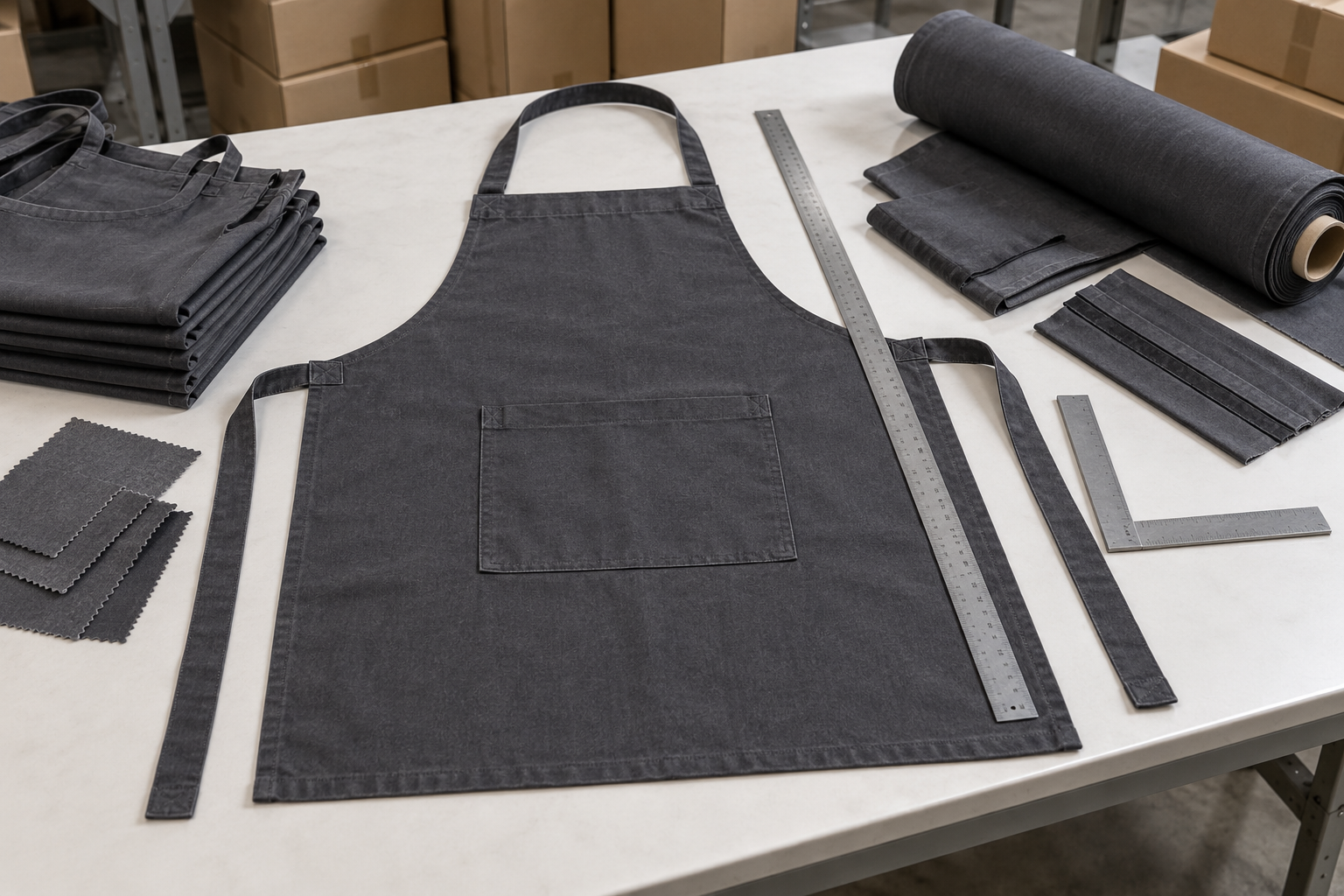
The charcoal cotton-twill bib chef apron below is an illustrative buyer proposal, not a confirmed Linwa Apron catalogue model or measured test result. Every numerical specification is an example assumption to verify in the supplier quote and sample approval.
| Specification field | Example RFQ assumption to verify | Measurement or approval record |
|---|---|---|
| Fabric mass | 240 g/m² ±12 g/m² for the proposed cotton-twill fabric | Confirmed fibre composition, agreed measurement and conditioning method, and material-lot reference |
| Finished body length | 850 mm ±10 mm, from the upper bib edge at centre front to the lower hem, excluding the neck strap | Defined measurement state, drawing revision and pilot measurements |
| Finished maximum body width | 700 mm ±10 mm, across the widest body section, excluding waist ties | Agreed measurement landmarks used for pilot, bulk and reorder checks |
| Finished front pocket | 250 mm wide × 200 mm high, with ±5 mm tolerance on each dimension, measured at the outer sewn edges | Pocket position, attachment construction and recorded dimensions |
Complete neck-strap adjustment, waist-tie dimensions, seam allowances, stitching and pocket placement before approval. Specify whether measurements are taken before laundering, after laundering or in both states; do not compare different measurement conditions without an agreed basis.
For laundry acceptance, have the intended laundry operator and supplier agree temperature, detergent, drying conditions, cycle count and conditioning. Require before-and-after measurements in millimetres and percentage change, plus acceptance criteria for colour, seams, ties and hardware where present. The procurement guide supports including industrial laundry testing; it does not provide a passed result for this proposed apron.
Agree defect classes, inspection coverage, accept/reject rules, reporting and re-inspection responsibility. Make material, dye-lot, pattern, site and subcontractor changes traceable to the affected lot, with defined triggers for renewed sample, laundry or inspection approval.
The manufacturer-selection source mentions BSCI and OEKO-TEX documentation. Where a supplier cites such documents, check the current file’s type, holder, scope and validity, then recheck applicability after site or material changes. An audit report is not a product certificate. These are checks of supplier claims, not universal order requirements or assertions of Linwa Apron certification.
Keep European delivery commitments destination-specific
Put the destination country, postcode and receiving site on the quotation and release schedule. Distinguish EU destinations, non-EU EEA destinations and UK destinations; identify Great Britain or Northern Ireland for UK deliveries. Confirm other European destinations separately rather than extending an EU, EEA or UK assumption to them.
Ask the importer or designated compliance owner to confirm applicable fibre-composition labelling, language, traceability, product-safety and substance-documentation requirements for the actual destination and placement. These are verification tasks, not a claim that identical rules apply throughout Europe. Build approval of the relevant label and document file into the packing schedule.
If FOB or DDP is offered, have the logistics adviser confirm suitability for the transport mode and route. Record the term and edition, named port or place, included charges, responsible importer and applicable customs, duty, VAT and brokerage responsibilities. Keep production completion, dispatch and warehouse receipt as separate milestones, including for staged deliveries.
RFQ Checklist
- Specify the chef apron drawing revision, fibre composition, weave, fabric mass, colour reference, dimensions, tolerances, measurement state, pocket and tie construction, stitching and decoration that pilot, bulk and reorders must match.
- Ask the supplier for separate pilot, bulk and replenishment quantities, prices and calendars, identifying whether MOQ applies per style, colour, material, decoration, size variant or combined order.
- Require the manufacturer to state sample turnaround, the production start conditions after written approval, reorder timing with and without reserved fabric, and calendar exclusions.
- Ask the supplier to quote the delivery term and edition for the named European port or receiving place, including currency, quote validity, importer responsibility and applicable duty, VAT, brokerage and delivery charges.
- Require the manufacturer to map in-house and subcontracted operations, identify the bottleneck, document allocated accepted-and-packed output and the working calendar, and state volume thresholds that change the production route.
- Specify inspection and laundry methods, defect classes, inspection coverage, required evidence, acceptance deadlines and accept/reject rules before shipment booking.
- Ask the supplier for current files supporting any relevant BSCI, OEKO-TEX or other scheme claim, including document type, holder, site or product scope and validity; do not approve a certification claim without the applicable document.
- Require the supplier to identify the compliance owner and obtain destination-specific confirmation of labels, languages and records, distinguishing EU, non-EU EEA, UK—including Great Britain and Northern Ireland where relevant—and other European destinations.
- Specify carton quantities, SKU and dye-lot identification, receiving-site allocations and any European stock-holding arrangement, including ownership, availability, maximum holding period and exit terms.
- Ask the supplier to define remedies for an out-of-tolerance colour, defective lot or late reorder, including rework, replacement or credit, inspection costs, remedy deadlines and expedited-delivery responsibility.
- Require the supplier to document fabric and capacity reservations, expiry dates, payment milestones, permitted partial shipments, cancellation terms and responsibility for unusable pilot or residual material stock.
- Approve the sample, specification, inspection plan, packaging and destination delivery schedule in writing before authorising the corresponding bulk release or any substitution.
Evidence, method and limitations
Evidence and method: The chef-uniform guide provides RFQ comparison context; the customizable-apron article provides general MOQ and document-check context; the wholesale-apron article provides overseas quantity and timing examples. Each range retains its source and product or route scope. The ranges are not averaged or converted into European commercial terms. The bulk example divides assumed lot quantity by assumed allocated output; the reorder example multiplies assumed weekly demand by assumed receipt lead time. The specification table is a separate buyer proposal, not sourced product data.
Limitations and verification: Publication/as-of dates for the reported ranges are unverified. These buyer-education pages do not establish Linwa Apron’s prices, available capacity, lead times, catalogue dimensions, test results or current certification status. They are not legal authorities for destination compliance. Before release, replace example assumptions with a dated supplier quotation and approved specification, then verify material and allocation records, physical samples, inspection and laundry evidence, destination-specific compliance sign-off and written acceptance and remedy terms. Use that order-specific file—not published ranges—to approve the pilot, bulk lot or replenishment.
Discuss Your Requirements
Review our manufacturing capabilities, then share your specifications for a supplier-fit review.