Chef Apron Wholesale Supplier Business Continuity Planning for Europe
By Vincent Xi, Editorial Author — https://linwaapron.com/authors/vincent-xi/
Decision first: For European B2B procurement, treat chef apron wholesale supplier business continuity planning as an RFQ control—not as evidence that a supplier already has stock, capacity, certification, or a recovery guarantee. Before approving a chef-apron wholesale supply award, fix the style and approved sample, material or fibre declaration, repeat terms, destination file, and continuity response in the quote. The response should name a decision owner, define a piece- or day-based trigger, state any buffer position, identify the recovery action, and require written buyer approval for substitutes. These are buyer requirements, not claims that any supplier already meets them.
The linked UK continuity briefing frames continuity planning around responsibilities, thresholds, and pre-agreed responses before a credible disruption. That structure can be translated into a European chef-apron RFQ, but it does not prove any supplier’s inventory, production capacity, certification, or recovery time. Europe is the only sales-market scope here: an EU member-state address, a UK address, and an EEA address outside the EU need separate checks where destination rules differ.
Business continuity planning for European chef-apron wholesale supply
For this chef-apron RFQ, business continuity planning means documenting what happens if an order faces late material allocation, a buyer-rejected shade lot, missed planned dispatch, or a repeat-order requirement. These are buyer-selected test scenarios, not reports about a named supplier.
Use the source-backed structure to record:
- The decision owner and escalation contact.
- The piece- or day-based trigger.
- The initial action, such as releasing an agreed buffer or starting an approved remake.
- The evidence required before a substitute or recovery action is accepted.
The continuity briefing supports this planning discipline; it does not set stock levels, service levels, or recovery times for any supplier.
Lock the chef-apron specification before continuity terms
The chef-uniform procurement guide is used here for checks on reorder terms, confirmation of the minimum repeat quantity before signature, colour continuity, urgent replenishment, and batch-to-batch consistency. Use these as RFQ controls, not as universal legal requirements or evidence that a supplier has agreed to them.
Style lock and substitutions
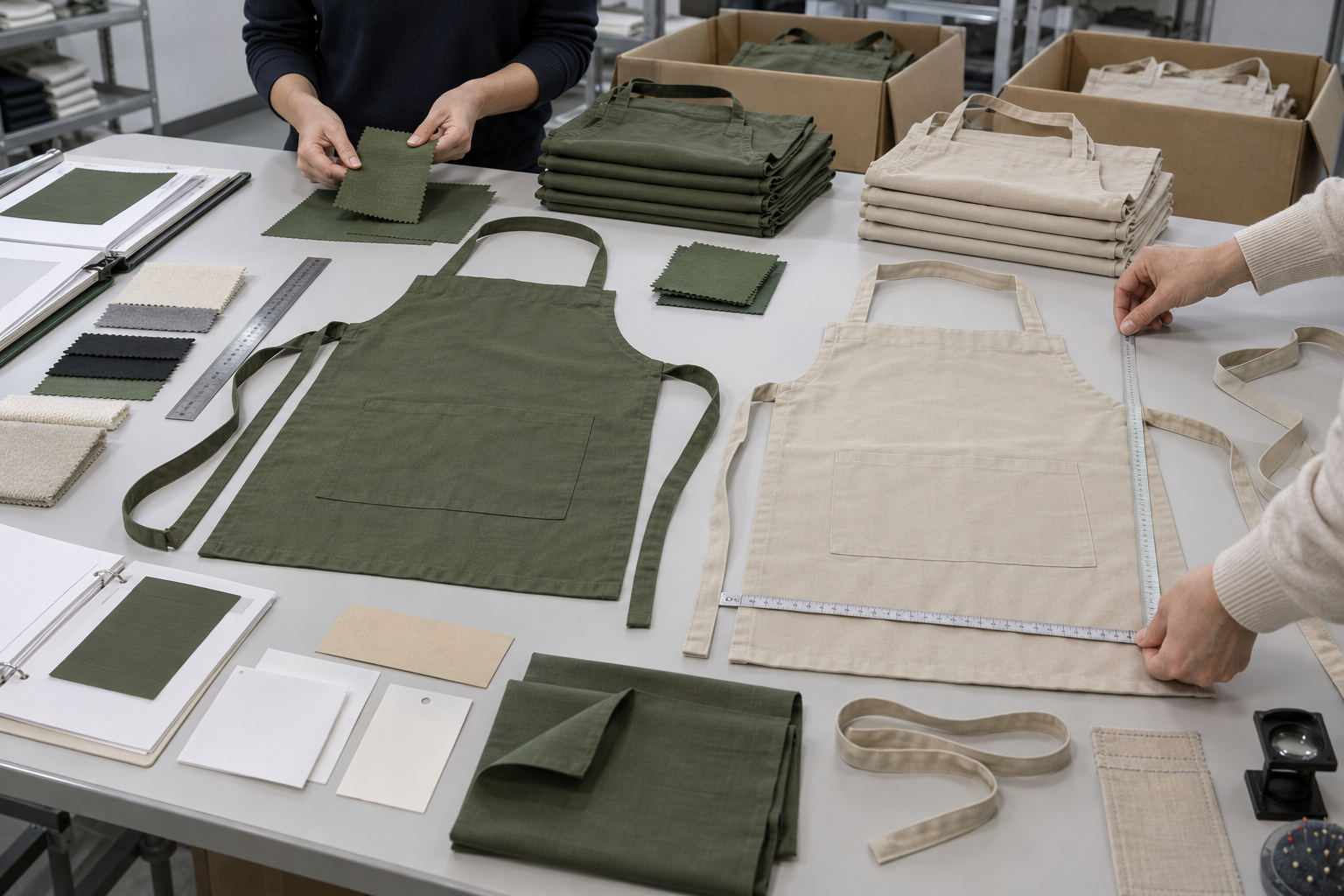
Place the style code, approved sample, colour master, fibre declaration, construction details, and last repeat date in one schedule. Specify whether a change to the material, colour, pattern, pocket or tie construction, or production location needs written approval. If a substitute is permitted, name the permitted alternative and the buyer approver; otherwise mark substitution as forbidden. This is a commercial control, not a legal certificate.
Repeat and replenishment terms
Ask for the minimum repeat quantity in pieces, reorder window, urgent-replenishment service level, and condition that starts the service level. The quote should distinguish a supplier’s stated term from a buyer-approved commitment.
Fileable evidence
Keep the signed specification, approved sample or colour master, dated quote, destination label file, stock statement, and continuity response as separate evidence items. Descriptions such as stable supply or fast replenishment do not replace a quantity, trigger, owner, and clock.
Buffer, style life, and recovery terms for chef-apron wholesale supply
UK-scoped production-life benchmark
The linked UK hospitality workwear procurement guide framed for 2026 advises buyers to ensure that a specific style remains in production for at least 36 months. The number is a duration from that guide’s UK hospitality procurement advice, with the guide framed for 2026. Treat it as a UK-scoped commercial benchmark—not an EU or EEA legal minimum and not a supplier commitment. Put any agreed style-life term into the dated quote.
The same guide describes significant UK stock-holding as reducing lead times from weeks to days. That is a qualitative source comparison, not a measured dispatch-to-delivery result for this page. Request a calendar-day commitment for each named destination and tie it to inventory status and shipping mode.
Illustrative RFQ arithmetic — assumptions to verify
At the buyer’s RFQ planning date, use this illustrative calculation only—replace the assumptions with buyer issue data and verify them in a dated supplier quote. For a European buyer site, assume 90 wearers and 2 chef aprons per wearer. The illustrative issued base is 180 aprons (90 × 2). If the buyer selects a 25% buffer, the illustrative buffer is 45 aprons (180 × 25%). These figures are example assumptions, not observed stock, production capacity, or service performance.
Compare the quoted repeat minimum with the illustrative buffer. If the minimum exceeds the buffer, ask what response covers the shortfall. Separate reserved-stock dispatch from make-to-order production, and require the quote to state the unit, start trigger, destination, owner, and escalation route.
EU, EEA, and UK destination checks for European chef-apron wholesale supply
EU member-state address. Use the official EU textile-fibre labelling regulation to review fibre-composition labelling for goods intended for an EU destination and file the approved declaration with the style record. The source is a labelling check; it does not establish a commercial buffer, recovery clock, colour tolerance, or style-life term. Ask the compliance owner to confirm any language or public-procurement requirements for the named destination and buyer type.
UK address. Run current UK labelling, delivery, customs or transport, and buyer-procurement checks as separate RFQ lines, where relevant to the transaction. Do not reuse the EU destination file without current review. This package does not cite a UK legal source, so require the compliance owner to document the current basis for acceptance.
EEA state outside the EU. Open a separate row for the named country. Verify current labelling, language, transport or customs, and delivery requirements for that address. Do not assume that the EU regulation applies identically without a current country review.
Buyer type. Ask the procurement owner whether a public tender or private kitchen requires additional records. Use the named buyer’s requirements rather than reusing a generic European file.
Buyer decision table for approving continuity terms
Use this table to turn continuity planning into award evidence. Each row is a buyer control, not a claim about supplier performance.
| RFQ control | Put in quote | Compare and approve | Scope warning |
|---|---|---|---|
| Style lock | Style code, approved sample, colourway, fibre declaration, construction, and last repeat date | Dated quote against the approved sample and any agreed style-life term | UK production-life advice is a commercial benchmark, not EU or EEA law and not a supplier promise |
| Buffer | Pieces, storage location, owner, release authority, and replenishment rule | Quoted quantity against the buyer’s issue calculation | No cited source establishes a supplier’s stock |
| Repeat minimum | Minimum pieces, reorder window, and urgent service level | Quoted minimum against the buyer’s buffer and site issue | The procurement guide recommends checking these terms; it does not publish a universal or supplier-specific minimum |
| Delivery | Calendar days, stock status, ship-to address, and shipping mode | Separate dispatch-to-delivery clock for an EU, UK, or named EEA address | The UK guide gives a qualitative comparison, not an EU or EEA measurement |
| Fibre label | Approved composition and destination file | EU, UK, or named EEA review | The EU legal source is used for the EU check only; do not assume the same file covers every destination |
| Colour continuity | Master sample, viewing method, batch record, and reject or replace route | Batch evidence against the master | No numeric tolerance is sourced here |
| Substitution | Permitted alternatives and approver, or an explicit prohibition | Pre-agreed response against the approved specification | Continuity planning must not bypass specification control |
Approve a row only when the evidence can be filed as a signed specification, dated quote, approved sample or master, destination label review, stock statement, or written service term.
RFQ Checklist
Use these buyer actions in the request for quotation. They are requirements to ask for, not claims about any supplier.
- Ask the supplier to provide a written continuity plan for the chef apron that names decision owners, piece or day triggers, escalation route, and pre-agreed responses before the purchase order.
- Require the manufacturer to identify the style code, approved material and fibre declaration, colourway, construction details, and last date for repeat supply in the quote.
- Specify the buffer quantity in pieces, storage country, owner, release authority, and whether it covers a launch, replacement issue, or delay only.
- Compare dispatch-to-delivery calendar days for the named EU member state, UK address, or EEA country, and require the stock status that supports the clock.
- Verify the colour-continuity method, master sample, viewing condition, reject or replacement route, and buyer-approval rule for any shade change.
- Ask the supplier to state the minimum repeat quantity in pieces, the reorder window, and the urgent-replenishment service level.
- Require the supplier to provide the destination-specific fibre-composition labelling file and to identify whether the ship-to is an EU member state, the United Kingdom, or an EEA state outside the EU.
- Approve any substitute fabric, colour, pattern, pocket, tie, or production site in writing before use; otherwise mark substitution as not permitted.
Do not issue the purchase order while the style end date, destination file, repeat minimum, buffer position, or substitute rule is open.
Methodology and source context
Methodology. The UK continuity briefing supplies the planning structure: responsibilities, thresholds, and pre-agreed responses. The chef-uniform procurement guide supplies the procurement checks for reorder terms, repeat quantities before signature, colour continuity, urgent replenishment, and batch consistency. The UK hospitality workwear guide framed for 2026 supplies the UK-scoped production-life advice and qualitative stock-holding comparison. The official EU textile-fibre labelling regulation is used only for the EU destination labelling check.
Data method. The production-life figure is reported with its source scope and guide-date framing. The illustrative RFQ arithmetic is transparent multiplication of the stated wearer count, issue rate, and buffer assumption; it does not infer inventory, capacity, or supplier performance. Recommendations about RFQ wording, buffers, approval gates, and evidence files are editorial controls rather than facts about a supplier.
Author note. The author profile identifies Vincent Xi as Editorial Author. This article does not rely on a first-person factory, testing, purchasing, customer-outcome, award, or certification claim.
Limitations and what to verify
The cited commercial pages are procurement guidance, not evidence of any named supplier’s stock, capacity, lead time, colour result, certification, customer outcome, or guarantee. The UK production-life advice and stock-holding comparison are not EU or EEA legal rules. The official EU source is used here only for the fibre-composition labelling check; it does not set the commercial buffer, recovery clock, repeat minimum, colour tolerance, or style-lock term.
At approval, verify the current requirements for the named EU country, UK address, or EEA state outside the EU, taking buyer type and delivery route into account. Replace the illustrative arithmetic with buyer issue data. File the signed specification, approved sample or master, destination label review, buffer statement, repeat terms, and written recovery response before issuing the purchase order. This page is limited to European B2B procurement; a supplier or manufacturing-origin reference does not expand its sales-market scope.
Discuss Your Requirements
Review our manufacturing capabilities, then share your specifications for a supplier-fit review.