Chef Apron Sourcing Communication Workflow Review for Canada Procurement
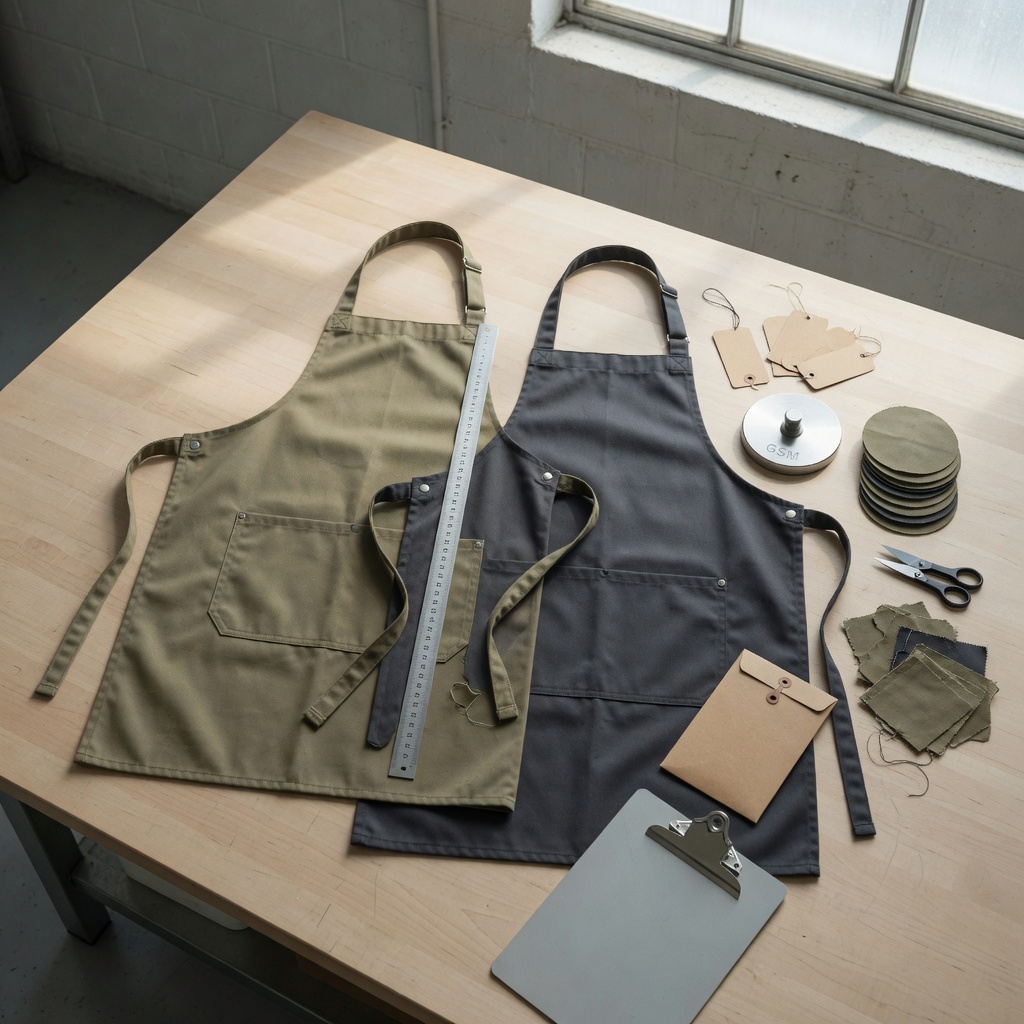
Chef Apron Sourcing Communication Workflow Review for Canadian Buyers
By Vincent Xi, Editorial Author https://linwaapron.com/authors/vincent-xi/
Do not place a chef apron purchase order for shipment to Canada until one written communication packet answers specification, wash evidence, quantity, calendar, and Incoterms. A chef apron sourcing communication workflow review is that stage-gated file: it puts every manufacturer on the same questions and blocks cutting until stain, fray, hygiene, minimums, and delivery risks are documented in one comparable record.
Lock the spec first—fabric weight, blend, finish, closures, pockets, and label copy—not a free-form request for “options.” Then send every supplier an identical table covering the industrial-wash claim and test method, pre-production sample policy, piece and fabric minimums, sampling and production lead times, factory holiday blackouts, Incoterms to the Canadian ship-to, and who signs the pre-production sample. Catalog photos and chat fluency are not that record.
A published fabric-sourcing note describes a restaurant operator who only asked, after the fact, for what should have been specified when custom aprons stained and frayed in service. The same note tells buyers to call out stain-resistant finishes intended to last 50+ industrial washes, 200–270 GSM fabric weights, and polyester-cotton blends for chef wear, then to verify remotely with pre-production samples and wash tests (How to Source Fabric for Custom Aprons and Chef Wear). Treat those figures as publisher-stated RFQ prompts, not as a current laboratory result for any named mill, and reconfirm every number in the live quote that will ship to Canada.
Approve the packet only when each vendor reply is a filled table with document IDs, a production-intent sample ID, and named Incoterms to the Canadian address. Reject the reply when it uses adjectives without GSM, says “samples available” without a bill of materials, answers in unmatched units, or describes shipping without a named ship-to. Verbal “OK to proceed” does not pass this communication workflow review.
Why the communication file decides chef apron outcomes
Stained bibs, frayed edges, and pocket-hygiene misses show up on samples only if the RFQ states how those defects will be scored. The procurement failure is a missing written standard, not a missing chat thread.
A manufacturer-search guide treats communication quality as fluency plus documents: technical sheets, sample requests, virtual quality review, and explicit questions on MOQ, customization fees, sampling turnaround, DDP shipping, and dispute resolution (How to Find Manufacturers for Customizable Aprons). A chef-uniform procurement guide adds the internal layer: audit kitchen roles and environments, write precise specs, convert those specs into RFQs that extract MOQ and lead times, then use field tests and stakeholder sign-off before reorder terms are locked (Chef Uniform Procurement Guide).
This page stays on the communication workflow for chef apron procurement. Publisher ranges below are RFQ prompts, not a factory quote from Linwa Apron. Standards named later are documents to request. A named standard is not this company’s practice, and a directory badge is not a current certificate.
Communication workflow review stages from spec lock to reorder
Assign one owner, one filename convention, and one decision log. Each stage has a required artifact. If the artifact is missing, the stage has not passed and the next stage must not start. If a later change alters GSM, blend, finish, or construction, issue a new spec revision and a new sample ID before any deposit.
- Role and environment lock. Artifact: an environment sheet that records grease exposure, wet stations, front-of-house visibility, and whether the chef apron must stay pocket-free. The uniform-procurement guide flags snaps instead of buttons and pocket-free designs as hygiene-oriented spec choices (Chef Uniform Procurement Guide).
- Written technical brief. Artifact: a spec revision ID covering GSM, blend split, finish, stitch type, bartack locations, closure type, strap adjustability, colour standard, and care-label copy.
- Comparable RFQ. Artifact: one question table sent to every vendor, with the same revision ID and the same response deadline in the Canadian receiving timezone. Require a table, not a paragraph.
- Sample and wash-evidence gate. Artifact: a production-intent sample ID, a stated wash method, remnant swatches from the same lot, and measurements tied to that sample ID. A library leftover fails this gate.
- Calendar and logistics gate. Artifact: production days after written approval, material lead time, Chinese New Year or other blackout dates, and Incoterms. The fabric guide advises planning production calendars around Chinese New Year closures (How to Source Fabric for Custom Aprons and Chef Wear).
- Approval packet. Artifact: signed spec, signed sample photos, rejected-alternative log, and PO terms including reorder colour continuity.
- First-receipt review in Canada. Artifact: actual wash and seam results against the written claim so the next RFQ is shorter.
If a stage is skipped, the workflow reopens as emergency chat—the pattern that produces stain and fray complaints after the invoice.
Fabric, finish, and construction questions for the first written brief
Ask for testable statements, not adjectives. Put the prompts below in the communication file before anyone cuts cloth. Numeric figures in this section are publisher-stated; they are not mill certificates and not Linwa Apron specifications.
Weight. Request GSM with a tolerance. The fabric-sourcing guidance cites 200–270 GSM for chef wear. Unit: grams per square metre. Scope: custom apron and chef-wear fabric as stated by that publisher. As-of: as published on that page; this article does not assign a lab date. Source: Fumao Fabric. Require the mill’s actual proposed GSM on a cutter photo or mill certificate.
Blend. Require polyester and cotton percentages. Do not accept “chef quality” without a split. Polyester-cotton for chef wear is a publisher prompt to specify, not a certified result on this page.
Stain-release durability. If a stain-resistant finish is offered, require industrial-wash cycle count, temperature, detergent class, and whether the claim is mill-level or garment-level. That guidance cites finishes intended to last 50+ industrial washes as a specification to request after stained, frayed aprons. Unit: industrial wash cycles. Scope: stain-resistant finishes on custom aprons and chef wear in that guidance. As-of: publisher-stated; independent test date not verified here. Source: Fumao Fabric.
Two different minimums. Fabric MOQs in that guidance are stated as 1,000–3,000 metres per colour. Unit: metres of fabric per colour. Scope: fabric purchasing for custom aprons and chef wear as stated by that publisher. As-of: as published on that page. Source: Fumao Fabric. A manufacturer-search guide states customizable-apron MOQs of 100–1,000 pieces, with combinable sizes. Unit: finished pieces. Scope: customizable aprons in that guidance. As-of: as published on that page. Source: Shanghai Garment. These ranges are not interchangeable; the RFQ must ask which constraint binds the order.
Closures, pockets, colour. Specify snaps versus buttons and whether pockets are allowed (Lantao Work). Ask how leftover fabric from a custom dye lot will be recorded for Canadian reorders of the same SKU.
Unit match. If one vendor answers in GSM and another in ounces per square yard, or one in metres and another in yards, the comparable RFQ stage has failed until every cell uses the unit named in the spec revision.
Remote verification without treating a video as a certificate
A chef apron can be reviewed without travel if the sample is traceable to the production bill of materials. The communication rule is traceability, not a live call.
Request:
- A pre-production sample in the proposed GSM and blend, not a library leftover.
- A measurement sheet covering bib width, length, strap length, and pocket placement, each tied to the sample ID.
- Wash-test remnants from the same lot, with cycle count and method.
- Photos of bartacks at neck and pocket corners against a ruler.
- A technical sheet. A scheduled video of measuring the sample is an inspection aid, not a substitute for the sample.
- Named certificates only as current PDFs. The manufacturer-search guide lists BSCI or OEKO-TEX among items buyers evaluate (Shanghai Garment). If a chemical or social-audit document is required, ask for the certificate number, issuing body, and expiry date. Do not treat a badge, or this article, as proof that any factory is certified. Those names are third-party documents to request when relevant; they are not Linwa Apron certifications on this page.
The uniform-procurement guide describes 12-hour field tests as part of converting specs into a buying decision. Unit: hours of wear testing. Scope: chef-uniform procurement, including aprons, as described by that publisher. As-of: as stated on that page. Source: Lantao Work. Canadian operators can adapt that idea to a single-shift kitchen trial on the pre-production sample, with a written scorecard for stain, strap stability, and seam integrity. Label the trial as an operational protocol unless the RFQ also names a textile test method. This page does not report a first-hand kitchen trial.
MOQ, sampling, lead time, and holiday trade-offs
Score trade-offs in the decision log, using the piece-minimum and metre-minimum bands already labeled in the written-brief section. Do not mix finished-piece constraints with fabric-colour constraints.
- Ask which binds first: the customizable-apron piece minimum (combinable sizes, customization fees, sampling turnaround) from the manufacturer-search guidance, or the custom-colour metre minimum from the fabric-sourcing guidance (Shanghai Garment; Fumao Fabric).
- Treat DDP as a logistics question for delivery control, not as an automatic Canada tax-paid result (Shanghai Garment).
- Place production around Chinese New Year closures, as the fabric guide advises (Fumao Fabric).
Record the buying implications:
- A lower piece MOQ on stock fabric may serve mixed Canadian sizes better than a custom dye lot.
- A custom cloth in the GSM discussion range labeled above, with stain-release finishing, may bind the order to the metre minimum even when the piece minimum looks small.
- Sampling turnaround only helps if the sample uses production-intent cloth.
- DDP can simplify the receiving dock and still leave duties, brokerage, and taxes for finance and the importer of record. This article does not state Canadian duty rates.
- Ask for the factory’s closure calendar covering the next twelve months, including Chinese New Year and audit shutdowns. That twelve-month window is a buyer request, not a published industry average.
Example calculation / assumption to verify in the supplier quote (not a price and not a measured yield): if a custom colour is quoted at 1,500 metres (an example quantity inside the publisher-stated 1,000–3,000 metre range; unit: metres of fabric per colour; scope: custom-colour fabric purchasing in the Fumao Fabric guidance; as-of: as published on that page), do not convert metres into apron counts until the supplier states consumption per size in metres per piece, including shrinkage and marker loss.
Canada procurement communication cadence
Keep Canada in the file as the receiving market and the approval timezone, not as a generic country guide. The buying task remains the chef apron order and the RFQ sign-off.
- Put the legal buyer name, Canadian ship-to address, and requested Incoterm on page one of the RFQ so DDP versus FOB is not debated after sampling.
- State the review window in the Canadian receiving timezone (for example, Eastern Time for a Toronto ship-to) and ask the supplier to confirm overlapping hours they will staff. Record the agreed window; do not assume a fixed overlap.
- Attach exact care-label and fibre-content copy. If bilingual label text is required, attach that artwork as buyer specification. This article does not assert a federal bilingual-label rule for chef aprons; have a compliance advisor confirm what applies to the SKU.
- Request transit time under the proposed Incoterm, carton dimensions, and whether delivery is to a Canadian distribution centre or to doors. Verify broker, duties, and taxes outside this page.
- Place factory blackouts and Canadian receiving closures on one calendar so a long weekend and a production shutdown do not stack.
Buyer decision table: score the written reply, then the cloth
Every row is a specify, compare, verify, approve, or order action. Numeric bands in this table are the same publisher-stated ranges already labeled with unit, scope, as-of context, and source in the written-brief section. They are not a Linwa Apron quote and not a dated census. Do not deposit until every row that applies to the SKU has a written answer.
| Decision row | Specify in the RFQ | Weak communication | Strong communication | Buyer action |
|---|---|---|---|---|
| File owner and revision | Named buyer owner, spec revision, RFQ date | Chat thread with no owner | Spec ID, RFQ date, and named approver on page one | Reject unsigned packets |
| Fabric weight | GSM plus tolerance | “Heavy duty chef cloth” | Proposed GSM named against mill certificate and cutter photo; 200–270 GSM used only as the cited discussion range | Compare to abrasion need; verify certificate; approve only the named GSM |
| Blend | Polyester % / cotton % | “TC fabric” with no split | Percentage split on the technical sheet and sample label | Compare stain release versus hand; verify on the sample |
| Stain-release claim | Cycle count, temperature, method | “Stain proof” | Industrial-wash claim with method, or a test report; 50+ cycles treated as a cited prompt, not a lab result | Verify remnant swatches from the same lot; reject a finish card from a different mill lot |
| Hygiene construction | Snaps versus buttons; pocket policy | Fashion sketch only | Written snap spec and pocket-free or mapped pocket placement | Compare to kitchen hygiene rules; approve the construction drawing |
| Label copy | Fibre-content and care text attached; bilingual artwork if the buyer requires it | “Standard labels” | Attached artwork file referenced in the RFQ | Confirm with a Canadian advisor; do not treat this page as a labelling statute |
| Piece MOQ | Units and size mix | “About 500” | Piece minimum stated; combinable sizes yes/no; 100–1,000 used only as the cited band | Compare to Canadian demand; order only with size mix in writing |
| Fabric colour MOQ | Metres per colour | Omitted | Custom dye: metres named (cited band 1,000–3,000); or stock colour with no metre minimum | Verify which constraint binds before colour is approved |
| Sample policy | Who pays, days, which BOM, ship-to in Canada | “Samples available” | Sampling turnaround in days, production-intent fabric, reject/resubmit path, Canadian review address | Compare sample days to the launch date; reject a sample ID that does not match the BOM |
| Wear test | Hours and scorecard | No protocol | Written stain/seam scores; 12-hour field test used as the cited process prompt or adapted to a single shift | Verify on the actual sample ID; approve after the scorecard |
| Calendar | Closures plus production days after approval | “Rush available” | Chinese New Year and other blackouts listed | Compare to Canadian receiving dates; do not PO into a blackout |
| Logistics | Incoterm plus Canadian ship-to | Ship-to left unnamed | DDP or itemized freight to the named Canadian address, transit days, carton data | Verify with importer of record; do not treat DDP wording as a tax opinion |
| Chemical or social documents | Standard name, cert ID, expiry | Directory badge screenshot | Current PDF with number and expiry, or an explicit “not certified” | Verify documents; never imply certification from a badge |
| Dispute path | Replacement, debit, evidence rules, sample retention | “We will take care of it” | Written steps and sample-retention period | Approve terms before deposit |
| Reorder | Colour continuity | “Reorder anytime” | Dye-lot record, leftover fabric policy, repeat-PO lead time to Canada | Order bulk only with reorder terms attached |
Practical RFQ checklist for chef apron procurement
A complete communication packet is the spec revision, the question table, the technical sheet, sample photos tied to an ID, wash-remnant notes, MOQ and calendar replies, Incoterms to the Canadian ship-to, certificates or a written “none,” and dispute/reorder terms. Complete every item before deposit.
- Name the file. Owner, spec revision, RFQ date, legal buyer, and Canadian ship-to on page one.
- Specify roles. List stations that will wear the chef apron and the soil types to be scored (oil, sauce, chlorine exposure).
- Specify dimensions. Attach bib width, length, and strap range by size; require those measurements on the sample sheet.
- Specify fabric. Demand GSM, blend split, and finish by document. Use 200–270 GSM only as the cited discussion range until the mill number is named.
- Specify wash claim. Write cycle count, temperature, and tester. If the cited 50+ industrial-washes prompt is used, say whether it is a target to quote against, not a completed test.
- Specify hygiene construction. Snaps versus buttons; pocket-free or mapped pockets; bartack locations.
- Specify labels. Attach fibre-content and care copy, including any bilingual artwork required, then confirm legal fit with a Canadian advisor.
- Request piece MOQ. Units, size-combination rules, and the actual minimum—not a copied 100–1,000 range.
- Request fabric MOQ. Metres per colour if custom dyeing, versus stock mill colour with no metre minimum.
- Request consumption. Metres per size, including shrinkage and marker loss, before converting a metre quote into piece counts.
- Request sample terms. Sample count, days to the Canadian review address, cost, freight payer, BOM match to bulk, and reject/resubmit path.
- Request production lead time. Calendar days after written sample approval, excluding transit.
- Request holiday calendar. Next Chinese New Year window and any other closures that stop cutting or finishing.
- Request Incoterms. DDP or a landed-cost worksheet to the Canadian address, with duties, brokerage, and taxes listed as included or excluded.
- Request documents. Technical sheet, mill certificates, and any social or chemical certificates with ID and expiry—or a written “none.”
- Request measurable photos. Time-stamped images of the sample being measured, named with the sample ID; treat directory “verified” marks as optional context only (Shanghai Garment).
- Request dispute and reorder terms. Replacement lead time, photo-evidence rules, sample-retention period, dye-lot continuity for the next Canada PO.
- Compare. Score at least two suppliers on the decision table using the same questions.
- Verify. Run the sample through the written wash or field protocol; tie failures to the sample ID. If GSM, blend, or finish changes after that ID, restart the sample gate.
- Approve and order. Collect stakeholder sign-off on spec and sample photos before PO (Lantao Work). Issue a PO that references spec revision, sample ID, GSM, blend, MOQ, Incoterm, and blackout dates. After first receipt in Canada, add actual defect notes to the next RFQ.
Evidence, methodology, and what to verify
Author. Vincent Xi, Editorial Author. Profile: https://linwaapron.com/authors/vincent-xi/. This article does not claim factory visits, laboratory tests, years of personal kitchen work, named customers, or awards. No first-hand factory, laboratory, or kitchen trial is reported on this page.
Source contexts. (1) Fabric-oriented sourcing guidance for custom aprons and chef wear, used for GSM, stain-wash prompts, metre MOQs, and Chinese New Year calendar planning (Fumao Fabric). (2) Manufacturer-search guidance for customizable aprons, used for piece MOQs, sampling questions, DDP, and document evaluation (Shanghai Garment). (3) Chef-uniform procurement process guidance, used for role audits, snaps and pocket hygiene, RFQ extraction of lead times, 12-hour field tests, and stakeholder sign-off (Lantao Work).
Methodology. Process stages on this page are an editorial grouping of communication artifacts described on those published pages. Numeric prompts were copied as publisher-stated ranges or counts, then labeled with unit, scope, as-of context, and source. They were not re-measured in a lab for this article, not averaged into a market index, and not treated as demand evidence for any search phrase. Example metre quantities and buyer-side wear trials are labeled as assumptions or operational protocols to confirm in the quote.
Limitations. Verify in the live file: current piece and fabric MOQs; true GSM of the production cloth; whether a stain-release claim is mill-level or garment-level; sample fees and days to a Canadian address; production days after approval; Chinese New Year dates for the actual factory; Incoterms, duties, taxes, and brokerage for the Canadian ship-to; certificate numbers and expiry; label rules for the SKU; and any vendor quote values, which this page does not invent.
If a supplier cannot fill the decision table in writing, the chef apron sourcing communication workflow review has already failed—before fabric is cut.
Discuss Your Requirements
Review our manufacturing capabilities, then share your specifications for a supplier-fit review.