Chef Apron Sourcing Business Continuity Planning for Australian Procurement
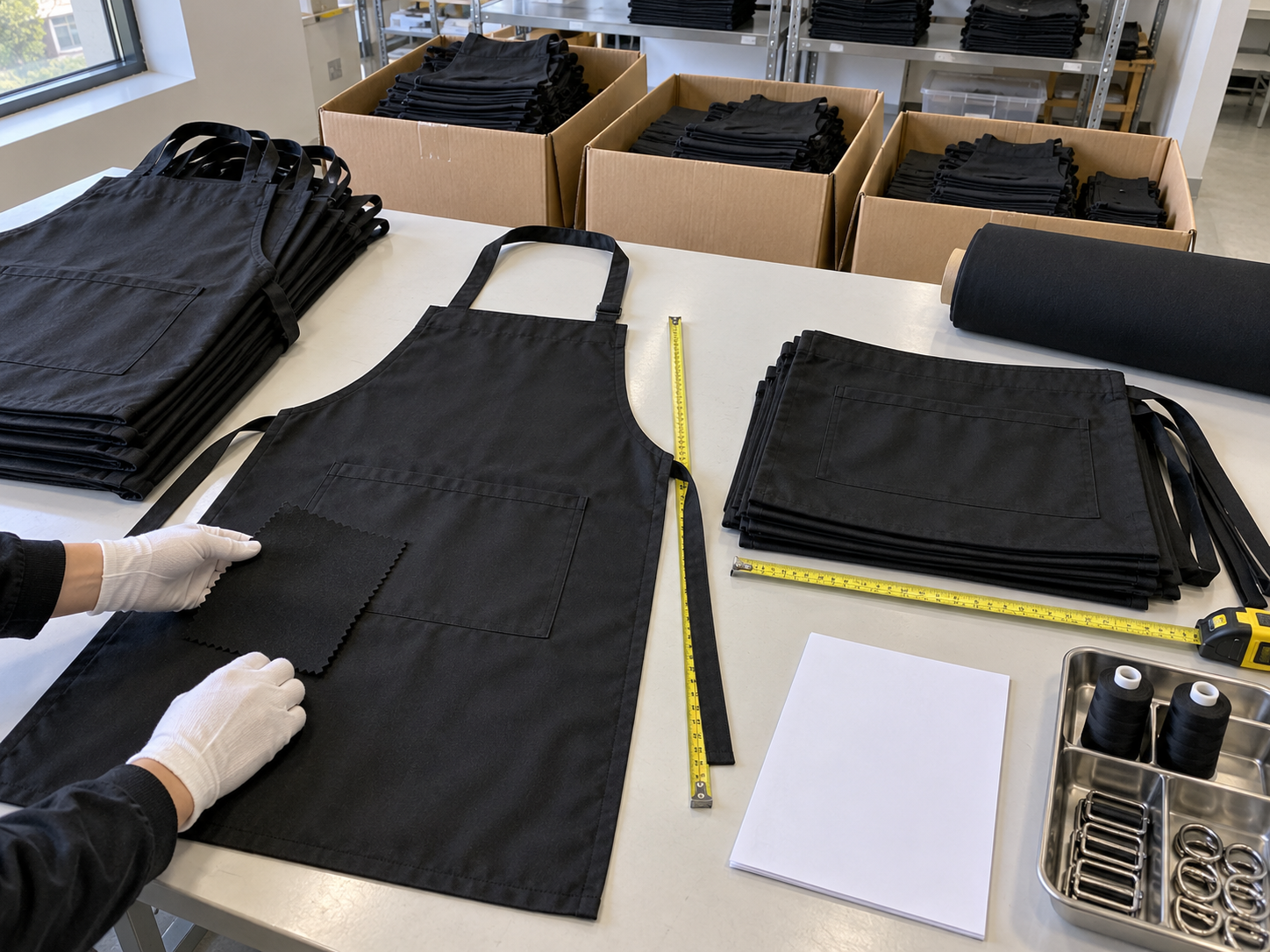
Chef Apron Sourcing Business Continuity Planning for Australian Kitchens
Chef apron sourcing business continuity planning for Australian procurement is the operational practice of preventing kitchen uniform stockouts by securing dual production routes, documented lead times, verified minimum order quantities (MOQs), and reserve buffer inventory before supply disruptions occur. For Australian hospitality groups, multi-site restaurants, and contract caterers, establishing business continuity planning for every core chef apron means converting uniform replenishment from an ad-hoc reorder process into a resilient, risk-managed supply agreement. When an unexpected mill closure, shipping delay, or dyeing defect occurs, an effective continuity plan ensures commercial kitchens maintain daily garment issuance without compromising fabric quality or garment fit. A 2026-focused chef uniform procurement roadmap confirms that RFQs must define minimum order quantity, sample turnaround, first-production lead time, and reorder lead time so multi-site kitchen operators can establish automated replenishment and protect batch-to-batch color consistency (Lantaowork). A uniform-programme guidance note defines continuity of supply as sustained garment issuance during vendor failure or raw material shortage, achieved through explicit decision thresholds, diversified manufacturing, and clear visibility of lead times and fill rates (JSD). Furthermore, commercial fabric guidance for custom aprons and chef wear highlights the necessity of combining core stock with just-in-time specials, holding a 6-month buffer against unexpected delays, and planning around custom-fabric minimums of 1,000 to 3,000 meters per color (Fumao Fabric).
This page is published for Linwa Apron by Vincent Xi, Editorial Author, whose profile is at https://linwaapron.com/authors/vincent-xi/. The profile is the byline source only. No first-hand factory visit, wear trial, client result, or personal production test is claimed, because none is approved for this page.
Why Australian Buyers Put Business Continuity Planning on the Chef Apron RFQ
Australia is the sales market for this procurement brief. A chef apron programme still fails in a practical way if the core bib or waist style cannot be issued in the agreed color and size when a dye lot, mill, or sewing slot stops. The cited pages do not publish an Australia-only freight timetable, care-label rule, or climate test, so those points stay on the verification list rather than being stated as facts.
Business continuity planning, in the sense used here, means the buyer can keep issuing the approved chef apron if one supply route fails. JSD describes that outcome as continuity of supply and lists a documented plan, decision thresholds, resilient sourcing, diversified manufacturing, and stock visibility on lead times and fill rates (JSD). For procurement, the continuity items are the core SKUs. A logo placement, a one-season color, or a special length is not a continuity item unless sites cannot open service without it.
Lantaowork’s 2026 roadmap connects that plan to the RFQ. Buyers are advised to shortlist vendors for automated replenishment and batch-to-batch color consistency, and to ask for MOQ, sample turnaround, production lead time, and reorder lead time (Lantaowork). A named backup factory without a reorder lead time does not tell the buyer when cover runs out. Color consistency matters for the same reason: a backup lot that sites refuse is not usable stock.
Measurable Trade-offs in Buffer Cover, Fabric MOQ, and Just-in-Time Specials
Fumao Fabric’s guide sets a hybrid model for long-term chef wear sourcing: hold core aprons, order specials closer to need, and plan a 6-month buffer against delays. The same page states custom-fabric MOQs of 1,000 to 3,000 meters per color and tells buyers to plan for turnover and production hiccups (Fumao Fabric). The excerpt used here does not show a publication date. Treat both figures as that page’s stated planning values, not as Linwa Apron’s finished-garment terms, until a current quote says otherwise.
Three figures belong on the worksheet.
First, custom-fabric MOQ: 1,000 to 3,000 meters per color. Unit is meters of fabric. Scope is custom fabric for aprons and chef wear as stated by Fumao Fabric. As-of context is that undated guide page. This is not a finished-apron count.
Second, buffer horizon: 6 months of cover against delays. Unit is months. Scope is the core planning approach in that same undated chef-wear fabric guide, not every special color and not a measured Australian average.
Third, an example calculation to verify in the supplier quote and against the buyer’s own issue records: assume 150 core chef aprons issued per month. Six months of cover is 150 times 6, which equals 900 aprons. The 150 and the 900 are assumptions, not market statistics and not a Linwa stock recommendation. Replace 150 with actual issues before anyone approves a purchase quantity.
The trade-off is carrying cost versus time-to-stockout. A 6-month buffer, using the Fumao horizon, can cover a long dye or shipping slip, but it locks quantity into a size mix that may be wrong if the crew changes. Just-in-time ordering suits specials, yet it fails when the special uses custom fabric at a 1,000-meter minimum. One meter is not one apron. None of the sources states a cutting yield, so this page does not estimate how many aprons a meter produces. The quote must make that conversion.
A second trade-off is single-route simplicity versus diversified manufacturing. JSD lists diversified manufacturing inside a resilient uniform programme (JSD). A second source helps only if it is approved on the same fabric construction, color standard, stitch, and hardware. Two unapproved samples are not a continuity plan.
Lantaowork’s excerpt does not publish a numeric sample-day or production-day figure. Do not fill that blank with a guessed duration. Require business days and a quote date, and do not approve a timing cell left empty.
What the Continuity File Must Contain Before the First Bulk Order
Use JSD’s contents as the file structure: documented plan, decision thresholds, resilient sourcing, diversified manufacturing, and visibility of lead times and fill rates (JSD). Map each item to a chef apron field the buyer can approve.
Decision thresholds should be written in weeks of cover and in units. Example assumption to verify, not a sourced statistic: reorder when on-hand core aprons fall below 8 weeks of the buyer’s own issue rate, and release the backup route if the quoted reorder lead time is longer than remaining cover. The 6-month buffer from Fumao is a stock policy, not automatically the reorder point. A buyer can hold six months and still trigger at eight weeks, or earlier. Write the chosen trigger down.
Resilient sourcing means a primary fabric and at least one substitute construction the kitchens will actually wear. The sources do not publish a pass-fail method for heat, oil, or shrinkage. If a bidder names a textile or factory standard, that name is a claim, not evidence. Require the current document, the holder’s legal name, the product scope, and the expiry date, and compare the scope to the apron being purchased. This page does not state that Linwa Apron, or any factory, holds any certification.
Diversified manufacturing needs a precise meaning on the RFQ. A second factory, a second mill feeding the same sewing plant, and a second dye lot are different risks. A second dye lot does not cover a plant shutdown. Record which one is being offered.
Stock visibility means lead time and fill rate on the core SKU, which JSD names as the figures a programme should be able to see (JSD). The excerpt gives no numeric fill-rate target. Ask for the definition, the SKU, and the period. Do not copy an invented percentage into the contract.
Color is an issuance control. Lantaowork highlights batch-to-batch color consistency for multi-site kitchen groups (Lantaowork). Approve a retained swatch and a written comparison method before a replenishment release. If the next lot fails that comparison, it should not count as available cover.
Decision Table for Chef Apron Procurement Continuity
Use one core chef apron as the row subject. Each row is a specify, compare, verify, approve, or order action. Figures that are not in the cited pages are marked as assumptions.
| Buyer decision | Option A | Option B | What to put on the order | Verify before approval |
|---|---|---|---|---|
| Core versus special | Stock the core bib or waist apron | Just-in-time for logo or seasonal specials | Split SKUs so specials do not ride the core MOQ | Confirm which SKUs sites may stock out of |
| Cover length | 6-month delay buffer cited by Fumao | Shorter cover plus a qualified second source | State cover in months and in units from the buyer’s issue rate | Recalculate units; 6 months is a published approach, not an Australian average |
| Fabric minimum | Custom fabric at 1,000–3,000 meters per color (Fumao range) | Mill-stocked fabric with a finished-apron MOQ | Quote meter MOQ and finished-apron MOQ, dated | Require the meter-to-apron conversion; do not assume yield |
| Timing fields | One blended “production” lead time | Separate sample, first bulk, and reorder | Business days for each, as in the 2026 Lantaowork RFQ set | Reject blanks; the excerpt gives no default day-count |
| Backup route | Single approved factory | Diversified manufacturing as described by JSD | Name the backup legal entity and the spec it matches | Compare swatch, construction, stitch, and hardware side by side |
| Reorder trigger | Fixed calendar order | Threshold in weeks of cover | Write weeks and units; 8 weeks is an assumption to verify | Check remaining cover against quoted reorder lead time |
| Color continuity | Informal visual match | Retained swatch and lot comparison | Attach the swatch ID to the release | Do not count an off-shade lot as usable buffer |
| Fill-rate visibility | No history required | Lead time and fill rate, per JSD | Ask for period, SKU, and the definition of a filled line | Do not invent a percent target |
| Receiving count | Count at the factory | Count at the Australian issue point | Name the DC or kitchen location and the Incoterm | Subtract transit that is still outside the issue point |
| Quote status | Open-ended MOQ and lead time | Dated quote in one unit of measure | Reissue when the date lapses | Match meters, aprons, or sets to the purchase order |
The 8-week trigger is an example assumption. The 6-month buffer and the 1,000 to 3,000 meter band are the sourced figures, with the undated-page limitation. Lantaowork contributes the 2026 field list, not a day-count. JSD contributes the plan contents, not a fill-rate percentage.
How These Procurement Figures Were Derived
Methodology. Only three public pages support the factual claims. Lantaowork supplies the 2026 framing and the RFQ fields of MOQ, sample turnaround, production lead time, and reorder lead time, plus shortlisting for automated replenishment and batch-to-batch color consistency. JSD supplies the continuity definition and the plan contents: decision thresholds, resilient sourcing, diversified manufacturing, and lead-time and fill-rate visibility, applied to uniform programmes that include chef aprons. Fumao Fabric supplies the hybrid of core stock and just-in-time specials, the 6-month buffer, and the custom-fabric MOQ of 1,000 to 3,000 meters per color. The 900-apron figure is arithmetic from an assumed 150 aprons per month times 6 months, labeled as an example to verify. The 8-week trigger is not taken from any source. No search-volume, cost-per-click, difficulty, or ranking figure is used. No Linwa price, capacity, certificate, or client name is used, because none was supplied.
Vincent Xi, Editorial Author (https://linwaapron.com/authors/vincent-xi/), is the named author. That attribution does not add experience claims beyond the byline.
Australia Receiving and the Point Where Cover Is Counted
For Australian procurement, count buffer cover where the chef apron can be issued, not only where it was sewn. The cited sources do not publish port-to-kitchen days, duty treatment, or Australian care-label text. Those are gaps. They are not a basis for inventing a transit time or a local legal requirement.
On the order, specify the Incoterm, the destination, and whether lead time ends ex-works, at arrival, or at the distribution point that issues to kitchens. Then compare remaining issue-ready cover with that full lead time before calling the programme protected for six months. A 6-month factory order that still has a long unstated transit leg is not six months of Australian cover.
Acceptance should use the continuity spec. Require a packing list by SKU and size, a lot or dye reference that can be matched to the retained swatch, and a counted quantity in the same unit as the order. If the delivery is short, update the fill-rate record JSD treats as visibility. Lantaowork’s color-consistency point means a short, off-shade delivery fails both quantity and usability (Lantaowork).
Size mix is part of cover. The example 900 aprons are not usable if they are one size. Specify the ratio from issue history. If no history exists, mark the ratio as an assumption. An example review window to verify, not a sourced rule, is to correct that ratio after 90 days of actual issues.
RFQ Checklist
- Ask the supplier to quote finished-apron MOQ and, where fabric is custom, fabric MOQ in meters per color, with the quote date and the unit of measure on the same line.
- Require the manufacturer to state sample turnaround, first-production lead time, and reorder lead time as separate values in business days.
- Specify which chef apron SKUs are core stock and which are just-in-time specials, and state buffer cover in months and in units from the buyer’s monthly issue rate.
- Ask the supplier to name a second approved manufacturing or fabric route and to confirm it matches the approved swatch, construction, stitch, and hardware.
- Require a written definition of fill rate, plus the trailing lead time and fill-rate period for the core SKU, or a written statement that no history is available.
- Specify the reorder trigger in weeks of cover and in apron units, and compare remaining cover with the quoted reorder lead time before approving the release.
- Ask the supplier to attach any cited standard as a current document showing holder, scope, and expiry, and withhold approval if the scope does not cover the apron being ordered.
- Require the delivery terms to name the Australian receiving point where issue-ready stock is counted and the Incoterm that starts and ends the lead time.
Limitations and What to Verify on the Next Quote
Limitations. The meter range and the 6-month buffer come from a fabric-sourcing article. The excerpt shows no publication date, no country of use, and no finished-apron yield. Using 1,000 to 3,000 meters per color as if it were an apron count will misstate the buy. The 6-month horizon is one published delay-cover approach, not a requirement that every site hold half a year of aprons. JSD does not quantify fill rate or a threshold in the excerpt. Lantaowork is described as 2026-focused, but the excerpt does not list sample days, production days, prices, or an Australian freight lane. None of these pages is used here as a government regulation, a standards-body text, or a Linwa test report. This page does not claim that any apron meets a named standard.
What to verify. Match every purchase-order number to a dated quote. Replace the example 150 aprons per month, the example 900-apron buffer, the example 8-week trigger, and the example 90-day size review with the buyer’s records. Confirm whether MOQ is meters, aprons, or sets. Confirm that a backup route is approved on the same spec, not merely named. Confirm where stock is counted for Australian issuance. If a certificate is offered, read its scope before accepting it as evidence for the ordered apron.
A workable plan for this procurement task is short: core SKUs, a dated MOQ, three lead times, a buffer in the buyer’s units, a trigger, a second approved route, a swatch, and a fill-rate definition. That is chef apron sourcing business continuity planning. Unsourced performance claims and unrelated product categories do not change the order.
Discuss Your Requirements
Review our manufacturing capabilities, then share your specifications for a supplier-fit review.