Chef Apron OEM Quality Control Inspection: RFQ Controls for Australia
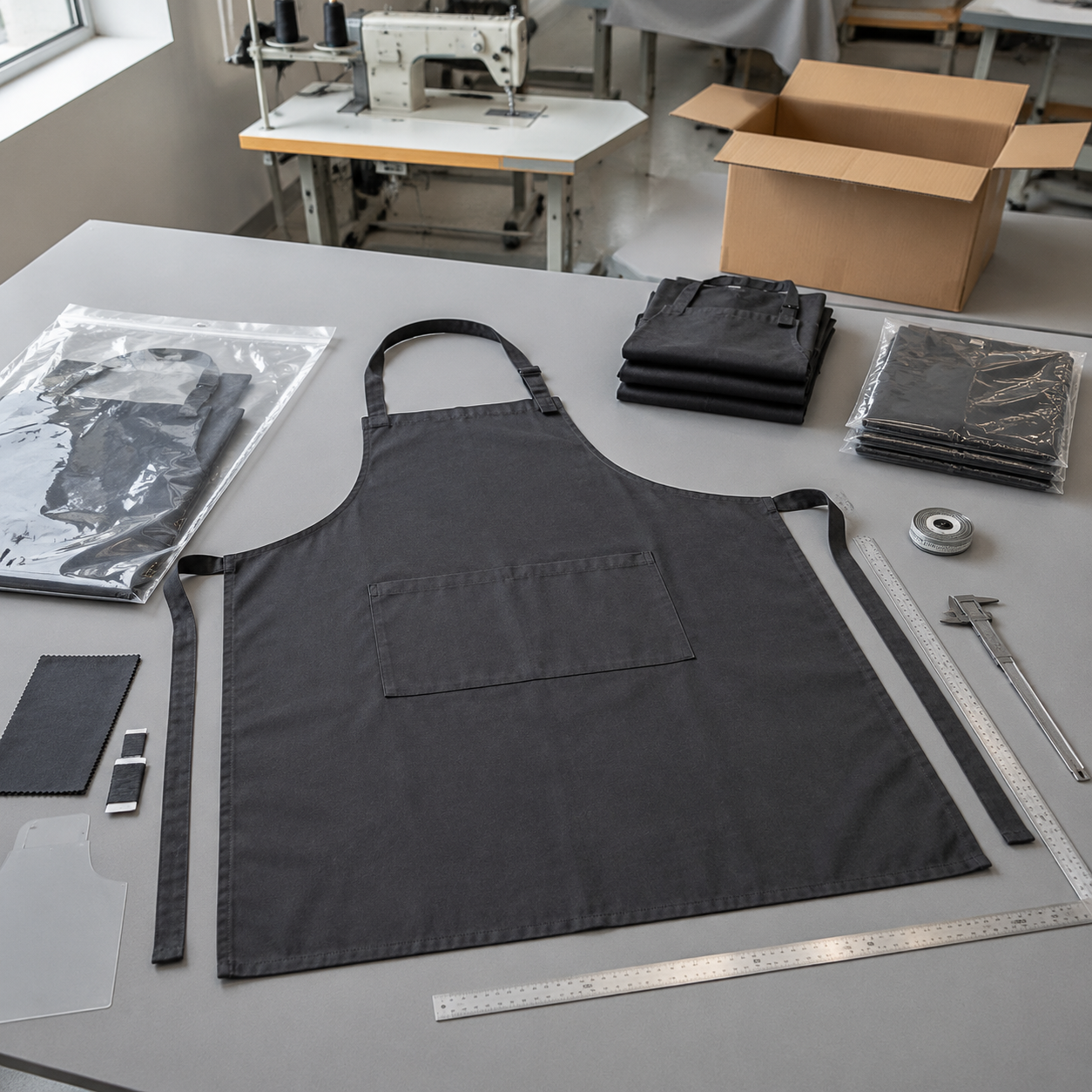
By Vincent Xi, Editorial Author
For B2B buyers sourcing chef aprons for Australia, a chef apron OEM quality control inspection should lead to a defined order decision: accept the quotation, approve a production-material sample, hold affected work, require correction, or release a finished lot. The RFQ should connect each decision to the purchase order, SKU, colour, production lot, manufacturing location, approved sample, current specification revision, and required evidence.
Descriptions such as heavy fabric, strong stitching, accurate colour, or export packing are not usable inspection criteria on their own. Before manufacturing is authorised, convert each description into a material reference, measurement point, tolerance, inspection method, evidence requirement, and failure disposition. Require the supplier to disclose substitutions and exceptions instead of treating an unanswered RFQ field as acceptance.
The controls below are proposed buyer requirements. They do not claim that a particular supplier, factory, or chef apron follows them. The supplied sourcing references concern adjacent kitchenware categories and support procedural RFQ and document-review context only; they do not establish textile performance, supplier capability, Australian compliance, or certification.
Editorial basis: The Vincent Xi author profile identifies Vincent Xi as Editorial Author. It supports the byline and role only. It does not document factory visits, inspections, or product testing, so no first-person experience claim is made.
Quality Control Inspection Gates for Chef Apron Orders in Australia
Set the release gates before comparing quotations. This prevents inspection requirements from being added only after production has started.
| Buyer decision | Controlled inputs | Required evidence | Release rule |
|---|---|---|---|
| Accept the quotation | Product revision, materials, quantity, manufacturing location, sample route, inspection scope, packing requirements, documents, and supplier exceptions | Completed supplier-return RFQ with each exception linked to the affected requirement | Resolve or formally record material exceptions before sample approval; supplier silence is not confirmation |
| Authorise manufacturing | Production-material sample, bill of materials, measurement table, construction details, branding artwork, packing prototype, and approval record | Dated approval identifying the sample, material status, and specification revision | Record temporary components and substitutions so they cannot become bulk approval by default |
| Continue production | Defined inline stage, quantity available, sampled units, attributes checked, defects, and corrective action | Inline report tied to the current lot and revision | Hold affected work when an agreed control fails until containment and disposition are documented |
| Release the finished lot | Lot definition, sample-selection method, measurements, defect results, requested evidence, packed quantity, and carton checks | Pre-shipment report and packing reconciliation tied to the purchase order | Release only the lot and quantity covered by the report; unresolved failures require rework, reinspection, or written concession |
| Accept a deviation | Deviation, affected quantity, risk review, commercial remedy, and approval authority | Written concession identifying the lot, SKU, colour, revision, and disposition | Keep the concession order-specific unless a controlled specification revision is separately approved |
Use the written specification and approved sample together. Treat the sample as the accepted physical reference only for the materials and attributes it actually represents. If it contains substitute fabric, trims, decoration, or packing, identify those differences and require production-material approval before bulk release.
Chef Apron Manufacturing RFQ Controls
The Sancong OEM sourcing guide provides adjacent-category project-brief context covering materials, product type, size, colour, packaging, quality expectations, target market, quantity, and timing. The UFamcooks sourcing guide discusses procedural topics including supplier review, manufacturing route, documentation, payment, lead time, inspection, and RFQ pricing. These sources concern kitchenware rather than textiles, so their procedures are used only to structure supplier-return fields.
| RFQ control | Buyer issues | Supplier returns | Inspection consequence |
|---|---|---|---|
| Order traceability | Australia destination, intended B2B use, purchase-order reference, SKU, colour, requested quantity, lot rule, and permitted delivery variation | Quoting entity, proposed manufacturing location, subcontracted operations, confirmed quantity basis, and exceptions | Reports must identify the same order, location, lot, SKU, colour, and revision |
| Fabric and components | Required declared fibre composition, construction, mass in grams per square metre, finish, colour reference, thread, ties, adjusters, labels, decoration materials, and substitution rule | Proposed bill of materials, material references, available declarations or reports, and every substitution | Inspect against the approved production-material references rather than an unverified development sample |
| Finished dimensions | Controlled drawing with measurement points, targets, tolerances, sample condition, and measurement method | Completed sample measurement table and manufacturing exceptions | Record results for each sampled apron, not only an average |
| Construction | Seam and edge finishes, pocket geometry, tie orientation, attachment method, reinforcement locations, and visual boundaries | Construction specification, sample evidence, and requirement-level exceptions | Link each defect to the relevant construction requirement or approved boundary sample |
| Branding | Controlled artwork revision, application method, finished size, colour reference, orientation, placement coordinates, and buyer-selected test protocol | Artwork confirmation, placement template, proposed method, sample result, and exceptions | Separate artwork approval, placement approval, and any durability requirement |
| Approval samples | Required development, production-material, branding, size-set, and packing approvals where applicable | Sample sequence, material status, charges, timing, identifier, and revision at each stage | Do not use a substitute sample as evidence of production-material conformity |
| Quality control inspection | Lot definition, inspection stages, sample-selection authority, sampling instruction, defect classes, acceptance rules, requested tests, report format, and release authority | Inspection plan, responsible parties, access arrangements, corrective-action process, report fields, and reinspection terms | Resolve incompatible methods or acceptance rules before manufacturing begins |
| Packing and freight data | Fold, unit protection, assortment, units per carton, carton construction, buyer-set carton limits, destination marks, and required shipping data | Packing prototype, carton dimensions, gross mass, net mass, assortment method, and exceptions | Reconcile inspected and packed quantities before dispatch approval |
| Evidence and change control | Required declarations, reports, current certificates, notification thresholds, approval authority, and deviation process | Available documents with entity, site, product or material scope, issue or validity information, plus identified gaps | Treat document scope and production changes as release inputs rather than administrative attachments |
A completed matrix exposes assumptions but does not prove conformance. Approval still depends on the returned evidence, production-material sample, manufacturing result, inspection record, and agreed contract terms.
Approved Sample and Specification Control
Assign every approval sample an identifier, approval date, specification revision, material status, decoration status, packing status, approver, and list of unresolved differences. Photographs may support traceability, but they should not replace a retained physical reference when physical comparison is part of the agreed inspection method.
For each controlled attribute, state what the inspector must compare and how the result will be recorded:
- Fabric and components: Record supplier-declared composition, construction, mass, finish, colour reference, component references, and substitution status. State whether a declaration is sufficient or specified test evidence is required.
- Dimensions: Define measurement points, targets, tolerances, sample condition, and measuring method on the controlled drawing.
- Construction: Define seam and edge finishes, pocket geometry, tie orientation, attachment method, reinforcement locations, and buyer-approved visual boundaries.
- Branding: Control artwork revision, application method, finished size, colour reference, coordinates, orientation, appearance boundary, and any separately agreed test protocol.
- Packing: Approve the fold, unit protection, assortment, carton arrangement, carton construction, and buyer-provided destination marks. Identify prototype elements that do not represent bulk packing.
Measurable Chef Apron Quality Control Inspection Schedule
Every figure below is an article-created example buyer assumption, not a benchmark, recognised sampling requirement, product-performance claim, or statement of supplier capability. Each assumption applies only as of the dated RFQ revision issued for the applicable order and must be verified in the supplier quote, approved production-material sample, purchase order, and inspection instruction.
| Buyer control | Example numeric assumption | Scope and method | Source, as-of context, and verification |
|---|---|---|---|
| Finished apron body | 85 cm finished body length and 70 cm widest body width, each with a +/- 1 cm tolerance | One adult bib-style chef apron SKU covered by the RFQ; measure each sampled finished apron flat at buyer-defined points without intentional stretching | Article-created buyer assumption as of the dated RFQ revision for the order; verify in the supplier quote and approved production-material sample |
| Waist ties | 95 cm per tie, with a +/- 1 cm per-tie tolerance | Every waist tie on each sampled apron; measure from the buyer-defined attachment seam to the finished end | Article-created buyer assumption as of the dated RFQ revision for the order; verify in the supplier quote and approved production-material sample |
| Branding position | Decoration centre no more than 5 mm from the buyer-approved coordinate on each controlled axis | Every sampled branded apron; compare with the signed placement template using buyer-defined reference points | Article-created buyer assumption as of the dated RFQ revision for the order; verify in the supplier quote and approved branding sample |
| Approval-stage wash check | No more than 3 percent dimensional change in either controlled direction after 5 wash-and-dry cycles at 40 degrees C | Identified approval sample and any buyer-selected retained bulk sample; the RFQ must define detergent, load, wash program, drying method, conditioning, and calculation | Article-created buyer assumption as of the dated RFQ revision for the order; verify in the supplier quote, approved sample, and agreed test instruction |
| Pre-shipment sample draw | 80 finished aprons from a lot of 2,000 finished aprons, equal to 4 percent lot coverage | One SKU, one colour, and one defined production lot; the example calculation divides the sampled finished aprons by the finished-apron lot quantity | Article-created example calculation as of the dated RFQ revision for the order; verify the draw, distribution method, and acceptance rule with the supplier or appointed inspection party |
The sample-draw example establishes only the stated lot coverage. It does not establish statistical confidence or an acceptance threshold under a formal sampling standard. If a standard is made contractual, identify its exact title, edition, scope, lot definition, inspection level, defect classes, acceptance values, and switching rules in the purchase order. The standard's requirements remain distinct from the supplier's internal practice, and use of a standard does not establish certification.
Inspection Report and Defect Disposition
The Goldensea quality-control resource provides adjacent-category document-review context covering laboratory scope, tested sample, material, named standard, test conditions, and results. The fields below adapt that review structure to evidence requested for a chef apron order. The source does not prove that an apron, material, supplier, or factory passed a test.
Require the inspection record to identify:
- Purchase order, SKU, colour, specification revision, approved-sample identity, manufacturing location, production lot, and inspection date.
- Quantity manufactured, quantity presented, quantity packed, cartons available, cartons selected, and sampled-apron sequence.
- Individual measurements, inspection method, equipment reference where requested, applicable target, tolerance, and result.
- Defect photographs linked to the sampled apron, failed requirement, buyer-defined defect class, quantity found, and disposition.
- Requested report identity, tested sample, material, method or named standard, conditions, results, laboratory scope, and issue or validity information.
- Packing assortment, unit protection, carton construction, carton dimensions, gross mass, net mass, buyer-provided marks, and quantity reconciliation.
- Containment, corrective action, reworked or screened quantity, reinspection result, and written concessions.
Define defect classes contractually instead of presenting them as universal legal or industry categories:
| Buyer-defined class | Proposed contractual meaning | Required response |
|---|---|---|
| Critical | A condition prohibited by the buyer's documented safety, legal, or risk rule | Hold the potentially affected lot, contain the possible scope, investigate, and obtain buyer disposition before release |
| Major | Failure of specified identity, function, material, dimensions, construction, branding, or packing that the buyer defines as commercially unacceptable | Record the failed requirement and apply the agreed rejection, rework, and reinspection rule |
| Minor | A limited cosmetic departure within the buyer's stated saleability boundary that does not meet the critical or major definition | Record and count the departure under the agreed acceptance rule |
Issue a defect catalogue or approved boundary samples when visual interpretation affects acceptance. For a failed lot, the corrective-action record should identify the affected scope, suspected cause, containment, rework or screening method, processed quantity, and reinspection plan.
Australia-Bound Packing and Shipment Release
The supplied evidence does not establish specific Australian legal, labelling, import, freight, climate, or hospitality-uniform requirements. The buyer should determine which requirements apply to the intended Australian B2B channel with an appropriately qualified adviser and place the resulting instructions in the RFQ and purchase order.
Before shipment release, confirm that:
- Buyer-issued product, fibre, care, identification, and carton instructions for the intended channel are reflected in the inspected goods and packing.
- SKU, colour, assortment, inspected quantity, packed quantity, and packing-list quantity reconcile.
- Fold, unit protection, carton construction, closure, and any buyer-specified route protection match the approved packing reference.
- Carton dimensions, gross mass, net mass, carton count, and buyer-provided destination marks match the supplier-return packing data.
- Requested commercial, inspection, packing, and shipping records refer to the applicable entity, product, lot, and revision.
- Containment, corrective-action, and reinspection records cover the exact lot proposed for dispatch.
- Every unresolved deviation has written buyer approval and an order-specific disposition.
An inspection result is evidence for a contractual release decision, not certification or legal approval. If certification is requested, verify a current document's legal entity, site, product or material scope, referenced standard, and issue or validity information. Do not describe a supplier, site, material, or product as certified without a current document covering the stated scope.
Practical Chef Apron Quality Control Inspection RFQ Checklist
Attach this checklist to the RFQ and require the supplier to mark every item as confirmed, exception, or not available, with an evidence reference where applicable. Treat every blank response as unresolved rather than accepted.
- [ ] Order identity completed: Record the purchase order or RFQ reference, Australia destination, intended B2B use, SKU, colour, requested quantity, permitted delivery variation, and current specification revision.
- [ ] Manufacturing route disclosed: Obtain the quoting legal entity, proposed manufacturing location, subcontracted operations, and the party responsible for final quality control inspection.
- [ ] Lot rule agreed: Define which production, SKU, colour, material batch, and packing quantity form an inspection lot and how split or combined lots will be handled.
- [ ] Bill of materials returned: Require proposed fabric, thread, ties, adjusters, labels, decoration materials, finishes, material references, and all substitutions to be stated.
- [ ] Production-material sample identified: Record the sample identifier, approval date, specification revision, material status, decoration status, packing status, and every unresolved difference.
- [ ] Measurement schedule completed: Attach the controlled drawing with measurement points, targets, tolerances, sample condition, method, and a field for each sampled apron result.
- [ ] Construction requirements confirmed: State seam and edge finishes, pocket geometry, tie orientation, attachment method, reinforcement locations, and approved visual boundaries.
- [ ] Branding controls confirmed: Record the artwork revision, application method, finished size, colour reference, orientation, placement coordinates, sample approval, and any separately agreed test method.
- [ ] Inspection stages agreed: State whether sample, inline, pre-shipment, rework, and reinspection checks apply and identify who may select units and authorise release.
- [ ] Sampling instruction agreed: Define the lot presented, carton-selection method, unit-selection method, sample quantity, defect classes, acceptance rules, and required individual records.
- [ ] Defect disposition agreed: Define containment, correction, screening, rework, reinspection, written concession, and rejection responsibilities before manufacturing begins.
- [ ] Packing specification returned: Confirm fold, unit protection, assortment, units per carton, carton construction, closure, carton dimensions, gross mass, net mass, and buyer-provided destination marks.
- [ ] Australia-bound instructions inserted: Add only the product, fibre, care, identification, commercial, shipping, and carton requirements the buyer has determined apply to the intended Australian channel.
- [ ] Evidence scope checked: For every requested declaration, report, or certificate, verify the named entity, site, product or material, tested sample, method or standard, result, issue date, and validity information where applicable.
- [ ] Change notification agreed: Require written disclosure and buyer approval before any change to manufacturing location, material, component, construction, decoration, packing, or approved process.
- [ ] Commercial consequences recorded: State sample charges, inspection charges, reinspection charges, correction responsibilities, delivery effects, and remedies for an unresolved failure or unauthorised substitution.
- [ ] Shipment release authority named: Identify the buyer representative authorised to approve the lot, accept an order-specific concession, or continue a hold.
Before accepting the quotation, confirm that every exception is linked to the affected requirement and has a proposed resolution. Before authorising manufacturing, confirm that the production-material sample and controlled documents agree. Before shipment release, confirm that the inspection report covers the exact lot, revision, inspected quantity, packed quantity, corrective actions, and approved deviations. A failed or incomplete checklist item should trigger the disposition written into the RFQ rather than an informal release assumption.
Evidence, Method, and Source Boundaries
| Source context | Support retained | Extrapolation excluded |
|---|---|---|
| Vincent Xi author profile | Author name, Editorial Author role, and profile URL | First-hand inspections, factory visits, testing, credentials, or manufacturing experience |
| Goldensea quality-control resource | Document-review context covering laboratory scope, tested sample, material, standard, test conditions, and results | Proof of apron testing, supplier compliance, certification, or product performance |
| Sancong OEM sourcing guide | Project-brief context covering material, product type, size, colour, packaging, quality expectations, target market, quantity, and timing | Cookware manufacturing statements transferred to textiles or chef aprons |
| UFamcooks sourcing guide | Procedural context connecting supplier review, documentation, lead time, payment, inspection, manufacturing route, and RFQ pricing | Source-specific volumes, timing, certification, capability, or product claims applied to chef aprons |
Method: Procedural fields were extracted from the supplied adjacent-category sources and mapped to a chef apron RFQ requirement, observable attribute, evidence item, inspection record, or release decision. Category-specific production claims and unsupported statements about suppliers, textile performance, Australian law, certification, pricing, order minimums, or timing were excluded. Numerical values were added only as clearly labelled buyer assumptions or example calculations requiring order-level verification.
Limitations and Buyer Verification
No chef apron technical specification, production-material sample, supplier quote, purchase order, test report, inspection report, packing specification, factory record, freight quotation, current certificate, or Australia-specific legal opinion was supplied. This article therefore cannot establish actual composition, construction, durability, wash performance, manufacturing capacity, defect performance, price, order minimum, timing, certification, legal status, freight suitability, or fitness for a particular hospitality operation.
Before ordering, verify the supplier return against the controlled RFQ, inspect and approve a production-material sample, confirm the identity and scope of requested evidence, agree who selects inspection units, and assign shipment-release authority. If a standard is selected, record its exact title, applicable edition, scope, and contractual acceptance rule. Verify every certification claim against a current document covering the relevant entity, site, product or material, and validity period.
Discuss Your Requirements
Review our manufacturing capabilities, then share your specifications for a supplier-fit review.