Chef Apron OEM Communication Workflow Review for New Zealand RFQs
By Vincent Xi — Editorial Author
Decision answer: For a New Zealand chef apron manufacturing RFQ, treat the OEM communication workflow as decision-ready only when each material decision identifies the controlling revision, authorised approver, supporting evidence, and stop-or-proceed effect. Rapid messages may move operational questions, but they should not replace the record controlling specifications, sample disposition, changes, QC release, packing, or dispatch.
Use these buyer-side outcomes:
- Shortlist: Required fields are complete, revisions agree, decision authority is named, and the requested evidence is available.
- Clarify: Gaps remain, but the supplier accepts the proposed controls and can close them before the affected release.
- Hold: Authority is unclear, revisions conflict, substitutions can proceed without approval, or manufacturing or dispatch can continue without the agreed evidence.
This review covers communication controls within a chef apron OEM RFQ. It does not assert supplier capability, product performance, a service level, or a New Zealand compliance outcome.
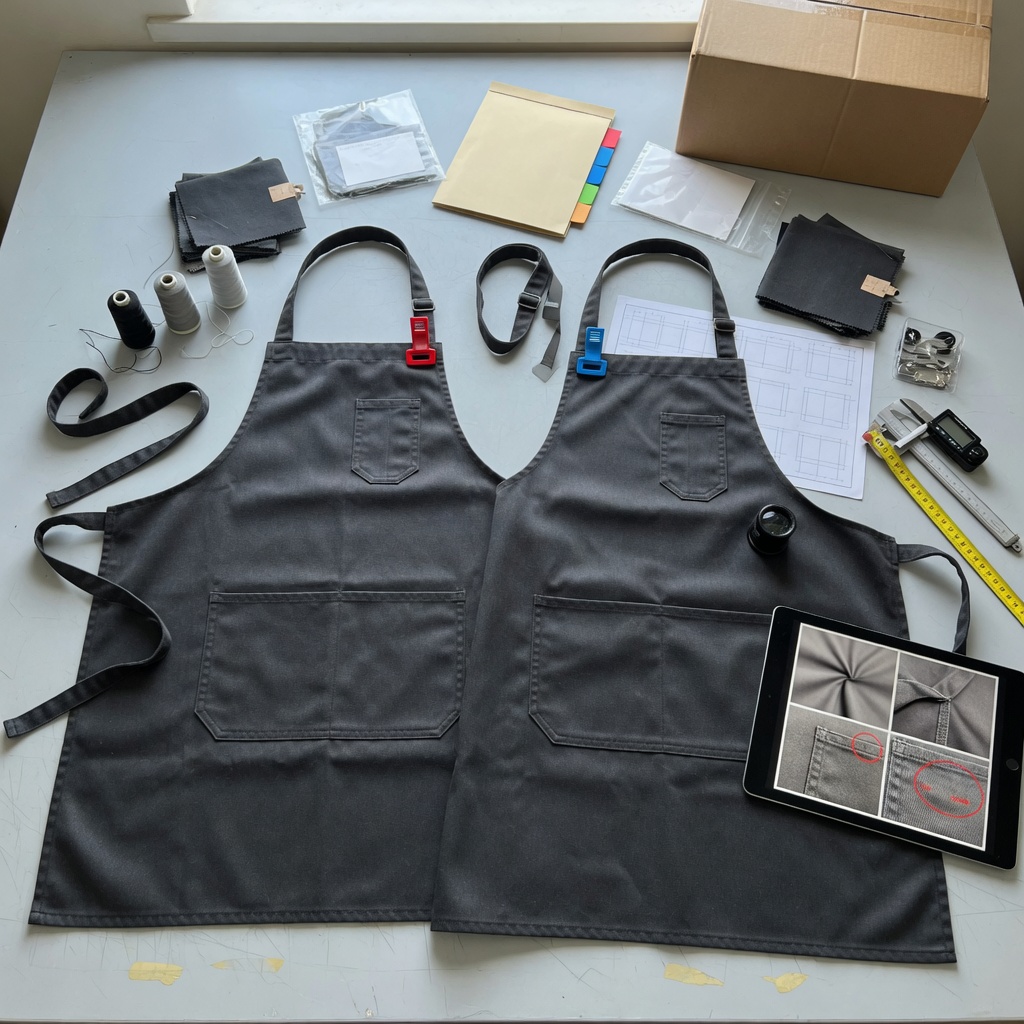
Communication workflow review for New Zealand chef apron manufacturing RFQs
The practical test is whether an authorised reader can identify what is current, who owns the decision, what evidence supports it, and what event releases further work without reconstructing an uncontrolled message history.
| Review gate | Supplier return | Evidence requested | Hold trigger |
|---|---|---|---|
| Contact and authority | Operational contact, technical owner, backup, commercial approver, escalation contact, rapid channel, controlling record, and working overlap in New Zealand and supplier local time | Completed authority matrix and response to a controlled clarification | An approver, backup, escalation route, or controlling record is missing |
| RFQ baseline | Current quotation, specification, artwork, quantity split, packing instruction, named New Zealand delivery place, and commercial assumptions | Revision register and field-level exception schedule | Current revisions cannot be identified or exceptions are hidden behind a general confirmation |
| Sample review | Sample identifier, purpose, linked revisions, measurements, deviations, buyer disposition, and manufacturing-release status | Identified sample, measurement report, traceable images, and approval record | The sample is not revision-linked or approval does not state whether manufacturing may proceed |
| Change control | Written effect on product, material, price, quantity, rework, schedule, QC, packing, and freight | Completed change notice with authorised disposition | A substitution or other material change can proceed from an informal message |
| QC release | Inspection criteria, scope, evidence format, nonconformance process, and release authority | Blank or redacted report example, followed by order-specific records | Release relies only on an unsupported statement such as QC passed |
| New Zealand handoff | Delivery responsibilities, freight assumptions, packing data, requested document drafts, open issues, and dispatch authority | Freight basis, packing return, document review record, and issue log | Freight, documentation, or dispatch responsibility remains unresolved |
Set document precedence among the purchase order, quotation, specification, artwork, approved sample, change records, and release records. The RFQ can define a read receipt, reaction icon, or short acknowledgement as evidence of receipt only, not approval, unless the controlling agreement states otherwise.
Chef apron OEM communication channels, ownership, and response commitments
Assign each channel a declared function:
- Rapid operational channel: Clarification questions, close-up images, short videos, production-blocking notices, and status updates.
- Controlling approval record: Specifications, artwork, quotations, sample dispositions, manufacturing releases, change notices, QC decisions, packing approvals, and dispatch authorisation.
Each material communication entry should identify:
- RFQ or purchase-order reference.
- Current quotation, specification, and artwork revisions.
- Related sample, change, inspection, or shipment record.
- Affected chef apron style, component, colour, artwork, or quantity scope.
- Issue, requested decision, responsible owner, and authorised approver.
- Date, local time, and time-zone reference.
- Attachments or evidence supplied.
- Required action and its stop-or-proceed effect.
The Shanghai Garment communication article is undated in the supplied source context, which does not provide a derivation method for its examples. It reports the following publisher-specific figures:
| Reported figure | Unit and source scope | Date and source | Use in this review |
|---|---|---|---|
24 hours | Elapsed hours in an email-delay example within the publisher's custom-clothing article | Publication date not stated in the supplied context; Shanghai Garment | Prompt for quote-specific acknowledgement and escalation fields; not a target |
8 minutes | Elapsed minutes in a resolution example using hybrid messaging and email within the same publisher context | Publication date not stated in the supplied context; Shanghai Garment | Illustration of channel choice; not a benchmark or service commitment |
17 hours | Elapsed hours in another delay example within the same publisher context | Publication date not stated in the supplied context; Shanghai Garment | Prompt for an escalation rule; not a New Zealand lead-time claim |
These figures are not audited market benchmarks, New Zealand service levels, or Linwa Apron commitments. Replace them with commitments in the supplier's current quotation.
Ask the supplier to complete these fields:
- Rapid operational channel and controlling approval record.
- Owner responsible for recapping material decisions in the controlling record.
- Routine-question acknowledgement target in business hours.
- Production-blocking acknowledgement target in business hours.
- Technical answer or action-plan target in business hours.
- Working-day definition and holiday coverage.
- Overlap window stated in New Zealand and supplier local time, with time-zone references and the applicable date range.
- Technical owner, backup, commercial approver, and escalation contact.
- Escalation trigger and stop-work authority.
- Default action outside the overlap window: hold affected work, continue only approved unaffected work, follow the last approved revision, or apply another written rule.
RFQ baseline communication for a measurable chef apron specification
To make communications traceable, require a field-level supplier response rather than a blanket statement that the specification is confirmed.
| RFQ category | Buyer defines | Supplier returns |
|---|---|---|
| Order scope | Intended workplace use, apron style, SKU structure, quantity split, and named New Zealand delivery place | Feasibility response, quantity mapping, MOQ basis, and exceptions |
| Finished dimensions | Measurement point, method, unit, target, tolerance, and treatment of straps or ties | Completed measurement schedule and proposed values for open fields |
| Fabric | Fibre percentages, construction, areal mass, colour reference, finish, shrinkage requirement, substitution rule, and evidence requested | Proposed material specification, swatch plan, available evidence, and deviations |
| Components and sewing | Strap and tie dimensions, adjuster, pocket construction, seam type, reinforcement, stitch density and unit, thread, hardware, and edge finish | Component schedule, construction response, and approval-required alternatives |
| Branding | Artwork revision, method, placement datum, dimensions, tolerances, colour references, and approval artefact | File review, setup requirements, physical approval method, and limitations |
| Sampling | Purpose, linked revisions, courier responsibility, fees, approval authority, and resample triggers | Quote-specific sample plan, dependencies, and conditions requiring further approval |
| Packing and handoff | Folding, individual packing, assortment, carton data, marking fields, and pallet or wooden-packaging instructions if applicable | Packing proposal, assumptions, exclusions, and data-return timing |
| Commercial and schedule | Currency, quote validity, payment milestones, charges, exclusions, manufacturing-start trigger, pause events, readiness milestone, and change-impact method | Line-item quotation and schedule tied to the requested quantity split |
Illustrative buyer RFQ assumptions: Every value and feature below is hypothetical and must be verified in the supplier's current quotation. It is not a Linwa Apron product specification, stock claim, test result, or market norm.
| Field | Example assumption to verify | Measurement or evidence instruction |
|---|---|---|
| Finished body length | 85 cm finished body length — example assumption to verify in the current supplier quotation | Lay the apron flat without stretching; measure centre-front from the upper body edge to the bottom hem, excluding the neck strap; supplier states tolerance and sample result |
| Finished body width | 70 cm finished body width — example assumption to verify in the current supplier quotation | Lay the body flat; measure across the specified widest body datum, excluding waist ties; supplier states tolerance and sample result |
| Fabric | 240 g/m² cotton/polyester twill — example assumption to verify in the current supplier quotation | Supplier states exact fibre percentages, construction, finish, declared tolerance, and agreed evidence or test method |
| Colour and style | Charcoal bib chef apron — example assumption to verify in the current supplier quotation | Buyer supplies or approves the colour reference and viewing conditions |
| Components | Adjustable neck strap with matte metal slider, long waist ties, and a centred reinforced patch pocket — example assumption to verify in the current supplier quotation | Supplier returns component dimensions, material and finish references, pocket datums, seam construction, and reinforcement details |
When proposing an alternative, the supplier return should identify the affected requirement, proposed substitute, comparison evidence, commercial effect, schedule effect, and approval status.
Sample communication workflow review: link approval to the current revision
A sample submission should state the decision it supports, such as material confirmation, finished dimensions, construction, branding execution, or pre-production approval. Approval for a limited purpose should not release manufacturing unless the approval record expressly authorises that action.
The BlueCut custom-apron article is identified in the supplied context as a publisher-labelled 2026 vendor guide. It reports these figures for the publisher's described project process:
| Source-reported figure | Unit and scope | Date and source | Limitation |
|---|---|---|---|
Weeks 1–2 | Project weeks assigned to design consultation and quoting in the publisher's process | Publisher-labelled 2026 guide; BlueCut | Vendor-specific context, not an industry or supplier schedule |
Weeks 2–4 | Project weeks assigned to sampling in the publisher's process | Publisher-labelled 2026 guide; BlueCut | Not a Linwa Apron or New Zealand sampling commitment |
1–3 physical samples | Physical sample count in the publisher's process | Publisher-labelled 2026 guide; BlueCut | Not a market norm or an included-sample allowance |
Use these figures only as source context. Obtain the quoted supplier's actual sample allowance, dependencies, revision terms, courier responsibility, approval sequence, and manufacturing schedule in writing.
Require each sample submission to include:
- Unique sample identifier and submission date.
- Decision purpose and approval authority.
- Specification, artwork, quotation, and change revisions used.
- Fabric, thread, strap, adjuster, hardware, and branding references.
- Measurement report against requested targets and tolerances.
- Traceable front, back, side, pocket, strap, seam, and branding-detail images.
- Supplier deviation list and proposed correction for each deviation.
- Buyer comment register with owner, disposition, and affected scope.
- Explicit status: approved for the stated purpose, revision required, rejected, or clarification required.
- Separate statement confirming whether manufacturing may proceed.
Each measurement row should identify the feature and datum, measurement method, target and unit, tolerance, actual result and unit, requested instrument-status information, evidence reference, and required action. Replace comments such as move the pocket lower or use heavier fabric with a measurable target, reference datum, affected revision, application scope, and authorised disposition.
Change-control communication before chef apron manufacturing
Use a formal change record whenever a proposal affects the approved product, material, quantity, price, schedule, sample status, QC plan, packing, or freight handoff. A rapid-channel message may flag the issue, but the controlling record should authorise implementation.
Each change record should state:
- Change identifier, request date, initiator, and reason.
- Current quotation, specification, artwork, and sample revisions.
- Affected styles, colours, artwork variants, components, and quantities.
- Requested change and supplier-proposed implementation.
- Material already purchased, work already completed, and treatment of affected stock or rework.
- Revised unit price, setup charge, rework charge, and other commercial effects.
- Effect on sampling, manufacturing readiness, QC, packing, and dispatch timing.
- Comparison evidence for a proposed substitute.
- Requirement for another sample or approval artefact.
- Buyer disposition, authorised approver, effective revision, and permitted action.
The RFQ should define the default for an unresolved change. Affected work remains on hold unless an authorised record permits another action; unaffected work continues only within the buyer's written release scope.
QC communication and release evidence
The SFATEC work-apron buyer guide discusses communication, customisation, production reliability, multi-stage quality control, and the risk of choosing on price alone. These themes support RFQ questions; they do not prove that any supplier follows a particular QC process.
Convert the qualitative source context into order-specific return fields:
| QC field | Supplier response required |
|---|---|
| Inspection stages | Proposed pre-production, in-process, final, and packing checks relevant to the quoted chef apron order |
| Controlling criteria | Approved specification revision, measurement points, tolerances, construction criteria, branding references, and packing instruction |
| Inspection scope | Quantity inspected, selection method, measurements and attributes checked, and exclusions |
| Evidence format | Report structure, traceable photographs, measurement results, sample references, record owner, and retention arrangement |
| Nonconformance handling | Defect description, containment, rework, replacement, reinspection, concession request, and schedule reporting |
| Release authority | Supplier sign-off role, buyer approver, treatment of unresolved exceptions, and event authorising further work or dispatch |
Request a blank report template or appropriately redacted example before award. The order-specific report should identify the order, chef apron SKU, approved revision, inspection date, inspected quantity, result, exceptions, corrective actions, and release status.
Hold the relevant release when evidence cannot be traced to the approved revision, inspection scope is missing, corrective actions remain unresolved, or a proposed concession lacks authorised buyer disposition.
New Zealand communication workflow review for freight, documents, and compliance handoff
For a New Zealand chef apron order, finish the communication workflow with a reviewable handoff tied to the quotation and purchase order. The following are RFQ return fields, not claims about universal New Zealand requirements.
| Handoff field | Supplier returns | Buyer verifies or holds |
|---|---|---|
| Delivery responsibility | Named New Zealand delivery place and allocation of pickup, export, main freight, insurance, destination handling, and local delivery responsibilities | Consistency across the quotation, purchase order, and appointed logistics arrangement |
| Freight quotation | Transport mode, route assumptions, readiness basis, quotation issue date, validity period, charge basis, update trigger, and excluded charges | Current advice from the appointed freight or import adviser and consistency with packing data |
| Packing data | Carton count, external dimensions with units, net and gross weights with units, assortment, packing method, and pallet or wooden-packaging details if proposed | Agreement with approved packing instructions and freight assumptions |
| Requested document drafts | Documents and data requested by the buyer or its adviser, including any requested commercial invoice, packing list, and transport-document details appropriate to the selected mode | Consignee details, quantities, values, descriptions, routing, and adviser instructions |
| Classification and origin | Supplier's proposed product description, classification, origin statement, and supporting basis requested for review | Final treatment with the New Zealand buyer's customs broker, import adviser, or relevant authority |
| Compliance evidence | Exact buyer-requested requirement, supplier response, evidence document, scope, issue date, and validity status | Applicability to the quoted product, packaging, manufacturing site, and shipment |
| Dispatch authorisation | Final QC status, closed or accepted exceptions, packing return, requested document status, freight update, open-issue log, and named authoriser | No dispatch until the agreed release conditions are satisfied |
The supplied sources do not determine which current New Zealand customs, tax, textile-labelling, workplace-use, packaging, or biosecurity requirements apply to a particular chef apron, packaging material, shipment, or importing arrangement. Confirm applicability for the specific order with an appropriate New Zealand authority, customs broker, freight adviser, or other qualified professional before dispatch authorisation.
If a quotation references a standard, test, or certification, request the exact title, edition, issuer, document holder, covered product or site, scope, issue date, and current validity status. A supplier's internal procedure describes that supplier's stated practice. A buyer requirement functions as an order control only when accepted in the controlling order documents. Neither is proof of an external standard's requirement or certification without a current, scope-matching document.
Practical RFQ checklist for New Zealand chef apron manufacturing
Copy this checklist into the RFQ and require a supplier response, evidence reference, or written exception for every item.
Before supplier shortlisting
- [ ] State the RFQ or purchase-order reference, intended workplace use, quantity split, and named New Zealand delivery place.
- [ ] Identify the current quotation, specification, artwork, packing instruction, and document-precedence rule.
- [ ] Receive field-level responses for dimensions, tolerances, fabric, fibre percentages, construction, components, branding, packing, commercial assumptions, and exceptions.
- [ ] Record the operational contact, technical owner, backup, commercial approver, escalation contact, rapid channel, and controlling approval record.
- [ ] Record acknowledgement and escalation commitments, working-day definition, holiday coverage, and overlap in New Zealand and supplier local time.
- [ ] Obtain the quote-specific sample plan, QC proposal, change terms, packing return, and freight and document assumptions.
Before manufacturing release
- [ ] Link the approved sample to the current quotation, specification, artwork, and change revisions.
- [ ] Confirm measurement evidence, traceable images, deviations, buyer disposition, and explicit manufacturing-release status.
- [ ] Close or authorise every material substitution, rework issue, price effect, schedule effect, and unresolved exception in the controlling record.
- [ ] Name the authorised manufacturing-release approver and the exact scope of work allowed to proceed.
Before New Zealand dispatch
- [ ] Receive final QC evidence tied to the approved revision, inspected scope, exceptions, corrective actions, and release status.
- [ ] Reconcile carton data, weights, packing method, freight assumptions, delivery responsibility, and requested document drafts.
- [ ] Verify classification, origin, compliance, standard, test, or certification claims using current scope-matching evidence and appropriate New Zealand advice where needed.
- [ ] Record open issues, accepted concessions, dispatch authority, and the exact event permitting shipment.
Decision use: Shortlist when the award-stage checklist is complete and internally consistent. Clarify when a stated gap can be closed before the affected release. Hold when the buyer would otherwise need to infer authority, revision status, supporting evidence, or permission from an uncontrolled message history.
Evidence method, source boundaries, and what to verify
Source map
| Source | Supported use | Does not support |
|---|---|---|
| Shanghai Garment communication article | The publisher-specific elapsed-time examples and the need to request channel, acknowledgement, and escalation fields | Market benchmarks, New Zealand service levels, audited performance, or Linwa Apron commitments |
| BlueCut custom-apron vendor guide | The publisher-labelled 2026 project-stage and physical-sample figures quoted above | Industry norms, supplier terms, New Zealand timing, or Linwa Apron product claims |
| SFATEC work-apron buyer guide | Qualitative purchasing context concerning communication, customisation, production reliability, QC, and price comparison | Proof that a supplier operates a stated QC process or satisfies a specific requirement |
| Vincent Xi author profile | Visible author name and Editorial Author role | Factory visits, product tests, procurement outcomes, certifications, or customer results |
Methodology
This review uses only the supplied context for the cited pages. Source-reported numerical data were retained with their units, publisher scope, and available publication-date context. No figure was averaged, extrapolated, or converted into a market benchmark or New Zealand commitment.
The communication fields, evidence requests, checklist items, and hold conditions are buyer-side controls derived by mapping the cited communication, sampling, purchasing, and QC themes to specific RFQ decision points. The illustrative dimensions, material value, style, and components are explicitly marked as hypothetical assumptions requiring verification in the supplier's current quotation.
No Linwa Apron manufacturing practice, product specification, MOQ, sample allowance, response time, lead time, certification, test result, freight term, or customer outcome has been inferred from the external sources.
Limitations and what to verify
The cited commercial editorial sources are not a current supplier quotation, purchase order, factory audit, inspection report, laboratory report, freight schedule, certificate, or New Zealand regulatory determination. Before placing or releasing an order, verify the supplier's actual contacts, authority structure, response commitments, specification response, material proposal, MOQ allocation, sample plan, manufacturing schedule, change terms, QC scope, packing data, freight assumptions, requested document set, and support for any standard, testing, compliance, origin, or certification claim.
For New Zealand, verify the specific product, packaging, shipment route, delivery arrangement, and importing entity before dispatch.
Author basis: The Vincent Xi profile identifies Vincent Xi as an Editorial Author. The profile does not support factory-visit, product-testing, procurement-outcome, certification, or customer-result claims, and none are made here.
Discuss Your Requirements
Review our manufacturing capabilities, then share your specifications for a supplier-fit review.