Barista Apron Wholesale Supplier Product Development Capability for Australia
By Vincent Xi, Editorial Author
First-hand experience note: The approved Vincent Xi author profile identifies Vincent Xi as Editorial Author only. It does not support claims of factory visits, product tests, audits or procurement outcomes; none are made here.
RFQ decision: For Australian B2B buyers, treat barista apron wholesale supplier product development capability as order-specific only when a candidate converts the buyer brief into a controlled production package. The expected evidence includes an annotated requirements review, finished-measurement specification and tolerances, bill of materials, traceable sample revisions, approved pre-production sample, order-specific quality-control plan and dated commercial quote.
This is a buyer-control framework, not a claim that Linwa Apron or any cited supplier currently provides those outputs. A product image, customisation menu, headline minimum order quantity or general capacity statement can help screen candidates, but it does not establish that approved apron details will transfer into bulk production. Before release, the quote, purchase order, specification, bill of materials, sample approval and QC plan should identify the same style, revision, materials, branding and packaging scope.
Evidence is labelled as follows:
- Supplier-published statement: A claim represented in the supplied source material and attributed to that source.
- Buyer control: A proposed RFQ or purchase-order safeguard, not a claim about any supplier's established practice.
- Illustrative assumption: An example used to make the RFQ measurable; the supplier must accept, counter or replace it in a dated quote and approved sample.
Product Development Capability for Australia: Order-Level Release Gate
| Development gate | Evidence the supplier should return | Buyer hold point |
|---|---|---|
| Requirements review | Annotated tech pack, sketch, reference-sample review or written brief, plus an instruction hierarchy for conflicting inputs | Keep sampling on hold until contradictions and open questions are documented |
| Finished product definition | Point-of-measure diagram, finished targets, tolerances, measurement methods, pocket placement, strap construction, seams, reinforcement and branding locations | Do not approve appearance without measurable acceptance criteria |
| Material and trim control | Bill of materials, component specifications, source references, availability, booking conditions and proposed alternatives | Do not accept unspecified components or undisclosed substitutions |
| Sample traceability | Style code, sample revision, completion date, change record, actual measurements, open issues and approval status | Do not replace a controlled sample record with verbal comments or unversioned photographs |
| Production transfer | Approved pre-production sample, final bill of materials, production-pattern confirmation and bulk control points | Do not release bulk cutting until production records match the approved package |
| Quality control | Order-specific measurement, workmanship, branding, packing, defect-treatment and shipment-release plan | Do not infer order coverage from a generic QC statement |
| Commercial and Australia delivery scope | MOQ by variant, itemised charges, quote validity, payment terms, timing trigger, allocated capacity, dispatch point and Australian destination basis | Do not compare offers until candidates quote the same product revision and delivery scope |
Source-Supported Claims Relevant to Product Development
Only supplier-published statements represented in the supplied evidence are retained below. They are not Linwa Apron claims or current commitments for a proposed order.
| Supplied source context | Retained supplier-published statement | RFQ evidence needed | Limitation |
|---|---|---|---|
| Kingbird custom-apron source | The supplied content lists embroidery, screen printing, heat transfer, custom colours, pockets and private labelling | Method-specific artwork review, physical sample or strike-off evidence, placement tolerance, charges, MOQ and timing | The list does not establish current availability, bulk repeatability or order-specific terms |
| SiATEX custom-made apron source | The supplied content says the company can work from customer designs and tech files | Annotated file review, open-question list, measurement specification, bill of materials and sample plan | The statement does not show that the buyer's file has been reviewed or that proposed materials and capacity are available |
| Kingbird and SiATEX textile contexts | The supplied content refers to canvas, denim, cotton, polyester and poly-cotton categories | Exact fibre composition, construction, mass per unit area, finish, colour basis, shrinkage method, source and bulk availability | Category names do not establish composition, performance, suitability or continuity from sample to bulk |
| Bagsplaza leather-apron source | The supplied content describes patterning, cutting, stitching, hardware selection and QC in a leather-apron service context, and says AQL inspections are offered | Order-specific pattern status, material specification, trim set, sample revision, inspection plan and failed-inspection remedy | Leather-apron statements do not establish the process for a textile barista apron, and the term AQL alone does not define a shipment-release rule |
Published MOQ, Sampling and Capacity Figures
The supplied excerpts contain no publication, access or current-as-of date. Each figure is therefore presented as an undated supplier-published statement that requires confirmation in a current dated quote.
| Source and product scope | Exact supplier-published figure | Date or as-of context | Required verification |
|---|---|---|---|
| Kingbird custom-apron source | 10–50 pieces per custom-apron order and 15–25 days per source-stated production cycle | Supplied excerpt undated; no current as-of date is established, and the source does not specify business or calendar days | Confirm MOQ by style, fabric, colour and branding; confirm the timing trigger, included work, material status, inspection allowance and dispatch date |
| SiATEX custom-made apron source | 500 units per custom-apron order and claimed capacity of up to 500,000 aprons per month across the source-stated operation | Supplied excerpt undated; the monthly figure is an operation-wide claim rather than an allocation to the buyer's order | Confirm capacity reserved for the proposed style, material, quantity and delivery window, including material-procurement time |
| Bagsplaza leather-apron source | MOQ beginning at 100 units per leather-apron order and 7–14 days per source-stated sample cycle | Supplied excerpt undated; revision allowance, branding scope, material availability and courier time are not defined | Confirm what the sample cycle includes and do not transfer leather-product figures to a textile-apron quote |
These figures are not market averages and should not be averaged or transferred across product scopes. Ask whether an offered MOQ depends on stock materials, stock colours, standard patterns or restricted branding. Replace general capacity statements with written allocation for the proposed order.
Build the Controlled Barista Apron Development Package
The values below are illustrative RFQ assumptions to verify in the supplier's dated quote, returned measurement sheet and approved sample. They are not Linwa Apron specifications, supplier claims or Australian requirements.
| Measurement point | Illustrative assumption per finished apron | Illustrative acceptance basis to verify |
|---|---|---|
| Apron body | 82 centimetres finished length × 70 centimetres finished width per apron | ±1.0 centimetre on each body dimension per apron; measure flat and relaxed using defined top, bottom and width points |
| Bib width | 26 centimetres finished width per apron | ±0.5 centimetre per apron; identify the horizontal measurement line |
| Waist ties | Paired ties measuring 90 centimetres finished length each per apron | ±1.0 centimetre per tie; measure from the attachment seam to the free end without stretching |
| Patch pocket | 20 centimetres finished width × 15 centimetres finished height per apron | ±0.5 centimetre on pocket width and height per apron, with an illustrative centreline placement tolerance of ±0.5 centimetre per apron |
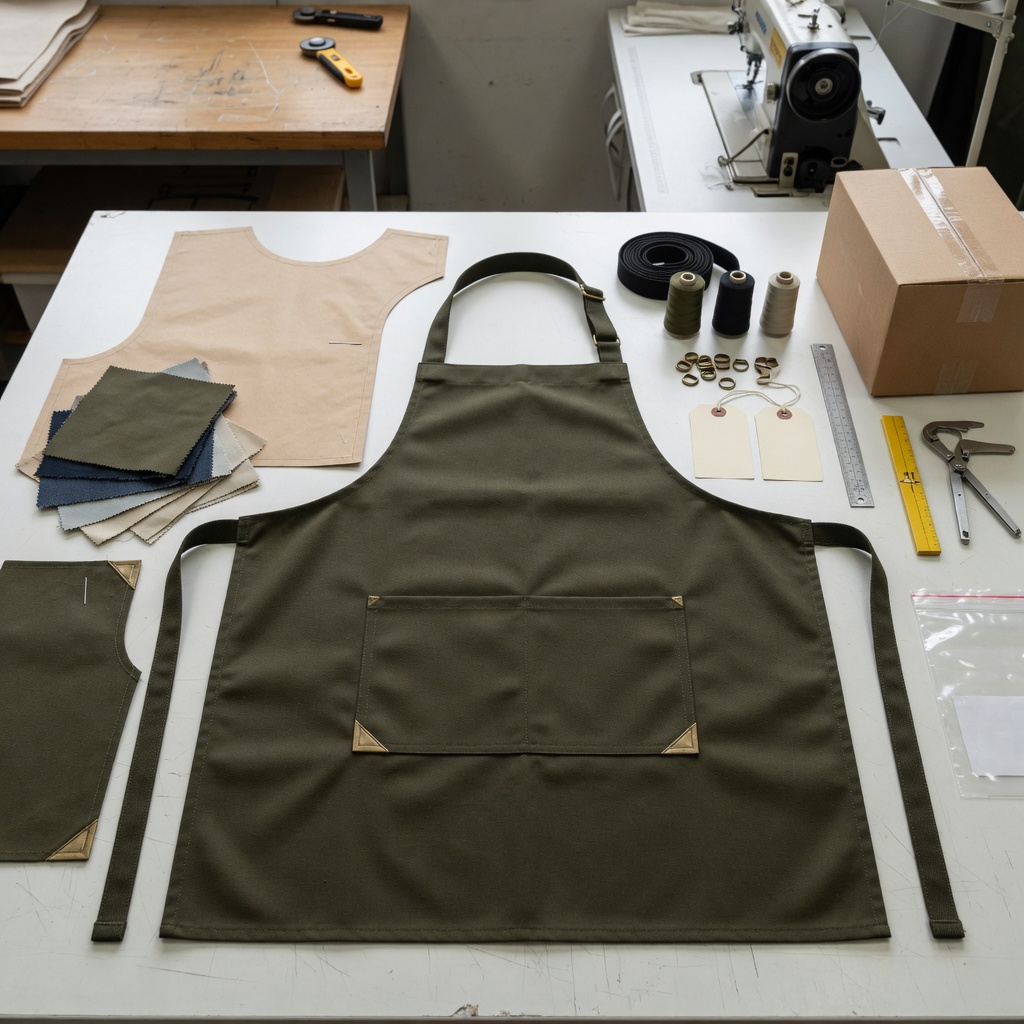
The matching illustrative material concept is dark-olive cotton canvas, black webbing for the adjustable neck strap and brass-tone hardware. These details are assumptions to verify, not statements about an existing product.
The supplier's development response should include:
- Its own point-of-measure diagram and measurement method.
- Accepted or counter-proposed targets and tolerances.
- Actual measurements for every submitted sample revision.
- Pass, fail or buyer-waiver status for each controlled point.
- Construction drawings for pockets, ties, neck adjustment, hems, seams and reinforcement.
- Written identification of any requirement that cannot be held in bulk production.
Bill of materials fields
| Component | Required development fields |
|---|---|
| Main textile | Fibre composition, fabric construction, mass per unit area, finish, colour reference, shrinkage target and method, bulk source and booking status |
| Pocket material | Confirmation that it matches or intentionally differs from the body textile, including construction and colour basis |
| Thread and seams | Thread type and reference, seam type, stitch definition, seam allowance, topstitching position and edge finish |
| Webbing, ties and hardware | Material, dimensions, colour or finish, adjustment range, attachment construction and approved physical reference |
| Stress points | Reinforcement method and location for pockets, ties and strap attachments |
| Branding and labels | Artwork revision, application method, dimensions, colour basis, placement measurement, label content, material and attachment |
| Packaging | Individual pack method, packaging components, carton configuration and approved component references |
The candidate should identify the planned bulk source for each component and disclose any difference between sample-stock material and production material. Any unavailable component or proposed substitution should trigger written review of appearance, function, cost, MOQ and timing before approval.
Sample Revision and Bulk-Transfer Controls
Each physical sample should be accompanied by a controlled record containing:
- Buyer and supplier style references.
- Sample revision identifier and completion date.
- Controlling specification and artwork revisions.
- Actual finished measurements and tolerance status.
- Fabric, thread, webbing, hardware, branding, label and packaging references.
- Changes made since the preceding sample.
- Deviations accepted for sampling only.
- Corrections, open questions and approval status.
Before bulk cutting, require confirmation that the production pattern, bulk material source, colour basis, trims, construction and branding process match the approved package. The pre-production sample should be identified in writing as the workmanship reference for the order.
Photograph approval should not replace approval of measurable dimensions, material references or physical components. If remote approval is necessary, record which characteristics remain conditional until physical inspection and how a failed condition will be handled.
QC Evidence and Australia Quote Normalisation
Order-specific QC evidence
The returned inspection plan should define checks for:
- Finished body, bib, tie and pocket measurements.
- Pocket position and reinforcement.
- Seam security, hems, topstitching and loose threads.
- Tie and neck-strap anchoring.
- Adjustment function and hardware attachment.
- Branding size, placement, orientation and appearance.
- Shade consistency, stains, damage and sharp components.
- Label, individual-pack and carton accuracy.
- Defect classification, acceptance procedure, reinspection and rework responsibility.
- Evidence required before shipment release.
The Bagsplaza source uses the term AQL inspections, but the supplied content does not define the order lot, sampling plan, defect limits, decision rule or failed-inspection remedy for a textile barista-apron order. Those controls should be written into the purchase order or inspection instruction rather than inferred from the term.
The supplied sources do not establish which Australia-specific labelling, chemical, product or import obligations apply to the proposed apron. No local legal requirement is asserted here. The Australian buyer should insert only requirements confirmed for the actual product, materials, branding, packaging and import arrangement.
Australia commercial and freight scope
Require candidates to quote the same product revision, quantity basis and Australian destination.
| Quote field | Required supplier response |
|---|---|
| Product identity | Buyer style code, supplier style code and controlling specification revision |
| Quantity basis | MOQ and quoted quantity by material, colour, branding design and packaging format |
| Price structure | Unit price plus separately stated development, sampling, tooling, branding, labels, packaging, inspection and other charges |
| Quote controls | Currency, validity, payment terms, inclusions and exclusions |
| Sampling timing | Event that starts the sample period, included work, revision allowance and dispatch point |
| Production timing | Material-booking status, event that starts production, production window, inspection allowance and dispatch date |
| Capacity | Written allocation for the proposed style, material, quantity and requested delivery window |
| Delivery basis | Selected delivery rule and named place, Australian suburb or postcode, dispatch location and included services |
| Freight basis | Proposed transport mode, transit basis, handover point and excluded charges or services |
| Carton plan | Units per carton, carton dimensions, net weight, gross weight and packaging method |
| Change control | Cost and timing effects of buyer revisions, failed samples, unavailable materials and proposed substitutions |
Use the same buyer calculation structure for each quote:
Comparable order cost = product cost + development and sample charges + tooling + branding + labels and packaging + inspection + freight + applicable delivery or import charges.
Accepted-unit cost = comparable order cost ÷ accepted saleable units after the agreed inspection process.
Use inputs only from the supplier's dated quote or buyer-verified cost records. Do not insert unsupported duty, freight, exchange-rate, rejection or transit assumptions.
Practical RFQ Checklist
Copy this practical RFQ checklist into the enquiry for barista apron wholesale supply in Australia and require a written response against every line. Ask the candidate to mark every unanswered field as excluded, pending or not applicable rather than leaving it blank.
Product development response
- [ ] Buyer and supplier style references.
- [ ] Controlling tech pack, sketch, reference sample or written brief.
- [ ] Instruction hierarchy for conflicting buyer inputs.
- [ ] Annotated brief or tech-pack review.
- [ ] Open-question and feasibility list.
- [ ] Finished-measurement diagram, targets, tolerances and methods.
- [ ] Bill of materials with supplier component references.
- [ ] Fabric composition, construction, mass per unit area, finish and colour basis.
- [ ] Pocket dimensions, placement, divisions and reinforcement.
- [ ] Neck strap, waist ties, adjustment range and attachment construction.
- [ ] Hardware specification and approved reference.
- [ ] Seam, hem, topstitching and stress-point requirements.
- [ ] Branding artwork revision, method, dimensions, colours and placement.
- [ ] Label and packaging inputs requiring buyer approval.
- [ ] Material availability, booking needs and proposed alternatives.
Sampling and production response
- [ ] Required prototype, revised-sample and pre-production stages.
- [ ] Sample timing trigger, included work, charges and revision allowance.
- [ ] Change-log method and approval authority.
- [ ] Actual measurement report for each sample revision.
- [ ] Approved pre-production sample identified as the bulk workmanship reference.
- [ ] Written prohibition on unapproved substitutions.
- [ ] Event that starts production lead time.
- [ ] Order-specific material and capacity allocation.
Commercial and Australia delivery response
- [ ] MOQ by material, colour, branding design and packaging format.
- [ ] Itemised prices at the requested quantity basis.
- [ ] Development, sample, tooling and non-recoverable charges.
- [ ] Quote currency, validity, payment terms, inclusions and exclusions.
- [ ] Australian delivery suburb or postcode.
- [ ] Selected delivery rule and named place.
- [ ] Dispatch location, handover point and proposed transport mode.
- [ ] Units per carton, carton dimensions, net weight and gross weight.
- [ ] Freight, handling, delivery and import-related inclusions and exclusions.
QC and documentary response
- [ ] Order-specific measurement and visual inspection plan.
- [ ] Lot definition, defect treatment, acceptance procedure and failed-inspection remedy.
- [ ] Required pre-shipment measurement, inspection and packing records.
- [ ] Traceability method for bulk fabric, trims, branding, labels and packaging.
- [ ] Current scope-matched documents only where specifically required by the buyer.
- [ ] Procedure for reporting unavailable components or proposed substitutions.
- [ ] Rework, replacement and late-delivery terms for the purchase order.
Purchase-Order Release Decision
| Decision stage | Release only when | Response to missing evidence |
|---|---|---|
| Development sampling | Product assumptions, input hierarchy, material feasibility, charges and sample scope are documented | Keep the requirement open and do not treat the sample schedule as confirmed |
| Pre-production approval | Measurements, materials, trims, branding, construction and corrections match the controlled revision | Request a corrected sample or written resolution before bulk cutting |
| Bulk production | Approved sample, final specification, bill of materials, QC plan, quote and purchase order identify the same product | Withhold bulk release until the records are aligned |
| Shipment | Agreed inspection, measurement, packing and documentary evidence are complete | Apply the purchase-order remedy rather than accepting an undocumented exception |
Methodology, Source Contexts and Limitations
Methodology: This revision maps only statements represented in the supplied source material. Supplier-published claims are separated from buyer controls and illustrative assumptions. Retained numerical statements preserve their source, unit, product scope and undated status. Illustrative dimensions are labelled as assumptions to verify. No cross-source average, market benchmark or performance forecast is calculated.
The source contexts are distinct:
- The Vincent Xi author profile supports the visible author name and Editorial Author role only.
- Kingbird provides a supplier-published textile custom-apron and customisation context.
- SiATEX provides a supplier-published customer-design, tech-file and stated production context.
- Bagsplaza provides a supplier-published leather-apron, sampling and QC context that should not be transferred to a textile order without specific evidence.
Limitations: The cited supplier pages are self-descriptions rather than independent audits. The supplied excerpts are undated and do not establish current prices, quote validity, material availability, reserved capacity, Linwa Apron's capability, current certification or audit status, Australian landed costs or applicable Australia-specific obligations. Textile and leather scopes differ. No factory visit, physical apron test, document audit or purchasing outcome is claimed.
Verify before purchase-order release: Obtain a dated quote, annotated requirements review, controlled measurement specification, bill of materials, material and trim references, approved sample record, order-specific capacity confirmation, QC plan, current scope-matched documents where required, carton plan and Australia delivery basis. Release bulk production only when those records identify the same product revision and commercial scope.
Discuss Your Requirements
Review our manufacturing capabilities, then share your specifications for a supplier-fit review.