Barista Apron Wholesale Supplier Minimum Order Quantity for United Arab Emirates RFQs
By Vincent Xi | Editorial Author
For a United Arab Emirates procurement team, a barista apron wholesale supplier minimum order quantity is decision-ready only when it states the accepted number of finished aprons for a controlled configuration. The quotation should also show whether colors, fits, artwork, decoration, and packing can share that threshold. It should connect the quantity to a unit price, delivery boundary, production variance, validity period, and reorder rule.
There is no source-supported universal threshold in this package. The supplied evidence does not verify a Linwa Apron minimum order quantity, price, lead time, product specification, or delivery performance. Treat any quantity as an RFQ input until a dated supplier quotation confirms it.
The food-business MOQ explainer defines minimum order quantity as the smallest order a supplier will accept and discusses the cash-flow and storage exposure created by oversized orders. This is secondary commercial context, not evidence of apron production capability or United Arab Emirates requirements. The bulk-apron purchasing article connects fabric, garment format, decoration, proofing, and delivery decisions. It supports requesting a configuration-linked quotation but does not verify a supplier's MOQ, specifications, quality, or delivery performance.
United Arab Emirates minimum order quantity evidence for a barista apron RFQ
A usable quotation should answer the following questions without relying on assumptions:
| Evidence field | What the quotation should state | Buyer control |
|---|---|---|
| Threshold and unit | Accepted quantity stated in finished barista apron units | Do not accept a bare quantity, a material-volume threshold, or a minimum spend as a substitute |
| Configuration scope | Buyer item code and revision linked to garment format, material, color, fit, dimensions, artwork, decoration, and packing | Treat unallocated configurations as potentially subject to separate minimums |
| Variant mixing | Colors, fits, sizes, artworks, and packing variants permitted within the quoted threshold | Do not infer that variants can be combined |
| Price basis | Unit price, currency, included charges, excluded charges, delivery term, and named handover place | Compare quotations only after they share a common commercial boundary |
| Production variance | Permitted overrun or underrun, allocation by configuration, and invoice treatment | Do not approve an open-ended quantity variance |
| Quote control | Quotation date, validity, legal seller, and applicable configuration revision | Request a revised quotation after expiry or a controlled configuration change |
| Reorder rule | Reorder minimum and the changes that trigger new pricing, setup, sampling, or approval | Do not assume initial-order terms remain current |
Passing this evidence gate means the minimum order quantity can be compared with another quotation. It does not by itself approve the supplier, configuration, landed cost, or purchase order.
Define the configuration attached to each minimum order quantity
Ask the supplier to allocate the following buyer-controlled fields to the quoted MOQ line:
- Garment format: bib or waist format, coverage, fit options, and buyer item revision.
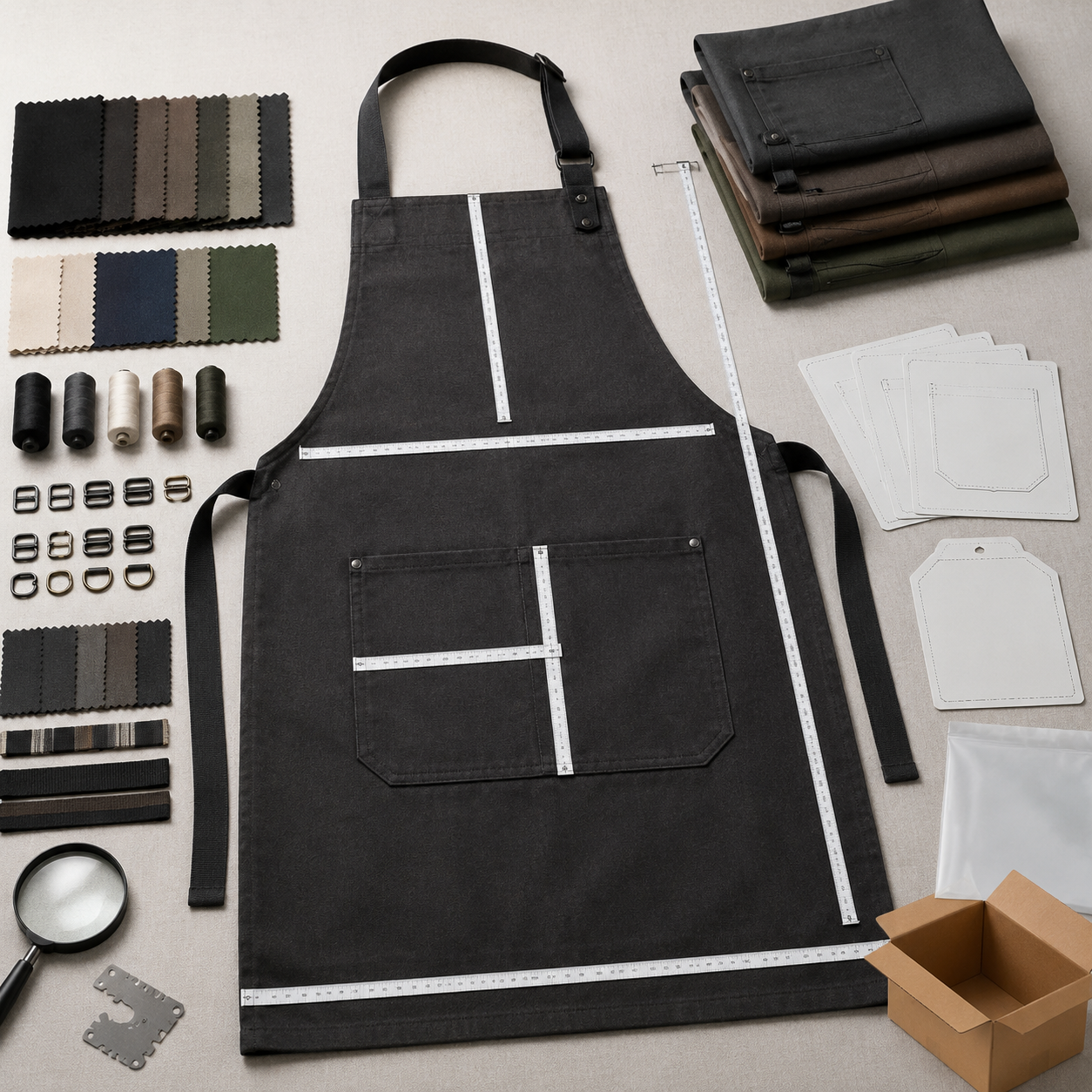
- Finished dimensions: body length and width, pocket dimensions and position, strap lengths, measurement units, measurement points, and tolerances.
- Material: fibre composition, fabric construction, declared fabric mass in grams per square metre, finish, and permitted tolerance.
- Color: controlled color reference, matching method, and permitted tolerance.
- Construction: pocket layout, strap adjustment, hardware, seam type, and reinforcement points.
- Decoration: controlled artwork revision, application method, position, finished dimensions, and color references.
- Packing: folding method, unit pack, assortment, carton configuration, and buyer-provided marking inputs.
For each field, require the supplier to mark the request as accepted, replaced by a proposed alternative, or subject to a separate minimum order quantity. A proposed change to material, color, trim, decoration, construction, or packing should appear as a distinct quotation line when it changes the threshold or price.
A concise RFQ clause can be transferred into the purchase order after verification:
Minimum order quantity: [quantity] finished barista aprons for [buyer item code, revision, and configuration]. Permitted variant mix: [allocation]. Unit price and currency: [terms]. Delivery term and named UAE place: [boundary]. Quote date and validity: [dates]. Production variance and invoice treatment: [terms]. Reorder minimum: [quantity and conditions].
Test the quoted minimum order quantity against UAE demand
All numerical values below are buyer-created example assumptions or calculations. Their scope is a buyer-defined United Arab Emirates rollout using the same barista apron material, color, decoration, and packing configuration. Their as-of date is the buyer's RFQ issue date. They are not supplier, company, customer, or market data and must be replaced with an approved demand plan and a dated supplier quotation.
| Planning input or result | Example value | Source, scope, and verification status |
|---|---|---|
| Forecast consumption | 15 finished barista aprons per month | Buyer-created example assumption for the defined UAE configuration, as of the RFQ issue date; verify against the approved demand forecast |
| Opening deployment | 45 finished barista aprons | Buyer-created example assumption for the same UAE configuration, as of the RFQ issue date; verify against the approved deployment plan |
| Quoted MOQ scenario | 90 finished barista aprons per unique configuration | Buyer-created supplier-quote assumption for the same UAE configuration, as of the RFQ issue date; replace with a dated supplier quotation |
| Inventory coverage | 6 months for the same UAE configuration | Buyer-created example calculation, as of the RFQ issue date, derived from the assumed MOQ divided by assumed monthly consumption; verify both inputs |
| Balance after deployment | 45 finished barista aprons for the same UAE configuration | Buyer-created example calculation, as of opening deployment on the RFQ issue date, derived from the assumed MOQ less the assumed deployment quantity; verify both inputs |
Use verified inputs in these formulas:
Inventory coverage = accepted finished quantity / approved forecast consumption per periodBalance after deployment = accepted finished quantity - approved deployment quantityQuantity above plan = accepted finished quantity - approved deployment quantity - approved reserve quantityComparable delivered unit cost = total verified cost to a common UAE handover point / accepted finished quantity
The cash-flow and storage principle is supported only as general commercial context by the food-business MOQ explainer. The buyer's approved forecast must determine whether a quoted threshold is commercially workable.
Practical RFQ checklist for minimum order quantity decisions
Use this practical RFQ checklist before sending a barista apron request to a shortlisted supplier or approving a quotation for United Arab Emirates delivery:
- [ ] Identify the buyer item code, revision, garment format, material, color, fit, dimensions, decoration, construction, and packing configuration.
- [ ] Ask for the minimum order quantity in finished barista apron units for that exact controlled configuration.
- [ ] Require the supplier to state whether the threshold applies per order, per material, per color, per fit, per artwork, per decoration method, or per packing variant.
- [ ] Record which colors, fits, sizes, artworks, and packing variants may share the threshold and require an allocation for each approved configuration.
- [ ] Request separate quotation lines for every supplier-proposed alternative that changes the minimum order quantity, unit price, setup charge, sample requirement, or timing.
- [ ] Confirm the unit price, currency, included charges, excluded charges, payment schedule, quotation date, and validity period.
- [ ] Define the permitted production overrun or underrun, allocation by configuration, invoice treatment, and remedy for an unapproved variance.
- [ ] Link the quotation to the required sample type, material basis, artwork revision, decoration proof, approval record, and production configuration.
- [ ] State the requested delivery term and named UAE handover place, then identify the cost and responsibility at each handover.
- [ ] Ask the supplier to list proposed shipment documents and package markings without assuming that the list satisfies current UAE requirements.
- [ ] Verify applicable documentation, labeling, customs, duty, tax, and destination-cost requirements through current qualified UAE authority, customs, or logistics sources.
- [ ] Compare the accepted quantity with the approved deployment forecast, consumption rate, reserve policy, storage capacity, and available budget.
- [ ] Request the current reorder minimum and identify which material, color, trim, artwork, decoration, packing, or manufacturing changes trigger new terms.
- [ ] Resolve every blank, qualification, alternative, and exclusion in writing before purchase-order release.
Use the same controlled configuration and response structure for every shortlisted quotation. Keep the request focused on evidence needed to accept or reject the minimum order quantity.
| RFQ field | Supplier response required |
|---|---|
| MOQ line | Accepted quantity, finished-product unit, configuration scope, and permitted variant mix |
| Technical allocation | Buyer item code, revision, format, material, color, fit, dimensions, decoration, and packing assigned to the MOQ line |
| MOQ-changing variables | Materials, components, colors, fits, artworks, decoration methods, or packing choices that create another threshold |
| Sample relationship | Sample type, configuration revision, material basis, charge, timing, and relationship to the production quotation |
| Production variance | Overrun or underrun limit, allocation by approved configuration, and invoice treatment |
| Price composition | Garment, decoration, setup, sample, proof, packing, and other applicable charges |
| Timing assumptions | Dependencies for material, sample approval, production, inspection, dispatch, and transport |
| Delivery boundary | Delivery term, named UAE place, included costs, excluded costs, and responsible party at each handover |
| Reorder control | Current reorder MOQ and changes that require new pricing, setup, sampling, or configuration approval |
The bulk-apron purchasing article connects fabric choice with decoration and proofing. Use that limited context to request a decoration proof on the material proposed for the quoted configuration. The source does not establish acceptable proof criteria or supplier capability, so the buyer must define and document its own approval requirements.
Compare United Arab Emirates landed cost at the accepted minimum order quantity
Normalize cost only after the configuration and accepted MOQ are fixed. Ask for separate quotation lines covering all applicable garment, material, trim, decoration, setup, sample, proof, packing, origin handling, transport, insurance, destination processing, and final-delivery costs.
Each comparison record should identify:
- Accepted finished quantity and unit price for the controlled configuration.
- Quote currency, quotation date, validity, and payment schedule.
- Delivery term, named UAE handover place, and included or excluded costs.
- Legal seller, manufacturing location, shipment destination, and responsible party at each handover.
- Permitted production variance and the accepted quantity used in the delivered-unit-cost calculation.
- Supplier-proposed document and package-marking list.
Do not compare a product-only price with a quotation that includes transport or destination delivery. Convert each offer to the same named UAE handover point and record unresolved costs separately.
The supplied sources do not establish current United Arab Emirates duties, taxes, customs procedures, mandatory documents, labeling rules, package markings, or destination charges. Include such items in landed cost only after their applicability, responsible party, and amount have been verified through current qualified UAE authority, customs, or logistics sources for the planned transaction.
Link MOQ approval to the sample and reorder
Before purchase-order release, link the accepted MOQ line to the controlled specification, approved sample, artwork revision, packing instruction, production variance, and agreed inspection evidence. Require the supplier to disclose whether any proposed material, color, fit, trim, hardware, decoration, construction, or packing change affects the MOQ, price, timing, or sample requirement.
The approval record should confirm that:
- The sample configuration matches the material and construction assigned to the quotation line.
- Measurements are recorded against buyer-defined points, units, and tolerances.
- Decoration is reviewed on the proposed fabric at the controlled position and finished dimensions.
- Workmanship, measurement, decoration, and packing acceptance criteria are documented before production.
- Finished quantity and any permitted variance will be allocated by approved configuration.
- Nonconforming quantity or configuration has an agreed escalation and remedy process.
For a reorder, request a new dated quotation and written confirmation of the current configuration-specific minimum order quantity. Ask whether material source, color process, trim, hardware, decoration setup, packing, or manufacturing location has changed. An expired quotation or previous sample is not evidence of current commercial terms.
Methodology, source traceability, and limitations
Methodology: Only the supplied pages were used for factual attribution. The general MOQ definition and cash-flow or storage context came from the food-business MOQ source. The relationship among fabric, garment format, decoration, proofing, and delivery came from the bulk-apron purchasing source. Those limited concepts were converted into conditional RFQ fields, example calculations, and buyer-side controls. These controls are editorial recommendations and do not represent a supplier's documented practice.
| Source context | Supported use | Evidence boundary |
|---|---|---|
| The Chef Royale MOQ explainer | General MOQ definition and inventory-related commercial context | Secondary commercial source; not apparel capability or UAE regulatory evidence |
| Dirt Cheap Product bulk-apron article | Connected fabric, garment, decoration, proofing, and delivery decisions | Secondary commercial source; not supplier-specific MOQ, quality, or delivery evidence |
| Vincent Xi author profile | Author name, Editorial Author role, and profile URL | Supports the visible byline and author identity only |
| Buyer-created example assumptions in this article | Demand, deployment, MOQ, coverage, and balance illustration | Not supplier, company, customer, or market data; replace before procurement use |
Limitations and verification: No verified Linwa Apron MOQ, price, lead time, production capacity, material specification, test result, certification, customer outcome, or delivery record was supplied. No current UAE authority source was supplied for import documentation, labeling, duties, taxes, customs clearance, or destination charges. Verify applicable requirements through dated supplier documents and current qualified UAE authority, customs, or logistics sources before issuing a purchase order.
No product standard is named because the supplied evidence does not establish an applicable standard or test method. If the buyer specifies a standard, place the applicable requirement and product scope in the RFQ and distinguish it from the supplier's own inspection practice. Do not infer certification without a current document identifying the holder, issuer, validity, and covered product scope.
The Vincent Xi profile supports the stated author identity and Editorial Author role. It does not provide a source basis for personal factory, testing, customer, or product-performance experience claims.
Discuss Your Requirements
Review our manufacturing capabilities, then share your specifications for a supplier-fit review.