Barista Apron Wholesale Supplier Business Continuity Planning for Canadian Cafes
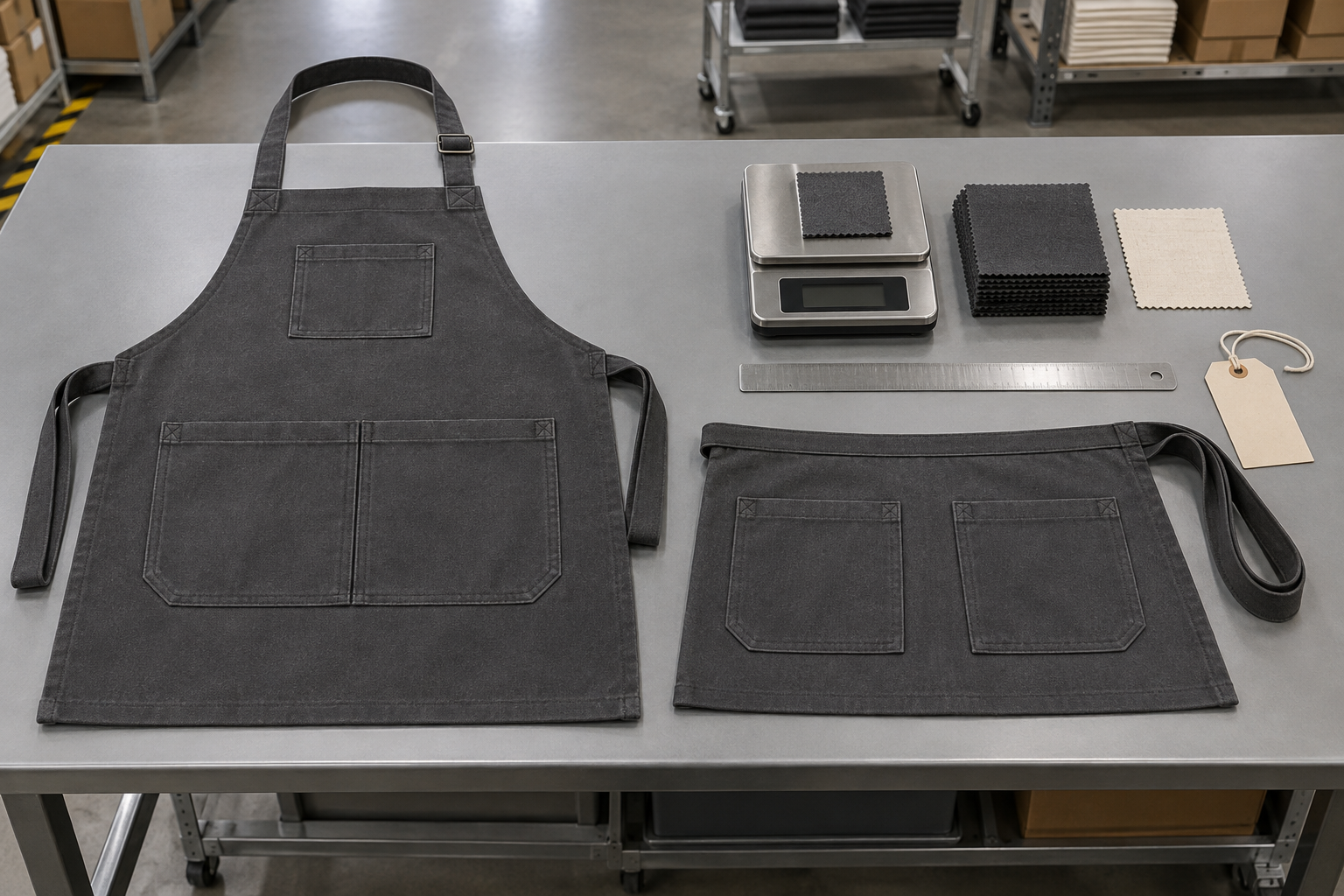
For Canadian cafe and multi-site coffee operators, barista apron wholesale supplier business continuity planning is essential before awarding an order, approving a production sample, or setting reorder terms. The procurement decision is direct: treat the apron as a repeatable specified uniform garment, not as an interchangeable spot purchase. If the primary cutting line, embroidery facility, or inbound logistics route is disrupted, the buyer still needs a documented protocol to place a matching reorder for new hires, replacements, and new cafe locations across Canada.
In this wholesale supply context, business continuity planning requires four verification points before a multi-unit operator commits to a primary supplier. The garment specification must be locked and reproducible. The supplier must present documented response plans for operational disruptions. A qualified backup production or logistics option must be established in advance. Finally, receiving acceptance rules must automatically reject any reorder that fails to match the approved physical sample. Procurement research on contingency management outlines this exact operating model for critical bought-in inventory: embed continuity checks into initial qualification, the RFQ, the supply contract, and ongoing vendor reviews, requiring documented recovery times, alternative facilities, and backup inventory so frontline staff uniforms do not become emergency-sourced items after a fire, cyber disruption, or transport failure (Business Contingency Planning in Procurement).
This briefing is authored by Vincent Xi, Editorial Author at Linwa Apron. Author profile: https://linwaapron.com/authors/vincent-xi/. It does not report proprietary laboratory tests, factory audits, client outcomes, years of tenure, or quality management certifications. Where measurable operational results are not documented in the cited research sources below, the claim is omitted.
Why Barista Apron Wholesale Supply Is a Continuity Decision in Canada
A barista apron carries a minor unit cost compared to front-of-house payroll, yet a broken supply line creates immediate operational friction on the cafe floor. Baristas cannot work service shifts in mismatched garments when brand visual identity requires a standardized bib profile, pocket configuration, hardware closure, and dye lot. Multi-unit operators managing store networks in Canada experience this risk first when regional hiring spikes outpace local store stock or an overseas freight delay threatens an opening date. The central continuity challenge is ensuring the next purchase order yields identical aprons without re-sampling or specification redesign.
Commercial uniform distributors describe barista aprons as continuous apparel programs rather than one-off merchandise. For example, published wholesale product collections explicitly position barista aprons for coffee shops, cafes, and hospitality teams by highlighting volume pricing, repeat-order consistency, and long-term uniform continuity across staffing turnover and multi-store expansions (Barista Aprons Wholesale | Joe's USA). That statement reflects that specific vendor's published commercial offering and illustrates recurring operational demand profiles. It does not establish that all wholesale manufacturers maintain identical controls, nor does it replace the buyer's requirement to verify supply resilience. The practical procurement task for Canadian buyers is to require every bidding vendor to demonstrate how reorder consistency and production continuity are governed.
For Canadian cafe groups, continuity planning also governs the inbound freight and customs clearance leg after garments exit the sewing floor. A low unit price that excludes customs brokerage, domestic Canadian freight, and clearance lead times creates budget overruns when an overseas transport bottleneck forces air-freight expedites or divided shipments. This briefing does not cite default Canadian customs tariff rates, brokerage fees, or standard transit schedules, as the underlying sources do not provide verified Canada-specific tariff tables. Canadian procurement teams must instruct bidding suppliers to break out these destination costs on their official quotations.
Business Continuity Planning Evidence to Request from a Wholesale Supplier
A business continuity plan cannot remain an unsupported claim in marketing brochures. Procurement contingency frameworks emphasize that buyers must demand verifiable documentation rather than informal assurances when auditing supplier resilience (Business Contingency Planning in Procurement). Applied to commercial barista apron wholesale programs, Canadian buyers should inspect four specific categories of operational evidence before awarding a contract.
First, specification control must be formally audited. The approved golden sample must lock fabric composition, fabric weight, color coordinates, stitch construction at stress points (such as pocket corners and strap joins), pocket dimensions, strap hardware, and decoration parameters (screen print, embroidery, or heat transfer). Without signed specification sheets, a backup sewing contractor can produce an apron that fails store visual standards.
Second, capacity redundancy and alternate routing must be documented. Buyers should ask whether a secondary sewing facility, a contracted partner line, or a dedicated finished-goods safety stock covers an agreed number of operational weeks. Procurement guidelines emphasize establishing verified alternative sites and inventory buffers for critical procurement categories (Business Contingency Planning in Procurement). If a manufacturer relies exclusively on one facility, the buyer must classify the arrangement as single-source and decide whether to qualify an independent secondary supplier before disruptions occur.
Third, recovery-time objectives must be stated in concrete calendar days. General commitments to resume manufacturing quickly do not provide actionable planning data. Canadian buyers should require a contractually binding recovery objective in calendar days for defined disruption events, such as machinery breakdowns, localized factory closures, or port strikes, and measure that recovery window against scheduled store opening dates.
Fourth, buyers must request documented verification of plan testing. Supply chain contingency guidance indicates that tested response protocols differ fundamentally from unverified paperwork (Business Contingency Planning in Procurement). If a wholesale supplier cannot furnish records of simulated or operational disruption drills, the buyer must document this gap in the risk register and adjust buffer inventory levels accordingly.
Buyers should also distinguish formal management standards from unsubstantiated quality slogans. This guide does not claim third-party certifications for Linwa Apron or any supplier mentioned, nor should buyers assume compliance without original documentation. When procurement policies mandate specific ISO or social compliance standards, buyers must independently request the active certificate, registered facility scope, and current expiration date.
Measurable Trade-Offs in MOQ, Fabric Weight, and Reorder Price
Supply chain continuity involves clear financial and inventory trade-offs. Lower unit pricing tied to high minimum order quantities (MOQs) increases inventory carrying costs and concentrates capital in a single dye run. Conversely, smaller release quantities through domestic wholesale distributors reduce lead times during stockouts but carry higher per-unit prices. The following figures reflect benchmark data from a published wholesale apron pricing analysis; the source material does not state a publication date, currency standard, or specific Incoterms, meaning all figures must be verified in supplier quotes (Wholesale Aprons: Costs, MOQs & What Actually Resells).
According to the published pricing analysis, wholesale aprons for commercial buyers such as coffee shops were priced at $3–$6 per unit through distributors when purchased in quantities of 12–72 cases (Wholesale Aprons: Costs, MOQs & What Actually Resells). Scope: distributor sales channels for case-pack purchasing. These figures represent commercial baseline benchmarks rather than landed Canadian quotes or cafe-specific bib apron price lists.
The same source outlines an overseas landed cost range of $1.80–$4.00 per unit based on factory minimum order quantities of 100–500 units (Wholesale Aprons: Costs, MOQs & What Actually Resells). Scope: direct overseas manufacturing imports. The term "landed" in that source does not define specific Canadian ports, Incoterms (such as DDP vs. FOB), Canadian customs duties, GST/HST, or local drayage. Buyers cannot assume these figures cover delivery to a Canadian distribution center.
Furthermore, the cost report notes that hospitality operators recommend a 100–150 unit initial test order alongside a physical sample review to confirm 7–9 oz fabric weight, while printed units command $9–$14 in cafe resale contexts (Wholesale Aprons: Costs, MOQs & What Actually Resells). The 7–9 oz specification represents a durable canvas weight benchmark identified during physical sample evaluation. The $9–$14 band represents retail/resale pricing to end customers, not wholesale procurement cost for employee uniforms. Canadian multi-unit cafe operators should price staff uniform budgets strictly on wholesale cost plus landed freight, setting retail resale assumptions aside.
In addition, select commercial wholesale suppliers advertise bulk barista apron programs with no minimum purchase requirements while maintaining program consistency across reorders (Barista Aprons Wholesale | Joe's USA). While this proves that zero-MOQ structures exist in the commercial apparel market, it represents a proprietary commercial term of that vendor rather than an industry-wide policy, and does not confirm Canadian warehouse stock.
Example calculations (labeled assumptions for quotation modeling, not guaranteed price commitments): The midpoint of the cited overseas price band ($1.80 to $4.00) is calculated as ($1.80 + $4.00) / 2 = $2.90 per unit.
- A 100-unit pilot order evaluated at the $2.90 midpoint yields an illustrative subtotal of $290, excluding embroidery/print setup, import tariffs, Canadian customs clearance, domestic freight, and provincial sales taxes.
- A 150-unit pilot order at the same $2.90 midpoint equals $435 on the same incomplete basis.
- If quoted at the top of the overseas band ($4.00 per unit), 100-unit and 150-unit orders calculate to $400 and $600 respectively before import overhead.
- A 500-unit commitment at the entry-level price point of $1.80 per unit totals an illustrative $900 in bare garment costs.
These arithmetic calculations use published midpoint benchmarks without currency conversion assumptions. Canadian buyers must verify active pricing, exchange rates, and freight terms directly on formal supplier quotes.
From a business continuity perspective, these numbers demonstrate working-capital exposure. Committing to a 500-unit production tier locks up capital in a single dye lot; if a disruption forces a switch to an alternate sewing floor that cannot match the color tone, the operator faces significant stranded inventory. Running an initial 100–150 unit pilot run—as recommended by operators in the pricing study—confirms factory pattern accuracy, hardware durability, and 7–9 oz fabric weight before high-volume capital is deployed.
How to Compare Suppliers on Continuity Rather Than Unit Price Alone
Comparing prospective vendors strictly on initial unit cost creates supply vulnerabilities. Canadian procurement teams should use a structured evaluation matrix that weights continuity controls alongside commercial terms:
| Procurement Decision Point | Specification to Standardize | Continuity Impact | Verification Action Prior to Award |
|---|---|---|---|
| Pilot Run vs. Full Program MOQ | Define initial test volume (using 100–150 units as benchmark) separate from bulk reorder MOQ | High upfront minimums risk capital on unmatched dye lots if secondary production shifts occur | Confirm whether pilot units use identical production-line fabric, thread, and hardware as bulk runs |
| Fabric Construction & Weight | Specify fabric weight (7–9 oz benchmark) and weave (e.g., 100% cotton canvas or poly-cotton twill) | Inadequate weight checks lead to pocket sagging, strap tearing, and fabric shrinkage during commercial laundering | Weigh physical fabric swatches on a calibrated scale; contractually mandate a ±3% weight tolerance |
| Visual & Dimensional Uniformity | Define exact Pantone/color standard, pocket dimensions, and reinforced bar-tack positions | Multi-location Canadian store networks require new hires across provinces to display identical visual branding | Compare production reorders against a retained golden sample under standardized lighting |
| Decoration Execution | Specify embroidery stitch density, screen-print ink type, or patch attachment method | Secondary finishing facilities may use incompatible print or embroidery processes | Require pre-production strike-offs from the exact embroidery/print line handling recurring orders |
| Disruption Recovery Route | Contractually document secondary sewing facility, finished-goods buffer, and recovery days | Core operational mechanism of business continuity planning | Request records of recent recovery testing or formally record vendor as untested single-source |
| Order Release Quantities | Evaluate case-pack ordering (12–72 case tiers) against no-minimum programs or overseas tiers | Flexible small releases mitigate regional stockouts during sudden hiring surges | Model total cost for a rolling 90-day inventory reserve rather than optimizing solely for large-volume unit discounts |
| Landed Delivery to Canada | Isolate FOB/ex-works garment price, international freight, Canadian customs duties, brokerage, and final-mile delivery | Unanticipated freight rerouting or expedited air shipping erodes margin during supply disruptions | Require binding quotation specifying Incoterms, delivery address in Canada, and party responsible for customs clearance |
| Quality Acceptance & Remake Terms | Document clear rejection thresholds for fabric weight deviations, color mismatch, or defective stitching | Prevents cafe managers from accepting sub-par garments under opening-day operational pressure | Contractually define vendor remake obligations, turnaround timelines, and return freight coverage |
Commercial supplier statements regarding no minimums or ongoing program consistency illustrate vendor positioning (Barista Aprons Wholesale | Joe's USA). However, buyers must validate promotional statements against contractual specifications. Marketing claims do not replace verified recovery testing (Business Contingency Planning in Procurement).
Backup Production and Logistics Options When the Primary Path Slips
Once a wholesale barista apron program is active, Canadian operators encounter predictable supply chain friction. A common procurement question is whether initial order volumes can be lowered below full manufacturing minimums to validate quality. The cited cost analysis indicates that commercial buyers frequently use 100–150 unit test batches alongside physical samples to verify construction, while balancing 100–500 unit factory minimums or 12–72 case distributor orders (Wholesale Aprons: Costs, MOQs & What Actually Resells). However, whether a manufacturer accepts a lower pilot volume depends entirely on individual vendor negotiations and cannot be assumed.
Preserving style, cut, and color consistency across an expanding Canadian cafe chain requires rigorous sample retention. The purchasing team should store three signed reference items: an approved golden apron, an uncut fabric swatch, and a decorated strike-off. The supplier must maintain identical counterparts. Subsequent reorder lots must be checked against these reference samples prior to domestic distribution. Suppliers advertising ongoing uniform consistency must establish documented tolerances for color variance (Delta E) and garment measurements. Written tolerances protect both parties and remove subjective judgment.
When a primary supplier experiences manufacturing shutdowns or shipping delays, recovery options depend on prior qualification. Procurement research confirms that operational disruption risk is substantially lowered when alternative facilities and backup supplies are secured before disruptions occur, eliminating the need for emergency sourcing under duress (Business Contingency Planning in Procurement). Practical redundancy measures for barista apron supply chains include:
- A pre-qualified secondary sewing facility that has already produced an accepted sample to identical pattern specs.
- A localized finished-goods buffer stock maintained in Canada sized to cover projected hiring needs and store openings over a defined operating period.
- Contracted air-freight or express road-transport agreements to bypass localized ocean port congestion.
- A dual-sourcing framework where two wholesale vendors supply an agreed split (e.g., 70/30) of total uniform volume.
Redundancy protocols must be clearly integrated into commercial supply agreements. Contracts must stipulate mandatory notification windows (e.g., vendor must notify buyer of operational disruptions within 48 hours), trigger criteria for rerouting orders to secondary plants, and whether alternate yarn or fabric sources may be utilized without prior buyer approval. If a supplier operates only a single plant, the Canadian cafe operator should maintain an internal warehouse safety stock, storing aprons in dry, climate-regulated conditions to prevent fabric dampness, tie rot, or print peeling.
Partial shipment protocols are equally critical. Supply chain bottlenecks often result in split shipments rather than total failure. The supply contract should specify whether split deliveries may be allocated to priority store openings, set binding delivery schedules for balance quantities, and establish whether color-mismatched emergency lots will be rejected outright to prevent visual brand fragmentation.
RFQ Checklist
- Ask the supplier to quote both a pilot test quantity (using 100–150 units as an evaluation benchmark) and standard production minimum order quantities, confirming that the pilot batch uses identical fabric, stitching, and hardware specifications.
- Require the manufacturer to lock fabric weight (within the 7–9 oz benchmark range), color standards, pocket dimensions, stress-point bar-tacking, and decoration methods against a signed golden sample with documented numeric tolerances.
- Specify binding operational disruption scenarios—including primary facility shutdowns, decoration subcontractor delays, and port bottlenecks—requiring clear recovery-time objectives in calendar days for each event.
- Ask the supplier to name the designated secondary manufacturing site or verified finished-goods reserve, stating covered volume and providing the date of the most recent business continuity plan test.
- Require the quotation to provide a clear cost breakdown separating base unit price, export handling, international freight, Canadian customs duties, brokerage fees, and final-mile delivery to the designated Canadian address.
- Specify formal receiving inspection criteria that mandate immediate return and vendor-funded remakes for out-of-tolerance fabric weight, incorrect dye lots, missing pocket reinforcements, or unapproved decoration substitutes.
- Ask the supplier to confirm the formal reorder approval process for new Canadian cafe locations, including how recurring production runs are cross-checked against retained reference samples to eliminate style drift.
Methodology, Source Limits, and What a Buyer Still Must Verify
Methodology. Quantitative figures cited in this guide originate from the published commercial apron cost study: distributor price points of $3–$6 per unit at 12–72 case volumes, overseas production pricing of $1.80–$4.00 per unit across 100–500 unit MOQs, operator pilot test orders of 100–150 units, a 7–9 oz sample fabric weight benchmark, and a $9–$14 printed retail resale band (Wholesale Aprons: Costs, MOQs & What Actually Resells). Mathematical calculations ($290, $435, $400, $600, and $900 based on the $2.90 midpoint and boundary values) are direct illustrative models provided for quote-checking purposes. Continuity principles—including embedding qualification criteria, RFQ standards, contractual recovery terms, verified secondary sites, and tested response protocols—are derived from procurement research on business contingency planning and applied specifically to uniform supply operations (Business Contingency Planning in Procurement). Statements regarding zero-minimum bulk purchasing and reorder consistency across expansion cycles reflect published wholesale marketing descriptions from Joe's USA (Barista Aprons Wholesale | Joe's USA). No search engine ranking, traffic, or keyword difficulty metrics were utilized in this analysis.
Limitations and Buyer Verification Requirements. The referenced cost analysis lacks publication timestamps, currency definitions, designated Incoterms, specific fiber content data, and Canadian duty or tariff schedules. The $9–$14 pricing band addresses retail resale rather than internal B2B uniform procurement budgets. Furthermore, promotional no-minimum offers reflect specific distributor programs rather than universal manufacturing practices. None of the cited references document active business continuity certifications or audit results for Linwa Apron or third-party suppliers. Buyers must obtain formal written quotations, confirm current exchange rates, inspect physical pre-production samples, verify fabric weight on calibrated scales, and contractually document continuity commitments prior to awarding business.
Vincent Xi, Editorial Author, developed this technical briefing on barista apron wholesale supply and business continuity planning for Canadian hospitality procurement teams. Author profile: https://linwaapron.com/authors/vincent-xi/.
Discuss Your Requirements
Review our manufacturing capabilities, then share your specifications for a supplier-fit review.