Barista Apron Sourcing Communication Workflow Review for United States Buyers
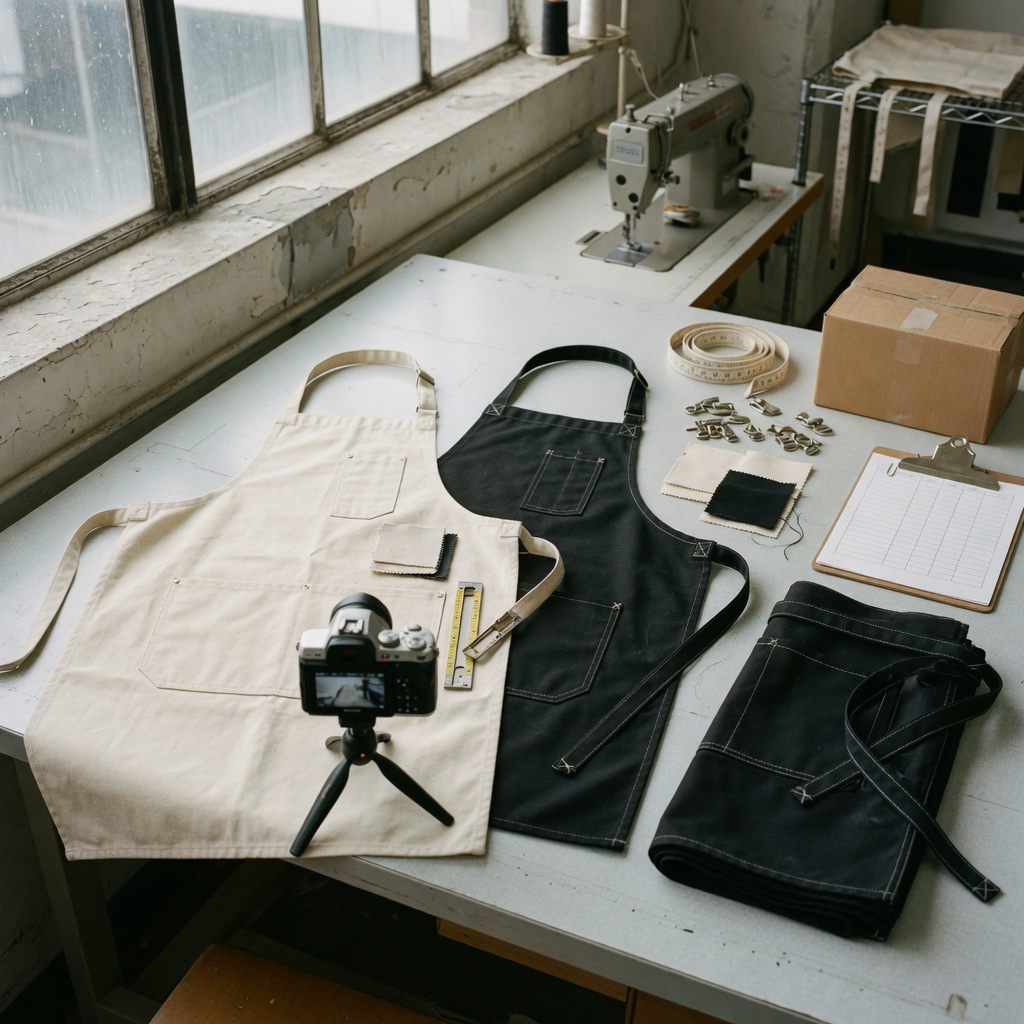
By Vincent Xi, Editorial Author. This page does not claim factory visits, laboratory tests, named customers, awards, certifications, or first-person production experience.
Do not issue a United States barista apron purchase order until a barista apron sourcing communication workflow review is written into the RFQ. Treat communication as a procurement control, not as informal chat. The review is a buyer-defined PO-blocking set, not a published industry standard. It should name owners for tech-pack questions, pattern, QC photos, and ship documents; require a dual-channel stack (instant message for stitch-level photos; email or a shared tracker for the legal record); write sample gates (proto, pre-production, top-of-production); assign United States labeling, packing, and landed-cost data owners; and restate chat decisions as RFQ and PO records within one buyer business day (example restatement window to confirm in the supplier quote).
Fast chat with no restatement rule creates unpriced rework. Email-only cadence with no overnight overlap creates idle calendar days into a United States sample address. The trade-off to specify in the RFQ is cycle time versus change-control: extra physical approval gates are a buyer control against spec drift and usually add courier days unless photo evidence, time-zone overlap, and a written change-order path are named. Score suppliers on communication evidence, not on promise language. Unchecked RFQ items are not understood.
Three concrete data points used below. (1) Starbucks' C.A.F.E. Practices program, as described in the Green River case study, started with email and Excel and later used tablet and web apps for reviews, approvals, and corrections; the case states the system handles millions of data points through hundreds of workflows and that 99% of Starbucks coffee is verified that way (unit: percent of coffee, not aprons; scope: Starbucks coffee verification as stated on that page; as-of date not stated on the cited page—verify the live page). Use that page as a recorded-approval pattern only; do not transfer coffee-verification rates to barista apron lots. Green River Starbucks supply-chain case (2) Coffee-shop supply guidance recommends formal supplier reviews at least quarterly and a comprehensive annual review of terms and alternatives (unit: reviews per year; scope: coffee-shop supply ordering, including communication channels; as-of date not stated on the cited page—verify the live page). That cadence is an analog for the apron-factory relationship, not a statistically sampled apparel-import result. Barista Life procurement process guide (3) A custom-clothing source states that a 24-hour delay on unanticipated micro-decisions (fit, fabric, trim) can stop production and is described as costing $500 to $5,000 (unit: USD per delay event; scope: custom clothing orders, not a barista-apron price list; as-of date not stated on the cited page—verify against your idle-line and air-freight exposure). Shanghai Garment on factory communication
Communication workflow review checkpoints for United States barista apron orders
A communication workflow review asks whether the supplier can move a barista apron from spec to ship without silent delays, unlogged changes, or missing United States documents. Apply the quarterly-plus-annual review cadence used in coffee-shop supply ordering to the apron factory relationship, not only to beans and cups. Barista Life procurement process guide During an active PO, the operational object is evidence: photos, open questions, change log, and ship-document status. In a quarterly relationship review, inspect on-time sample replies, tickets older than the SLA, unlogged fabric or hardware changes, and whether a backup vendor already holds the same tech pack.
The Green River Starbucks case is useful only as a control-type pattern: a shift from email and Excel to structured tools that captured reviews, approvals, and corrections. Green River Starbucks supply-chain case A cafe group or United States distributor does not need millions of data points. It does need the same three artifacts on each barista apron PO: a recorded approval, a correction loop, and a named reviewer.
Channel stack: speed versus evidence
Custom clothing factories, in the cited factory-communication source, often pair WeChat or WhatsApp for instant photo sharing with email for the record, using time-zone offset for overnight work. Shanghai Garment on factory communication That pairing is a manufacturing-origin communication pattern, not a sales-market target. United States buyers should specify the stack in the RFQ rather than discovering it after a pocket is sewn in the wrong place.
- Record channel. Email or a tracker that exports PDF/CSV. Purchase-order changes, price deltas, and ship releases live only here.
- Speed channel. WhatsApp, WeChat, or Teams for bartacks, hardware, print strike-offs, and carton photos. Every material decision is restated in the record channel within one buyer business day (example restatement rule to confirm in the quote).
- Language. English for approvals. Dual-language tech packs are optional; English sign-off is not.
- Overlap window. Named hours in US Eastern or Pacific plus factory local hours. Example specification to verify in the quote: if live overlap is under two hours, require overnight photo replies so a question sent at 18:00 US time can be answered before the next United States business morning.
Trade-off: instant message only is fast and weak in disputes. Email only is strong in disputes and slow on stitch-level questions. Hybrid with a restatement rule is the control that keeps both stitch-level speed and a dispute-ready record. A 24-hour unanswered micro-decision is not a soft inconvenience; the custom-clothing source frames it as a production stop with a published $500–$5,000 illustration of cost. Shanghai Garment on factory communication
Buyer decision table: communication controls versus sourcing risk
Use this table to specify, compare, verify, and approve communication before you order. Figures in the example-SLA column are planning assumptions to confirm in the supplier quote, not production promises and not this company's quoted service levels.
| Control | What to specify in the RFQ | How to compare suppliers | How to verify in sampling | Approve / order impact |
|---|---|---|---|---|
| Named owners | Buyer merchandiser; factory merchandiser, pattern, QC, ship-doc owner | Named seats versus a generic sales inbox | First proto cycle: did the named QC send the photo set? | Block the PO if only a salesperson is listed |
| Response SLA | Written hours for questions, photos, and change quotes | Quoted 4 h / 8 h / 24 h versus actual proto timestamps (example SLA bands to verify) | Compare chat time, email time, and restatement time | Tighter SLA can raise sample admin fees; looser SLA raises air-freight risk into the United States |
| Sample gates | Proto, pre-production (PPS), top-of-production (TOP) | Physical gates versus photo-only gates | Measure pocket, strap, hem, and hardware against the spec sheet | Extra physical gate adds courier days to a United States address |
| Change-order rule | No verbal fabric, color, or hardware changes | Written ECO template versus chat-only | Compare PPS to PO; flag unlogged deltas | Unlogged changes weaken on-time and quality claims |
| Photo evidence | Stitch, bartack, hardware, print, packed carton | Daily versus weekly versus milestone-only | File naming: PO–color–size–date | Daily photos can cut surprise defects; they add factory admin time |
| Backup vendor | Second factory with the same tech pack | Dual-source sample cost versus single-source | Parallel proto on the critical barista apron SKU | Higher sample cost; lower stockout risk for cafe rollouts |
| US document pack | Commercial invoice, packing list, fiber/care/COO label proof | Completeness of a dry-run PDF | Match carton marks to the PO before cargo close | Incomplete docs stall United States clearance and receiving |
Order rule. Approve the supplier only if named seats, a written SLA, at least one physical sample gate when hardware, print, or a new block is in play, a United States label-proof path, and Incoterm/landed-cost owners are accepted in writing. Hold the PO if only a salesperson inbox is listed. Dual-source the critical barista apron SKU if a backup factory cannot run the same tech pack through one proto cycle.
Spec, labeling, and landed-cost communication for United States delivery
Keep the product and RFQ decision primary. United States rules below are delivery, labeling, and record-owner constraints for this communication workflow review, not a country tour and not legal advice.
Spec communication. Treat straps, neck hardware, pocket placement, soil-hiding color, and seam stress as the inspection points that must have an owner, a photo or sample gate, and a written accept/reject path. This page does not report field-failure rates. The tech pack should communicate fabric construction and weight with the unit (for example oz/yd² or g/m²); finished measurements (bib height, waist width, strap length, pocket opening) with a tolerance unit (millimeters or inches); stitch type and stitches per inch if you require it; bartack locations; hardware finish; print or embroidery placement with a millimeter tolerance; care-icon intent; and carton quantity. If you name a test method (for example a colorfastness method), distinguish that standard's requirement from any factory's unverified marketing claim. Do not treat a logo on a website as certification. Ask for the current document, scope, legal entity, and date when a supplier asserts a management-system or materials mark.
United States labeling. Textile wearing apparel sold in the United States generally requires fiber content, manufacturer or importer identity, country of origin, and care instructions under the FTC Textile Fiber Products Identification Act and Care Labeling Rule, plus origin marking for imported goods under CBP rules. Those are regulatory requirements to assign in the RFQ; they are not a statement of this company's certification status. Assign owners in the workflow: who writes sewn-in label copy, who confirms English care wording, who approves carton marks. Put a label strike-off in the PPS gate, not after bulk is boxed. This article does not assert an HTS code or duty rate; classify the actual construction in the quote and confirm with a United States broker.
Landed-cost communication. Require the supplier to restate Incoterm (FOB, FCA, CIF, DDP, or other), origin port, estimated cube per carton, pieces per carton, and whether freight, insurance, duties, and delivery to your United States DC are inside the unit price. Example calculation to verify in the quote (not a market price and not a transit promise): if a 24-hour spec delay misses a weekly ocean cutoff, the buyer faces either a seven-calendar-day slip or an air upgrade; compare your actual air-freight delta on carton cube with the external custom-clothing stoppage illustration of $500 to $5,000 per delay event. Shanghai Garment on factory communication
Physical sample trade-off. Example planning assumption to verify with the courier and factory: a physical PPS round-trip to a United States address often consumes about 7–14 calendar days depending on service level, versus 1–2 business days for a photo-only gate. Photo-only is faster and misses caliper-level strap and pocket errors. Require photos plus at least one physical gate when hardware, print, or a new block pattern is in play.
Metrics that evaluate barista apron supplier reliability and communication
Do not score vanity email volume. Use a short scorecard in each quarterly review, with timestamps from your tracker:
- Question aging. Percent of buyer questions closed within the SLA (unit: percent of tickets; scope: that PO or that quarter).
- Unlogged changes. Count of spec deltas found at PPS or TOP that were not on a written change order (unit: count per PO).
- Sample calendar days. Proto request to written approval (unit: calendar days; quoted versus actual).
- Photo compliance. Percent of agreed milestone photos received on time (unit: percent of milestones).
- Document first-pass. Commercial invoice, packing list, and label proof accepted without rewrite (unit: pass/fail per shipment into the United States).
- Silence events. Times a named owner exceeded 24 hours without a record-channel reply during an active PO (unit: events per quarter; 24-hour threshold is an example aligned to the custom-clothing stoppage illustration—confirm in the quote).
The Starbucks/Green River example is a workflow pattern: email-and-Excel origins were replaced with tools that captured reviews, approvals, and corrections. Green River Starbucks supply-chain case A buyer placing a few hundred barista aprons (example volume band to size your tracker, not a demand forecast and not a search-demand figure) can keep a shared sheet if required fields and an owner exist. A multi-unit United States rollout should graduate to a tracker with attachments.
Coffee-shop procurement guidance also calls for primary and backup vendors, negotiated terms, performance tracking, and communication channels dedicated to issue resolution. Barista Life procurement process guide For barista aprons, the backup vendor should receive the same tech pack and at least one proto cycle before you need emergency production.
Practical RFQ checklist for barista apron communication and approval
Every item is a specify, compare, verify, approve, or order control. Paste it into the RFQ. Unchecked items are not understood.
A. Product and spec communication
- Product family and use. Barista apron (bib, waist, or both); front-of-house food service; United States ship-to locations.
- Tech-pack language. English master; optional second language; which file wins if they conflict.
- Measurement list. Finished dimensions; tolerance with unit (mm or in); strap adjust range; pocket positions.
- Material callouts. Fabric type; weight with unit (oz/yd² or g/m²); color code; hardware spec; mill/lot communication if reorder color continuity matters.
- Testing documents. If a named test method is required, report scope, lab name, and report date; a marketing claim is not a current test document.
B. Channel, SLA, and change-control
- Channel SLA. Record-channel response time; speed-channel response time; restatement rule (chat decisions copied to email within a stated number of hours).
- Named seats. Factory merchandiser, pattern, QC, shipping docs; buyer merchandiser and approver; backup contacts.
- Change-order form. Old/new spec, cost delta, lead-time delta, approver, date; verbal changes invalid.
- Delay notice. Trigger in hours of silence or days of slip; who emails the buyer; recovery options (overtime, split ship, air).
- Quality hold. Who can stop the line; how a failed TOP is communicated; rework versus replace path.
- Escalation path. Next named seat after an SLA breach; hours until that seat must reply in the record channel.
C. Samples and photo evidence
- Sample ladder. Proto quantity; PPS quantity; TOP quantity; who pays freight to the United States sample address; written approve/revise/reject template.
- Photo protocol. Required shots (front, back, pocket interior, bartack, hardware, carton); file naming; milestone list.
- Courier tracking. Who books the sample courier; tracking number posted in the record channel the same day.
D. United States labels, packing, delivery, and landed cost
- United States labels. Fiber, manufacturer or importer identity, country of origin, care; sewn-in versus hangtag; English copy proof at PPS.
- Packing. Pieces per poly; pieces per carton; carton dimensions; gross-weight unit; DC marks; pallet or floor-load rule.
- Incoterm and landed-cost split. What is inside unit price; who files importer security data if applicable; who pays duties.
- Production calendar. Fabric-in, cut, sew window, ex-factory, estimated United States arrival; which photo proves each stage.
- Document dry-run. Sample commercial invoice and packing list before cargo close.
- Delivery pre-alert. Who sends ASN or carton/pallet counts before United States DC arrival; who owns receiving-discrepancy photos.
- Order minimums and colorways. MOQ per color; any surcharge for extra communication on small lots (ask as a line item).
E. Cadence and PO block
- Quarterly review date. First formal relationship review; metric list; backup-vendor status.
- Backup vendor. Second factory with the same tech pack and at least one proto before emergency production.
- PO block list. No PO until named owners, SLA, sample gates, and United States label-proof path are accepted in writing.
How often to review channels without slowing the order
Minimum cadence, adapted from coffee-shop supplier-review practice: weekly evidence packets while a barista apron PO is in production; formal relationship reviews at least quarterly; comprehensive annual review of terms, pricing, and alternate sources. Barista Life procurement process guide Weekly is not a status meeting for its own sake. Example process to specify: a 20-minute packet of photos, open questions, change log, and ship-doc status. If the factory cannot produce that packet, the workflow is already failing.
If you buy once a year, run the communication workflow review at RFQ, at PPS, and after United States receipt (returns, label issues, carton accuracy). Do not wait for the next annual bid to discover that chat decisions never landed on the invoice.
Methodology, source context, and limitations
How this page was derived. Editorial synthesis of three public source contexts: a Green River case on Starbucks C.A.F.E. Practices workflows for verification, approvals, and corrections; Barista Life's coffee-shop supply ordering process, including quarterly and annual supplier reviews and issue-resolution channels; and Shanghai Garment's description of hybrid chat/email factory communication plus a published $500–$5,000 delay-cost range for custom-clothing micro-decision stoppages. United States labeling and import-document checkpoints are described as buyer controls to assign in the RFQ, referencing FTC textile/care rules and CBP origin marking as regulatory frameworks, not as legal advice and not as this company's certification.
Limitations / what to verify. The 99% figure applies to Starbucks coffee as stated in the case, not to barista apron lots. The $500–$5,000 delay range is a custom-clothing illustration without a dated barista-apron dataset on the cited page. Quarterly review frequency comes from a coffee-shop operations guide, not from a statistically sampled apparel-import study. Duty rates, HTS, transit times, sample fees, and SLA hours are factory- and lane-specific; treat planning numbers as assumptions to confirm in the supplier quote and with a United States customs broker. This article does not award certifications, claim factory capacity, report tests, or state search-demand, CPC, difficulty, traffic, or ranking metrics.
Author. Vincent Xi, Editorial Author, https://linwaapron.com/authors/vincent-xi/. No first-person production or customer-outcome claims are made.
Discuss Your Requirements
Review our manufacturing capabilities, then share your specifications for a supplier-fit review.